
Looking across my self-directed work so far, I can see my practice becoming more focused, although it is still developing. Photography, poetry, storytelling, mythology, language and moving image initially felt like separate interests. Through projects such as the Holy Island bird, my visual poems and more recently Storm, I have started to understand how they can operate together.
My self-directed work has helped me examine what repeatedly returns in my practice. Movement, memory, water, birds, journeys, uncertainty and belonging appear across different pieces, sometimes without me deliberately planning them. I have also become increasingly interested in the difference between travel and journey. Travel can describe movement from one geographical place to another, while a journey can continue through memory, language and changes in identity long after the physical travelling has ended. Recognising these recurring concerns is helping me understand what my emerging practice might be about rather than simply what media I use.
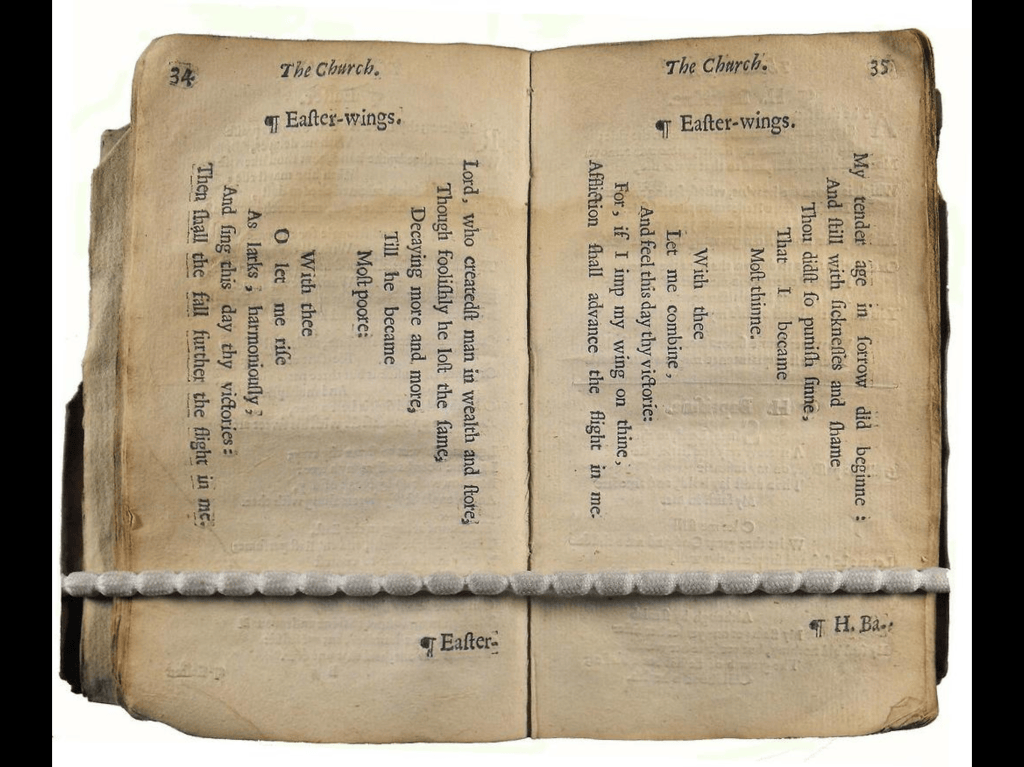
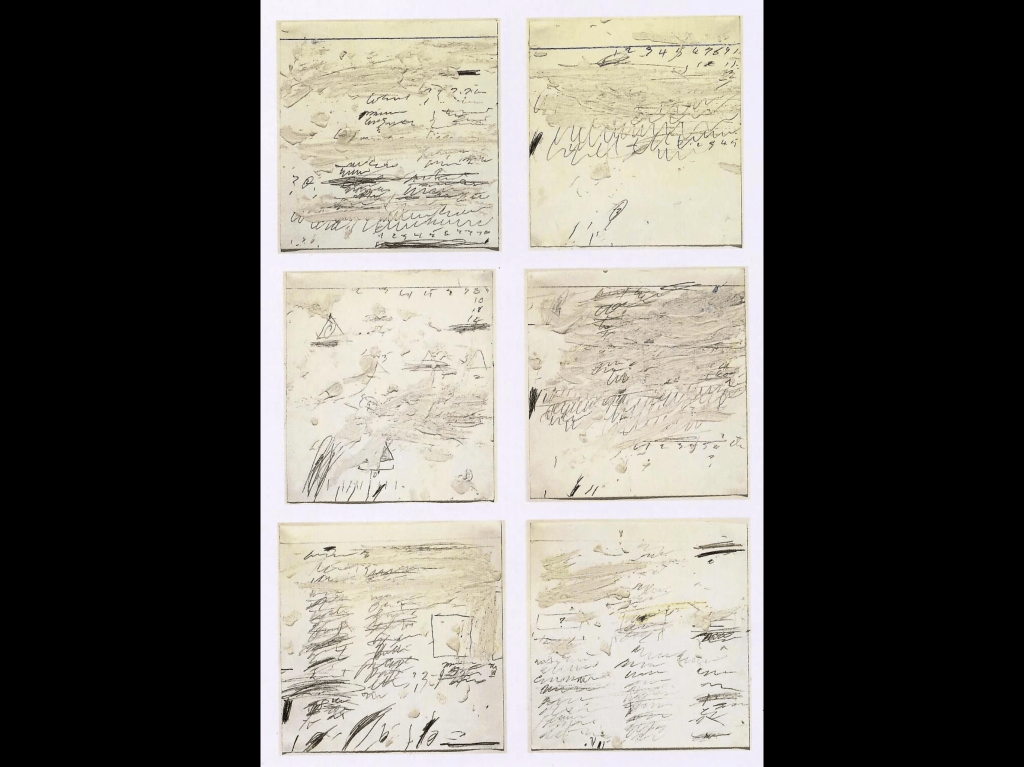
Research has increasingly become part of this development. Earlier I sometimes researched an artist or writer and then described their work separately from my own. I am now trying to use research to question decisions within my practice. George Herbert’s Easter Wings helped me think about language as something that can have physical and visual form. Cy Twombly opened another way of thinking about writing, marks and space existing within the same visual field. Jasmina Bolfek-Radovani’s multilingual practice has helped me consider whether language needs to be fully understood in order to communicate. Umberto Eco’s idea of the open work has also challenged my tendency to explain my symbols and intentions too clearly.
My formative feedback showed me that these connections need to become more rigorous. It is not enough to say that an artist or theory interests me; I need to demonstrate what it changes in my own thinking and making. Further research into interpretation, including Terry Barrett and John Berger, should help me examine more critically how meaning is constructed by both the artist and the viewer.
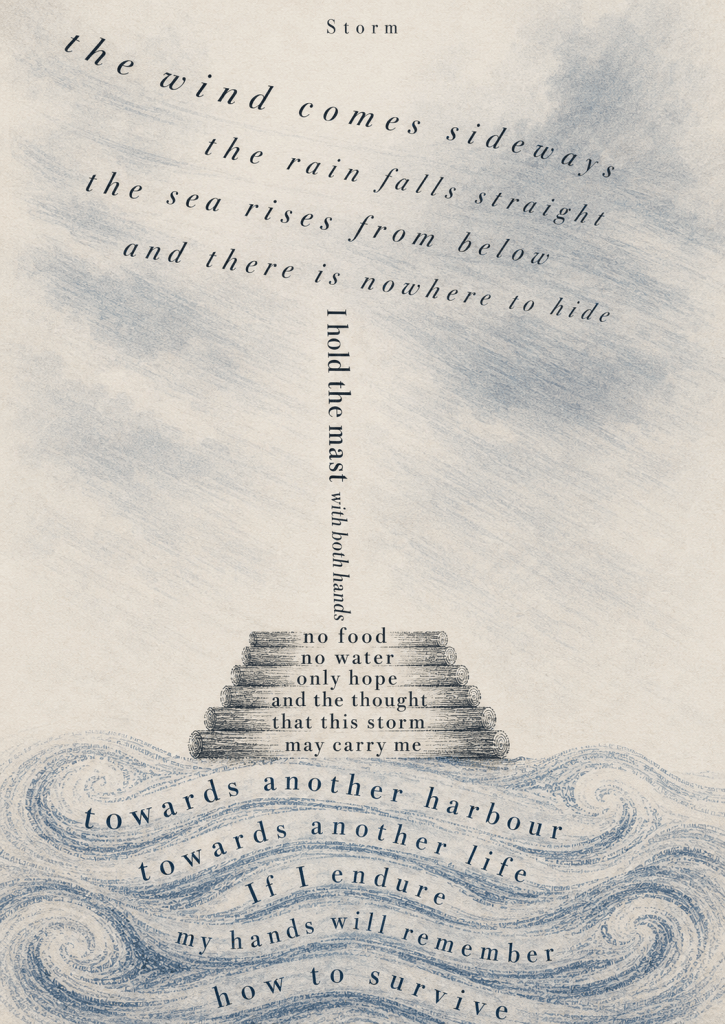
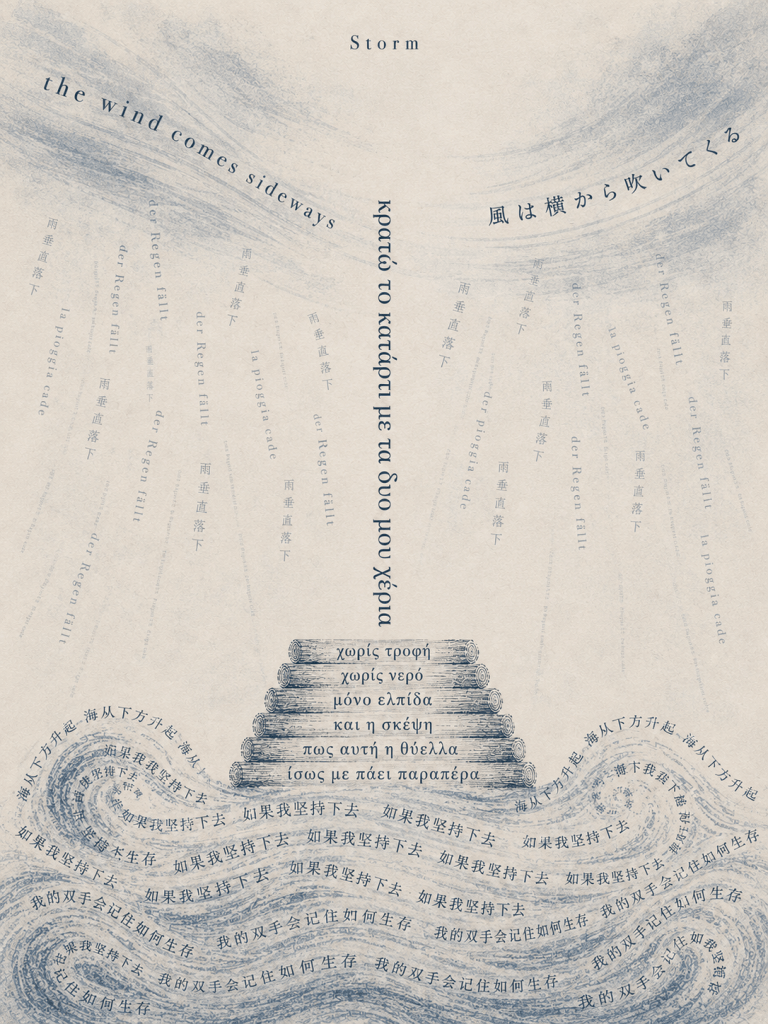
Storm is becoming an important testing ground for these ideas. It began as an imagined scene of an unnamed traveller on a handmade raft surrounded by an enormous sea. As the project developed, I began asking whether the poem could become the image itself. Words could become wind, rain, sea or parts of the raft rather than simply describing them. My tutor’s suggestion of introducing animation develops this further. If words appear, disappear, fall, drift or rise, language can become movement as well as meaning. This would also allow me to explore how poetry, image, sound and film might work together rather than treating them as separate forms.
Communication is another area in which my thinking has changed. Previously I often wanted the viewer to understand exactly what I meant, particularly when an image or symbol came from an important personal experience. I now recognise that explaining everything can close the work down. I am becoming more interested in creating enough structure for the viewer to enter the work while allowing interpretation to remain fluid. This does not mean abandoning intention, but accepting that the viewer brings their own memories and experiences to what they encounter.
For Projects 9 and 10 I therefore want to concentrate on depth rather than continually producing new and unrelated work. I want to develop Storm through experiments with movement, language, animation and possibly sound; strengthen the relationship between research and practical experimentation; and continue testing how much information a viewer needs.
I also need to think carefully about presentation. A website could bring together the different strands of the project while allowing individual works to remain independent. My existing blog contains the development, experiments and reflection, but the final presentation should be more selective. Rather than asking the viewer to follow everything chronologically, I would like them to be able to encounter individual works and gradually recognise relationships between them.
At this stage I do not feel that my practice has reached a fixed conclusion, and I do not think it needs to. What has become clearer is the territory I want to continue investigating: movement and journey, memory and mythology, language and image, and the space between what an artist intends and what a viewer understands. Projects 9 and 10 give me the opportunity to test these relationships more rigorously and to see what survives when an idea moves from one language, medium, place or form into another.
————————————————————————————————————————
Between Ithaca and the Unknown: Journey, Memory and Translation in My Creative Practice
Introduction
During this unit my practice has developed around a group of ideas that keep returning: journey, memory, mythology, language, photography and movement. At first I often treated these as separate interests. I made photographs, wrote poems, developed stories and experimented with moving image. Gradually I began to understand that the strongest part of the work is not any one medium, but the movement between them.
My own experience of living and working in different places has influenced this development, but I do not want the work to become a direct autobiography. Greece, England, China, the Isle of Man and Scotland have all entered the work through photographs, memories, music, language and encounters with people. What interests me is what happens after an experience has passed: how a photograph can trigger another memory, how memory can become mythology, how a poem can become an image, or how an image can become moving film.
This review examines how research has helped me understand these processes more critically. Homer and C.P. Cavafy gave me ways of thinking about journey. Joseph Campbell helped me recognise how strongly Western storytelling often depends on a pattern of departure, trial and return. Henri Bergson has helped me think about memory as something active rather than simply stored. Terry Barrett and John Berger have challenged the way I think about looking and interpretation. George Herbert, Cy Twombly, Jasmina Bolfek-Radovani and Umberto Eco have helped me consider how language, image and meaning can remain open rather than fixed.
The question that now connects these strands is: what survives when something is translated or transformed?
Homer, Cavafy and the journey
Homer’s Odyssey has been one of the most persistent influences on my work. I have returned to it through pieces such as Land of Lotus Eaters, None (ΚΑΝΕΝΑΣ), Leukothea and Aeolus. What continues to interest me is not simply Odysseus arriving home, but everything that interrupts that return: storms, strangers, temptations, loss, friendship and survival.
Earlier in the unit I sometimes used myth quite directly. A contemporary experience could become connected with a recognisable figure from the Odyssey. One example is Aeolus. A friendship formed while I was working in China later became associated in my mind with Aeolus, keeper of the winds. This transformation allowed an ordinary encounter to move into another imaginative space. However, I also became aware of a danger. If every symbol is explained, mythology can become a code that the viewer is expected to solve correctly.
Cavafy’s Ithaka helped me move away from this. The poem shifts attention from destination to the knowledge and experience collected during the journey. This connects closely with my own work because travel has rarely felt like a simple movement from A to B. Places continue to exist through memory long after I have left them.
Joseph Campbell’s description of the “hero’s journey” provides a useful contrast. In The Hero with a Thousand Faces, Campbell identifies a recurring mythic structure in which the hero leaves the familiar world, crosses into difficulty and transformation, and eventually returns (Campbell, 1949). This pattern helps me understand how strongly journey can imply progress and resolution. My recent work is becoming less certain than this structure. Campbell’s book was first published in 1949 and developed his idea of the monomyth or Hero’s Journey.
Storm developed from an image of an unnamed traveller on an imperfect handmade raft in a huge sea. The mast remains, but there is no clear destination and no promise of return. The traveller is not necessarily becoming a hero and there may be no reward at the end. The line “I don’t know. I just endure” has become important because it resists the idea that every journey needs to produce a clear lesson. In this sense, Storm begins with mythic imagery but moves away from Campbell’s linear pattern. It is closer to uncertainty than achievement.
This distinction has helped me separate travel, journey and movement. Travel can describe physical movement between places. Journey can carry narrative, psychological and mythological meanings. Movement is wider still. Memories move through time; images move between contexts; words move between languages; and work moves from photography into poetry and film. I now see this wider idea of movement as central to my practice.
Travel, photography and memory
Photography has been one of the main ways in which I have collected experience. I have photographed during periods of living and working in China, the Isle of Man, Scotland and England, but I do not see these images simply as travel documentation. They often become more important later, when I return to them and they begin to suggest something different from what I originally saw.
Henri Bergson’s distinction between habit memory and recollective memory has helped me think about this process. In Matter and Memory, memory is not presented simply as a fixed archive. The past can return in relation to the present and affect how we perceive what is in front of us (Bergson, 1896/1994). This is close to the way I use photographs. An image made in one place can acquire another meaning months or years later because I have changed.
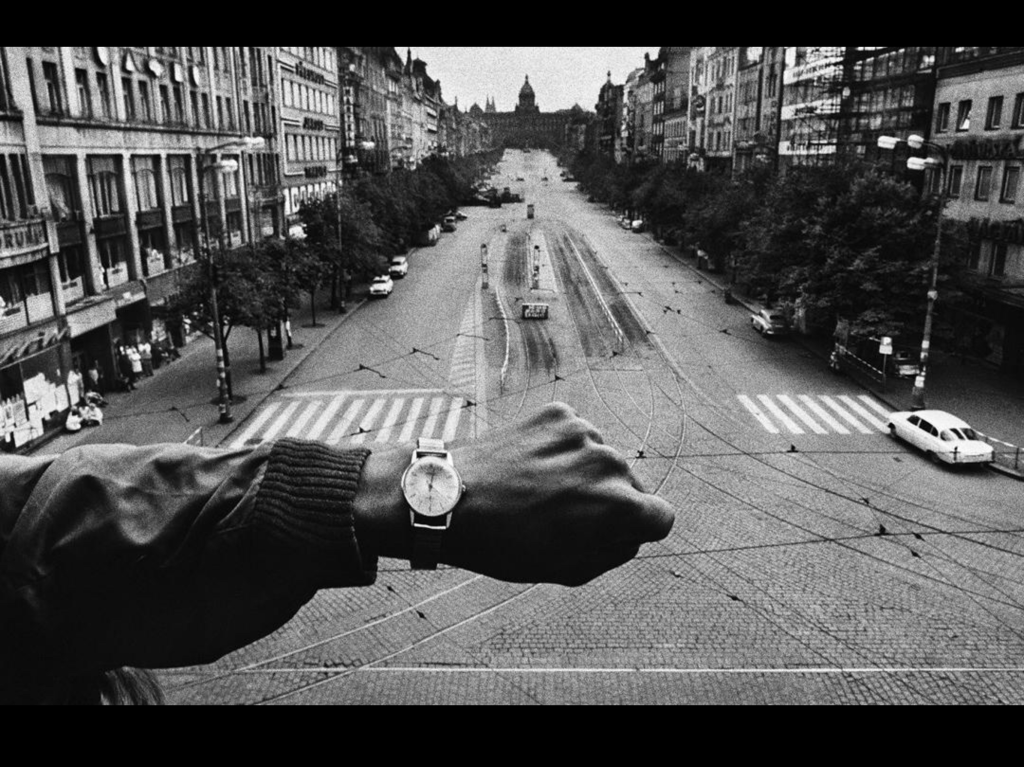
Josef Koudelka’s photography has also made me think about movement and displacement. His work developed through travelling across Europe after leaving Czechoslovakia, and Exiles (1988) brings together photographs shaped by wandering, separation and an uncertain relationship to place. I do not compare my circumstances with Koudelka’s political exile, but I am interested in the way his photographs can hold both a specific place and a more general feeling of being between places. This helps me consider how my own photographs might move beyond “this happened here” and become part of a wider emotional landscape. Koudelka left Czechoslovakia in 1970 and Exiles was published in 1988.
Yi-Fu Tuan’s distinction between space and place has also been useful here. Tuan describes place as connected with security and space with freedom and possibility (Tuan, 1977). I do not use this as a fixed formula, but it helped me understand why the Holy Island bird became important. The post gives the bird a place: stability, position and support. At the same time, the open horizon around it represents space and possibility. The image therefore contains both security and restriction. This tension is close to the wider questions in my work, where belonging can be comforting but can also create a feeling of being fixed.
The Holy Island bird became an important example. I photographed a wooden bird fixed to a post. Initially I understood the post as support: something that gave the bird stability and a place from which to look out. I then began to see the same support as restriction. The bird appeared able to see the horizon but unable to reach it. I experimented by removing the bird, suggesting flight, and eventually leaving the empty support.
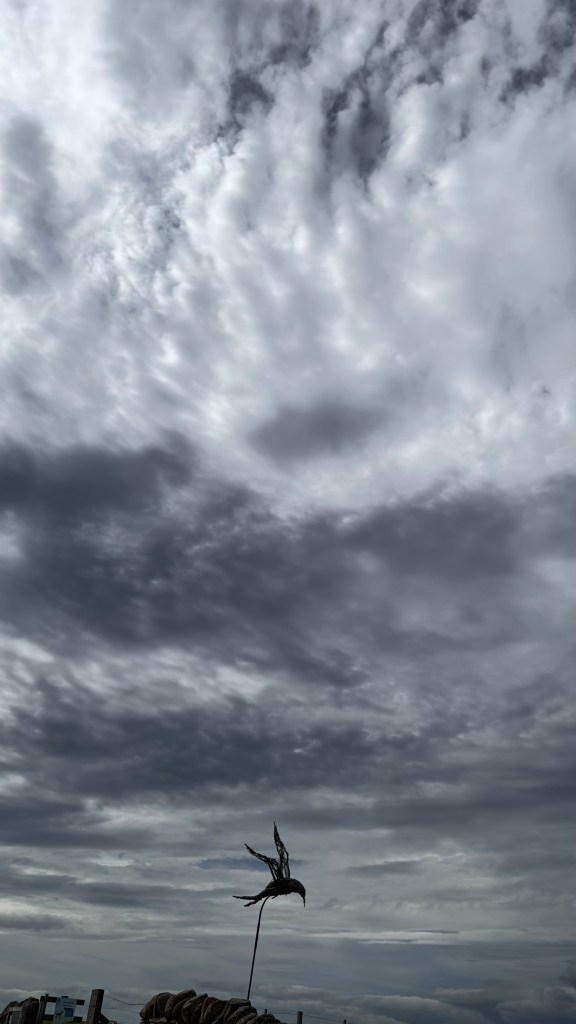
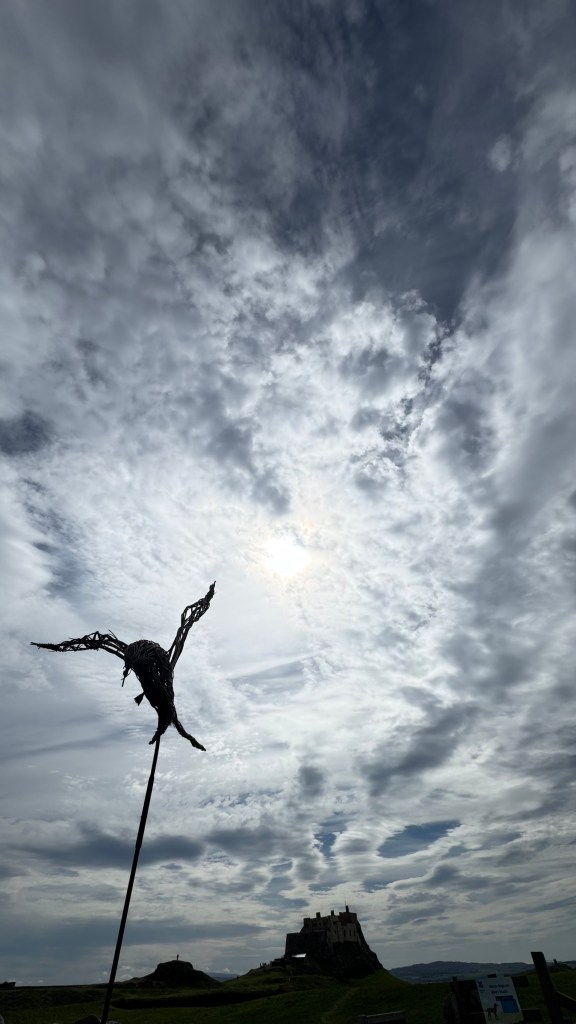
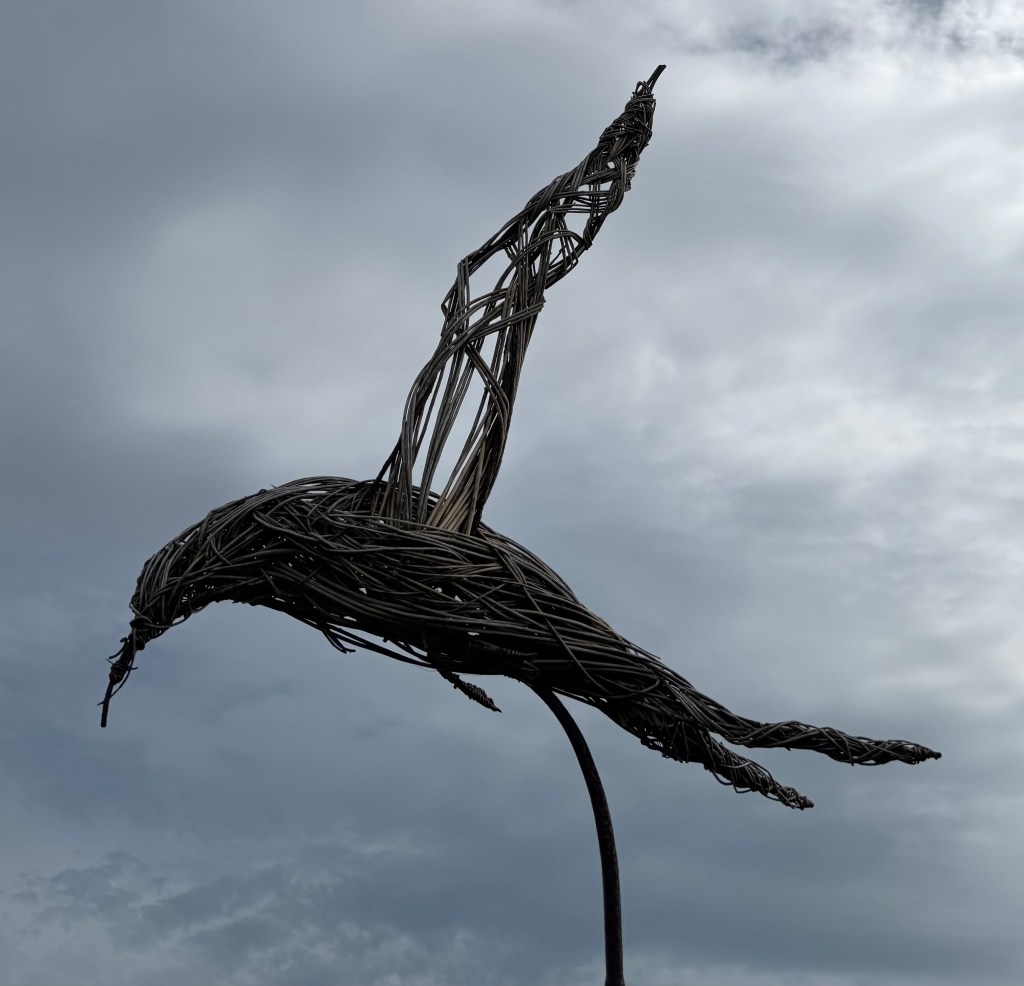
My first instinct was to explain this symbolism. However, Terry Barrett’s approach to interpreting photographs helped me recognise the difference between describing what is visible and deciding what it must mean. Barrett argues for interpretations that are supported by what can be seen and by context, while still allowing more than one reasonable reading (Barrett, 2021). His Criticizing Photographs specifically separates questions of description, interpretation and context.
John Berger also reminds us that seeing and knowing are never completely settled (Berger, 1972). Ways of Seeing begins from the relationship between looking, knowledge and language, and this has made me consider how quickly I try to explain an image after making it.
The bird can therefore remain personal without becoming private. For me it may connect with security, work, freedom or restriction. For another viewer it may suggest something entirely different. The empty post became stronger because the absence created space for interpretation.
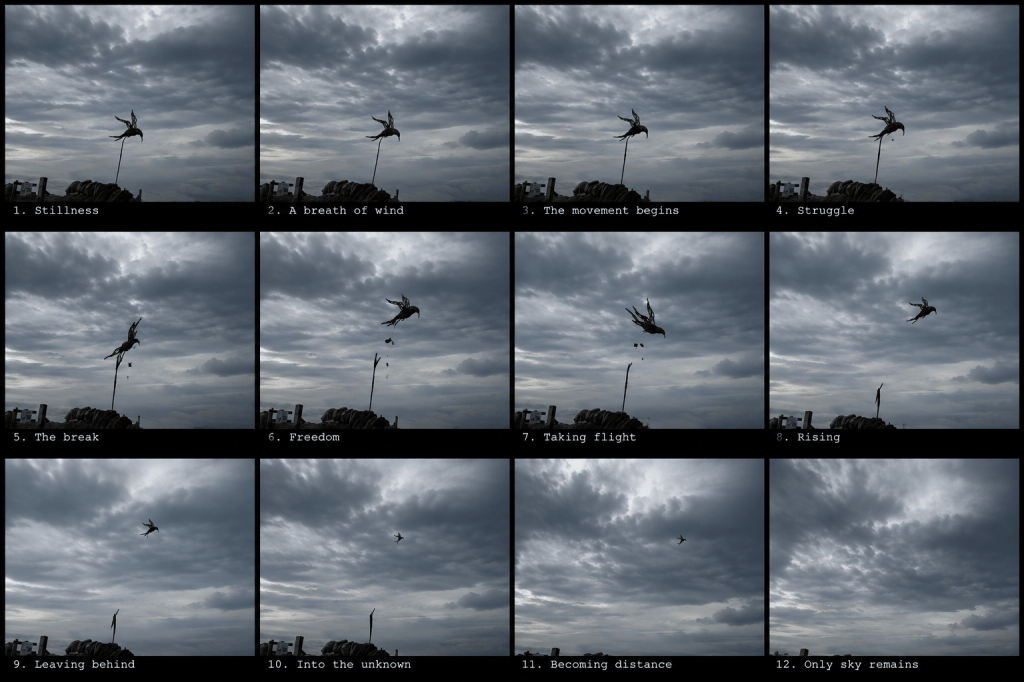
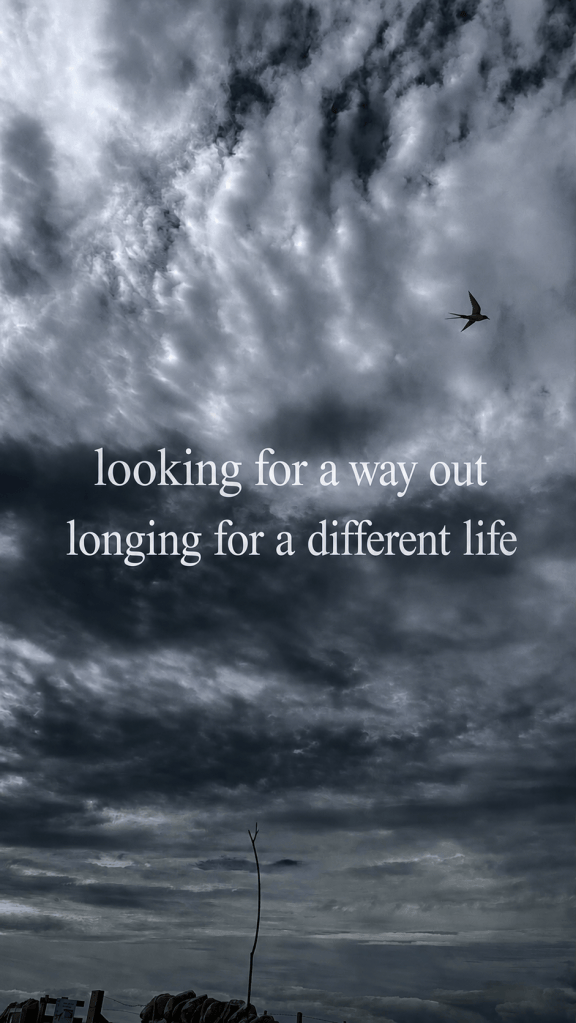
This has also affected my films. When photographs from China, Scotland, England and the Isle of Man are placed together with Greek music, geography becomes unstable. The images are no longer only records of where I was. They begin to work through association, rhythm and memory.
From storytelling towards visual poetry
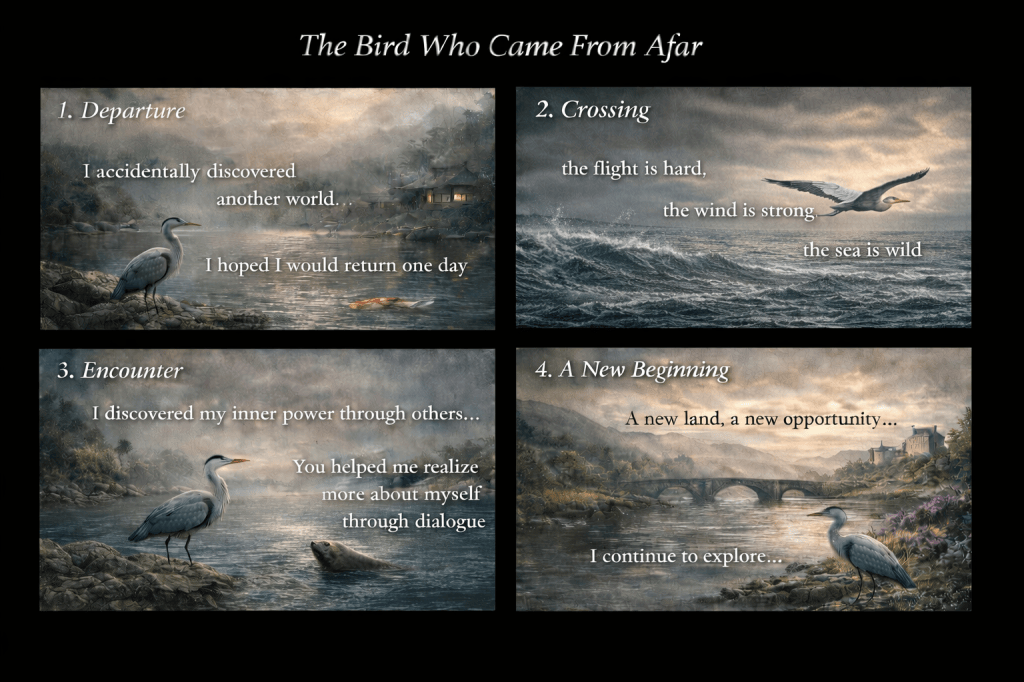
Storytelling has always been natural to me. The Bird and the Seal is an example of this. It established characters, relationships and a narrative that could be followed. However, as my work developed I became increasingly uncomfortable with telling the viewer exactly what had happened and what each element represented.
George Herbert’s Easter Wings offered an important historical example of language taking visual form. The poem is not only read through its words; its shape contributes to meaning. This became relevant to me because I was beginning to ask whether language could construct an image rather than simply describe one.
Cy Twombly opened this question further. His combination of writing, marks, erasure and open space allows language to sit between reading and seeing. I am interested in the moment when a written mark is recognised as language but is not fully available as explanation. This helped me move towards visual poetry, where words can operate spatially and visually.
Storm has become the clearest test of this. Instead of writing a poem underneath an illustration of a storm, I began using the words themselves to create the weather and the raft. Horizontal text can behave like wind. Vertical words can fall like rain. Language can rise from the bottom of the image like water. The mast can remain as a visual structure while the words around it become unstable.
My tutor suggested developing this through animation. This would move the work further because words could arrive, disappear, fall, drift or become unreadable. The viewer would no longer simply read about uncertainty; they would experience uncertainty through the act of trying to read.
Film also introduces duration. A static page allows the viewer to decide how long to look, but moving image can remove a word before it has been fully understood. Time therefore becomes another material in the work.
This is important because the research is no longer sitting beside the creative work. Herbert’s shaped poetry is helping me make a practical decision about how language occupies space. Twombly is helping me test the border between writing and mark-making. Animation can now test what happens when that visual language is no longer fixed.
Language, translation and transformation
My relationship with language has become increasingly important. Greek is my first language, English is the language of my everyday and academic life, and through travel and work I have also encountered Chinese, Italian, German and Japanese. I am not equally fluent in these languages, and this unevenness is important. Communication often includes partial understanding, sound, gesture, visual recognition and misunderstanding.
Jasmina Bolfek-Radovani’s work on multilingual poetry has helped me consider how languages can coexist without every element being translated for the audience. A language can be experienced through rhythm, sound and visual appearance even when its literal meaning is not immediately available. This relates closely to what I want to test in Storm.
I am becoming less interested in producing the same sentence six times in different languages. That would demonstrate translation but might not transform the work. Instead, I want languages to perform different visual actions. One language might become wind, another rain, another sea. A word could be partly visible, disappear, or overlap another alphabet. The viewer might recognise one language but not another.
This raises the question of what is lost and what survives.
Translation is not only linguistic in my practice. A photograph translated into a poem changes. A memory translated into mythology changes. A still image translated into film changes. Even the use of AI during experiments made this visible: an idea moves from thought into a written prompt and then into an image produced through another system. Each stage retains something and alters something.
This is where travel and translation begin to connect. Travelling also requires constant translation: between languages, behaviours, expectations and ways of seeing. An experience does not return home unchanged. It is carried through memory and reconstructed later. Movement therefore becomes not only geographical but cultural, visual and linguistic.
I increasingly see my practice itself as a form of movement. An image becomes a poem, the poem becomes research, research returns me to the image, and the resulting work can then move again into film. The process does not always move forward in a straight line. It circles, returns and transforms.
Meaning in motion: towards open interpretation
One of the most important changes in my practice has been my attitude towards the viewer. Earlier I often explained symbols because I wanted people to understand my intention correctly. The more I explained, however, the less room remained for another person.
Umberto Eco’s idea of the open work has helped me understand that openness does not mean that anything can mean anything. The artist still makes decisions and creates a structure, but the work can remain available to different acts of interpretation (Eco, 1989). Barrett and Berger have reinforced this by making me think more carefully about the relationship between what is presented, what is seen and what a viewer brings to an image.
The difference between The Bird and the Seal and Storm shows this change. The earlier work is more secure as a narrative. Storm gives less information. We do not know exactly who the traveller is, where they came from or whether they will survive. The uncertainty is not a missing part of the story; it has become part of the work.
This also changes how personal experience functions. I can begin from something that matters deeply to me without requiring the viewer to know my biography. Mythology, photography and language can act as forms of transformation rather than explanation. The work may begin with me, but it does not have to end with my meaning.
Conclusion: between Ithaca and the unknown
At the beginning of this unit I thought largely in terms of journeys. Looking back across the work, I now think movement is a more useful word because it connects the physical, emotional and formal changes taking place in my practice.
Homer gave me the journey and the desire to return. Cavafy shifted attention towards what is gained along the way. Campbell helped me recognise the expectation of a structured transformation and return, while Storm has allowed me to question whether transformation always leads to resolution. Bergson helped me understand memory as active and changing. Koudelka showed me how photography can carry feelings of movement and displacement beyond simple documentation. Herbert, Twombly and Bolfek-Radovani helped me see language as visual and material. Barrett, Berger and Eco have challenged my desire to control interpretation.
The practical consequence is that my media are no longer separate. Photography becomes memory; memory becomes story; story can become mythology; language becomes image; image becomes moving film. What connects them is translation and transformation.
This has also changed the way I judge my own work. I am less interested in whether the viewer has understood exactly what I intended. I am more interested in whether the work creates enough structure to invite attention while leaving enough uncertainty for another person to enter it.
Storm is therefore not simply another work about a journey. It has become a way of testing the questions that have emerged through the unit. What happens when words become weather? What happens when several languages occupy the same visual space? What happens when the viewer cannot read everything before it disappears? What survives when the work moves from poem to image to animation?
I do not yet have a final answer to these questions, and I no longer think that I need one. My practice is becoming less concerned with arriving at a fixed destination and more interested in what happens during movement between places, languages, memories and forms.
I began with Ithaca as a destination. I finish this stage somewhere between Ithaca and the unknown.
References
Barrett, T. (2021) Criticizing Photographs: An Introduction to Understanding Images. 6th edn. Abingdon: Routledge.
Berger, J. (1972) Ways of Seeing. London: BBC/Penguin.
Bergson, H. (1994) Matter and Memory. Translated by N.M. Paul and W.S. Palmer. New York: Zone Books. Originally published 1896.
Bolfek-Radovani, J. (2021) ‘“Reveries about language”: Challenges and opportunities of performing multilingual poetry’. Languages Future online conference, 15 April 2021.
Campbell, J. (1949) The Hero with a Thousand Faces. New York: Pantheon Books.
Cavafy, C.P. (1975) Collected Poems. Translated by E. Keeley and P. Sherrard, edited by G. Savidis. Princeton: Princeton University Press.
Eco, U. (1989) The Open Work. Translated by A. Cancogni. Cambridge, MA: Harvard University Press.
Herbert, G. (1633) ‘Easter Wings’, in The Temple.
Homer (1996) The Odyssey. Translated by R. Fagles. New York: Viking.
Koudelka, J. (1988) Exiles. New York: Aperture.
Tuan, Y-F. (1977) Space and Place: The Perspective of Experience. Minneapolis: University of Minnesota Press.
Varnedoe, K. (1994) Cy Twombly: A Retrospective. New York: Museum of Modern Art.

