
Storm. Discovery between Ithaca and the Unknown. A Draft and a Thought.
The Poem Storm began as an idea about an unnamed traveller alone on a handmade raft in the middle of an open sea. The raft is fragile and imperfect. Almost everything that once belonged to the traveller has already been taken by the sea. There is no food, no water and nowhere to hide. Only the mast remains.
Storm
The wind comes sideways.
The rain falls straight.
The sea rises from below.
There is nowhere to hide.
An imperfect raft,
an enormous sea,
and two hands
holding onto a mast.
No food.
No water.
Only hope,
and the thought
that this storm
may carry me
towards another harbour,
towards another life.
Another wave.
Another gust.
Another moment.
The body holds.
At the same time,
the mind continues travelling.
Where is the storm taking me?
Towards Ithaca?
Towards somewhere
I have never imagined?
Perhaps the storm
will destroy me.
Perhaps it will carry me home.
Perhaps it will carry me
somewhere else.
I don’t know.
I just endure.
And perhaps,
when everything else
has disappeared,
there will remain
only the knowledge
that my hands
continued to hold.
The poem above, was born by an image developed in my mind while I was thinking about periods of uncertainty and change, but I do not want the work to become autobiographical. Personal experience may sit somewhere underneath it, but I am more interested in creating a situation that another person can enter and interpret through their own experiences.
The physical structure of the storm became particularly important to me: the elements attack him from every site giving him no place to hide. The traveller is therefore surrounded by forces he cannot escape from. In the middle of these movements there is one relatively fixed point: the mast. Two hands hold onto it.
I do not imagine the traveller’s face entirely in despair. I imagine someone in survival mode. Fear and exhaustion are present, but the body is occupied with the immediate necessity of staying alive: surviving another wave, another gust, another moment.
At the same time, the mind continues travelling.
Alongside fear there is hope, but also curiosity. Where might this storm be taking the traveller? Could the same force that threatens to destroy the raft also carry it towards another harbour, another landscape or another stage of life? Perhaps somewhere beyond what can currently be seen there are people yet to be met and places never previously imagined.
This thought connects naturally with Cavafy’s Ithaka and the idea that the journey itself may expose us to unknown ports and experiences. Ithaca remains a destination, but perhaps reaching it is not the only possible meaning of the journey.
The Odyssey remains one of the central references within my practice. I repeatedly return to the figure of the traveller who attempts to move towards home while being diverted by forces outside his control. I have already explored this through other works, so I do not want Storm simply to illustrate another episode from Homer. Instead, the Odyssey provides a structure through which I can think about movement, survival, uncertainty and the possibility of transformation.
Shakespeare’s King Lear has also entered my thinking. The storm in Lear interests me because the external weather and the internal condition of the character seem to exist simultaneously. The storm is real, but it can also be understood psychologically. There is also a metamorphosis in him after it: the elements shape his character. This fact has encouraged me to think about Storm not as an illustration of bad weather, but as an allegory for those periods in life when certainty, direction and security disappear.
Another influence has been Ernest Hemingway’s The Old Man and the Sea, a story I first encountered through film many years ago and have recently revisited through its synopsis. What remains with me is the solitary figure who continues despite exhaustion and despite the loss of what he has achieved. Santiago returns with almost nothing material, yet something important remains: the knowledge of what he was capable of doing. The external world may take away the visible evidence of an achievement, but it cannot necessarily remove the experience or the knowledge gained from it.
This has made me consider about what remains with the traveller in Storm after almost everything else has disappeared.
Perhaps it is simply the knowledge that the hands continued to hold and saved him.
I have also been thinking about the image of an arrow being pulled backwards on a bow. From the position of the arrow, this movement could appear to be regression, yet the tension created by being pulled backwards is precisely what eventually allows it to travel forward. I am not certain whether this image belongs in the eventual poem, but it has helped me think about how difficult periods can sometimes precede an unexpected change in direction.
Many of the references informing this work come from older literature. I am aware of the importance of engaging with contemporary artists and writers, but I do not see historical references as exhausted simply because they belong to another period. There is no complete parthenogenesis in art. Art develops from previous art, which itself emerged from what came before it.
Homeric journeys continue through literature, cinema and popular culture, while ancient narrative structures can unexpectedly resonate with much later works. I am interested, for example, in the distant echo between Aeschylus’ Seven Against Thebes and the group of seven warriors in Kurosawa’s Seven Samurai, although I am not suggesting a direct line of influence. Seven Samurai was later reimagined directly as the Western The Magnificent Seven. Similarly, Homer’s Odyssey, (a hero’s journey) can appear again in Star Wars, while filmmakers such as Tarantino openly construct new work through conversations with earlier cinema.
The following videos are about ”Misirlou”.
A old Greek folk song who is transformed into an English speaking one, then to a guitar ‘serfer’ riff on the 60’s which used by Tarantino in the 90’s as a movie score on the ‘Pulp Fiction’ reimagined as a RAP song by Blacked Eyed Peas in the 00’s and became a Reggae song from a Greek group in the 2010’s. Recently there was another twirst: a heavy metal version was introduced.
For me, returning to older sources is therefore not about reproducing them. It is about asking why certain human experiences continue to survive within them and how they can acquire different meanings when encountered from another time and another life.
Initially I resisted giving Storm a visual form because I wanted language to leave space for imagination. Homer rarely gives the reader every visual detail; the listener or reader participates by constructing the missing image internally. I remain interested in that openness.
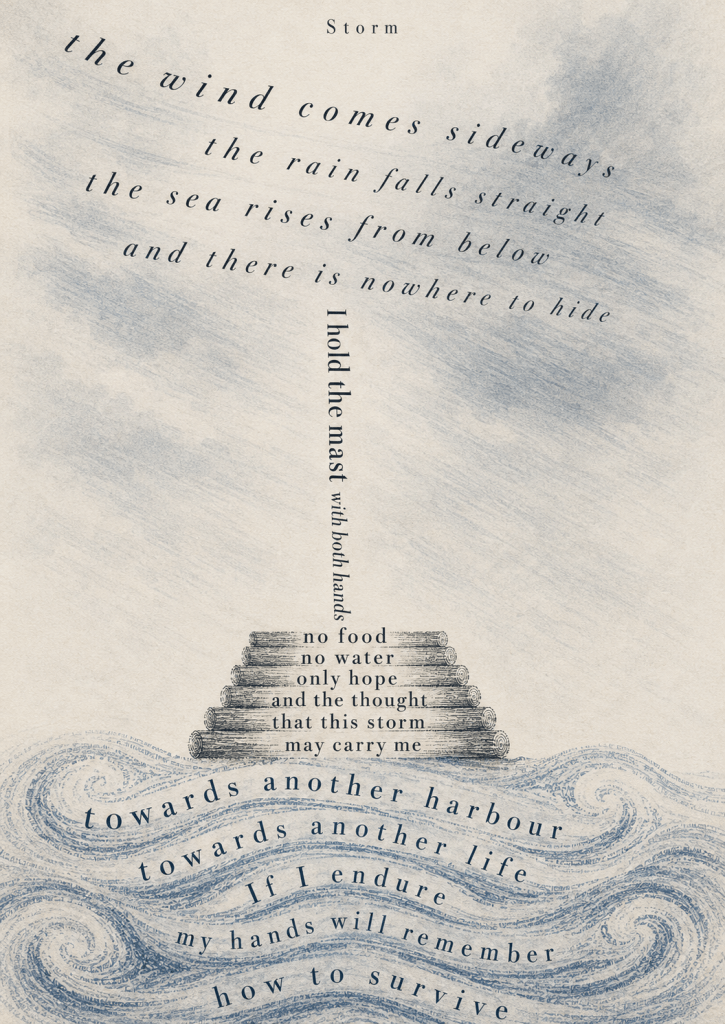
The recent typographic experiment does not attempt to illustrate the raft realistically. Instead, language itself begins to construct the environment. Words become wind, rain, waves, mast and raft. In this way the visual element remains closely connected to writing rather than replacing the reader’s imagination with a predetermined image.
At this stage, Storm remains deliberately unresolved. I do not know whether the traveller reaches Ithaca, another harbour, or nowhere at all. I do not want to manufacture an optimistic conclusion simply because hope exists within the work.
For now there is only an imperfect raft, an enormous sea, a storm coming from every direction, and two hands holding onto a mast.
The storm may destroy the traveller.
It may carry them home.
Or it may carry them somewhere they have never imagined.
They don’t know. They just endure.
Storm. A move on: another idea using multiple languages
During my Level 2 studies, particularly around modules 2.2 and 2.3, I came across the idea of writing with words. I remember searching for examples of artists and writers who used language not simply to describe an image, but to construct one. My tutor encouraged me to continue investigating this relationship between text and visual form, and the idea has remained somewhere within my practice.
Storm brought me naturally back to it.
The simplicity of the image (a raft, a mast, wind, rain and sea) seemed particularly suitable for working with language rather than conventional drawing. Words could become the elements themselves. The wind could travel horizontally, rain could fall vertically and the sea could rise and move beneath the raft. The mast and raft could also be made from language, allowing the image to exist somewhere between poetry, drawing and typography.
While developing this experiment, another possibility emerged: introducing more than one language into the work.
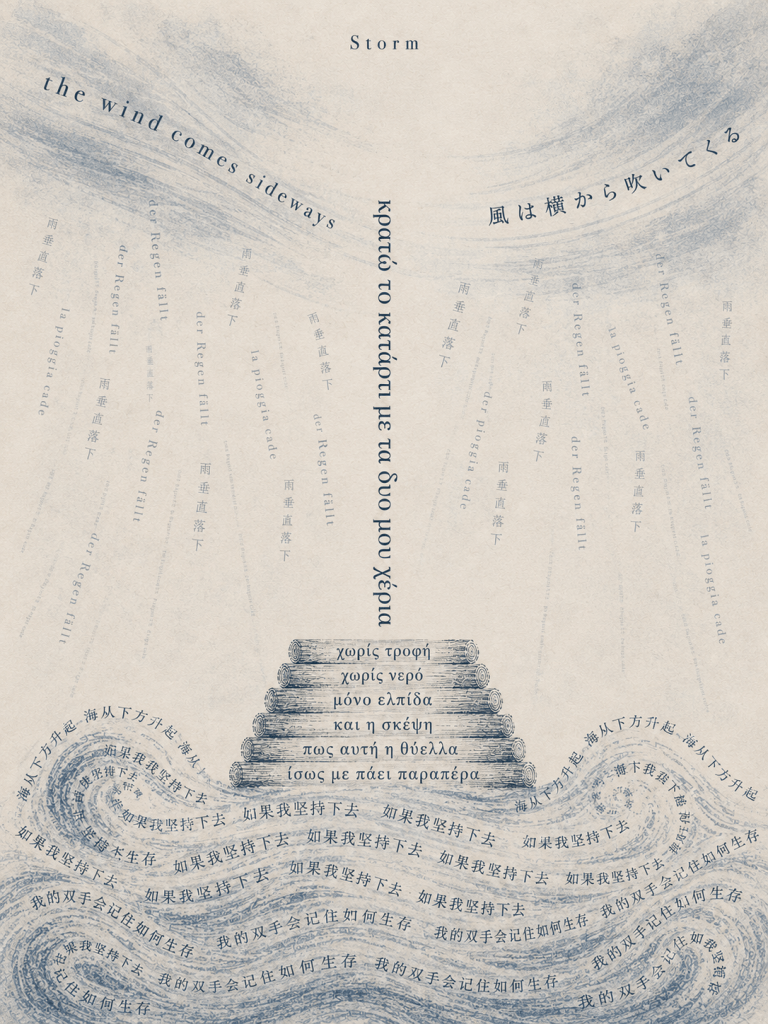
Language has always been connected with movement, place and cultural experience. Rather than creating the whole image in English, I am interested in allowing different languages to enter the storm. Greek could appear beside English, while Japanese, German, Chinese or Italian could introduce another visual and linguistic rhythm. The choice of language is not random. These countries and their languages shaped my thoughts, my past and I carry them with me on my own raft.
The purpose would not simply be to translate the same words repeatedly. I am more interested in what happens when different languages occupy the same space. Their alphabets, sounds, shapes and directions could become part of the movement of the storm itself.
A word for wind does not necessarily need to behave in the same way as a word for rain. A Greek word might move across the page, while another language falls vertically or disappears beneath the waves. The reader may understand some of the words and not others, but perhaps complete understanding is not necessary. The unfamiliar language could become another part of the uncertainty of the environment.
This opens a new direction for Storm. It could become not only an experiment in how words become image, but also an exploration of how different languages can coexist within the same visual and poetic space.
For now, I want to treat this as another possibility rather than a fixed decision and experiment with how the languages interact before deciding what belongs in the final work.
AI, authorship and the reconstruction of ideas
Storm did not begin as a finished image. It began as a small mental picture: a person on an imperfect raft, surrounded by vastness, holding onto a mast. From that first thought, the work gradually opened into a wider field of ideas. The words came from this imagined situation. They were not added afterwards to explain the image; they became part of the image itself. In this sense, language was not descriptive but structural. The text helped shape the form of the work, allowing words to function as material as much as meaning.
Using AI became a natural part of this process. I was not turning to it simply as a shortcut, but as a way of testing how an internal vision could be brought into visible form through dialogue. My own digital-making skills are limited in areas such as illustration software, so AI offered a practical way of constructing an image through description, revision and response. That process was important in itself. It allowed me to move from thought to form through language, and to see how an imagined space could be assembled, challenged and reshaped through collaboration with a machine.
What interests me here is not only the final result, but the method. AI made it possible to combine image, text and multilingual elements in a way that supported the concept I was developing. It also opened a space for further experimentation, particularly through the use of different languages. Because my own background moves across cultures and places, the inclusion of Greek, English, Chinese, Japanese, Italian and German felt appropriate to the work rather than decorative. The image therefore became not just a visual construction, but also a meeting point of languages, memories and cultural references.
This also connects to a wider idea that matters to me: nothing emerges in complete isolation. Just as art continuously grows out of earlier art, AI also works through re-composition, gathering fragments, structures and possibilities from what already exists and allowing them to reappear in another form. In that sense, this experiment feels entirely appropriate for Storm. It draws together earlier interests in writing with words, visual structure, migration between languages, and the transformation of inherited forms into something new. What emerged was not a finished answer, but a further stage in the development of the work: a way of thinking through image, language and technology at the same time.
Referenses:
Cavafy, C.P. (1975) Collected Poems. Translated by E. Keeley and P. Sherrard, edited by G. Savidis. Princeton, NJ: Princeton University Press.
Aeschylus (2003) ‘Seven Against Thebes’, in Prometheus Bound and Other Plays. Translated by P. Vellacott. London: Penguin Classics. (Original work performed 467 BCE).
Hemingway, E. (1952) The Old Man and the Sea. New York: Charles Scribner’s Sons. The work was singled out by the Swedish Academy when Hemingway received the 1954 Nobel Prize in Literature.
Homer (1996) The Odyssey. Translated by R. Fagles. London: Penguin Classics. [Replace this with your own edition if different.]
Kurosawa, A. (dir.) (1954) Seven Samurai [Film]. Japan: Toho.
Lucas, G. (dir.) (1977) Star Wars [Film]. USA: Lucasfilm/20th Century Fox.
Campbell, J. (2008) The Hero with a Thousand Faces. 3rd edn. Novato, CA: New World Library. (Original work published 1949). Campbell’s influence on Lucas’s development of Star Wars is documented by Lucasfilm.
Shakespeare, W. (2016) King Lear. Folger Shakespeare Library. Available at: Folger Shakespeare Library, online edition (Accessed: 30 August 2026).
Sturges, J. (dir.) (1960) The Magnificent Seven [Film]. USA: The Mirisch Company/United Artists. The film is a direct American reworking of Seven Samurai.
Singer, L. (2022) ‘Reservoir Dogs: 30 years of the film that shook up American cinema’, British Film Institute, 21 January. Available at: BFI (Accessed: 30 August 2026).

