
This Critical Review should be read alongside the body of work and experimentation documented throughout this unit. The two have developed together: one records the process of making, while the other reflects on the ideas, encounters and contextual research that have gradually shaped that process.
My work has not developed in isolation. It has grown through looking, reading, travelling, making, remembering and encountering the work and ideas of others. Some influences, particularly Homer and C.P. Cavafy, have remained with me for a long time, while others entered my practice temporarily and helped me question or redirect a particular idea.
The work documented during this unit records that movement. Photographs taken while travelling through different countries became visual poems; mythology moved from direct reference towards a more open structure; birds, water, horizons and journeys repeatedly returned; and language gradually became not only a means of communication but a visual material in itself.
This Critical Review is therefore not intended to explain every work or provide a fixed interpretation of my practice. Instead, it attempts to understand how these different influences, experiences and experiments have brought me to my current position, and to identify the questions I want to carry forward into the final stage of the project.
It remains a draft, presented at this stage for formative feedback before the development of my final work and presentation.
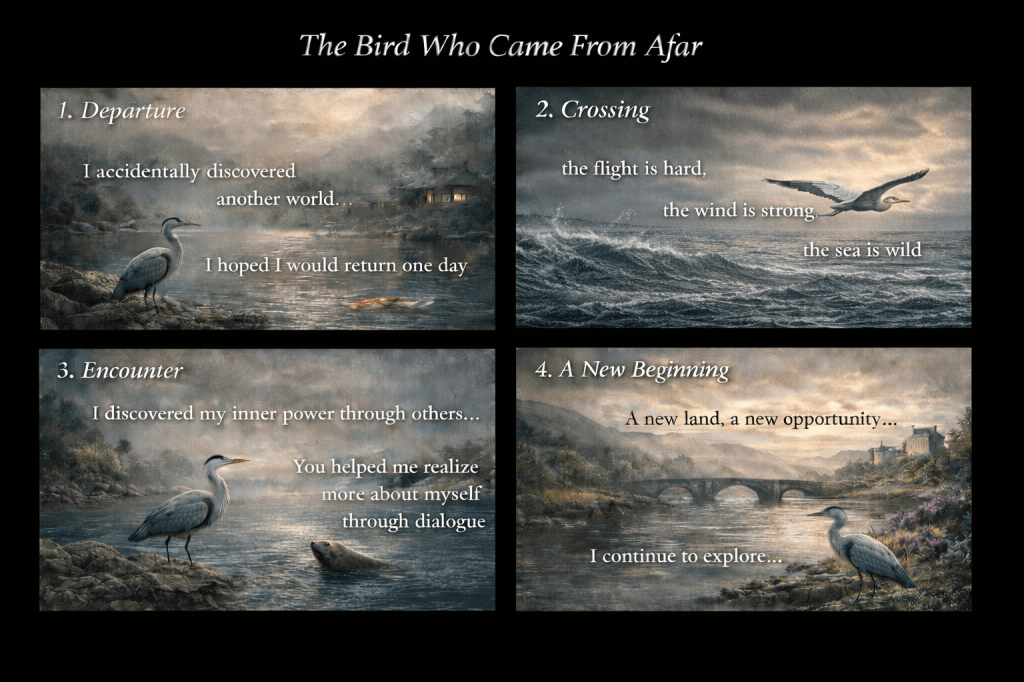
The Bird and the Seal: An Isle of Man Story
After many days of flying across the restless sea, the ”bird who came from afar” saw a dark island rising from the water.
At first the winds were gentle, and the island looked beautiful. The cliffs were green, and the sea lay quietly around the land. As the bird circled above it, a hopeful thought passed through its mind.
Perhaps this could be a place where my family might one day live.
But as the day went on, the winds began to change.
They grew stronger and stronger, pushing against the bird’s wings and turning the air into a restless struggle. The bird tried to fly forward, but each attempt became harder than the last.
Soon the winds were so strong that the bird could no longer continue.
Exhausted, it descended toward a rocky beach where the waves struck the shore with a slow and steady rhythm. There, between two large stones, the bird found shelter from the wind.
The sea was grey and cold.
For a long time the bird sat alone.
The dream of a peaceful island had vanished, and the wind seemed to carry away all hope.
At last the bird lifted its head and cried out into the empty air — a long cry of despair that travelled far across the water.
The sound moved over the waves and into the open sea.
Far away, someone heard the cry.
Curious and concerned, the creature rose from the depths and swam toward the shore where the lonely voice had come from.
Soon a dark head appeared above the water, and two calm eyes looked toward the rocks.
The seal climbed slowly onto the wet stones, shaking the salt water from its body. It had seen many birds before, but this one seemed different. The bird looked far away, as if its thoughts were still flying somewhere beyond the horizon.
The seal spoke gently.
“Bird,” it said, “the winds on this island are not kind to strangers. I heard your cry across the sea. You must carry a story with you. Would you tell it to me?”
The bird lowered its head.
“I do not think my story would interest anyone,” it replied quietly.
The seal smiled.
“Even the smallest story,” it said, “can reveal something true. Sometimes a story is not told for others, but for the one who carries it.”
The bird remained silent for a moment, and then it spoke.
“Once I travelled far across the world and found a quiet lake. There I met a creature from another world. A local bird there could speak both the language of the wind and the language of the water, and through him we were able to understand each other before I had to leave.”
The seal nodded slowly.
“Languages shape the worlds we live in,” it said. “I know the language of the sea, and the language of the land where you now sit. Between them, I have heard tales of many stories.”
The seal looked out across the grey water before continuing.
“The sea carries tales of countless layers!
Once, I heard of a small fish who lived beside a quiet rock where an anemone grew.
The anemone could not move, but the fish returned to it every day. The fish kept the anemone clean, eating the small sea worms that gathered on its fragile arms, and the anemone gave the fish shelter among its soft branches.
For a long time, they lived this way: one rooted to the stone, the other moving through the water, each other helping the other survive.
But one day danger came through the currents, and the fish had to escape into deeper water.
When the fish finally returned, the anemone had faded…
Without the small care of its companion,not been able to fight her own enemies, it had slowly weakened, until she gave up and became a memory.
When the danger was gone, the fish came back.
He circled the silent rock, and its cry travelled through the water. The currents carried that cry far across the sea.
It was a meeting that was never meant to happen — a creature that moved and one that could not — yet their brief life together mattered.”
The seal fell silent.
The bird listened.
For a moment, the memory of another water — calm and distant — passed through its mind like a reflection on a still lake.
And somewhere deep inside the bird, a thought returned quietly:
”Everything I saw was only a reflection… but you were true.”
But the bird did not speak those words aloud.
Stayed there silent, looking at the horizon.
After a while, the seal asked one last question.
“Bird,” it said softly, “if the winds here are so strong, why do you keep flying?”
The bird looked toward the dark horizon where the sea met the sky.
“Because if I stop flying,” it said quietly, “I fall into the sea.”
The seal gave a gentle laugh.
“And if you fall into the sea,” it said, “perhaps you will learn to swim. Some birds do. The sea teaches those who must survive. Hardship often reveals abilities we did not know we had.”
The bird listened carefully.
“Do not lose hope,” the seal continued. “The winds will calm. Wait for another day.”
The bird looked at the seal with gratitude.
“Thank you for your kindness,” it said. “Your words have helped me remember who I am.”
The seal dipped its head slightly.
“Sometimes,” it said, “all we need is a few kind words and a moment of companionship. You will not use my wings to leave this place. It will be your own wings that carry you across the sea. You only need to gather your strength, open them again, and fly.”
With that, the seal slid quietly back into the water.
For a moment the surface of the sea rippled where it had disappeared.
Then the waves became calm again.
The bird remained on the rocks through the night.
When morning came, the winds had softened.
The bird rose slowly and opened its wings again.
The sea was still restless, but the bird had found its strength.
High above the water it flew once more.
Far across the horizon the bird saw the faint outline of another land waiting in the light.
The bird flew toward it.
When it finally arrived, it discovered a place where rivers flowed through the land, carrying fresh water from the hills toward the sea.
There, beside the quiet sound of moving water, the bird rested its wings.
For the first time since leaving the island, the winds were calm.
And the bird understood that this land was not the end of its journey, but the beginning of another story.
Assignment: A Visual Poem (Draft Reflection)
Prologue
This short film is not intended to be a finished artwork. Instead, it forms part of my ongoing experimentation for Assignment 5 and my mid-point presentation. I see it as a visual sketchbook rather than a final destination. Through this process I wanted to explore whether photographs, music and memory could communicate emotionally without relying on spoken explanation or a conventional narrative.
The soundtrack is the Greek song Ήταν Μια Φορά (“Once Upon a Time”) by Nikos Xylouris. For a Greek audience, these opening words immediately suggest the beginning of a story or a fairy tale. Even for viewers who do not understand the language, I hope the strength, passion and emotion of Xylouris’ voice communicates something beyond words. Rather than translating the lyrics directly, I wanted the music to function as an emotional current that carries the viewer through the sequence of images.
Reflection
This experiment developed from a simple question: can photographs from different countries and different periods of my life coexist within a single emotional landscape?
The images come from China, Scotland, England and the Isle of Man. At first glance they appear unrelated, connected only by the fact that I happened to visit these places. However, while editing the sequence I realised that I was not creating a travel documentary or a chronological record of my journeys. Instead, I was exploring how memory moves. Memories rarely appear in perfect order; they surface unexpectedly, connected by emotion rather than by geography or time.
As I assembled the sequence, I began to understand that the music behaves almost like a river. It flows continuously, carrying the viewer from one image to the next. Rather than asking the audience to analyse each individual photograph, I wanted them to experience the emotional rhythm created by the movement between images. The photographs become brief moments that appear and disappear, much like memories passing through the mind.
During this process I also recognised several recurring visual themes within my own practice. Birds, water, reflections, horizons, architecture and moments of solitude appear repeatedly throughout the film. These subjects were not consciously selected in advance; instead, they have gradually become part of my own visual language. Looking back at the completed sequence, I realised that I am less interested in documenting places than in exploring how different places shape my perception of the world.
The film therefore became an experiment in creating what I would describe as a visual poem. Rather than presenting a clear argument or explanation, it invites the viewer to experience connections between cultures, landscapes and memories through observation and feeling. The central figure is not necessarily myself, but the act of looking. The work reflects my belief that travel is not simply about moving across geographical borders but about allowing different cultures, experiences and encounters to coexist within us.
This remains a draft and an important stage in my learning. My intention is not to present a completed piece, but to invite feedback that will help me understand whether these emotional connections are also experienced by others. The questions I hope to explore further are whether images alone can communicate across cultures, and how music, photography and narrative might work together to create a shared emotional experience.
————————————————————————————————————————
DEN LES KOUVENTA
Reflection
This film represents a continuation of an enquiry that began with my previous experiment using Nikos Xylouris’ Ήτανε Μια Φορά (Once Upon a Time). In that work, I explored whether photographs from different countries and different periods of my life could coexist within a single emotional landscape. Although the sequence deliberately rejected chronology, the opening phrase of the song naturally suggested the beginning of a story. Looking back, I now realise that my interest was still connected to storytelling.
This new work marks an important shift in my practice. Rather than asking whether photographs can tell a story, I became interested in whether photography and music could exist as two parallel emotional experiences without one explaining the other. The choice of Sotiria Bellou’s Δεν λες κουβέντα(You Don’t Say a Word) fundamentally changed the direction of the project. Bellou’s voice carries a profound emotional weight for Greek audiences, evoking themes of longing, resilience, love and loss. For me, the song immediately awakens memories that are both personal and collective. However, rather than allowing the photographs to illustrate the lyrics, I wanted both elements to remain independent, creating a dialogue between two different emotional worlds.
As the editing developed, I realised that I was no longer constructing a travelogue or even a visual memoir. The photographs no longer represented places I had visited; instead, they became fragments of memory that drifted freely between China, Scotland, England and the Isle of Man. Images from one country unexpectedly evoked memories of another, suggesting that memory does not organise itself according to geography or chronology, but through emotional association. Travel, therefore, became less about movement through physical space and more about movement between identities, cultures, languages and states of mind.
I began to think of the music as something more than a soundtrack. It became a vehicle that carries the viewer through the sequence, almost like a magic carpet transporting us beyond ordinary reality into a landscape of memory and imagination. Within this space, the photographs do not explain the music, nor does the music explain the photographs. Instead, they unfold simultaneously as two parallel narratives originating from different universes. One belongs to an older Greece, deeply rooted in cultural memory, poetry and nostalgia. The other emerges from contemporary places encountered during my travels, yet many of these photographs already possess a timeless or vintage quality. Their relationship is not one of illustration but of emotional resonance.
During the editing process I also became increasingly aware of the role played by atmosphere and sound. Towards the end of the film I deliberately introduced natural sounds after the music fades. The gentle sound of crickets recalls the cicadas of the Greek summer, instantly transporting me back to childhood memories that exist beyond the photographs themselves. Shortly afterwards, the cries of seagulls introduce another emotional register, suggesting the sea, departure, longing and travel. These sounds continue the narrative after the song has ended, allowing memory to linger rather than conclude.
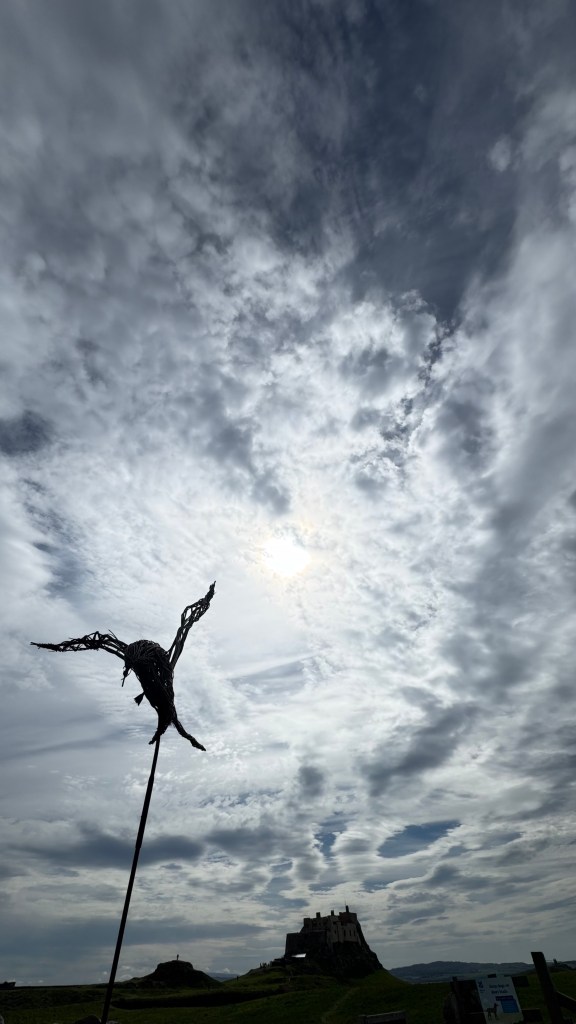
The final image became particularly significant within my developing practice. It depicts a man-made bird sculpture woven from branches, standing on a wooden post overlooking the sea on Holy Island. I found myself returning repeatedly to this image because it seemed to embody a paradox that increasingly interests me. The post functions both as support and as limitation. Without it, the bird would lie on the ground, unable to see beyond itself. Yet because it remains attached to the post, it can never truly fly. I began to understand this image as representing the contradictions that often shape our lives: the structures that protect us may also confine us; the responsibilities that give us purpose may simultaneously restrict our freedom. Rather than offering a conclusion, the sculpture invites multiple interpretations, becoming a recurring symbol within The Bird Who Came From Afar.
Throughout the film I also experimented extensively with animation, movement and a variety of visual filters. These decisions were never intended simply as stylistic effects. Instead, they became a way of exploring the unstable nature of memory itself. Some recollections remain vivid and sharply defined, while others gradually fade, blur or transform over time. The shifting textures of the photographs reflect this continual movement between remembering and forgetting. The images become less like documentary records and more like memories unfolding within the mind.
Looking back, I believe this work represents a significant development in my practice. My interest has gradually shifted away from photography as documentation towards photography as visual poetry, where rhythm, association, sound and atmosphere become as important as the images themselves. Increasingly, I am less concerned with representing places than with exploring how places continue to exist within us long after we have left them behind.
Perhaps the most important question emerging from this work concerns its audience. Bellou’s song carries profound cultural significance for Greek listeners, yet many viewers will not understand a single word of the lyrics. I therefore find myself asking whether emotion itself can travel across languages. Can photography, music and atmosphere communicate something meaningful even when cultural references remain inaccessible? Can a viewer experience longing, memory and hope without understanding the words being sung? These questions now lie at the centre of my practice and will continue to shape the development of The Bird Who Came From Afar.
Moment That Stayed With Me
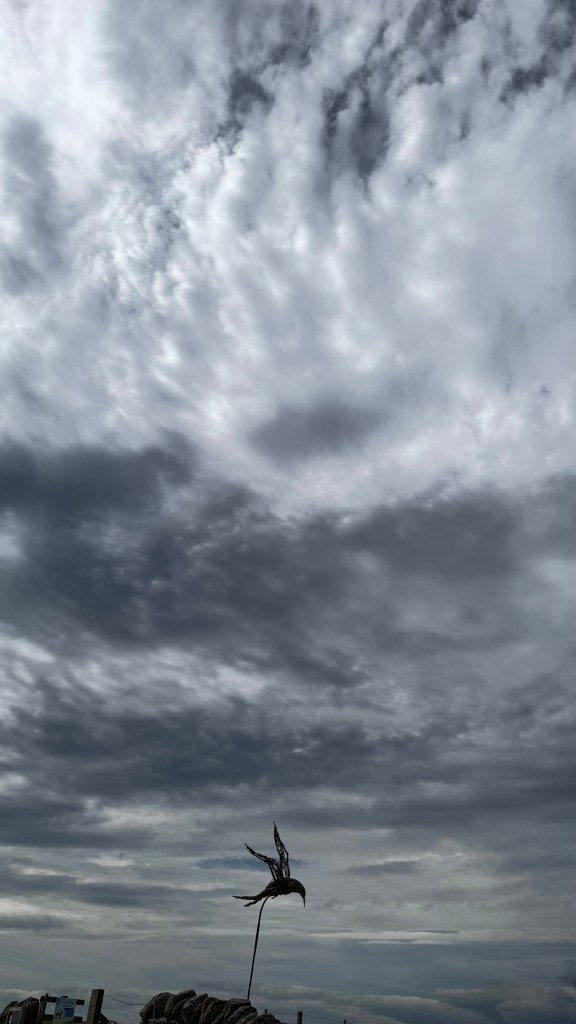
During a visit to Holy Island, I came across this small bird sculpture standing alone against the open sky. At first, it seemed like nothing more than a decorative feature placed along the path. I took several photographs and continued my walk, but the images stayed with me long after I had left.
As I found myself returning to it, I realised that what interested me was not the object itself, but the quiet contradiction it represented. From its elevated position, the bird overlooked the coastline and the changing sea beyond. It occupied a place many would envy, yet it remained fixed to a single point. That contrast lingered in my thoughts.
Over time, the photograph began to connect with moments from my own life. Looking back over the different places I have lived, the opportunities I have embraced and the choices I have made, I recognised how circumstances can often hold opposing meanings at the same time. What offers security may also demand sacrifice. What appears desirable from a distance may carry limitations that only become visible once experienced.
This photograph has therefore become more than a record of a place I visited. It has become a point of reflection: a reminder that a single encounter can continue to unfold in meaning long after the moment has passed. It also reminds me that photography, for me, is not simply about recording what I see, but about recognising when an ordinary scene quietly begins to ask deeper questions and the memories as well as the thoughts awaken along.
Breaking the Boundaries: The work
For a long time, I saw birds as a symbol of migration: a traveller moving between places, cultures and identities. Looking at this image now, I see something different. The bird is not simply preparing to fly; it is breaking the very thing that has kept it in place.
The slender stem becomes more than a support. It represents the invisible boundaries we accept without questioning: routine, fear, expectations, responsibility, security and the identities we inherit. Sometimes these structures protect us, but they can also become the limits of our imagination.
I thought: What if it tries to break free?
In this imagined sequence, the bird does not wait to be released. It breaks the support that has defined its existence and discovers that flight begins not when the world changes, but when it chooses to let go.
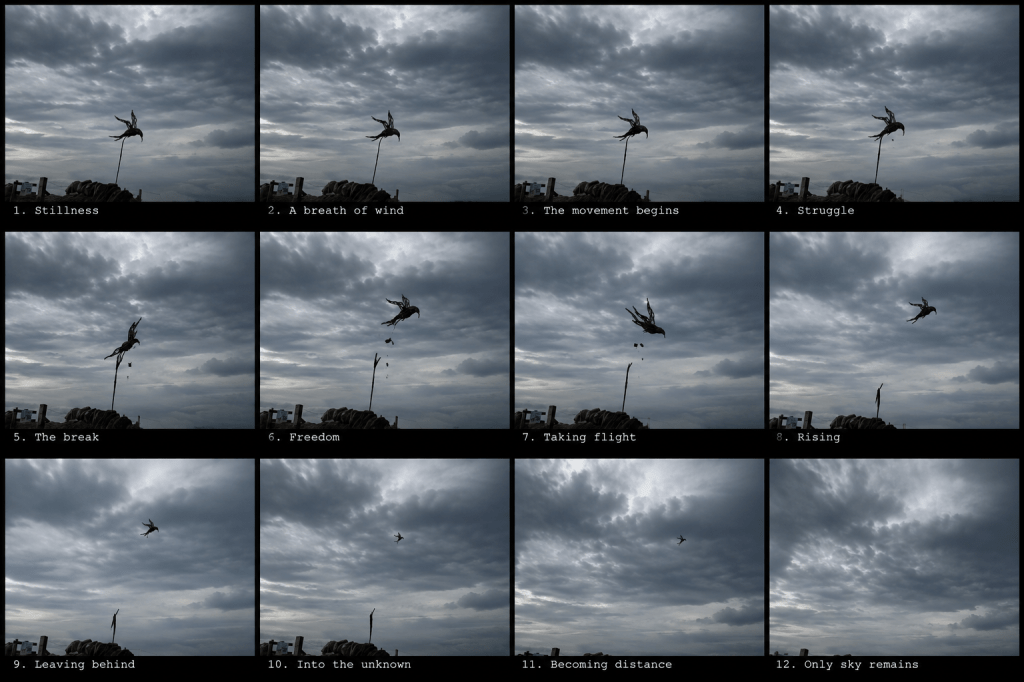
This is not an act of escape or rebellion. It is an act of transformation. The broken stem remains behind as a reminder of where the journey began, while the bird carries only what it truly needs into the open sky: a vision to discover and move beyond the horizon.
To use the words of the Sotiria Bellou’s song I used to accompany my previous photo sequence:
Ξέρω τ’ όνομα σου———I know your name
την εικόνα σου— — — your face
και πάλι από την αρχή— — — and all the way from the beginning
Ψάχνω για— — — I’m looking for
μια διέξοδο γυρεύοντας— — — a way out
μια ‘λλιωτικη ζωή…— — — longing for a different life….
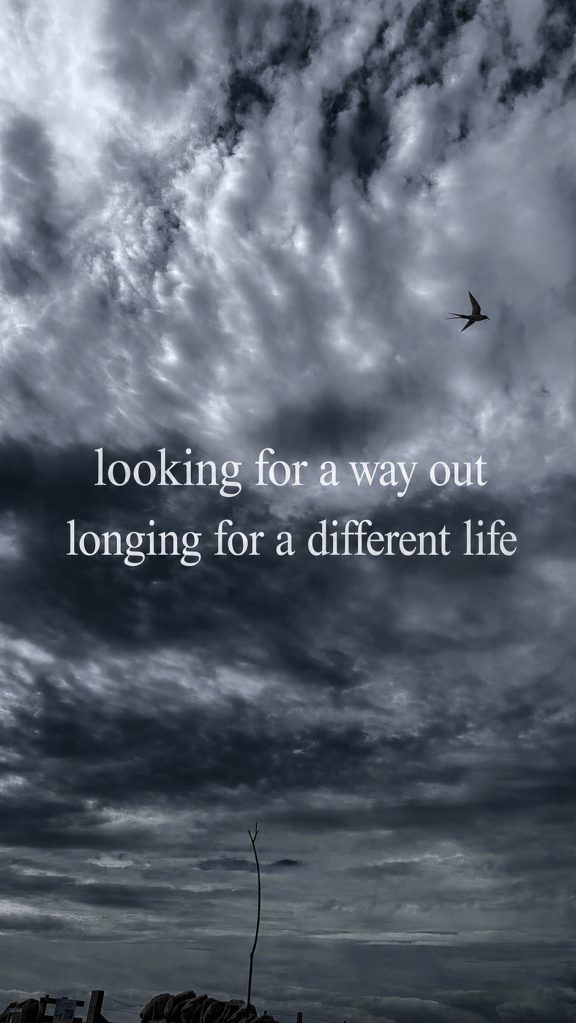
Perhaps we all spend part of our lives believing that something outside ourselves keeps us grounded. Yet the greatest boundaries are often the ones we have learned to accept. The moment we question them, we begin to discover that freedom is not simply the absence of restraint: it is the courage to imagine ourselves differently.
Experiments, Revisions and Reflections
The sequence of the bird leaving the stick did not emerge as a finished idea. It developed through a series of experiments, questions and revisions. Looking back, I realised that the creative process was as valuable as the final outcome.
My first thought was simply to remove the bird from the photograph. Although this immediately suggested absence, it did not communicate transformation. The empty space felt descriptive rather than emotionally engaging. The image seemed incomplete, as though something had been lost rather than intentionally changed.
The next experiment introduced the bird in flight. This brought movement into the sequence, but I soon realised that something important was missing. Without the original support remaining in the frame, there was little visual evidence of where the journey had begun. The image became one of flight alone, rather than a reflection on transition.
Returning the stick to the composition became a significant turning point. This small change altered the meaning of the image. The empty support became a silent witness, encouraging the viewer to imagine what had happened rather than presenting a complete explanation. The absence of the bird became more powerful because the place it once occupied remained visible.
I also experimented with the relationship between image and text. My initial instinct was to place the words beneath the photograph, treating them as a caption. However, this separated language from the visual experience. By allowing the words to occupy the sky itself, they became less like an explanation and more like an internal voice, existing within the same visual space as the landscape.
Throughout this process I repeatedly questioned whether the image needed words at all. I wondered if the text directed the viewer too strongly, or whether it simply opened another way of reading the work. I also questioned whether the sequence had become too literal, asking myself if the viewer could still discover their own meaning without being led towards a predetermined interpretation.
Not every version was successful. Some felt overly descriptive, while others became too ambiguous. Instead of seeing these as unsuccessful outcomes, I began to recognise them as necessary stages in understanding what the work itself required. Each revision revealed something that the previous version had not, allowing the sequence to develop gradually rather than arrive fully formed.
Looking back, I have come to appreciate that documenting these experiments is just as important as presenting the finished work. The abandoned ideas, the uncertainty and the continual adjustments reveal how the project has evolved through reflection, curiosity and experimentation. They demonstrate that creative practice is rarely a straight path, but an ongoing conversation between intuition, observation and critical judgement.
As my final decision, I made it the way I thought it would work better for me, and let the audience decide what to keep and what not to.
TRIALS
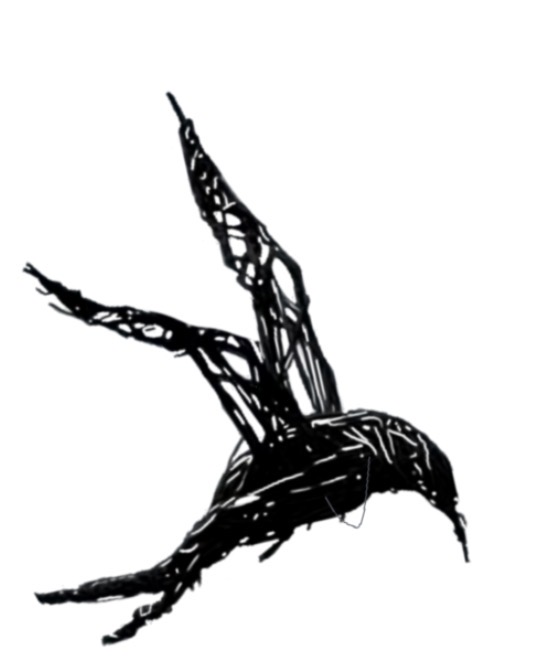
These are three frames I worked on using an app called PROCREATE.
I used the sequence in a loop to see the animated movie of the flight as well as to understand the whole process of editing and moving images.
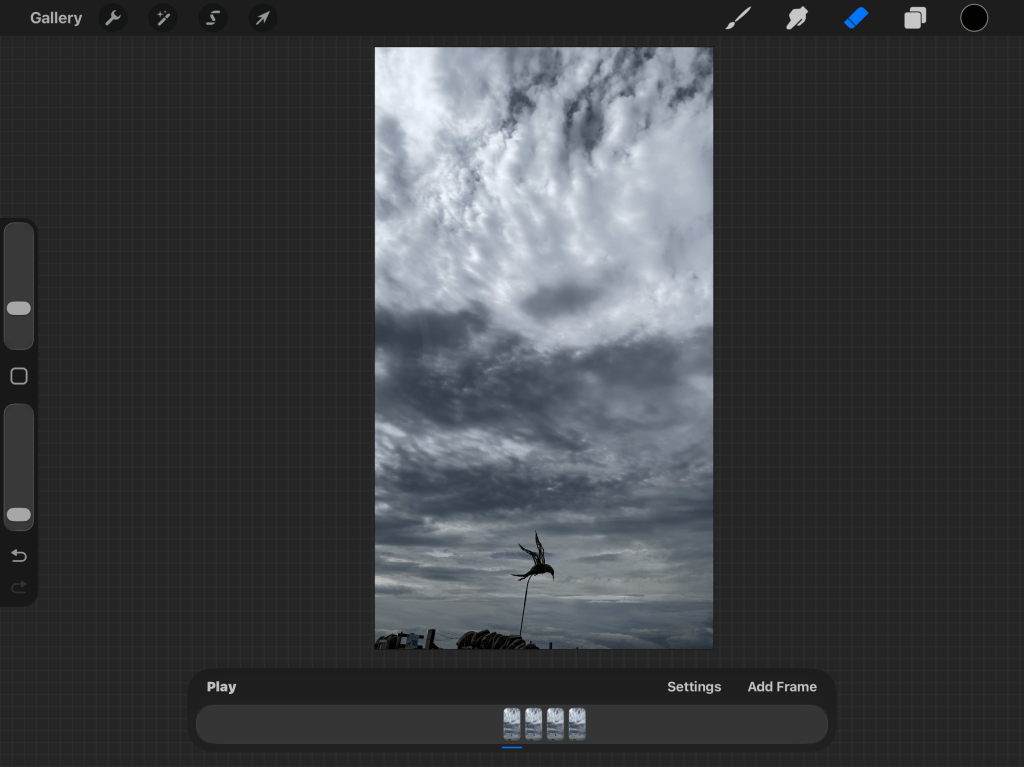
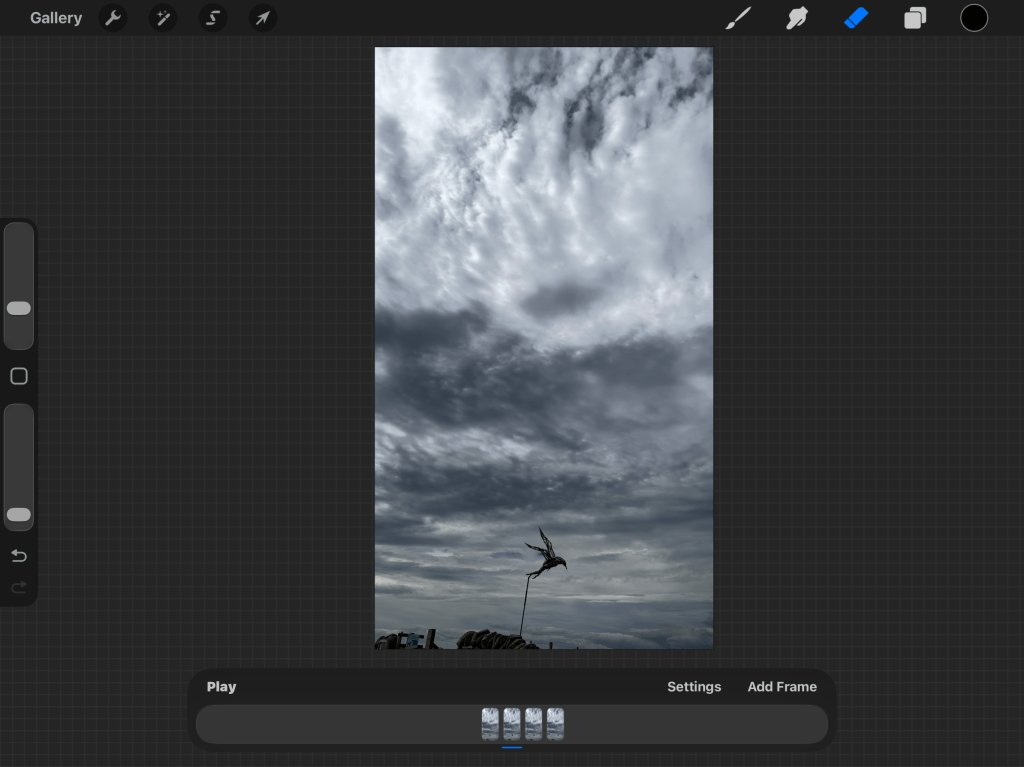
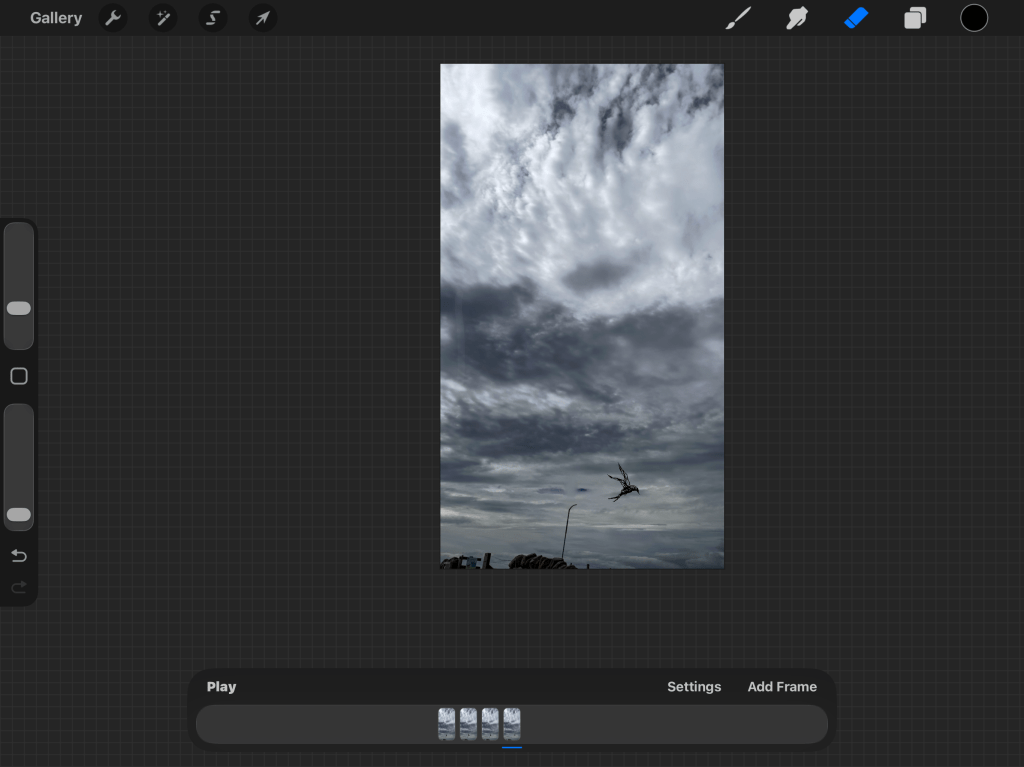
After a few frustrating trials and a lot of work on the pixel size magnifications, I managed to understand how to proceed and discover what works better for me as an aesthetic and contextual outcome.
Storm. Discovery between Ithaca and the Unknown. A Draft and a Thought.
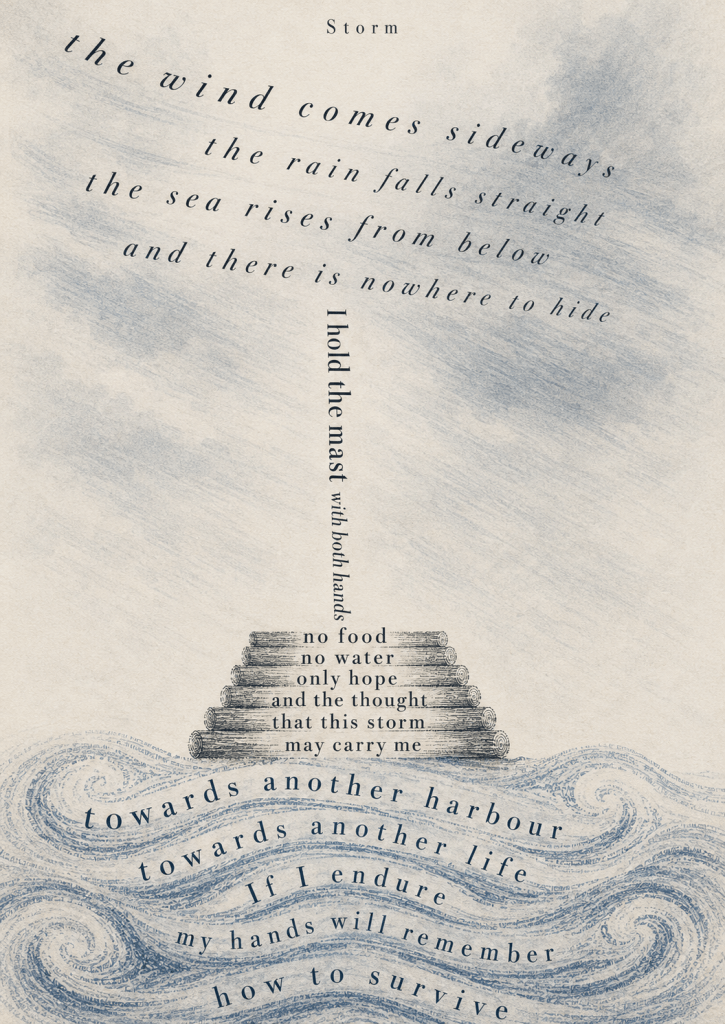
The Poem Storm began as an idea about an unnamed traveller alone on a handmade raft in the middle of an open sea. The raft is fragile and imperfect. Almost everything that once belonged to the traveller has already been taken by the sea. There is no food, no water and nowhere to hide. Only the mast remains.
Storm
The wind comes sideways.
The rain falls straight.
The sea rises from below.
There is nowhere to hide.
An imperfect raft,
an enormous sea,
and two hands
holding onto a mast.
No food.
No water.
Only hope,
and the thought
that this storm
may carry me
towards another harbour,
towards another life.
Another wave.
Another gust.
Another moment.
The body holds.
At the same time,
the mind continues travelling.
Where is the storm taking me?
Towards Ithaca?
Towards somewhere
I have never imagined?
Perhaps the storm
will destroy me.
Perhaps it will carry me home.
Perhaps it will carry me
somewhere else.
I don’t know.
I just endure.
And perhaps,
when everything else
has disappeared,
there will remain
only the knowledge
that my hands
continued to hold.
The poem above, was born by an image developed in my mind while I was thinking about periods of uncertainty and change, but I do not want the work to become autobiographical. Personal experience may sit somewhere underneath it, but I am more interested in creating a situation that another person can enter and interpret through their own experiences.
The physical structure of the storm became particularly important to me: the elements attack him from every site giving him no place to hide. The traveller is therefore surrounded by forces he cannot escape from. In the middle of these movements there is one relatively fixed point: the mast. Two hands hold onto it.
I do not imagine the traveller’s face entirely in despair. I imagine someone in survival mode. Fear and exhaustion are present, but the body is occupied with the immediate necessity of staying alive: surviving another wave, another gust, another moment.
Initially I resisted giving Storm a visual form because I wanted language to leave space for imagination. Homer rarely gives the reader every visual detail; the listener or reader participates by constructing the missing image internally. I remain interested in that openness.
The recent typographic experiment does not attempt to illustrate the raft realistically. Instead, language itself begins to construct the environment. Words become wind, rain, waves, mast and raft. In this way the visual element remains closely connected to writing rather than replacing the reader’s imagination with a predetermined image.
At this stage, Storm remains deliberately unresolved. I do not know whether the traveller reaches Ithaca, another harbour, or nowhere at all. I do not want to manufacture an optimistic conclusion simply because hope exists within the work.
For now there is only an imperfect raft, an enormous sea, a storm coming from every direction, and two hands holding onto a mast.
The storm may destroy the traveller.
It may carry them home.
Or it may carry them somewhere they have never imagined.
They don’t know. They just endure.
Storm. A move on: another idea using multiple languages
During my Level 2 studies, particularly around modules 2.2 and 2.3, I came across the idea of writing with words. I remember searching for examples of artists and writers who used language not simply to describe an image, but to construct one. My tutor encouraged me to continue investigating this relationship between text and visual form, and the idea has remained somewhere within my practice.
Storm brought me naturally back to it.
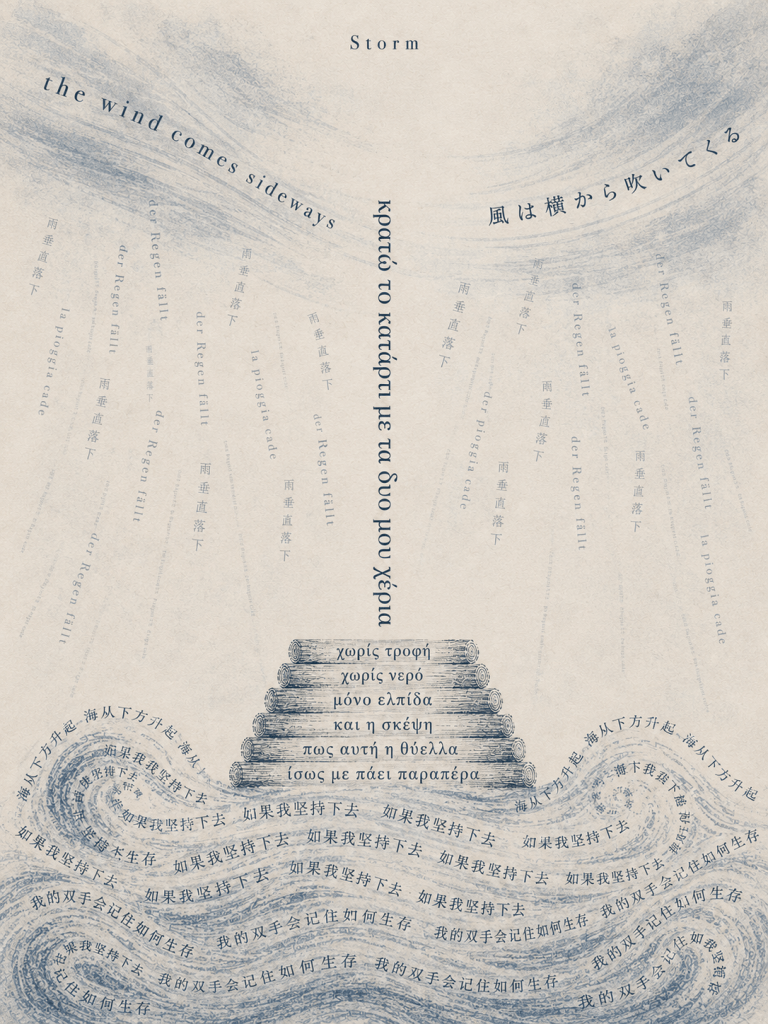
The simplicity of the image (a raft, a mast, wind, rain and sea) seemed particularly suitable for working with language rather than conventional drawing. Words could become the elements themselves. The wind could travel horizontally, rain could fall vertically and the sea could rise and move beneath the raft. The mast and raft could also be made from language, allowing the image to exist somewhere between poetry, drawing and typography.
While developing this experiment, another possibility emerged: introducing more than one language into the work.
Language has always been connected with movement, place and cultural experience. Rather than creating the whole image in English, I am interested in allowing different languages to enter the storm. Greek could appear beside English, while Japanese, German, Chinese or Italian could introduce another visual and linguistic rhythm. The choice of language is not random. These countries and their languages shaped my thoughts, my past and I carry them with me on my own raft.
The purpose would not simply be to translate the same words repeatedly. I am more interested in what happens when different languages occupy the same space. Their alphabets, sounds, shapes and directions could become part of the movement of the storm itself.
A word for wind does not necessarily need to behave in the same way as a word for rain. A Greek word might move across the page, while another language falls vertically or disappears beneath the waves. The reader may understand some of the words and not others, but perhaps complete understanding is not necessary. The unfamiliar language could become another part of the uncertainty of the environment.
This opens a new direction for Storm. It could become not only an experiment in how words become image, but also an exploration of how different languages can coexist within the same visual and poetic space.
For now, I want to treat this as another possibility rather than a fixed decision and experiment with how the languages interact before deciding what belongs in the final work.
AI, authorship and the reconstruction of ideas
Storm did not begin as a finished image. It began as a small mental picture: a person on an imperfect raft, surrounded by vastness, holding onto a mast. From that first thought, the work gradually opened into a wider field of ideas. The words came from this imagined situation. They were not added afterwards to explain the image; they became part of the image itself. In this sense, language was not descriptive but structural. The text helped shape the form of the work, allowing words to function as material as much as meaning.
Using AI became a natural part of this process. I was not turning to it simply as a shortcut, but as a way of testing how an internal vision could be brought into visible form through dialogue. My own digital-making skills are limited in areas such as illustration software, so AI offered a practical way of constructing an image through description, revision and response. That process was important in itself. It allowed me to move from thought to form through language, and to see how an imagined space could be assembled, challenged and reshaped through collaboration with a machine.
What interests me here is not only the final result, but the method. AI made it possible to combine image, text and multilingual elements in a way that supported the concept I was developing. It also opened a space for further experimentation, particularly through the use of different languages. Because my own background moves across cultures and places, the inclusion of Greek, English, Chinese, Japanese, Italian and German felt appropriate to the work rather than decorative. The image therefore became not just a visual construction, but also a meeting point of languages, memories and cultural references.
This also connects to a wider idea that matters to me: nothing emerges in complete isolation. Just as art continuously grows out of earlier art, AI also works through re-composition, gathering fragments, structures and possibilities from what already exists and allowing them to reappear in another form. In that sense, this experiment feels entirely appropriate for Storm. It draws together earlier interests in writing with words, visual structure, migration between languages, and the transformation of inherited forms into something new. What emerged was not a finished answer, but a further stage in the development of the work: a way of thinking through image, language and technology at the same time.

