
Work in Progress Summary (Project 3 – Personal Voice)
At this point of Project 3, I feel that my work is starting to come together in a more coherent way. Up to now, I have been exploring different ideas through writing, photography, and reflection, but I am now moving towards shaping these into a more structured outcome. The main focus of my work continues to be The Bird Who Came From Afar, which I am developing into a moving image piece of around seven to eight minutes.
What has changed for me in this stage is that I am no longer just experimenting; I am beginning to make decisions. I have realised that the film format allows me to bring together everything I have been working on, including image, text, and sound, in a way that reflects my experience of movement, distance, and living between cultures. At the moment, my work is still in progress, but I can see a clearer direction forming.
I have started to structure the film into four parts: departure, crossing, encounter, and continuation. This structure helps me organise both the visual material and the narrative, but also reflects a personal journey rather than a fixed storyline. The images I am using come from China, the Isle of Man, and Scotland, but I am trying not to present them as separate places. Instead, I want them to feel like different moments within the same ongoing movement.
In the first part, departure, I am working with images from China and exploring a slower, more reflective tone. I am experimenting with voice as a way to introduce memory and origin, and I am considering whether this voice should be in Greek, as this feels more personal and closer to my identity. In the second part, crossing, I begin to introduce movement and uncertainty through imagery of the sea and transitional spaces. Here, I am also experimenting with natural sound, such as wind and water, and allowing language to become more fragmented, reflecting a shift away from clarity.
The third part, encounter, is the most important section for me conceptually. This is where the bird and the seal appear, and where I explore communication across difference. I am experimenting with separating voice and text, allowing one to be heard and the other to be read. This reflects my own experience of partial understanding when navigating different languages. The final part, continuation, moves away from resolution and instead suggests an ongoing journey. Using imagery from Scotland, I am trying to create a quieter and more open space, where sound and text are reduced and the narrative remains unresolved.
Overall, I can see that my work is shifting from exploration towards a more intentional practice. I am still developing my technical skills, particularly in editing and sound, but I am beginning to understand how these elements can work together. This project remains in progress, but I feel that I am starting to shape a clearer and more personal visual language.
Working Script (Draft – Work in Progress)
The film begins with a slow and reflective sequence based on images from China. The visual rhythm is calm, with still frames and gradual transitions that allow the viewer to enter a space of memory and distance. The sound at this stage remains minimal, consisting of low ambient noise, perhaps distant city sounds or a very soft movement of air. A voice begins to emerge slowly, spoken in Greek, introducing the sense of departure not as a clear decision but as something that happened almost without awareness. The words suggest a quiet realisation of leaving, and a belief that the separation would only be temporary. Alongside this, a small amount of text appears, minimal and understated, offering a simple phrase such as “I thought I would return,” reinforcing the idea without fully explaining it.
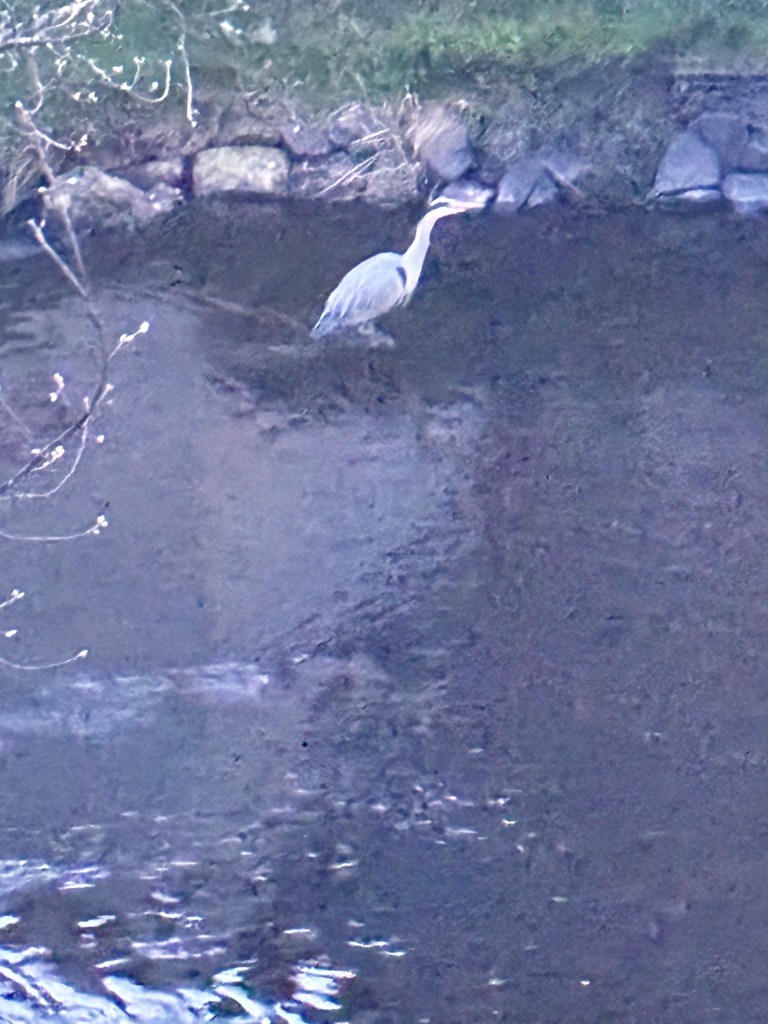
The second part of the film shifts into a space of transition, using imagery connected to the sea and the Isle of Man. The movement becomes more apparent, and the sound develops further, with wind and waves becoming more present. The atmosphere changes, creating a sense of uncertainty and displacement. The voice continues but becomes less stable, appearing and disappearing rather than remaining continuous. The language begins to reflect this change, suggesting that time and meaning are no longer fixed. Text appears in fragments rather than full sentences, indicating a breakdown in clarity. Words are no longer fully connected, and meaning becomes something that the viewer must interpret rather than receive directly.
The third part introduces the central encounter between the bird and the seal. The visual relationship between these two figures becomes the focus, with one representing movement and the other stillness. At this point, the separation between voice and text becomes more deliberate. The bird’s voice is heard in Greek, expressing recognition but also a lack of understanding. In contrast, the seal’s response appears only as written text, without sound. This creates a moment where communication is present but incomplete, where both sides exist in relation to each other but do not fully connect. A pause follows, allowing silence to become part of the narrative. The voice then returns with a more reflective tone, suggesting that understanding may not be necessary for connection to exist. This section remains open and experimental, as I continue to explore how these elements interact and how much should be revealed or left unresolved.
The final part of the film moves towards a quieter and more open-ended space, using imagery from Scotland. The pace slows again, and the sound becomes softer, returning to a more minimal use of natural elements such as wind or water. The voice is reduced to a few final lines, suggesting that the journey has not concluded but continues in another form. The use of text is minimal, perhaps limited to a final phrase such as “it continues,” allowing the work to end without closure. The intention is not to resolve the narrative, but to leave it in a state of continuation, reflecting the ongoing nature of identity and movement.
At this stage, this script remains a working structure rather than a fixed outcome. It reflects my current thinking and experimentation with the relationship between image, sound, and language. As I continue to develop the film, I expect these elements to evolve further, particularly in terms of timing, pacing, and the balance between clarity and ambiguity.
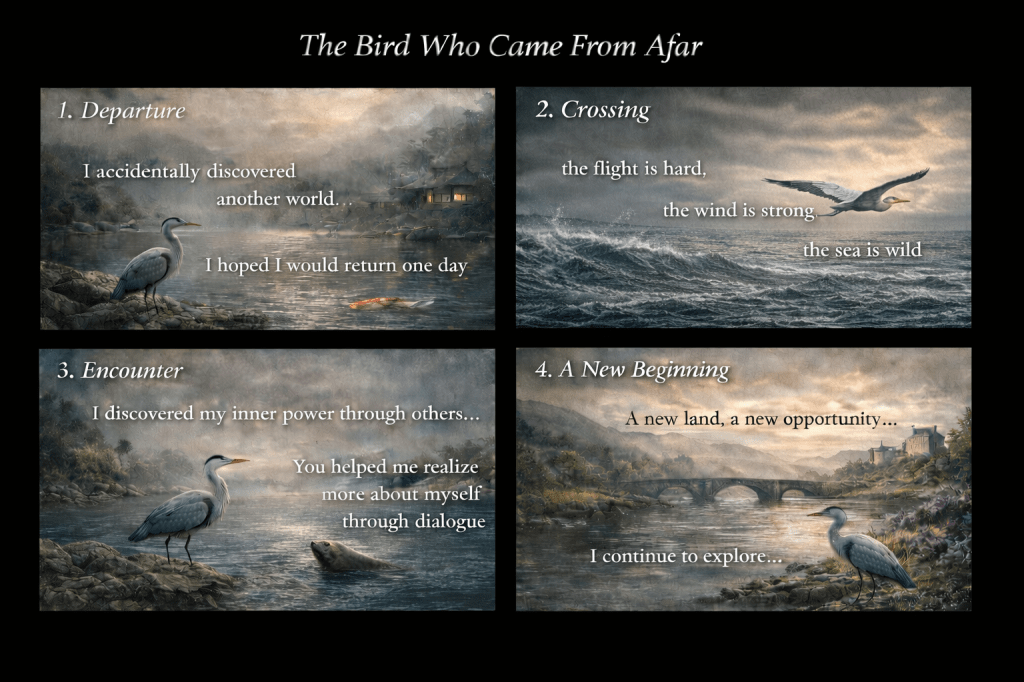
Visual Narrative Reflection
This visual sequence represents my interpretation of The Bird Who Came From Afar, not as a fixed story, but as a journey of discovery shaped through movement, encounter, and reflection. The images are not meant to describe places literally, but to suggest emotional states and transitions that I have experienced myself.
The first image presents a moment of quiet discovery. The bird stands still, observing a new environment that it did not intentionally seek, but encountered by chance. The presence of the koi fish and the local bird introduces an early form of connection, suggesting that even in unfamiliar surroundings, there is a possibility of dialogue. This moment reflects a personal realisation that sometimes we do not choose change, but we find ourselves within it. The thought “I accidentally discovered another world. I hoped I would return one day” expresses both curiosity and uncertainty, holding onto the idea of return while already being part of something new.
The second image shifts into movement and struggle. The bird is no longer grounded; it is crossing a vast and unstable space. The direction of the flight becomes important, as it suggests a conscious movement from one world to another. The stormy sea, the strong wind, and the effort of flight represent the difficulty of transition. This stage reflects a period where time feels altered, where familiar structures disappear, and where progress requires endurance rather than clarity.
In the third image, the journey becomes relational. The encounter between the bird and the seal is not simply a meeting of two creatures, but a moment of reflection through the presence of the other. The idea that “I discovered my inner power through others” suggests that identity is not formed in isolation, but through dialogue. The seal does not represent understanding in a literal sense, but rather the process of seeing oneself differently through another perspective.
The final image moves into a quieter space. The landscape suggests a new environment, but not a final destination. It is not about arrival, but about continuation. The bird stands again, but this time not in uncertainty, but in awareness. The phrase “a new land, a new opportunity… I continue to explore” reflects a shift in perspective. What was once unknown and unstable becomes part of an ongoing process of becoming.
Overall, this visual work reflects my understanding that identity is not something fixed or completed, but something that evolves through movement, experience, and interaction. The journey of the bird becomes a way to express my own experience of living between places, languages, and cultures, where meaning is not always clear, but is gradually formed through time.

