
Looking back over this unit, I can see that my practice has changed more than I initially realised. At the beginning I was working with a wide range of interests including journey, memory, mythology, photography, poetry and moving image, but I often treated them as separate areas. Through the unit, and particularly through tutor feedback, I began to understand that the most important part of my practice is not one individual medium but the movement between them.
My original interest in journey has gradually become more specific. I now think more about movement, memory, translation and transformation. Journey is still present, but I no longer see it simply as travelling from one place to another or reaching a destination. Research into Homer, Cavafy and Campbell helped me question the expectations we often place on journeys: departure, struggle, transformation and eventual return. My work Storm has become particularly important because it resists this structure. The traveller does not know where he is going or whether there will be a clear resolution. The idea of endurance has become more important than arrival.
Research has increasingly affected practical decisions rather than remaining separate from the work. Bergson helped me think about memory as something active rather than fixed. Barrett and Berger made me question how much I should explain an image to the viewer. This became particularly relevant in the Holy Island bird work. I originally wanted to explain the bird, the post and the symbolism, but I gradually realised that removing information could make the work stronger. The empty post created space for interpretation. At the same time, when I later added text to the storyboard, I began to see how words such as “Freedom” or “Into the Unknown” could also reduce that openness by directing the viewer too clearly.
This tension between openness and control has become one of the most useful things I have learned during the unit.
My tutor feedback has also pushed me to think more carefully about movement between photography and film. A photograph is physically still, but memory, association and context can make it unstable. Film introduces duration, rhythm and sequencing. A viewer can choose how long to look at a photograph, while moving image can control when something appears or disappears. This has made me think of time itself as another material within my work.
Translation has also become much more important than I expected. At first I was mainly thinking about multilingual language, but I now understand translation in a wider way. A photograph translated into a poem changes. A memory translated into mythology changes. A still image translated into film changes. Something survives, but something is also altered. This has become one of the central questions of my practice: what survives when something is translated or transformed?
I feel that I am now close to completing 3.1, but there is still important work to refine. The Critical Review needs final editing, consistent Harvard referencing, correct figure captions and some additional research around translation. I also need to make sure that the final presentation is selective rather than becoming another version of the blog.
For the final presentation I want to develop a website where each work can exist independently while still belonging to the same wider practice. The blog has been useful as a record of process, experimentation and development, but the final website needs to function differently. I want it to feel more like a curated exhibition than an archive.
The final project will therefore be less about producing large amounts of new work and more about looking carefully at what already exists, deciding what is strongest, refining it and considering how the different works communicate with one another.
I began this unit with many interests that sometimes felt disconnected. I am finishing it with a clearer understanding of how they relate. Photography, poetry, memory, mythology, language and moving image are no longer separate parts of my practice. They move into one another.
There is still uncertainty, but I now see that uncertainty not as a weakness that needs to be solved, but as something that can become part of the work itself.
Between Ithaca and the Unknown: Journey, Memory and Translation in My Creative Practice
Introduction
My practice explores journey, memory, mythology, language, photography and movement. Although these may appear as separate interests, working across photography, poetry, writing and moving image has made me realise that the strongest part of the work is often the movement between them.
My experience of living and working in different places has influenced this development, but I do not want the work to become direct autobiography. These places enter through photographs, memories, music, language and encounters. What interests me is what happens later: how a photograph can trigger memory, how memory can become mythology, and how a poem or still image can become moving film.
This review considers how journey has developed into a wider investigation of movement, memory and translation. Homer and Cavafy remain important, but I increasingly question the expectation that a journey must lead to resolution. Rather than using theory to explain finished outcomes, I am beginning to use it to test what the work can become. The question connecting these areas is: what survives when something is translated or transformed?
Homer, Cavafy and the journey
Homer’s Odyssey has been a recurring reference because it offers an enduring model of journey, separation, encounter and return (Homer, 1996). Earlier works such as Aeolus and Nafsika, None (ΚΑΝΕΝΑΣ), Leukothea and Land of Lotus Eaters used Homeric figures more directly, allowing lived experience to move into memory and then myth.
C.P. Cavafy’s ‘Ithaka’ shifted my attention from destination towards what is gained through the journey itself (Cavafy, 1975). Ithaca remains necessary, but its importance lies partly in giving the traveller a reason to move. This has become increasingly relevant to my own work because I am less interested in presenting movement as a straightforward route from one place to another.
Joseph Campbell’s account of the Hero’s Journey provides a useful contrast. Campbell identifies a recurring mythic structure in which the hero leaves the familiar world, crosses into difficulty and transformation, and eventually returns (Campbell, 1949). This pattern helps me recognise how strongly the idea of journey can imply progress, achievement and resolution. My recent work is becoming less certain than this structure.
Storm developed from an image of an unnamed traveller on an imperfect handmade raft in a vast sea. The mast remains, but almost everything else is exposed to the elements. There is no clear destination and no promise of return. The traveller is not necessarily becoming a hero and there may be no reward at the end. The line “I don’t know. I just endure” became important because it resists the assumption that every difficult journey must produce a clear lesson. Storm begins with mythic imagery but moves away from Campbell’s linear pattern. It is closer to uncertainty than achievement: the hardship of the process is itself the subject.
This distinction has helped me separate travel, journey and movement. Travel can describe physical movement between places. Journey can carry narrative, psychological and mythological meanings. Movement is wider still. Tim Cresswell’s writing on mobility helped me see that movement is not simply displacement from one point to another; it is also represented, interpreted and given meaning through social and cultural contexts (Cresswell, 2006). In my practice, memories move through time, images move between contexts, words move between languages, and work moves from photography into poetry and film. Movement therefore becomes both subject and method.
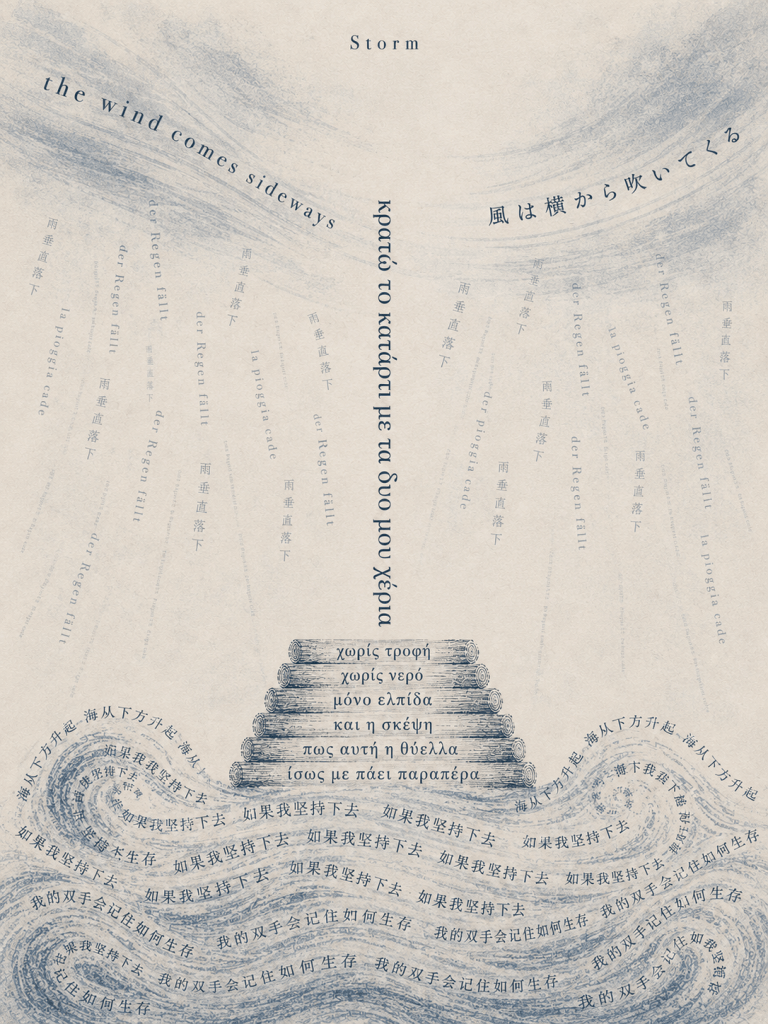
Figure 1: Storm, visual poem development. (Papanikolaou, 2026).
Travel, photography and memory
Photography has been one of the main ways in which I have collected experience. I photographed during periods of living and working in China, the Isle of Man, Scotland and England, but I no longer see these images simply as travel documentation. They often become more important later, when I return to them and they begin to suggest something different from what I originally saw.
Henri Bergson’s distinction between habit memory and recollective memory has been useful here. In Matter and Memory, memory is not treated as a static storehouse but as something active in the present (Bergson, 1991). This connects with my experience of returning to photographs months or years after they were made. The photograph remains materially fixed, but the person looking at it has changed. New experiences alter what the image can activate.
Josef Koudelka’s Exiles helped me think further about photography, displacement and memory. His 1968 Wenceslas Square photograph, showing an outstretched arm and wristwatch against an almost empty city, is historically specific but also carries a wider tension between time, absence and place. I am not equating Koudelka’s political exile with my own movement; what interests me is how a photograph can exceed documentation and become part of an emotional landscape.
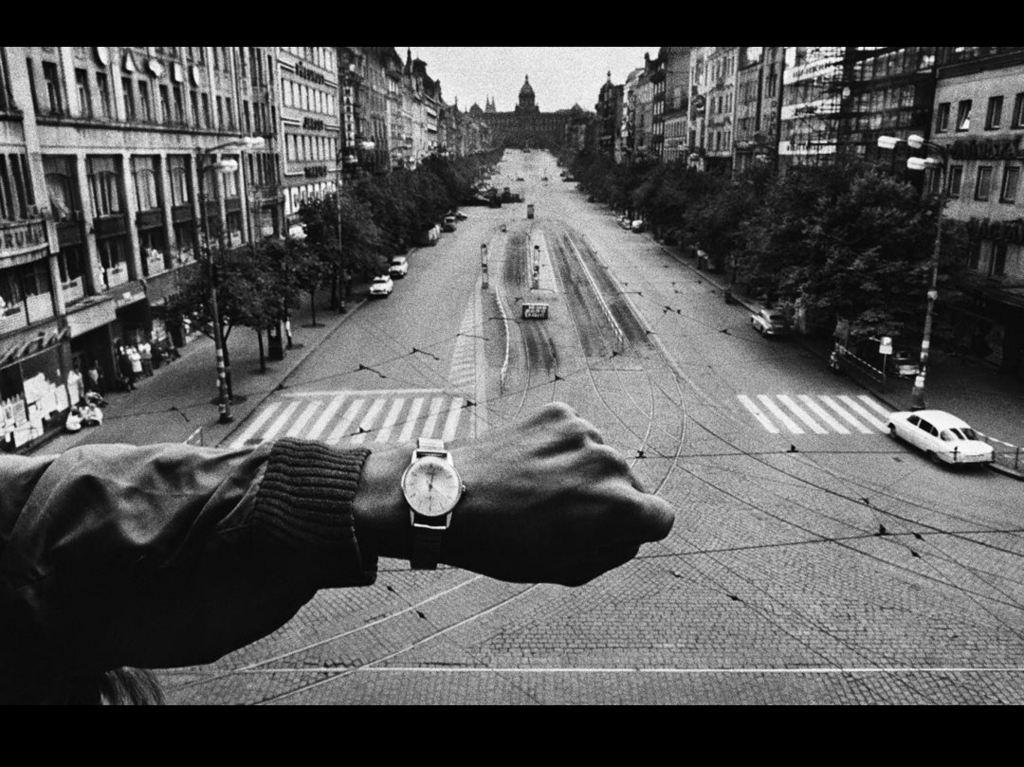
Figure 2: Wenceslas Square, Prague, 22 August 1968. (Koudelka, 1968, reproduced in Koudelka, 1988).
Yi-Fu Tuan’s distinction between space and place has also been useful. Tuan describes place in relation to security and attachment, while space can suggest freedom and possibility (Tuan, 1977). My Holy Island bird image began to connect these ideas. The bird was fixed to a post. I first read the post as support: something that allowed the bird to stand, look outward and survive. But the same support could also be a restriction. Removing the bird and eventually leaving the post empty changed the work. Absence created more space for interpretation because the viewer could no longer rely on the bird itself to explain the image.
Terry Barrett’s approach to interpreting photographs helped me recognise the difference between describing what is visible and deciding what it must mean. Barrett argues for interpretations supported by visual evidence and context while allowing more than one reasonable reading (Barrett, 2021). John Berger’s Ways of Seeing similarly reminds me that seeing is shaped by what we know and believe (Berger, 1972). These ideas have made me more cautious about explaining symbols too quickly.
This became clear when I developed the bird sequence into a storyboard. Captions such as Stillness, Freedom, Leaving Behind and Into the Unknown established rhythm and narrative, but they also narrowed interpretation. The empty post had opened the image; descriptive text began to close it again. Text can extend an image or control it, depending on what space it leaves for the viewer.
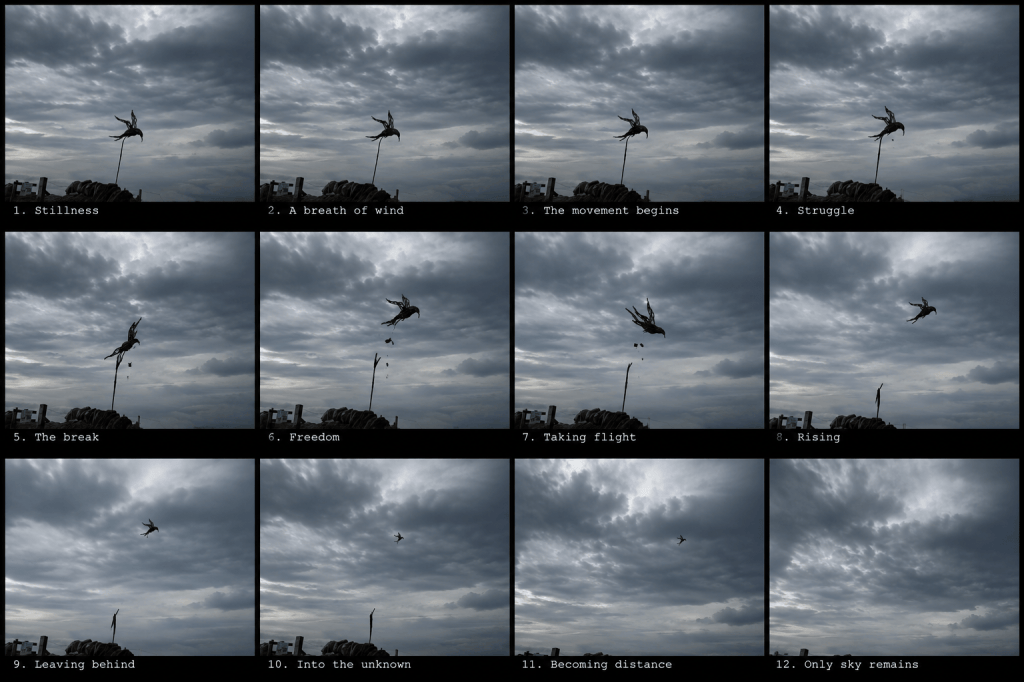
Figure 3: Development of the Holy Island bird image: stillness, movement and absence. (Papanikolaou, 2026).
The relationship between stillness and movement has also affected my films. In my visual poem, photographs from different countries and times are brought together with Greek music, making geography unstable within one sequence. A photograph fixes a fraction of time, while film places that still image into duration. Editing, rhythm and sound make the image move conceptually even when nothing inside it moves. Cresswell’s discussion of mobility is relevant because movement acquires meaning through representation and experience (Cresswell, 2006). This allows me to explore a distinction between physical stasis and perceived movement.
From storytelling towards visual poetry
Storytelling has always been natural to me. The Bird and the Seal is an example of a work in which characters, relationships and a recognisable narrative could be followed. As my practice developed, however, I became increasingly uncomfortable with telling the viewer exactly what happened and what each element represented.
George Herbert’s ‘Easter Wings’ showed me how language can occupy space rather than simply sit inside it. The poem’s visual form contributes to its meaning. This helped me think about words as material: something that can stretch, fall, disappear or shape an image rather than only describe it.
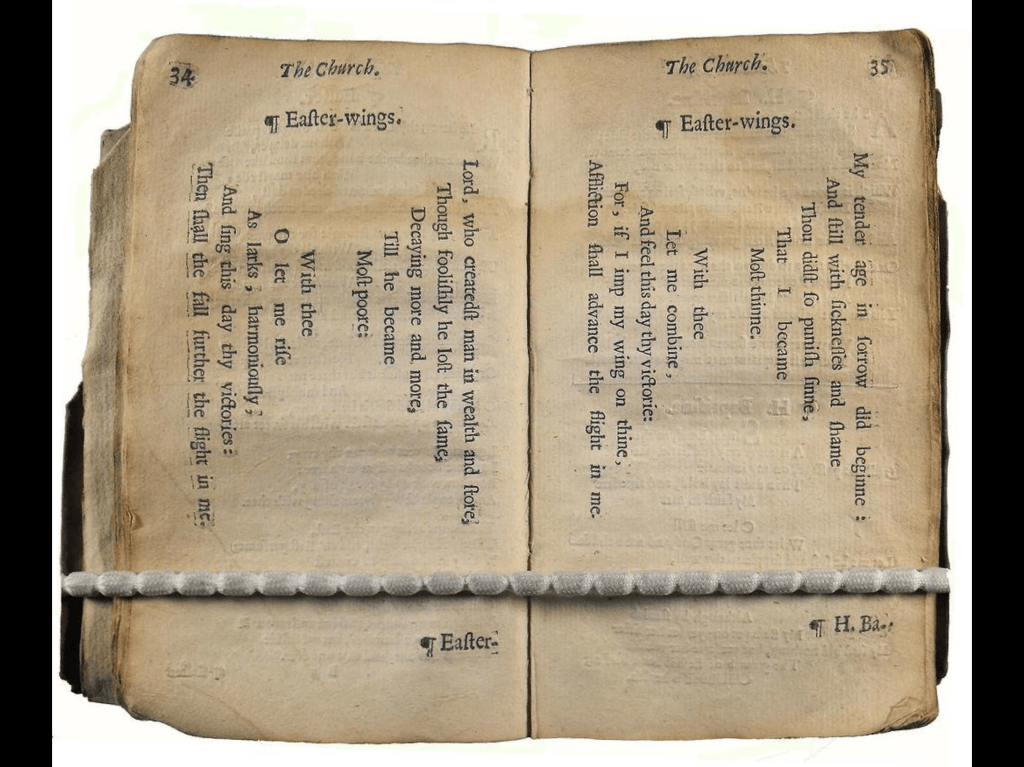
Figure 4: ‘Easter Wings’. (Herbert, 1633).
Cy Twombly’s work offered another way of thinking about the unstable border between writing and drawing. In works such as Poems to the Sea, marks can appear linguistic without always becoming fully readable. Varnedoe’s discussion of Twombly’s practice helped me understand how writing, gesture, erasure and open space can coexist without resolving into conventional illustration (Varnedoe, 1994). This has influenced the development of Storm, where words are beginning to become part of the weather, water and structure of the raft.
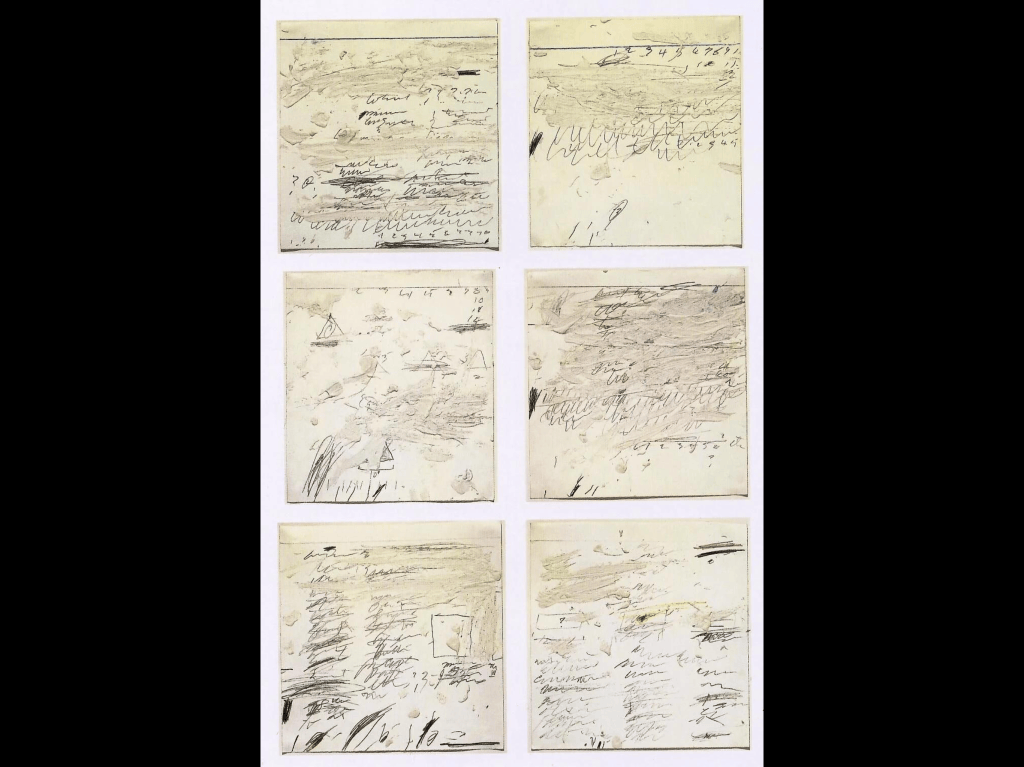
Figure 5: Poems to the Sea. (Twombly, 1959, reproduced in Varnedoe, 1994).
My tutor suggested developing Storm through animation. This would move the work further because words could arrive, disappear, fall, drift or become unreadable. The viewer would no longer simply read about uncertainty; they could experience uncertainty through the act of trying to read.
Film also introduces duration. A static page allows the viewer to decide how long to look, while moving image can remove a word before it has been fully understood. Time therefore becomes another material in the work. The difference between photography and film is not simply that one is still and the other moves; film can control sequence, duration and disappearance, making movement itself part of how meaning is produced.
Research is therefore no longer sitting beside the creative work. Herbert affects how language occupies space; Twombly helps me test writing against mark-making; research into movement makes me think about duration. Theory changes practical decisions.
Language, translation and transformation
Language has become increasingly important because my own experience of movement has always involved different languages. Greek is my first language, English is the language of my daily and academic life, and encounters with Chinese, Italian, German and Japanese have involved different levels of fluency and partial understanding. Communication therefore often includes sound, gesture, visual recognition, assumption and misunderstanding.
Jasmina Bolfek-Radovani’s multilingual poetry has helped me consider how languages can coexist without every element being translated for the audience. In ‘Reveries about Language’, unfamiliar languages remain part of the experience through sound, rhythm and visual or performative presence (Bolfek-Radovani, 2021). This relates closely to what I want to test in Storm.
I am becoming less interested in producing the same sentence six times in different languages. That would demonstrate translation but might not transform the work. Instead, I want languages to perform different visual actions. One language might become wind, another rain, another sea. A word could be partly visible, disappear or overlap another alphabet. The viewer might recognise one language but not another.
This partial recognition is important because it places the viewer in a condition similar to the traveller: not completely lost, but never fully secure. Understanding becomes temporary and uneven. The inability to understand everything is therefore not simply a linguistic obstacle; it communicates something about uncertainty, movement and being between places.
This raises the question of what is lost and what survives. Walter Benjamin’s ‘The Task of the Translator’ helped me think of translation not as a perfect copy but as part of a work’s continuing “afterlife” (Benjamin, 1968). Delphine Grass treats translation as creative-critical practice capable of producing new artistic possibilities rather than merely transferring information (Grass, 2023). In my practice, translation is not only linguistic.
A photograph translated into a poem changes. A memory translated into mythology changes. A still image translated into film changes. Even my experiments with AI made this visible: an idea moves from thought into written prompt and then into an image produced through another system. Each stage retains something and alters something. Translation therefore becomes a model for the whole practice.
This is also where travel and translation begin to connect. Travelling requires constant negotiation between languages, behaviours, expectations and ways of seeing. An experience does not return home unchanged. It is carried through memory and reconstructed later. Movement therefore becomes geographical, cultural, visual and linguistic.
I increasingly see my practice itself as a form of movement. An image becomes a poem, the poem leads to research, research returns me to the image, and the resulting work may move again into film. The process does not always move forward in a straight line. It circles, returns and transforms.
Meaning in motion: towards open interpretation
Umberto Eco’s concept of the open work has helped me understand why I am increasingly reluctant to fix meaning for the audience. Eco argues that some works invite the receiver to participate in completing meaning rather than presenting one closed interpretation (Eco, 1989). This does not mean that anything can mean anything. Barrett’s approach is useful here because interpretation still needs to respond to what is materially present in the work.
This has changed how I judge my own work. Earlier pieces sometimes depended on explanation because I wanted the viewer to understand the story I intended. I now find uncertainty more productive. The bird can remain personal without requiring the viewer to know my biography. Storm can draw on experiences of movement, separation and endurance without becoming a literal account of one journey.
There is still a tension. Text can open a work through association but close it by naming emotion too directly. Animation can create uncertainty through disappearance but also control when the viewer sees something. Openness therefore means providing structure without settling every meaning.
Conclusion: between Ithaca and the unknown
The central development in this unit has been my movement away from journey as a single theme and towards movement, memory and translation as connected processes. Homer gave me the journey and the desire to return. Cavafy shifted attention towards what is gained along the way. Campbell helped me recognise the expectation of structured transformation and return, while Storm has allowed me to question whether transformation always leads to resolution.
Bergson helped me understand memory as active and changing. Koudelka showed me how photography can carry displacement beyond documentation. Herbert, Twombly and Bolfek-Radovani helped me see language as visual, sonic and material. Barrett, Berger and Eco challenged my desire to control interpretation. Cresswell, Benjamin and Grass have helped me understand movement and translation as processes that generate meaning rather than simply transport it.
The practical consequence is that my media are no longer separate. Photography becomes memory; memory becomes story; story can become mythology; language becomes image; image becomes moving film. What connects them is translation and transformation.
Storm is therefore not simply another work about a journey. It has become a testing ground for the questions that have emerged through the unit. What happens when words become weather? What happens when several languages occupy the same visual space? What happens when the viewer cannot read everything before it disappears? What survives when a poem becomes an image and an image becomes film?
I do not yet have a final answer to these questions, and I no longer think I need one. My practice is becoming less concerned with arriving at a fixed destination and more interested in what happens during movement between places, languages, memories and forms.
I began with Ithaca as a destination. I finish this stage somewhere between Ithaca and the unknown, with one question still open: what happens after the Storm?
References
Barrett, T. (2021) Criticizing Photographs: An Introduction to Understanding Images. 6th edn. Abingdon: Routledge.
Benjamin, W. (1968) ‘The Task of the Translator’, trans. H. Zohn, in Arendt, H. (ed.) Illuminations. New York: Harcourt, Brace & World, pp. 69–82. Originally published 1923.
Berger, J. (1972) Ways of Seeing. London: British Broadcasting Corporation and Penguin Books.
Bergson, H. (1991) Matter and Memory. Translated by N.M. Paul and W.S. Palmer. New York: Zone Books. Originally published 1896.
Bolfek-Radovani, J. (2021) ‘“Reveries about language”: challenges and opportunities of performing multilingual poetry’, Languages Future online conference, 15 April 2021.
Campbell, J. (1949) The Hero with a Thousand Faces. New York: Pantheon Books.
Cavafy, C.P. (1975) Collected Poems. Translated by E. Keeley and P. Sherrard. Edited by G. Savidis. Princeton, NJ: Princeton University Press.
Cresswell, T. (2006) On the Move: Mobility in the Modern Western World. London: Routledge.
Eco, U. (1989) The Open Work. Translated by A. Cancogni. Cambridge, MA: Harvard University Press.
Grass, D. (2023) Translation as Creative-Critical Practice. Cambridge: Cambridge University Press.
Herbert, G. (1633) ‘Easter Wings’, in The Temple: Sacred Poems and Private Ejaculations. Cambridge: Thomas Buck and Roger Daniel.
Homer (1996) The Odyssey. Translated by R. Fagles. New York: Viking.
Koudelka, J. (1988) Exiles. New York: Aperture Foundation.
Tuan, Y-F. (1977) Space and Place: The Perspective of Experience. Minneapolis: University of Minnesota Press.
Varnedoe, K. (1994) Cy Twombly: A Retrospective. New York: The Museum of Modern Art.
—————————————————————————————————————-
Reflective Evaluation — Creative Arts 3.1: Practice and Research
At the beginning of Creative Arts 3.1, I understood my practice largely through personal experience: journeys, migration, memory and the places in which I had lived or worked. Photography, moving image, poetry and visual experimentation were already important to me, but I often approached them as separate ways of recording experience. Over this unit, my question has shifted. I am less concerned with documenting where I have been than with exploring what happens when an experience is remembered, translated or transformed into an artwork.
Movement has become more than a geographical subject. Working across Greece, the United Kingdom and China has made me conscious that a journey changes not only one’s surroundings but also one’s understanding of belonging. Research into mobility, photography, mythology and translation has challenged the assumption that an image can simply preserve a place or moment. Research has been most valuable when it has questioned a creative decision rather than merely supported an idea I already held.
The bird imagery developed through my travels is one example. Initially, the bird operated as a personal symbol of movement and displacement, almost an alter ego. Working with photographs made on Holy Island, particularly an image of an empty post, pushed me towards a less literal approach. I began to recognise that absence could communicate as strongly as a visible subject. Adding words could direct viewers towards my intended meaning, but could also close down other interpretations. This exposed a recurring weakness: my tendency to explain an image before allowing it to speak. I need to test whether ambiguity creates meaningful space for viewers or merely makes my intentions difficult to understand.
Photography and moving image have taught me different lessons. A photograph can hold a moment open for examination, while film introduces duration, sequence and sound. In moving-image experiments bringing together material from different places with Greek music, geographical continuity becomes unstable. Editing can suggest how memory combines places experienced at different times. I still need greater control over rhythm and transitions, ensuring that formal choices carry meaning rather than relying on the emotional force of the soundtrack.
My project Storm has brought several strands of my practice together. An unnamed traveller on a handmade raft moves through an immense sea, without any guarantee of rescue or arrival. Its central concerns are uncertainty, endurance and the fragile persistence of hope. Experimenting with multilingual text, including typographic arrangements that form the raft and surrounding weather, has made language part of the visual structure rather than simply a caption. Translation becomes a process of alteration: some meaning survives, while other associations are lost or newly created. Exploring AI-assisted visual possibilities has also made me think more carefully about authorship, selection and the distinction between an experiment and a resolved work.
My greatest development has been learning to move between making and critical reflection. Earlier, I sometimes began with a personal story and looked for a visual form to express it. Now I am more willing to let a material, an image or an unexpected juxtaposition change the original idea. This has not always produced stronger work immediately. Some experiments remain unresolved, and the relationship between poetic ambiguity and clear communication continues to challenge me. However, I am better able to identify why a piece is not working and what further experimentation might achieve. Comparing this with my original project plan, I see a shift from gathering experiences towards questioning how an artwork transforms them.
Writing my Critical Review has forced me to distinguish lived experience from critical argument, and to consider how research is evidenced through specific artistic decisions. Tutor feedback highlighted where my claims about translation, movement and the differences between media needed greater precision. This has been uncomfortable but productive: an evocative concept is not, by itself, a convincing explanation of practice.
Looking ahead, I want to develop Storm further, particularly the relationship between text, image and movement, while presenting a more selective body of work. I want viewers to encounter the work without being given every answer in advance. Before assessment, I also need to refine references and image captions, and present a selective website that distinguishes finished work from developmental experiments. These tasks are part of the critical process: choosing what to show changes how the work can be understood. My practice is becoming less about illustrating my own journey and more about creating spaces in which others can recognise experiences of distance, uncertainty, transformation and hope.

