Prologue: Context of the story to follow
The story of The Bird Who Came From Afar began during my time in China. It was written as a way of reflecting on the experience of living and working in a place that felt both distant and fascinating. Rather than describing those experiences directly, I chose to translate them into a fable-like narrative where animals and landscapes carry the emotional and philosophical meaning of the journey.
Using animals as characters follows a long literary tradition, from ancient fables to modern allegory. Through this approach it becomes possible to explore human experiences — migration, encounter, and adaptation — without tying them too closely to a single personal narrative. The travelling bird functions as an alter ego, a symbolic figure that moves across landscapes and encounters other beings who represent different worlds.
The first story, written in China, describes the bird’s meeting with a koi fish in a distant lake. That episode reflected the sense of discovery and cross-cultural encounter that often accompanies life in a new environment.
The present story, written later, continues the bird’s journey in a different landscape. It is set on a remote island shaped by strong winds and open sea. While the earlier story explored encounters between different worlds, this episode focuses more on endurance, adaptation, and the search for direction when circumstances become uncertain.
The metaphor of travel also reflects a broader reality of contemporary life. Many people move across countries and languages in search of opportunity, stability, or simply a different horizon. These movements are not only geographical; they also involve questions of identity, communication, and belonging.
Language plays an important role in this process. Each place shapes the way people speak and understand one another. During my own travels I often noticed how the same language can change from region to region, creating moments where communication requires patience, listening, and sometimes translation. In the earlier story, a local bird could speak both the language of the wind and the language of the water, enabling dialogue between different beings. In the present story, the seal speaks the language of the sea and the land, again acting as a bridge between worlds.
These symbolic encounters form part of a broader narrative thread that runs through the series of stories. Each landscape — the lake, the sea, and eventually the rivers — represents a different stage of experience and reflection.
The story that follows is therefore not simply about a bird and a seal. It is part of an ongoing exploration of travel, encounter, and the ways in which people make sense of unfamiliar environments.
————————————————————————————————————————
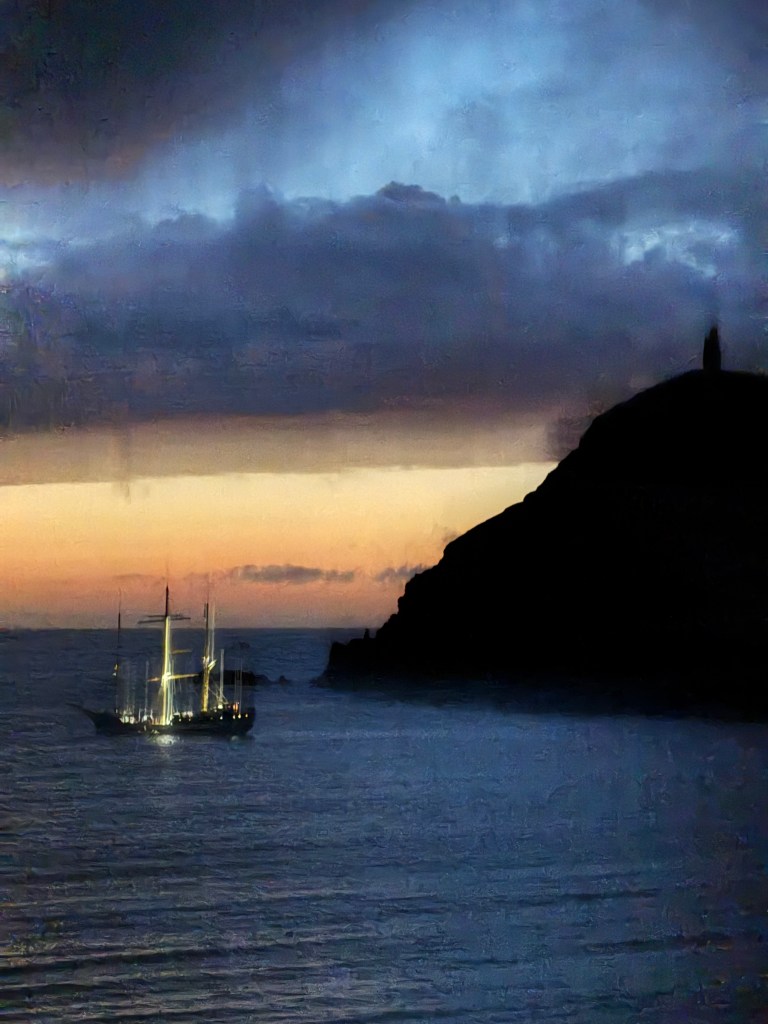
The Bird and the Seal: An Isle of Man Story
After many days of flying across the restless sea, the bird who came from afar saw a dark island rising from the water.
At first the winds were gentle, and the island looked beautiful. The cliffs were green, and the sea lay quietly around the land. As the bird circled above it, a hopeful thought passed through its mind.
Perhaps this could be a place where my family might one day live.
But as the day went on, the winds began to change.
They grew stronger and stronger, pushing against the bird’s wings and turning the air into a restless struggle. The bird tried to fly forward, but each attempt became harder than the last.
Soon the winds were so strong that the bird could no longer continue.
Exhausted, it descended toward a rocky beach where the waves struck the shore with a slow and steady rhythm. There, between two large stones, the bird found shelter from the wind.
The sea was grey and cold.
For a long time the bird sat alone.
The dream of a peaceful island had vanished, and the wind seemed to carry away all hope.
At last the bird lifted its head and cried out into the empty air — a long cry of despair that travelled far across the water.
The sound moved over the waves and into the open sea.
Far away, a seal heard the cry.
Curious and concerned, the seal rose from the depths and swam toward the shore where the lonely voice had come from.
Soon a dark head appeared above the water, and two calm eyes looked toward the rocks.
The seal climbed slowly onto the wet stones, shaking the salt water from its body. It had seen many birds before, but this one seemed different. The bird looked far away, as if its thoughts were still flying somewhere beyond the horizon.
The seal spoke gently.
“Bird,” it said, “the winds on this island are not kind to strangers. I heard your cry across the sea. You must carry a story with you. Would you tell it to me?”
The bird lowered its head.
“I do not think my story would interest anyone,” it replied quietly.
The seal smiled.
“Even the smallest story,” it said, “can reveal something true. Sometimes a story is not told for others, but for the one who carries it.”
The bird remained silent for a moment, and then it spoke.
“Once I travelled far across the world and found a quiet lake. There I met a creature from another world. A local bird there could speak both the language of the wind and the language of the water, and through him we were able to understand each other before I had to leave.”
The seal nodded slowly.
“Languages shape the worlds we live in,” it said. “I know the language of the sea, and the language of the land where you now sit. Between them, I have heard many stories.”
The seal looked out across the grey water before continuing.
“The sea carries many stories. Once I heard of a small fish who lived beside a quiet rock where an anemone grew.
The anemone could not move, but the fish returned to it every day. The fish kept the anemone clean, eating the small parasites that gathered on its fragile arms, and the anemone gave the fish shelter among its soft branches.
For a long time they lived this way — one rooted to the stone, the other moving through the water — each helping the other survive.
But one day danger came through the currents, and the fish had to flee into deeper water.
When the fish finally returned, the anemone had faded. Without the small care of its companion, it had slowly weakened.
The fish circled the silent rock, and its cry travelled through the water. The currents carried that cry far across the sea.
It was a meeting that was never meant to happen — a creature that moved and one that could not — yet their brief life together mattered.”
The seal fell silent.
The bird listened.
For a moment, the memory of another water — calm and distant — passed through its mind like a reflection on a still lake.
And somewhere deep inside the bird, a thought returned quietly:
Everything I saw was only a reflection… but you were true.
But the bird did not speak those words aloud.
After a while the seal asked one last question.
“Bird,” it said softly, “if the winds here are so strong, why do you keep flying?”
The bird looked toward the dark horizon where the sea met the sky.
“Because if I stop flying,” it said quietly, “I fall into the sea.”
The seal gave a gentle laugh.
“And if you fall into the sea,” it said, “perhaps you will learn to swim. Some birds do. The sea teaches those who must survive. Hardship often reveals abilities we did not know we had.”
The bird listened carefully.
“Do not lose hope,” the seal continued. “The winds will calm. Wait for another day.”
The bird looked at the seal with gratitude.
“Thank you for your kindness,” it said. “Your words have helped me remember who I am.”
The seal dipped its head slightly.
“Sometimes,” it said, “all we need is a few kind words and a moment of companionship. You will not use my wings to leave this place. It will be your own wings that carry you across the sea. You only need to gather your strength, open them again, and fly.”
With that, the seal slid quietly back into the water.
For a moment the surface of the sea rippled where it had disappeared.
Then the waves became calm again.
The bird remained on the rocks through the night.
When morning came, the winds had softened.
The bird rose slowly and opened its wings again.
The sea was still restless, but the bird had found its strength.
High above the water it flew once more.
Far across the horizon the bird saw the faint outline of another land waiting in the light.
The bird flew toward it.
When it finally arrived, it discovered a place where rivers flowed through the land, carrying fresh water from the hills toward the sea.
There, beside the quiet sound of moving water, the bird rested its wings.
For the first time since leaving the island, the winds were calm.
And the bird understood that this land was not the end of its journey, but the beginning of another story.
——————————————————————————————————————
Afterword — Reflections Beyond the Island
When this story reaches its end, the bird has crossed another stretch of sea and arrived in a new landscape. The winds that once seemed overwhelming have calmed, and the journey continues in a quieter place where rivers flow steadily toward the sea.
Like many fables, the story does not attempt to offer a single interpretation. Instead, it leaves space for reflection. The encounter between the bird and the seal can be read in many ways: as a moment of companionship between strangers, as a reminder that even a few kind words can restore hope, or as a reflection on the strength people discover when circumstances force them to adapt.
For anyone who has moved between places, cultures, or languages, the experience of navigating unfamiliar environments may feel familiar. New landscapes often bring both uncertainty and opportunity, and each journey asks its own questions about belonging, direction, and resilience.
The bird’s journey across the sea is therefore not only about travel. It is about learning when to persist, when to listen, and when to gather the strength to move forward again.
Perhaps the island was never meant to be a final destination. Perhaps its role was simply to offer a moment of encounter — a pause in the journey where reflection becomes possible.
And like many travellers, the bird eventually discovers that survival in a new environment is not only about reaching another shore, but about finding the courage to open its wings once more.
————————————————————————————————————————-
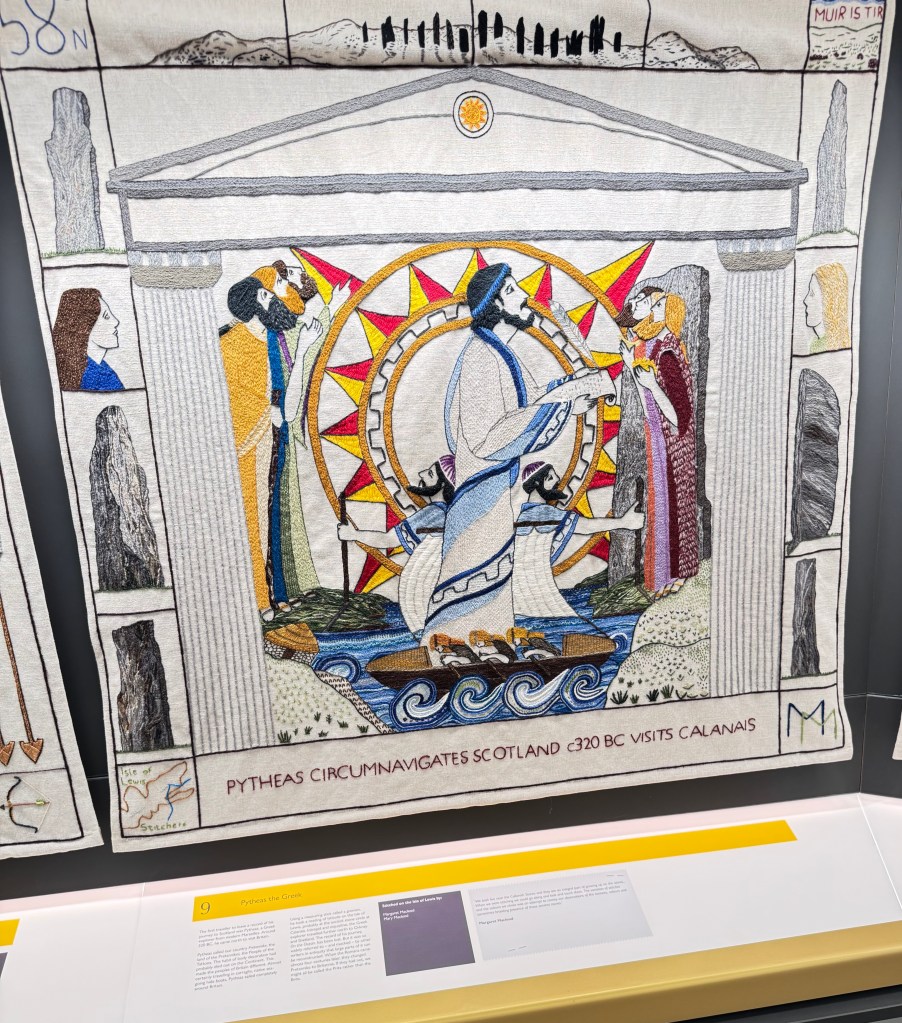
While visiting the Great Tapestry of Scotland in Galashiels, I encountered the story of Pytheas the Greek, an ancient explorer who travelled north from Marseille around 320 BC and recorded one of the earliest accounts of Britain. Seeing this narrative of a Greek traveller reaching the northern seas resonated strongly with my own reflections on migration, exploration and storytelling.
Work in Progress Summary
At this stage of the project I am developing a new narrative episode within my ongoing creative work The Bird Who Came From Afar. The project explores themes of migration, encounter and identity through allegorical storytelling, using the travelling bird as an autobiographical alter ego. The current episode, inspired by my experience in the Isle of Man, continues the earlier narrative chapter that emerged from my time in China.
The creative approach of the project draws on several traditions within Greek literature and philosophy. The narrative structure of travel and encounter echoes the journey framework of Homer, where movement across landscapes becomes a process of discovery and transformation. The use of animals as narrative characters is inspired by the tradition of Aesop, whose fables use animal encounters to explore human behaviour and experience through allegory.
The dialogic exchanges between the bird and other creatures also reflect the philosophical tradition associated with Plato, where understanding often emerges through conversation rather than direct explanation. Through dialogue the protagonist gradually recognises its own situation and direction.
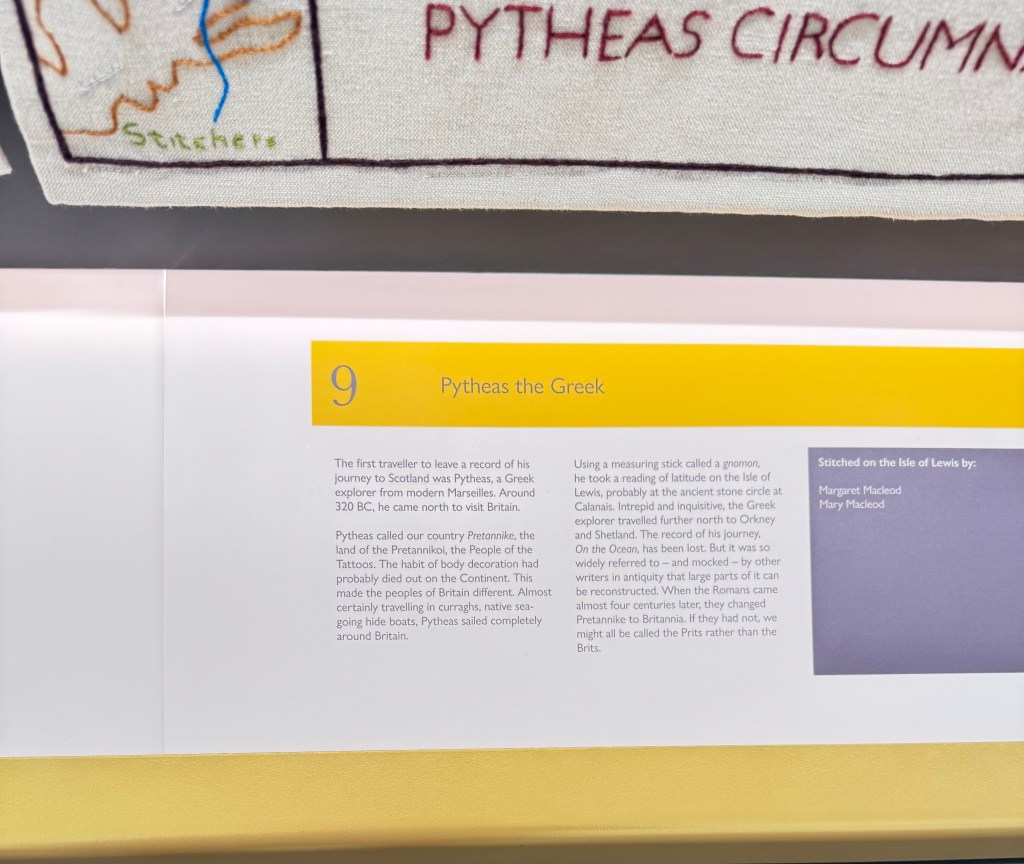
During a visit to the Great Tapestry of Scotland I encountered the story of Pytheas of Massalia, the Greek navigator who sailed north from Massalia (modern Marseille) around 320 BC and recorded one of the earliest written descriptions of the British Isles. His writings referred to the islands as Prettanike or Pritani, a name later adapted by the Romans as Britannia. Discovering that one of the earliest recorded names for Britain came from a Greek traveller resonated strongly with my own reflections on migration and exploration while living in Britain.
The maritime writing of Nikos Kavvadias also forms an important influence. In his prose work Vardia, sailors exchange stories during their night watch aboard a ship named Pytheas, referencing the ancient explorer. The narrative unfolds through conversations between sailors who share memories, experiences and reflections from their travels. This structure of storytelling within dialogue — stories told between travellers — strongly influenced my own narrative approach, where encounters between the bird and other creatures gradually reveal meaning through conversation.
The landscapes within the narrative — lake, sea and rivers — also function symbolically. The lake represents reflection and first encounter, the sea represents trial and transformation, and the rivers suggest renewal and the continuation of the journey.
Alongside the written narrative I am developing a visual component using photographs taken in China and the Isle of Man, and considering how sound and music might accompany the work. This stage therefore focuses on refining the dialogue, selecting visual material and strengthening the connections between personal experience, mythic narrative and historical traditions of travel.
 Alexander's blog