Exercise 1
Look carefully at the following images. Also look up a fourth image, Jacques-Henri
Lartigue’s Cousin Bichonnade in Flight online. Before reading the commentary, make some
notes about how each conveys movement. You don’t have to write anything technical; just note
down what you feel is going on in each image – and how successful it is. Compare what you’ve
written with the commentary below.
If you wish, have a go at taking some moving shots of your own. Ideally, try two or three
different approaches and see which works the best. Include the images in your learning log
together with a brief description of how you tackled them.
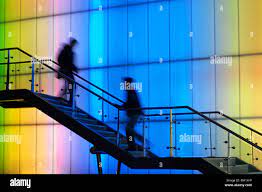
© Derek Trillo, Passing Place, Manchester, 2006
Derek Trillo, Passing Place, Manchester, 2006
- Conveys movement by using a slow shutter speed to capture two figures walking toward one another on a staircase. The resulting blur is effective, particularly because it works well with the silhouetted figures and the background colours—I think I can see some multicoloured fringing- a halo, that gives the impression of speed.
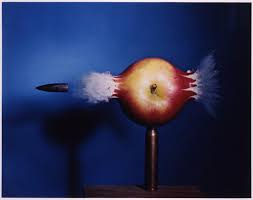
Harold Edgerton, Bullet and Apple, c.1964
- A high-speed flash has been used to freeze a bullet as it exits an apple stuck on a shell casing. This is also effective not because it allows movement to blur, but because it freezes an event that the eye cannot possibly see (the previous image also used a camera to portray an event in a way that the eye cannot naturally perceive). The entry and exit ‘wounds’ to the apple have only just been made and show the bullet’s explosive speed and power.

Harold Edgerton, Multiflash tennis serve, 1949
- Edgerton used a stroboscopic effect to slice up a moment that would have been visible to the eye (a tennis serve). Again, the technical properties of photography are effective in allowing us to ‘see’ an event in a way that would otherwise be impossible: this time a single, fluid movement portrayed as a series of discrete steps.
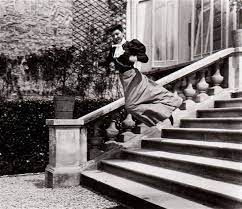
Jacques-Henri Lartigue, Ma cousine Bichonnade, 1905
- Lartigue’s picture of his cousin is also effective in showing movement through a relatively short exposure, although it gives the impression that the subject is floating in the air. In that sense, though, it is no more unnatural than any of the other images—each one of them portrays movement in a way that is foreign to us, but that tells us something interesting about movement and the passage of time.
 Alexander's blog