Fern Hill (1945) is a poem by Dylan Thomas, first published in the October, 1945, Horizon magazine, with its first book publication as the last poem in Deaths and Entrances. [source: Wikipedia, accessed 16 July 2022]
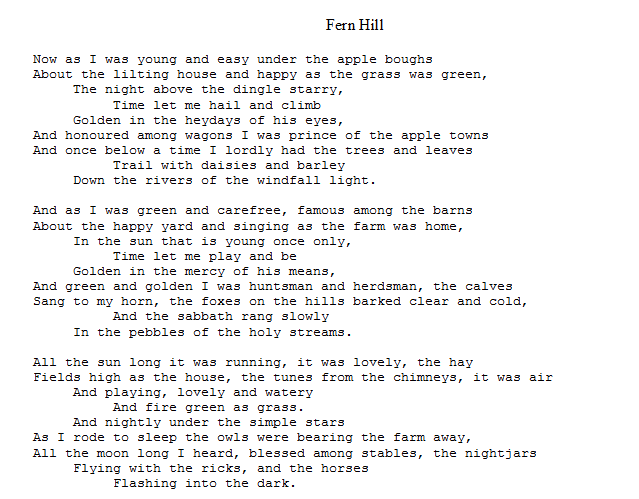

NOTES-FIRST THOUGHTS
Whimsy of childhood celebration. Long lost childhood.
Apples. Adam -Eve(maiden) paradise expulsion.
Praising and then lamenting the days speaker spent at Fern Hill as a youth.
Stoked about running through the country side.
Throughout the poem he talks how happy he was as a youngster and how oblivious he was that youth was passing.
In the end the tone shifts dramatically from joy to sorrow and grief.
What was carefree bliss for the speaker turns to be a fleeing joy that he ever can’t recapture.
Poem written at The End of a Thousand Years era (1950-1990) where rural life becomes urban.
1 MOOD OF THE POEM. FEELINGS READING IT.
It is a very nostalgic poem, a swirl of pictures, sounds and feelings inspired by the poet’s life as a kid in Fern Hill where there was no time, no rush but a place to live and a explore, feel free and careless being oblivious about the passing youth. A childhood celebration.
Even though English is not my first language and my background is different to the poet’s, I can understand his joy of describing little moments of his life in Fern Hill as they been recalled from his memory and the shift of emotion in the end when he realizes that these years will never come back again.
Reading it made me go back to my childhood back in Greece. My old innocent friends, the freedom,the sea, the careless years. My young parents, my late mother… Years that are shadows of the past, distant memories of a different era. Years that shaped us and made us who we are.
2 POETIC DEVISES
-RHYME
The rhyme of the poem is very subtle . I couldn’t even notice it even though I could see there was a rhyme flowing through. During an online research, I spotted a study about that particular poem. The rhyme pattern is abcddabcd ; That was a Eureka moment for me as it was the key to unlock the ‘rhyme riddle’.
examples
aa
–Now as I was young and easy under the apple boughs
–And honoured among wagons I was prince of the apple towns
bb
–About the lilting house and happy as the grass was green,
–And once below a time I lordly had the trees and leaves
–And as I was green and carefree, famous among the barns
–And green and golden I was huntsman and herdsman, the calves
cc
–The night above the dingle starry,
–Trail with daisies and barley
ddd
–Time let me hail and climb
–Golden in the heydays of his eyes,
–Down the rivers of the windfall light.
–RHYTHM
Technically, “Fern Hill” is not written in a traditional form. But it’s not exactly free verse, either. Each stanza has 9 lines and sticks to a strict syllabic count:
- Line 1 has 14 syllables.
- Line 2 has 14 syllables.
- Line 3 has 9 syllables.
- Line 4 has 6 syllables.
- Line 5 has 9 syllables.
- Line 6 has 14 syllables.
- Line 7 has 14 syllables.
- Line 8 has 7 syllables.
- Line 9 has 9 syllables.
These numbers would be arbitrary, except that Thomas sticks to them for each stanza of the poem. So each stanza has the exact same number of lines with the exact same number of syllables in each line. We call that open verse, which is meant to suggest that this poem has a form all its own. Sure, it’s no sonnet, but free verse it ain’t either.
–REPETITION EXAMPLES
The is repetition of the word ‘time’ as well as the conjunction ‘and’ to show how long were all the summer days back in the Fern Hill , word green and golden that go with the apples which they symbolize in my opinion youth, but also if we think deeper, apple was the forbidden fruit: the fruit that exiled Adam and Eve from paradise;
It can be resembled as the childhood’s long lost paradise of Dylan Thomas.
–ALLITERATION EXAMPLES
grass was green, wanderer white, tuneful turning,mercy of his means, house high hay, farm forever fled from.
–ASSONANCE EXAMPLES
I read the poem aloud to myself, and all I heard was long E’s in words like easy, lilting, happy, green, starry, me, carefree, be, mercy and means, and that’s just the first two stanzas.
–CONSONANCE EXAMPLES
prince of the apple,huntsman and herdsman, the calves , lordly had the trees and leaves,tuneful turning, farm forever fled from
–ONOMATOPOEIA
–lilting(house)? (colourful singing house?)
-the whinnying green stable (the echo of the stable?)
–PERSONIFICATION
Thomas uses personification when he introduces time, who grants the child permission to enjoy his days fully, to “climb golden” under his gaze. The use of golden adds the connotation of being charmed, like having a halo, untouched by the ordinary worries of life.
–SIMILE EXAMPLES
like a wanderer white/ with the dew”: This simile invokes an image of purity, which white often represents, and the innocence and promise of a new morning (“dew”).
“in my chains like the sea”: This mournful simile is far more abstract. The moon controls the tides; perhaps the speaker feels equally controlled and confined in the adult world.
–METAPHOR EXAMPLES
–the lilting house , gay house, the heart was long,
–IMAGERY
Thomas repeatedly refers to the sun and moon. Imagery of the sun, including “the sun long it was running” and “the sun born over and over” conveys the idea of endless summer day, contributing to the theme of youth untouched by time. References to the moon are in opposition to this idea. “All the moon long I heard …” and “the moon that is always rising” conjure images of night and the sense that darkness — as in the final darkness or end of time — is always present even in an idyllic world.
3 WHAT IS THE POEM SAYING ABOUT TIME AND PLACE
The poem is describing a Peter Pan’s land, a land of summer and bliss, were time is not an issue, a land of freedom, were children are wandering free to explore, to play games without any worries or concerns, dream and live their dreams.
4 WHAT IMAGES STAY WITH ME. HOW THEY MAKE ME FEEL AND WHAT DO THEY REMIND ME OF.
Dylan Thomas has done an astonishing job depicting an era using time (childhood) and space(Fern Hill). The image of the sun and the moon reminds me of summer days as a child back in Greece, playing carefree by the sea, diving from a pier and living the day again and again like Dylan Thomas did.
5 WHAT IS THE RHYTHM LIKE? IS IT CHOPPY OR IS IT FLOWING AND SMOOTH? HOW DOES THE RHYTHM IMPACT ON THE POEM?
The poem has a subtle rhythm, graceful and unhurried. The rhythmic pattern truly matches with the context of the poem were the poet creates an innocent (lamp white days) environment . The mood changes in the last lines : He comes back to reality realizing those days will not come back again.
6 IS THE ‘SPEAKER’ IMPORTANT? WHAT ARE HIS VIEWS? ARE THEY APPARENT OR INFERRED?
The sense of Time is personified in the poem, moving from a passive to active figure as the poem follows the progress of the child into adulthood. The poet is a participant of facts, speaks about incidents he took part of and the feelings he still cannot forget from his interaction with an idyllic landscape.
In the first four stanzas there is a sense of him overlooking the events from a distance, having a glimpse of the whimsical and innocent child who sees himself as a ‘prince’ and ‘lordly’ in his environment. The ‘Time who let me hail and climb’ at the start evolves into a figure whom the children follow ‘out of grace’ in stanza five and in stanza six time takes and holds the narrator. This is not to suggest that Time itself changes its nature, but rather the narrator’s perception and acknowledgement of the passage of time changes as childhood fades.
7 ARE THERE ANY LINES YOU DON’T GET? CAN YOU HAZARD A GUESS AS TO WHAT THEY MEAN OR ALLUDE TO?
It is a poem of many layers. It is really hard to say I get it or I don’t as the more I reed it the more the associations and the more the connections.
It is a praise and a lament about childhood in the first few layers but also there are biblical references about a paradise lost with the apple being the temptation fruit.
 Alexander's blog