Collage combines pre-existing images to create new meanings, by cutting out,
overlaying or juxtaposing different images together. Artists and designers such
as John Heartfield, Peter Kennard, Hannah Höch, and Martha Rosler have long used collage as a
form of social commentary, placing recognizable images in new contexts, placing recognizable
images in contrast to others, to generate new meanings, or to reveal critique or satirize
existing images and the ideas represented in those images in some way.
• Research the artists mentioned above or find other forms of collage to explore and then,
using a current news item as a starting point, re-contextualize an image to say something
new about the story it represents. Your communication might aim to reveal some hidden
truth, present a contradiction, or represent the story from a different viewpoint. Do this
exercise as a proposed collage (i.e. describing what you’d do) or as a form of hands-on
research by actually making the collage.
• In your learning log, reflect on the results. How have you constructed meaning within
your collage? What can you take from the work of other artists working in collage in terms
of how to construct effective collages and create meaning through juxtaposition and
contrast?
- John Heartfield
- http://www.johnheartfield.com/John-Heartfield-Exhibition/
- Born in Berlin in 1891 as Helmut Herzfeld but anglicized his name during WWI in response to anti-British sentiment in Germany.
- Politically active, a proponent of Dada, and an originator of photomontage as a means of artistic and political expression. Also built theatre sets for Bertolt Brecht.
- Fled Berlin for Prague in 1933 to avoid arrest by the SS after sustained criticism of the Nazi movement. Fled Czechoslovakia in 1938 when the country was invaded by Germany.
- Lived during WWII in Britain and returned to Berlin in 1950 where he was viewed with suspicion by the East German government. Died 1968.

Clearly, a passion for political activism, was influenced by his past and that of his family.
- Peter Kennard
- http://www.peterkennard.com/
- Born in London 1949 and based there. Artist and academic at the Royal College of Art.
- Politically active in left-leaning causes turned to photomontage as a means of expression. Produced work in support of the Committee for Nuclear Disarmament.
- Uses more modern photomontage tools (Photoshop) than were available to Heartfield (scissors and glue). As a result, some of his pieces are mistaken for “real” images, and the potential for the image to affect the perception of a mass audience can be heightened. A more deliberate effort to affect not only public discourse but perceptions: “We were trying to portray Iraq as it happened and not wait until afterward and make a history painting” [The Guardian].
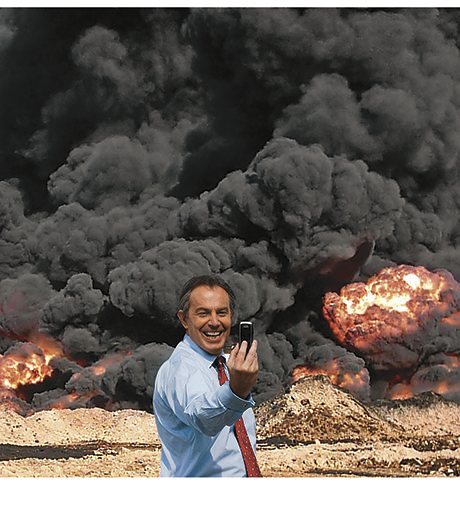
I couldn’t help but admire his audacious and daring collage reflection of his activity.
- Hannah Hoch
- http://www.theartstory.org/artist-hoch-hannah.htm
- Born 1889 Gotha, Germany. Died 1978 Berlin.
- Became friends with Raoul Hausmann, a fellow-participant in the Berlin Dada group and with him became a pioneer of photomontage.
- A strong advocate for contemporary women artists, she seems to have been undervalued by many of her male colleagues in the artistic community. Her photomontages often criticized the fashion and beauty industries, as well as the ideal of the Weimar New Woman, and frequently challenged gender roles by fusing images of male and female bodies.
- Her work appears to be just as political as Heartfield’s, although small “p” political rather than partisan. Her technique is also rougher, in that the components of her images are often torn from papers or magazines rather than being neatly cut with scissors. Her images are very abstract and distinct from Heartfield’s—often bizarre—”realism”.
- Höch’s works were seen as “degenerate” during the Nazi period and seldom shown. Although she was freer to exhibit after the war it seems that she never achieved the same degree of attention.
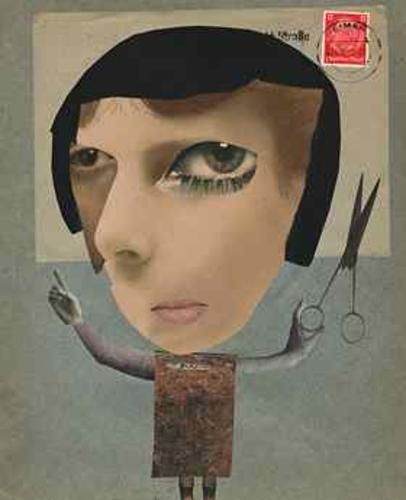
Activist against the Weimar government.
<<Höch’s work was intended to dismantle the fable and dichotomy that existed in the concept of the “New Woman“: an energetic, professional, and androgynous woman, who is ready to take her place as man’s equal. Her interest in the topic was in how the dichotomy was structured, as well as in who structures social roles.
Other key themes in Höch’s works were androgyny, political discourse, and shifting gender roles. These themes all interacted to create a feminist discourse surrounding Höch’s works, which encouraged the liberation and agency of women during the Weimar Republic (1919–1933) and continuing through to today.>>
source: Wikipedia.
- Martha Rosler
- http://www.martharosler.net/
- Born Brooklyn, 1943.
- Works in video, photo-text, installation, and performance, as well as writing about art and culture. Rosler’s work is centered on everyday life and the public sphere, often with an eye to women’s experience. Recurrent concerns are the media and war, as well as architecture and the built environment, from housing and homelessness to systems of transport. [Wikipedia].
- Influential artist, lecturer, professor and writer.
- “My art is a communicative act,” Martha Rosler says, “a form of an utterance, a way to open a conversation.” [www.artsy.net]
- Her work is reminiscent of Kennard’s and the two share an interest in protesting warfare. Whether it is coincidence or whether Kennard’s 2005 image was influenced by Rosler’s piece from the year before, each has produced a photomontage named “Photo Op” (above and below) depicting an individual taking a cellphone selfie, oblivious to the scene of fiery destruction behind them. Kennard indicts Tony Blair for the UK’s role in Iraq, while Rosler broadens the critique to include a non-politician too caught up in her comfortable surroundings to notice the bodies behind her and the armoured tank outside in the garden.
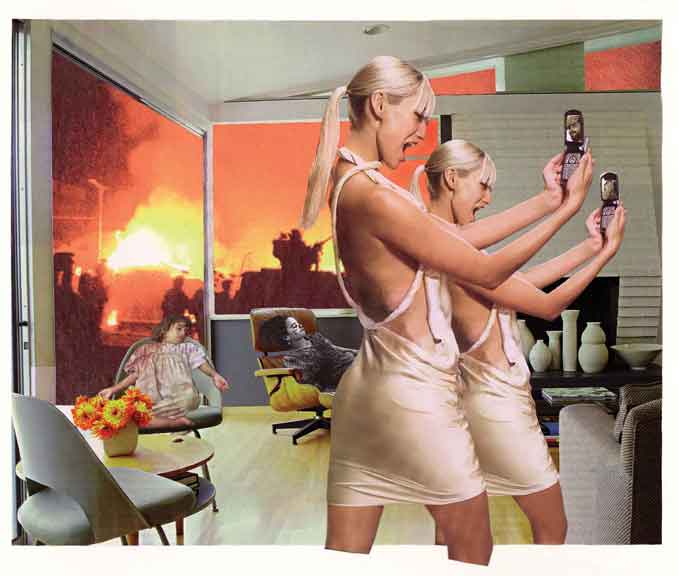
Once again, a provocative expression of vanity, violence, and war.
<<Rosler’s work is centered on everyday life and the public sphere, often with an eye to women’s experience.[4] Recurrent concerns are the media and war, as well as architecture and the built environment, from housing and homelessness to places of passage and systems of transport>>.
source: Wikipedia.
A re-contextualized image of my own:
If someone browses the web, reads a newspaper, or even watches the news, today, one of the first headlines would be the war in Ukraine.
Bellow, there is a map of the country, stating the situation.
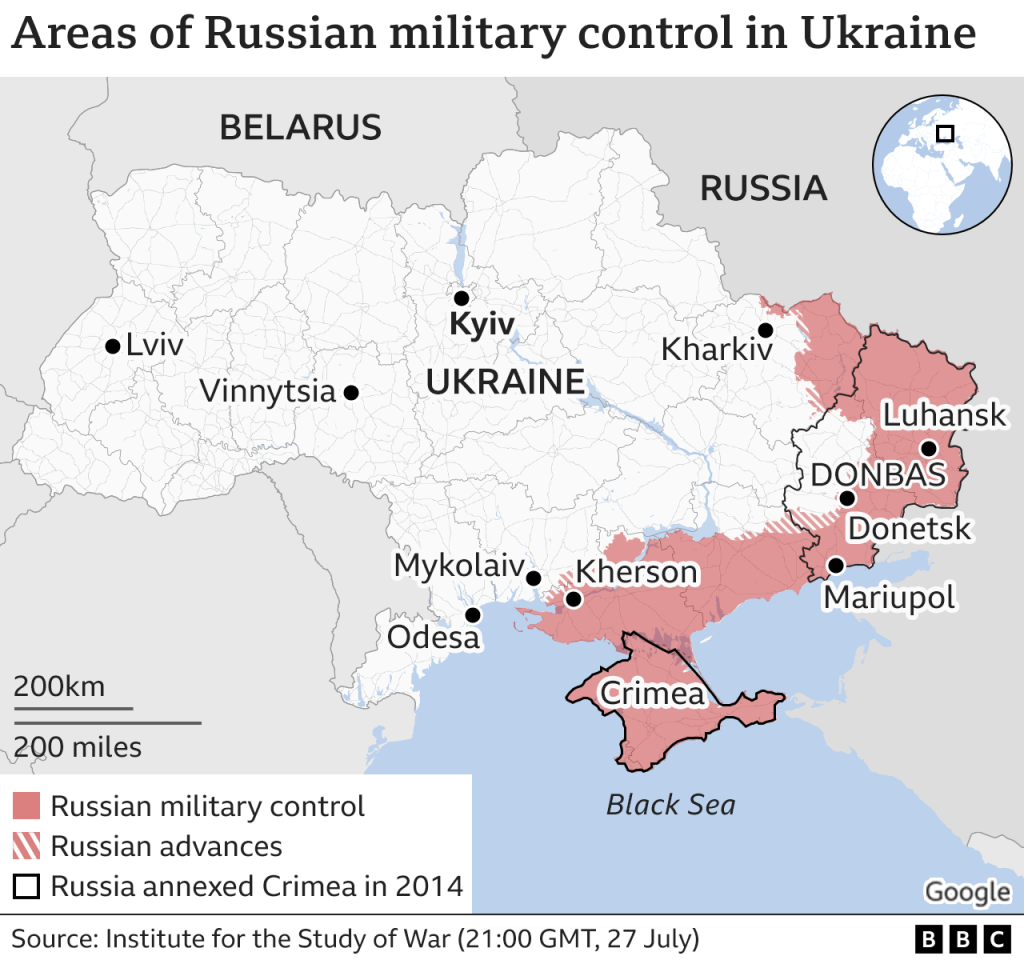
Source: BBC(18:00 GMT, 6 August 2022)
I used the original map as inspiration and considered the themes of war, inhumanity, and death as they pertain to this one.
In response to my distress, I thought my best action would be to change the map and create something positive out of it.
I had peace signs from all over the world printed and placed on the map. I reasoned, that covering up death and terror with comforting symbols would make me, the viewer, feel better. It would offer optimism and a positive outlook about life.
I have worked quickly, guided by my emotion.
When my urge to change the map was satisfied, I stopped.

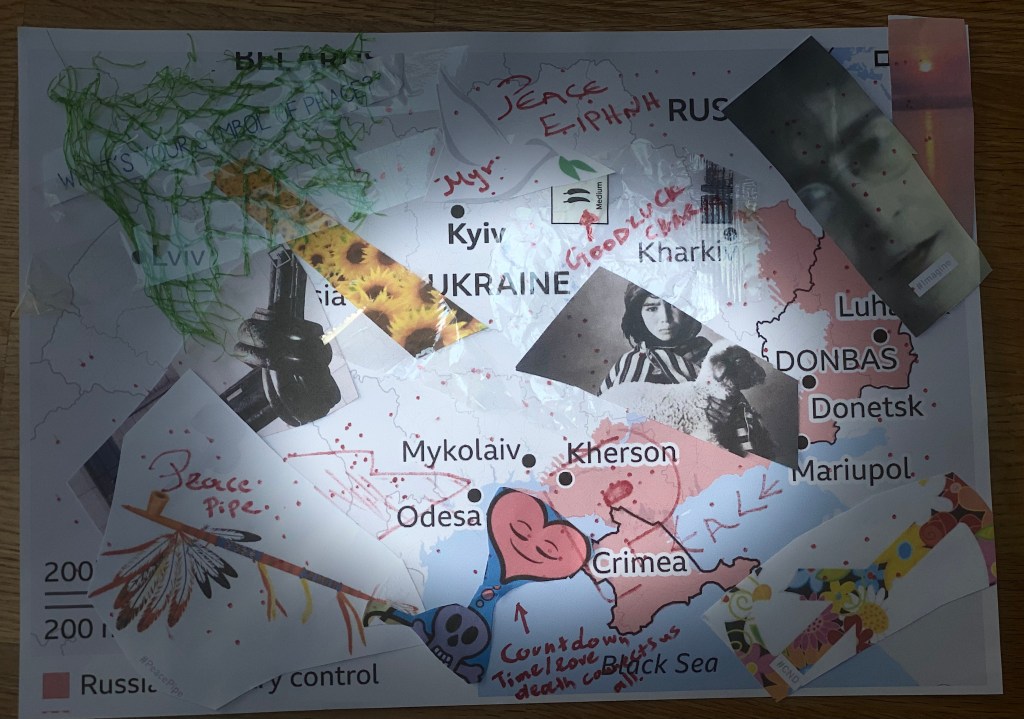
I’m very happy with the result.
All we need is peace.
Collage is a very powerful tool someone can use. It gives you so much flexibility and choice to work on, that the possibilities are endless. There is an unlimited option of materials as well as techniques someone can use which makes it a great medium for someone (like me) who is not very capable of drawing. So no artistic skills are needed! It is relatively fast to make. Above all it is therapeutic and it can help you express yourself using a great spectrum of media.
 Alexander's blog