Research point
Do some research into Slow Design.
• What are the guiding principles of this movement?
• Do you believe this approach to design and making could have a positive impact on our consumption of products?
• Would you place more value on a product that has been created with this principle in
mind? Why or why not?
Make some notes in your learning log
Slow design trend – the new movement that focuses on the creative process behind your furniture
Experts are in love with slow design – a trend that celebrates furniture long before it enters your home
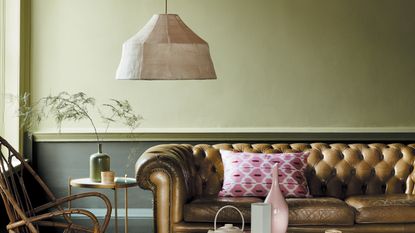
(Image credit: Little Greene)
BY MEGAN SLACK
PUBLISHED JANUARY 27, 2022
While it may seem that aspect of life is getting faster, things are quite the opposite in the design industry.
The most sustainable interior design trend of 2022 (so far) has revealed itself in the form of ‘slow design.’ However, in this case, it may seem unfair to label the movement as a ‘trend’.
Instead, it celebrates time: the lengthy amount of time it takes to create artisan furnishings – and the long time they will spend in our homes. So, while slow design is trending, these pieces are far from fleeting.
Artisan designers worldwide are already embracing the movement – while its aesthetic is making waves on social media. But what does slow design involve? And how can you show support? Here, those at the peak of the artisan world share their interior design tips to get you started.
WHAT IS SLOW DESIGN?
Slow design is a celebration of taking your time. It is the interiors equivalent to the anti-fast fashion movement that is taking a stance against mass-produced garments – only these pieces stretch beyond your closet. The movement recognizes the creative process behind a piece – and not only how the finished product looks in your home.
‘Slow design is a counter-response to the ever fast-paced lives we all lead,’ explains London-based designer Emma Stevenson.
‘Time has become the highest value commodity these days and is everything from self-care to sustainable living. Timelessness is attempting a comeback, and we couldn’t be happier.’
As timelessness attempts its comeback, the designer suggests investing in pieces that ‘resonate’ with you (and will not fall to pieces).
‘Championing longevity and quality over speed and quantity, slow design is created to last, adapt, and ultimately change,’ adds interior designer Manea Kella. But how do you know when something is slow-designed? These decorating ideas will help you out.
WHAT QUALIFIES AS SLOW-DESIGNED FURNITURE?
According to Manea Kella, slow-designed pieces are a ‘conscientious choice in itself’. They stand ‘for cultural awareness’ and ‘value craft in all its forms.’ Therefore, the movement involves multi functional and long-lasting pieces that will have a place in your home for the future.
For example, fine artist and rug designer Deirdre Dyson is a pioneer in slow design. Lady Deirdre(opens in new tab) explains that while designers always have to meet deadlines, some furnishings act simultaneously as artworks. These designs take the longest.
Before Deirdre’s pieces make it to your home, they have gone through a slow process that values artisan design.
‘For each carpet design, I do a detailed and accurate colored drawing… which is digitized precisely by our Design Technician to create an accurate map for our weavers. This takes a while, as it involves matching colors perfectly and serious attention to detail,’ Deirdre explains.
After the design process is complete, it takes her Nepalese craftspeople three months to hand-knot a rug. However, the result is ‘a piece of art of quality and durability that can last a lifetime.’ And that is exactly what slow design is all about.
This movement isn’t going to go anywhere fast, so prepare to enjoy this slow trend for seasons to come.
6 Slow Design Principles
- Reveal
- Expand
- Reflect
- Engage
- Participate
- Evolve
1. Reveal
‘Slow design reveals experiences in everyday life that are often missed or forgotten, including the materials and processes that can be easily overlooked in an artifact’s existence or creation.’THE SLOW DESIGN PRINCIPLES, CAROLYN F. STRAUSS AND ALASTAIR FUAD-LUKE
Reveal focuses on engaging with where products come from and encourages exploring undervalued materials. Reveal may help us find ‘unexpected aesthetic pleasures’, re-position the unfamiliar and help create awareness.
2. Expand
‘Slow design considers the real and potential “expressions” of artifacts and environments beyond their perceived functionalities, physical attributes and lifespans.’THE SLOW DESIGN PRINCIPLES, CAROLYN F. STRAUSS AND ALASTAIR FUAD-LUKE
Expand considers how we can explore other potential meanings and uses of different objects and environments.
3. Reflect
‘Slow Design artifacts/environments/experiences induce contemplation and…reflective consumption.’THE SLOW DESIGN PRINCIPLES, CAROLYN F. STRAUSS AND ALASTAIR FUAD-LUKE
Strauss and Fuad-Luke explain, ‘Product designers are questioning not only ecological values, but also perceptual and emotional experiences that the unique materiality of products can deliver.’ This means a heightened connection to everyday objects that goes beyond convenience or function. The Japanese wabi-sabi philosophy may be a useful reference here – everyday items are celebrated as they age and take on imperfections that reflect their own journey and relationship with their owner.
Strauss and Fuad-Luke’s Slow Design manifesto explains that slow designers seek to “satisfy real needs rather than transient fashionable or market-driven needs”.
4. Engage
‘Slow Design processes are open-source and collaborative, relying on sharing, cooperation and transparency of information so that designs may continue to evolve into the future.’THE SLOW DESIGN PRINCIPLES, CAROLYN F. STRAUSS AND ALASTAIR FUAD-LUKE
The fourth principle, engage, encourages producers to collaborate on designs, so design concepts are free flowing within industry.
5. Participate
‘Slow Design encourages users to become active participants in the design process, embracing ideas of conviviality and exchange to foster social accountability and enhance communities.’THE SLOW DESIGN PRINCIPLES, CAROLYN F. STRAUSS AND ALASTAIR FUAD-LUKE
Participate encourages designers to incorporate local knowledge into their designs and to create with the user and community in mind.
6. Evolve
‘Slow Design recognizes that richer experiences can emerge from the dynamic maturation of artifacts, environments and systems over time. Looking beyond the needs and circumstances of the present day, slow designs are (behavioural) change agents.’
5 Reasons to Slow Down Your Design Process
August 18, 2020 / By Brandon Reed
Even in our ever-accelerating, fast-paced world, you shouldn’t rush some things.
Design is one of those things.
The prevailing sentiment is that slowing down will cost the developer more money. But rushing the design stage can cost far more than extending your design time up front.
Unfortunately many designers have a habit of rushing through design – at the disadvantage of themselves and their clients. It’s so easy to do. In fact, for many of us it can be automatic. You need real discipline to take your time and reach the best design outcomes.
When you next find yourself rushing through design, remember these benefits of slow architecture and slowing down the design process.
1) Slowing Down Reduces Mistakes
Quality control takes time. And it’s generally not that exciting. That is why it can be difficult to make time for redlines and double checking. Most designers would rather be doing something else.
But, making time for quality control is a major part of slowing down the design process. It has many benefits. Quality control creates the opportunity to fix errors. It improves coordination with other consultants, firm standards, and client expectations. Considering how important the final result is to your clients, designers should commit to dedicating time for quality control. It is critical to project success that we slow down and check our work. By focusing on quality control you will make fewer mistakes during bidding and construction, saving time and money down the line.
Because some clients don’t understand the importance of quality control and internal reviews, designers should take the lead. We ought to make it standard procedure that is never compromised.
2) Slowing Down Produces the Best Ideas
It takes time to arrive at the right idea. We all want to produce something that we are proud of. That is why we need to devote time to let our ideas marinate.
The design process is an iterative process. Each cycle informs the next version of the idea, moving toward a better solution. If we cut this process short, we limit the efficacy of our ideas and put a cap on the value our clients will gain from our design. More cycles means better ideas. Better ideas lead to better results. It is important to project success that we slow down and let the ideas flow. After all, it’s the ideas that are at the core of what we do.
Clients have a range of design experience so it’s on designers to set the right expectations.
3) Slowing Down Keeps Budgets in Line
Keeping cost down is a constant battle. Nobody wants to throw their money away. That is why it’s urgent to keep the design within the budget.
Clients and designers both tend to get excited as things move through the design process. Together, they add a new feature here, or an expensive finish there. Then once the project goes to bidding, they discover the design is way out of line with the budget. Frequently, the budget was out of line to begin with. Clients often have budget expectations that don’t agree with their design aspirations. As we slow down the design process, we have the chance to check our design against the budget at key intervals. A running rough order of magnitude cost estimate can aid in the design process. It informs design decisions and helps align the design to the budget before it’s too far down the road.
Many clients resist discussing cost during the early stages of design. Smart designers understand the risks linked to ignoring budgets. We should insist on slowing down and starting the cost conversation early.
4) Slowing Down is an Investment
A typical workflow for a project looks a lot like the graph below. Time and effort expended heighten to a peak during the mad rush to produce construction documents. Then, much time and effort is required during the bidding phase as edits, revisions, and value engineering take place.
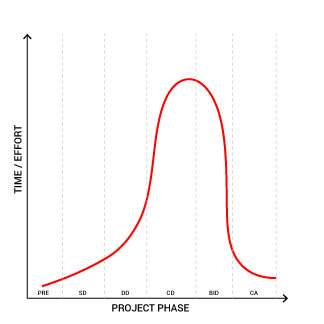
This happens because the earlier phases of a project get glossed over or rushed. Decision making is delayed until it is absolutely necessary for construction to take place. Consider instead what can occur when the schedule allows for design to flourish during the SD and DD phases of a project. A team spends a majority of their efforts and time in design instead of production. They spend so much time in exploration – becoming familiar with the project – that producing drawings is much less time consuming.
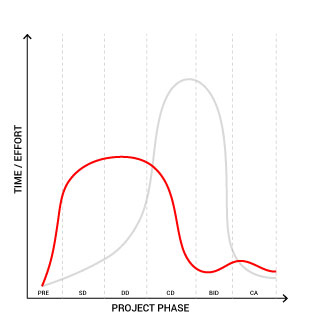
Traditionally, an architecture fee structure emphasizes the production stages of a project. But the greatest value to a client is in the design ideas. Those are what drive the whole project and determine the results. It is a disservice to your clients to spend more effort creating plans than originating creative designs and solutions. Our industry has over invested in production and under invested in creativity and problem solving. This is why so much design struggles to be inspiring and neglects to make a meaningful contribution to our built environment and culture.
It’s simpler to sell physical or digital plans and deliverables then expert knowledge and creativity. But to do so runs the risk of commoditizing design. Many clients struggle to know exactly what they are paying for when reviewing design fees. As designers it’s up to us to explain why slower design is valuable and a smarter investment.
5) Slowing Down Reduces Stress and Produces Confidence
It’s never a good feeling to be pressed up against a deadline and not know if you are going to make it or not. While some thrive under the last-minute thrill of racing toward a deadline, most of us could do without that added stress.
Even for those who claim they enjoy it, the cycle of procrastination and scrambling to finish work in time leads to burnout. It’s high time many of us ditch the unhealthy habits we picked up in school. Let’s end the tradition of late nights in the office. If we slow down design and set reasonable schedules we can relieve a lot of unneeded stress.
It’s been well established that creativity thrives when you take a break. This concept should play well into the design process as we come up with new iterations over time. We don’t get the benefit of fresh ideas and a new perspective if we never leave our desk.
As creatives, we should be helpful guides for our clients, not victims of unrealistic project timelines. If we trust our creative ability enough, we should slow down design. Let the results speak for themselves.
 Alexander's blog