Exercise 1 (P.176)
Think back to your work on visual communications and their various contexts
(Part Three). What function is Straub’s textile serving here other than providing
something hard-wearing to sit on?
Research point
Find out about Christian Boltanski’s 2010 installation Personnes, at the Grand Palais,
Paris. Start by analysing it using the terms set out at the start of Project 3.
Monumenta is series of monumental exhibitions at the Grand Palais, one of the great historic buildings of Paris created for the 1900 World Fair in the heart of the French capital. After Anselm Kiefer (in 2007) and Richard Serra (in 2008), French artist Christian Boltanski was invited by the Ministry of Culture and Communication to create an exceptional new work for the 13,500 square meter exhibition space. The work Boltanski has created for Monumenta is titled “Personnes”, on view at the Grand Palais until February 21, 2010.
In this conversation with Christophe Ecoffet, Christian Boltanski talks about the concept of the exhibition: what he wanted to achieve with this work, the title of the exhibition, the challenge of producing a work for the Grand Palais, the sound of heartbeats the visitors hear while walking through the exhibition.
Christian Boltanski, born in France in 1944, is one of the most internationally acclaimed artists of our time. In 2006 he was awarded the Praemium Imperiale. His artistic work revolves around the themes memory, death and loss. For Monumenta, Christian Boltanski created a work in sound and vision titled “Personnes” – meaning both “people” and “nobodies”. Personnes is a “social, religious and humanistic exploration of life, memory and the irreductible individuality of each and every human existence – together with the presence of death, the dehumanisation of the body, chance and destiny. Conceived as a work in sound and vision, Personnes takes up a new theme in Boltanski’s work, building on his earlier explorations of the limits of human existence and the vital dimension of memory : the question of fate, and the ineluctability of death. Personnes transforms the entire Nave of the Grand Palais through the creation of a coherent, intensely moving installation conceived as a gigantic animated tableau. Personnes is a one-off, ephemeral work. In accordance with the artist’s wishes, the components of the piece will all be recycled at the end of the exhibition.” (Excerpt from the press release).
Read what critics had to say about this work, for example Laura Cumming in the Guardian:
https://www.theguardian.com/artanddesign/2010/jan/17/christian-boltanski-personnnesparis-review [accessed 08/12/18]
Great art deserves a pilgrimage. We should travel to see it. Literalists might argue that this can hardly be avoided. But the long winter’s journey to Paris is not just a necessity if you want to see Christian Boltanski‘s momentous new show: it is peculiarly apt. For when you get there, the journey continues.
An icy breeze shivers through the colossal emptiness of the Grand Palais, desolate, bare, its exit signs creaking. The structure rises high above the void, a gigantic birdcage of iron curlicues and struts in which pigeons clatter in hope of a perch. Stretching out before you is nothing but an array of floor-level encampments, each marked out by four rusting poles with a neon tube slung between them. The last light is away in the distance.
Sixty-nine camps, but there are no tents and no living people, only thousands of old clothes lying face down on the floor. Is this where they fell or where they were laid? The irresistible metaphor springs literal in the visitor’s mind, as if clothes could have bodies or faces.
You walk, you look, you search for evidence among the mildewed raincoats and threadbare denim. Here is a corduroy jacket, almost new, and a faded gabardine; there is a baby’s knitted cardigan. They were young, they were old, they were not ready to die, poor departed souls who leave nothing behind but shucked garments. Mown down, laid out in groups, they have all met a terrible end. This is apparent without a single bloodstain or name; Boltanski’s evidence is both more and less than proof.
And as you walk, the sense is of honouring the dead, of trying to observe the details of each and every one. These grouped clothes may represent mass graves, or corpses arrayed for identification in the school gym, but they also constitute a kind of cemetery. For the experience is just the same: that there is nobody here and yet the place is crowded. Personnes, the piece is called: people, but at the same time no one.
The title is as characteristic of Christian Boltanski’s art as the work itself, being perfectly judged and distilled. I cannot think of a single piece by this poet-artist that is not equally affecting and concise. It is no surprise that he has long been considered France’s greatest living artist but, at 65, Boltanski has surpassed himself. The third in the Monumenta series – comparable with the Unilever Series in the Turbine Hall at Tate Modern – is his most profound installation yet.
Boltanski has always been a maker of monuments and memorials. His medium is the human trace and the memento mori. In the 1970s, he used to exhibit the “documents” of his own life, letters, scraps, locks of hair, photographs of himself as a child (which were probably nothing of the sort). Later, he began to commemorate the lives of others.
The Dead Swiss, the Children of Dijon: these world-famous shrines were assembled from photographs cut from obituaries, heaps of secondhand clothes, biscuit tins that might, or might not, contain personal effects; false memories, so to speak, especially since the dead were always anonymous. But these objects and images, no matter their provenance, were inevitably powerful for the sympathetic mind can hardly help but reconstruct a life from the smallest and most trivial of relics.
Pawned brooches, lost umbrellas, dogeared telephone books with their intensely intimate yet resolutely impersonal listings: your mind would rush in, imagining all these other people in other places. It did not matter that the evidence was meagre, partial, perhaps entirely specious, because the objects themselves were real, had once belonged to real livings beings.
That their owners were unknown equated very precisely with the universality of the evidence – a watch, a coat – and the poignant truth that one could only mourn the unknown through an act of the imagination.
This was an art that spoke so clearly and simply that a child could understand it and so it is, to some extent, with Personnes. The austerity of the scene is overwhelming, compounded by the booming heartbeats that seem to emit from nowhere and yet all around – time being measured out by human life.
But what makes this work – this experience – different is that it does not depend upon reality in quite the same way. You do not imagine these clothes to be those of murdered people so much as humanity en masse, flattened like biblical crops. And the metaphor climaxes in a towering mound of clothes, above which a five-fingered claw hangs from a crane, occasionally moving towards the pile, hoisting a random garment and then, just as arbitrarily, letting it drop.
You were in a necropolis, now you are in purgatory: balanced between heaven and hell, witnessing the hand of God. Except, of course, that you are in a freezing, cacophonous place surrounded by secondhand clothes and probably eager to be gone. That is the exceptional achievement of the piece. All its elements are frankly simple and apparent, you see how they combine, how it all works. Yet none of this stifles its resonant truths, that in the midst of life we are in death, that man’s inhumanity to man continues beyond Auschwitz, Srebrenica, Rwanda.
Boltanski keeps you there, looking and thinking, walking through the work instead of standing before it like a picture. And then he asks you to record your own heartbeat in a supremely pointless but utopian project. All the world’s heartbeats stretching out until the last syllable of recorded time: that should stand against oblivion. Or so it seems, listening to their rhythms filling the Grand Palais – a sound fearful to some, joyful to others, heralding one’s release back to life from this premonitory vision. The choice, as in life, is all yours.

His installation, created for MONUMENTA 2010, was conceived as a powerful physical and psychological experience, an episode of spectacular emotion and sensations exploring the nature and meaning of human existence. Embracing the whole of the immense Nave of the Grand Palais, Boltanski creates a rich, intense commemorative space, in sound and vision. “Personnes” (literally both “people” and “nobodies”) is the evocative title of this social, religious and humanistic exploration of life, memory and the irreductible individuality of each and every human existence – together with the presence of death, the dehumanisation of the body, chance and destiny.
Conceived as a work in sound and vision, “Personnes” takes up a new theme in Boltanski’s work, building on his earlier explorations of the limits of human existence and the vital dimension of memory : the question of fate, and the ineluctability of death. “Personnes” transforms the entire Nave of the Grand Palais through the creation of a coherent, intensely moving installation conceived as a gigantic animated tableau. Personnes is a one-off,
• You’ll see that, in addition to the garments, the noise of heartbeats permeates the
exhibition. Why do you think this might be?
Christian Boltanski, in his exhibition had created a dystopian environment, where all the senses were engaged. The heartbeat penetrating the Grand Palais signifies, in my opinion, something special: it is the first sound that the embryo hears when is still in the womb, heartbeat keeps us alive and when it stops, means the end of our lives. It is the heartbeat that accompanies our life journey and therefore it is a matter of life and death to us. In cinema, I have noticed that directors use the sound of heartbeat to accomplish a scene with more tension drama and agony. So, I think Boltanski is using this sound as a reminder of what keeps us alive as well as a director of his own work to make the audience feel and understand what he is trying to say through his work.
• To what extent are the textiles transformed into something other than fabric?
Textiles are the the extension of our bodies. They dress us up, they protect us, they keep us warm, they even have a human body shape for better comfort. So a shirt, a jumper, a pair of trousers, can me perceived as a human body.
• What’s the significance of the installation title – and of the mechanical grabber?
Having in mind that the clothes used resemble human bodies, we can see how insignificant a person looks in the pile and how a human’s personality can be crushed under the power of the flock, the pack. The mechanical grabber, <<THE HAND OF GOD>> is a brilliant installation of a mechanic hand which randomly grabs,lifts and releases garments off the pile, can be fate, who is not choosing who to deal with but is picking certain pieces without any obvious order. It is really interesting to see how the pieces of fabric are flying in the air when released only to end up in a different part of the pile (like fate which is pushing you off the top only to land onto a different cast, a different social class).
• What associations does this work conjure up in your mind?
This work reminds me of the Nazi concentration camps and the piles of people’s belongings when they were stripped down to were their ”striped pajamas”. Every garment on the pile had its own (sad) story to say.
Personnes makes an association between textiles and the people who wear them. The use of
textiles to cover/adorn the body is the focus of your next project.
Research point (P.176)
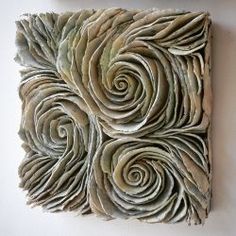
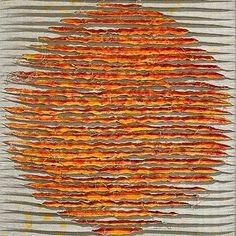
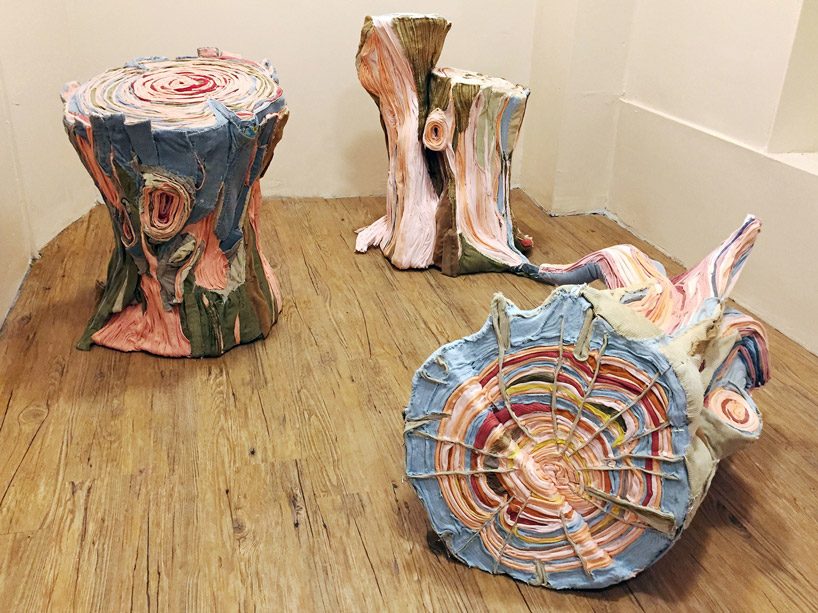
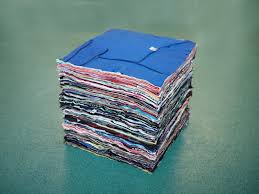
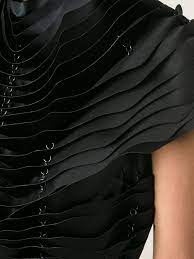
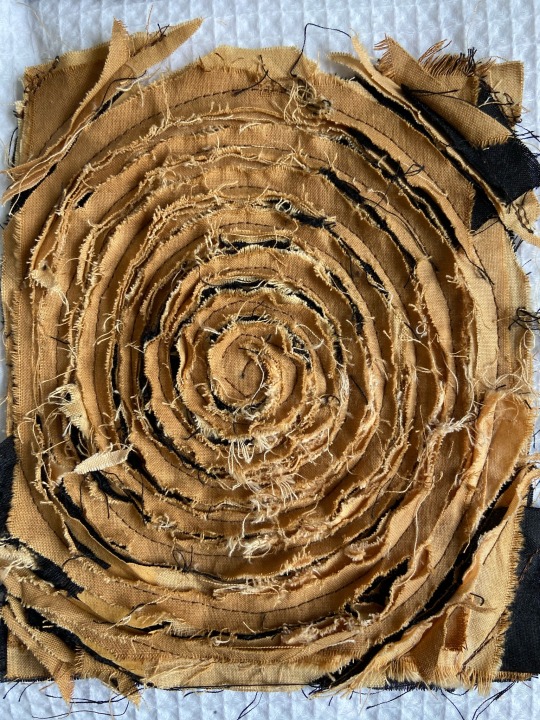
Explore the layering qualities of textiles and how they cover, hide, envelop, disguise
and transform an object, person and space. Consider the notion of ‘Architectural Palimpsest’,
where layers have been erased and added over time.
Palimpsest
“A manuscript or piece of writing material on which later writing has been superimposed on effaced earlier writing.” (1)
“Something reused or altered but still bearing visible traces of its earlier form.” (1)
“Architects imply palimpsest as a ghost – an image of what once was. In the built environment, this occurs more than we might think. Whenever spaces are shuffled, rebuilt, or remodeled, shadows remain. Tarred roof lines remain on the sides of a building long after the neighboring structure has been demolished; removed stairs leave a mark where the painted wall surface stopped. Dust lines remain from a relocated appliance. Ancient ruins speak volumes of their former wholeness. Palimpsests can inform us, archaeologically, of the realities of the built past.
Refer to ‘Room Three: Fantastic’ Pages 68-70.
Make some observations and give examples of noticeable textile layering.


 Alexander's blog