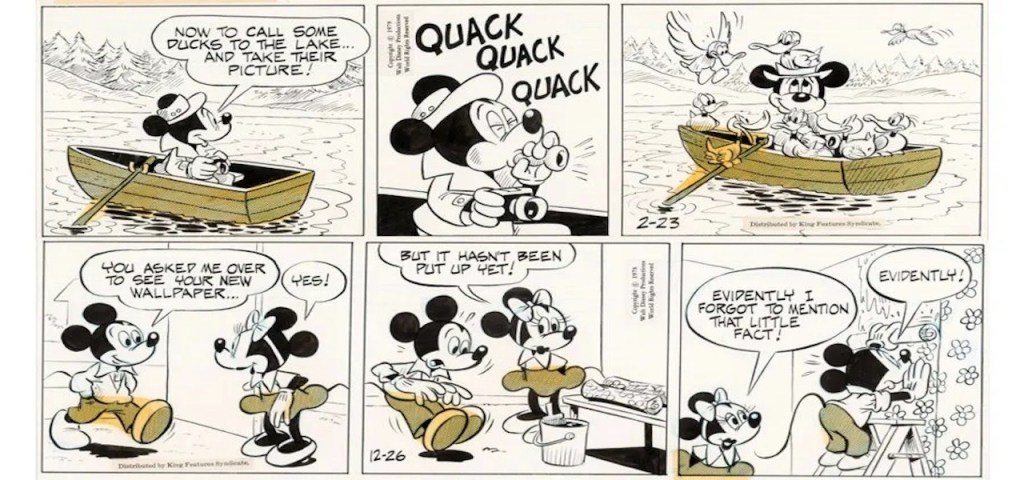
Find examples of different visual conventions used to convey time and/or place/ space – frame-by-frame storytelling, handling of perspective, use of speech bubbles, etc. – from different historical periods. Use this exercise to develop your research skills by accessing the online image libraries available to you at OCA, conducting internet image searches, or accessing your local library. Think carefully about the key terms you’ll use to describe what you’re looking for. You’ll find sequential images in cartoons, graphic novels or murals, to give just a few examples, and you’ll see them described as frame-by-frame, cartoon strips, visual stories, etc. Any of these terms would give you some results. Reflect on what you’ve found, identify areas you hadn’t considered and refine your search terms. For example, you might have found a particular cartoonist or identified sequential images in Egyptian hieroglyphs, both of which can now become new search terms. Reflect on your research in your learning log. What has it told you about the evolution of visual conventions and how time or place has been visually represented? Also reflect on the process of researching. What approach(es) did you find useful?
I have found a lot of interesting material online. Given the volume of the content as well as the time scale, I have tried to put it in chronological order.
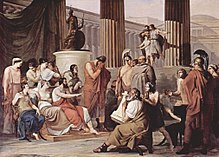
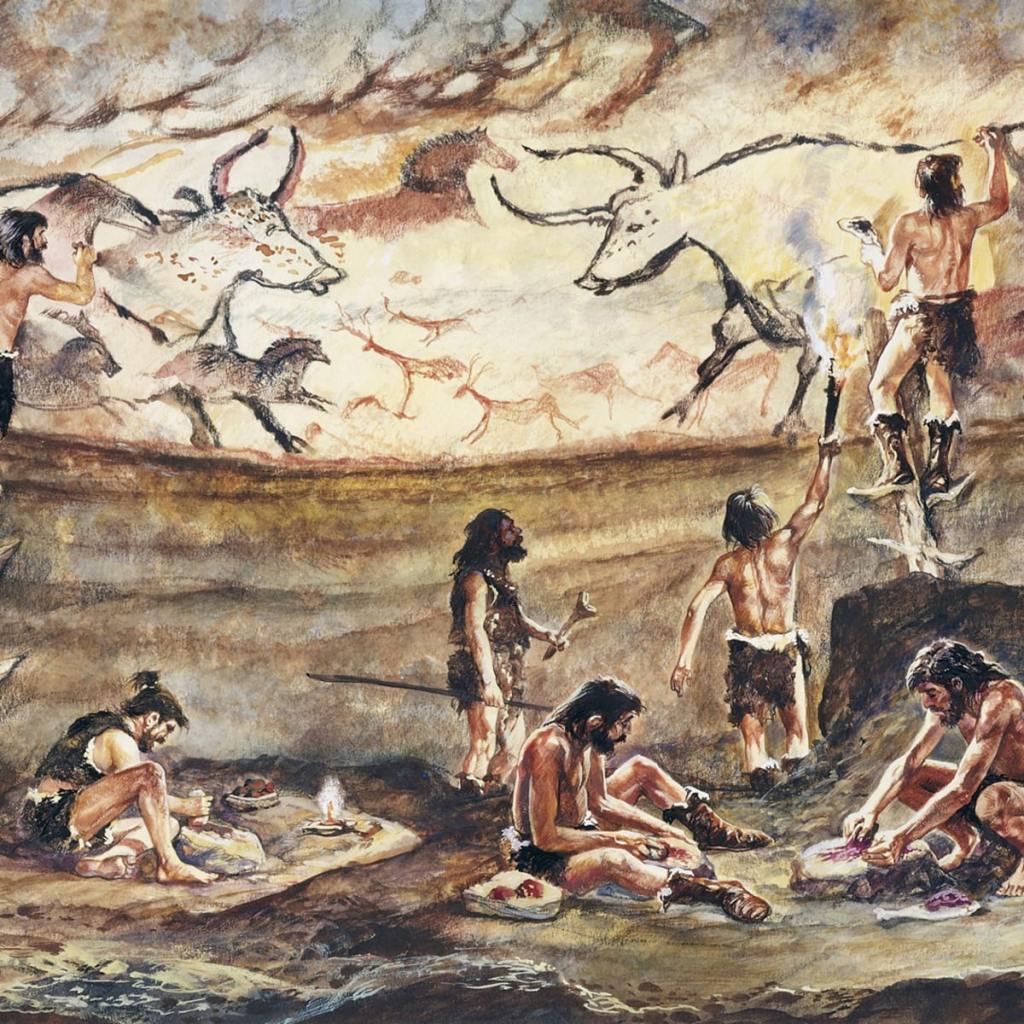
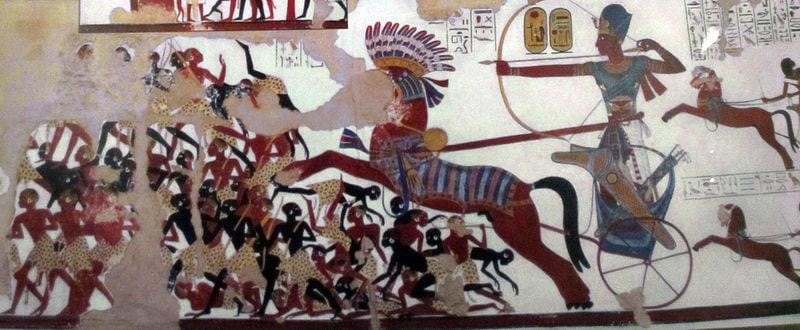
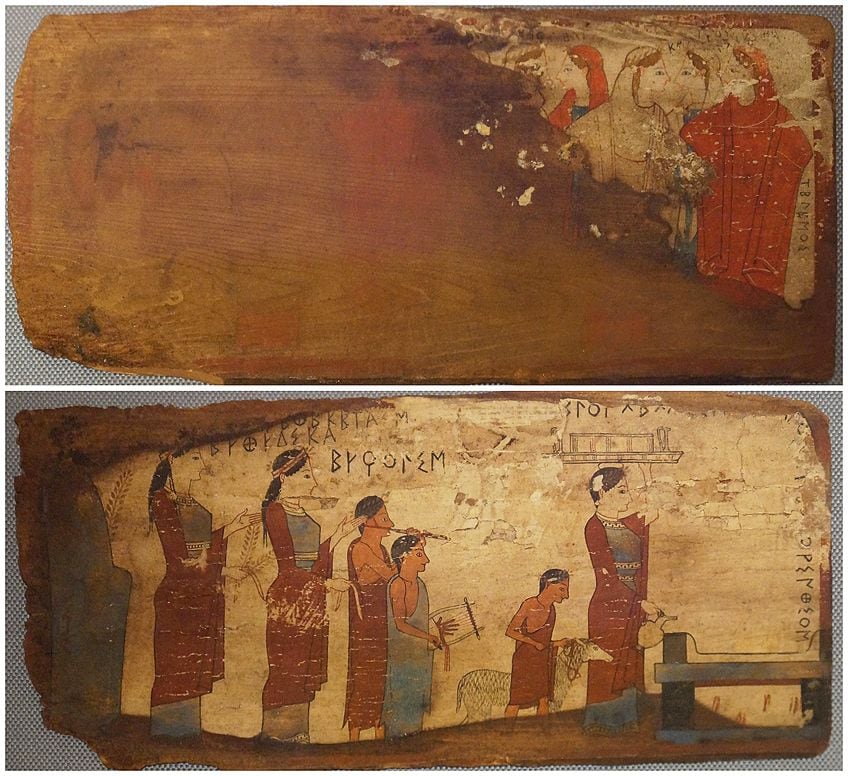
One of the earliest frame stories is in the Odyssey, which begins with Odysseus telling stories to King Alcinous on the island of Scheria.[2] Painting of Odysseus at the Court of Alcinous by Francesco Hayez, 1814-1815cave paintings imaginary pictureA 44,000-year-old cave painting discovered in Indonesia is believed to be the earliest known hunting scene to be uncovered. The image portrays a group of part-human, part-animal figures – therianthropes – hunting large mammals with spears or ropes.The Lascaux Cave Paintings depicting hunting scenesDancing played a major role in the culture of the ancient Egyptians. Music and dance were the norm. A rhythmic dance was imprinted into the hearts of the Egyptians, with people often working along to the sounds of songs and percussion instruments. The ancient Egyptian era also saw the birth of street dancers who would entertain passers-by. Egyptian dance was divided into different categories depending on the participants and the occasion. This painting, in particular, shows “pair dancing” where two women dance together in a pair while another group plays music. Pair dancing involved either two men or two women dancing together in unison. There were also group dances where a group of trained performers would entertain spectators, but even more popular were the festival dances with each dance unique to its particular celebration.King Ramesses fought numerous wars during his reign, and emerged victorious from most of them, expanding the riches of the vast Egyptian empire during his 66-year rule from 1279 BC to 1213 BC. He is often regarded as the most celebrated and most powerful pharaoh in ancient Egypt. His battle against the Nubians, a 200-year-old wealthy civilization, stands well documented in the form of the above papyrus painting. The battle is depicted on the south wall of the Beit el-wali temple, a Nubian stronghold. Ramesses II is depicted as charging into battle against the Nubians in a war chariot, while his two young sons Amun-her-khepsef and Khaemwaset are present behind him, also in war chariots. On one of the walls of the temple it says that in one of the battles with the Nubians he had to fight the whole battle alone without any help from his soldiers.The panels portray scenes of religious context that are connected with the lesser nature deities known as nymphs. One of the panels that are not fragmented depicts the scene of a sacrifice to the nymphs. Three feminine figures dressed in traditional Greek robes can be seen walking towards the altar on the right. Musicians accompany them playing instruments such as the Aulos and the Lyra.
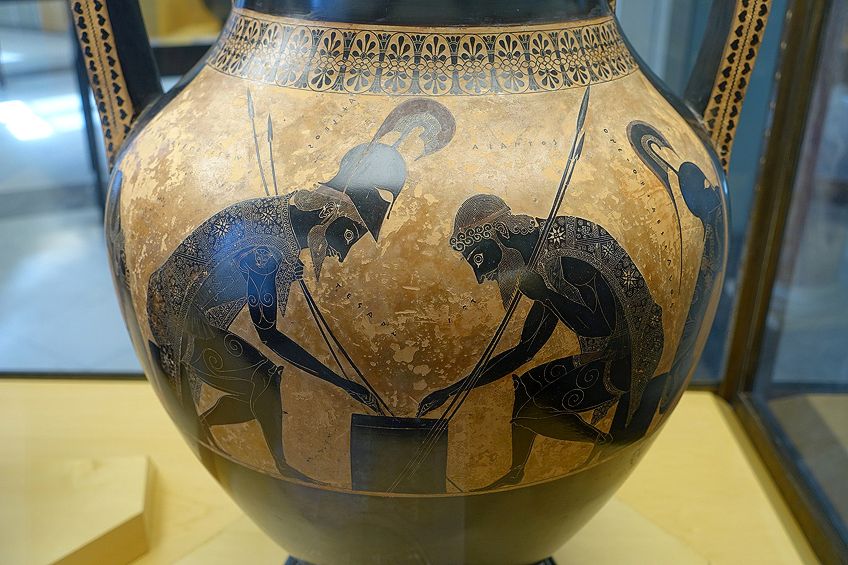
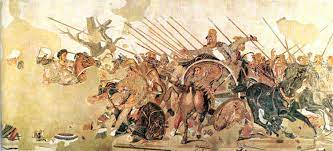
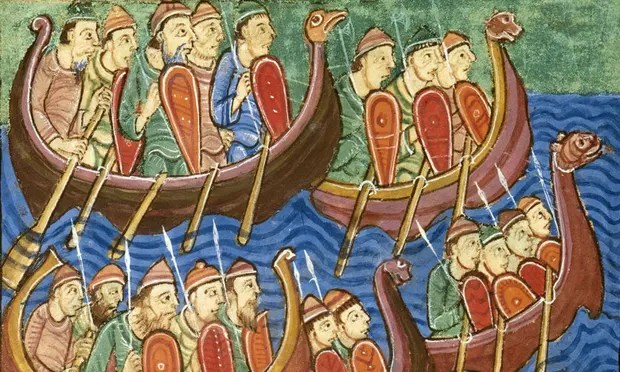
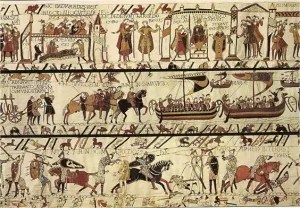
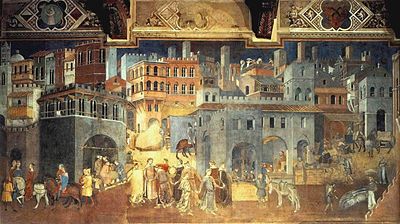
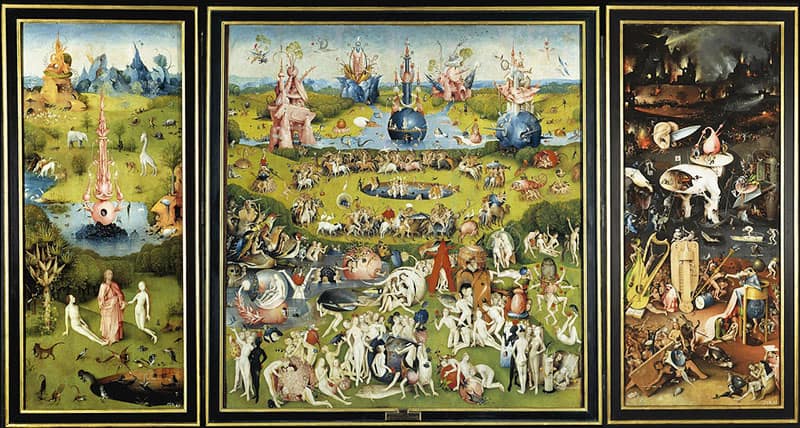
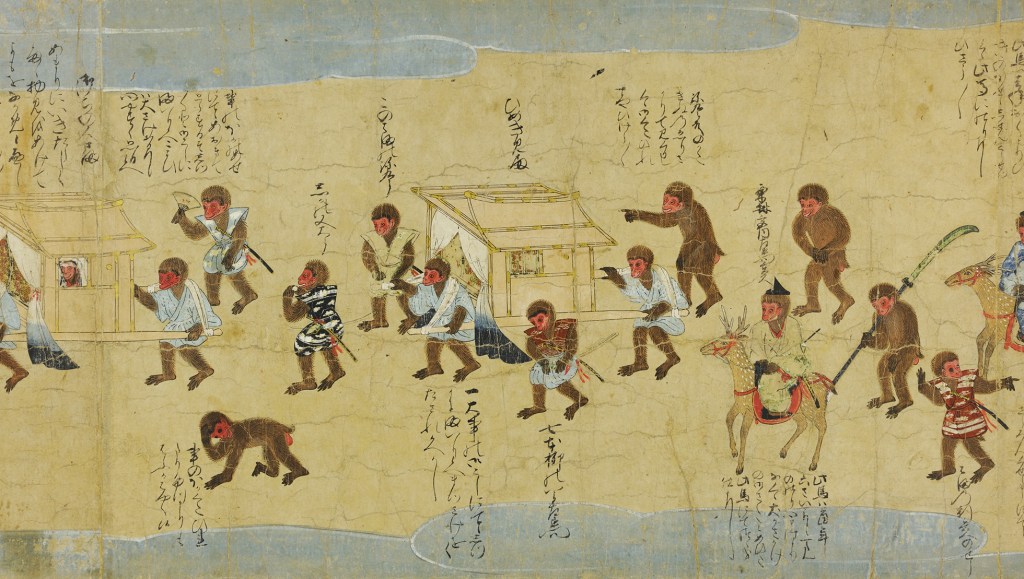
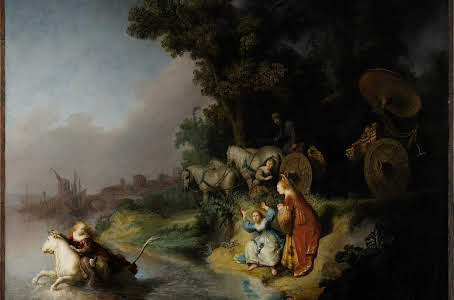
a small video regarding ancient Greek pottery and the way time-space and story telling was depicted Attic red-figured vase, side A. Odysseus, bound onto the mast of his ship, passes the Sirens. Painted by the Siren Painter, Athens, ca. 475-470 BC; ArchaiOptix, CC BY-SA 4.0, via Wikimedia Commons The vase depicting Achilles and Ajax is regarded as Exekias’s greatest work and shows the two figures of Greek legend involved in playing a game that this thought to be similar to checkers or backgammon. Although they are busy playing a game, they are depicted wearing armour and carrying spears, a sign that they are most likely taking a break from military duty and may perhaps be called back into battle at any time. There are no historical records of the two ever having sat down to play a game, so this painting is seen as more of a symbolic representation of the Trojan War. Alexander Mosaic One of the famous roman paintings – Alexander Mosaic is a roman floor mosaic developed around 100 BC. This painting depicts a battle between Alexander the Great and Darius III of Persia. It can be viewed at the National Archaeological Museum in Naples.Bizarrely elongated? Abbo of Fleury’s 10th-century illustration of Vikings arriving in Britain. Photograph: Fine Art Images/Heritage Images/Getty ImagesThe Bayeux Tapestry tells the story of the Battle of Hastings; why William felt he had to invade, the preparations made for the crossing and the battle itself. The tapestry contains about 50 different scenes and one researcher has counted that there are 632 human figures in it, 202 horse, 55 dogs, 505 other creatures (some clearly mythical beasts), 37 buildings, 41 ships, 49 trees and nearly 2000 Latin letters. http://www.historylearningsite.co.uk/medieval-england/the-bayeux-tapestry/Chōjū-jinbutsu-giga (鳥獣人物戯画, literally “Animal-person Caricatures”), commonly shortened to Chōjū-giga (鳥獣戯画, literally “Animal Caricatures”), is a famous set of four picture scrolls, or emakimono, belonging to Kōzan-ji temple in Kyoto, Japan. The Chōjū-giga scrolls are also referred to as Scrolls of Frolicking Animals and Scrolls of Frolicking Animals and Humans in English. Some think that Toba Sōjō created the scrolls; however, it seems clear from the style that more than one artist is involved.[1] The right-to-left reading direction of Chōjū-jinbutsu-giga is traditional in East Asia, and is still common in Japan. Chōjū-jinbutsu-giga is also credited as the oldest work of manga. The scrolls are now entrusted to the Kyoto National Museum and Tokyo National Museum.Detail of The Effects of Good Government, a fresco in the City Hall of Siena by Ambrogio Lorenzetti, 1338.The Garden of Earthly Delights is an intricate oil on panel work, painted in between 1490 and 1510. The painting is currently located at The Museo del Prado, in Madrid, Spain. The Garden of Earthly Delights has been analysed and interpreted many times over the years. This enigmatic artwork may be a warning against lust and earthly pleasure. The painting has also been interpreted as a political satire about the government of the time.Sandro Botticelli was an Italian painter during the Early Renaissance period. One of his best known artworks is Primavera, which is on display at the Uffizi Gallery in Florence. The meaning of Botticelli’s Primavera is still a mystery. In fact, it’s a work which can be read according to different levels of interpretation: mythological, philosophical and historical. Botticelli’s precision in portraying many species of flowers and plants (190 types of different plants!) hides a complex symbolism and connected to marriage. In fact, the blue cornflowers on Flora’s head can refer to a beloved woman, while the orange blossoms on the trees are the symbol of marriage. The Three Graces, instead, might represent the three aspect of Love, according to Neoplatonic philosophy: Chastity, Beauty and Pleasure. According to another hypothesis, the painting is a calendar of the months of spring and summer. Zephyr would represent February and Mercury would be September, in the middle a triumph of the best months of the year and the celebration of an everlasting spring.Aztecs made rich use of pictographs in the absence of written language. Different aspects of their history and culture were represented through Aztec drawings found in Aztec codices. For instance, one of the most famous Aztec drawings is found in Codex Mendoza which documents Aztec army conquering other city-states. The representation of the conquered city is given in the form of a toppled over pyramid in smoke and flames. To make clear the conquest, Aztec warriors are shown with captives taken during the battle. Famous representations of various Aztec gods are also found on a variety of codices, in particular CodexAround the year 1200 AD, a humorous, anonymous artist produced a set of painted handscrolls that show rabbits and monkeys bathing in a river, frogs and rabbits wrestling, and other scenes where animals behave like humans. Known as the Handscrolls of Frolicking Animals (Chōjū giga), this work is considered by some to be the foundation of modern manga. The Tale of the Monkeys made in the late 1500s follows on from this and shows monkeys acting out serious and comical human situations. It includes early examples of speech bubbles (fukidashi), and other techniques essential to modern manga – figures appearing multiple times within a single illustration, a strong sense of visual progression, funny details within a larger scene, and the dominance of visual action over text.Rembrandt Harmenszoon van Rijn’s The Abduction of Europa (1632) is one of his rare mythological subject paintings. The work is oil on a single oak panel and now located in the J. Paul Getty Museum.[1] The inspiration for the painting is Ovid‘s Metamorphoses, part of which tells the tale of Zeus‘s seduction and capture of Europa. The painting shows a coastal scene with Europa being carried away in rough waters by a bull while her friends remain on shore with expressions of horror. Rembrandt combined his knowledge of classical literature with the interests of the patron in order to create this allegorical work. The use of an ancient myth to impart a contemporary thought and his portrayal of the scene using the High Baroque style are two strong aspects of the work.Hokusai Manga depicting self-defense techniques (early 19th century)The Massacre at Chios (French: Scène des massacres de Scio) is the second major oil painting by the French artist Eugène Delacroix.[A] The work is more than four meters tall, and shows some of the horror of the wartime destruction visited on the Island of Chios in the Chios massacre. A frieze-like display of suffering characters, military might, ornate and colourful costumes, terror, disease and death is shown in front of a scene of widespread desolation. Unusual for a painting of civil ruin during this period, The Massacre at Chios has no heroic figure to counterbalance the crushed victims, and there is little to suggest hope among the ruin and despair. The vigour with which the aggressor is painted, contrasted with the dismal rendition of the victims, has drawn comment since the work was first hung, and some critics have charged that Delacroix might have tried to show some sympathy with the brutal occupiers.[1] The painting was completed and displayed at the Salon of 1824 and hangs at the Musée du Louvre in Paris.[2]A zoetrope is one of several pre-film animation devices that produce the illusion of motion by displaying a sequence of drawings or photographs showing progressive phases of that motion. It was basically a cylindrical variation of the phénakisticope, suggested almost immediately after the stroboscopic discs were introduced in 1833. The definitive version, with easily replaceable picture strips, was introduced as a toy by Milton Bradley in 1866 and became very successful.The late 19th century saw nascent motion picture technology develop at a rapid pace as cameras and other technology slowly became mainstream. One of the earliest attempts at a moving image was the result of a test by the film pioneer Eadweard Muybridge.
The purpose of the 24 rapidly taken photographs of a galloping horse was to see whether a horse lifts all four of its feet off the ground during a gallop, which human eyes cannot see at a certain speed. The images showed that a horse sometimes has all 4 feet off the ground simultaneously.
Opening scene of Notting Hill(1999). Great movie and great passage of time (ellipse) Hugh Grant walks through an entire year- and coupled with the pregnant lady, the orange-haired girl and with her guy in love in the early scenes and then back to the couple again and the new mom and her baby at the end plus this song – it is just an incredible montage!
Snatch(2000). Great time-space sequence!Some modern manga artists have been making fresh connections between historical and contemporary manga. In her book Gigatown, Kōno Fumiyo borrows characters from the famous Frolicking Animals handscrolls (painted about AD 1200) to explain the signs and symbols that manga artists frequently use to suggest actions or emotions (manpu).
REFLECTION
Manhood used illustration in narration in the same manner as poetry: a single storyline, a single picture that can be perceived and interpreted by the viewer in many ways. That was their idea about the time-space narrative. With the help of technology, moving images, and CGI, there has been an enormous change as well as a different approach. There is a use of more frameworks and more attaching angles. The modern creator is more specific: with the help of more frames, the message is direct and easier to understand.
Illustration as a visual communication has been the expression of civilization since the dawn of art. Studying this type of popular art of each historical era is easy to spot its morals and customs.
It literally took me days to find and download all the interesting and captivating stories linked to this type of art. It was fascinating to read the narrative about the work of art and then find out about the story is trying to tell. I felt fully engaged though as it felt like I was lured into a labyrinth where a yarn would lead me into another tale and so on. It was like a time machine, with various stops and interesting findings.










 Alexander's blog