Exercise 5: Case Studies
Review the following case studies and follow-up questions to unpack your thinking in more detail.
Dan Robinson – Ure & Ouse, Yorkshire, UK.
Artist and writer, Dan Robinson use a psychogeographic approach to create prose-poetry responses to two Yorkshire waterside sites the artist knows well and visits regularly — a smallholding at Lindley Wood reservoir and an area of the river where the Ure meets the Ouse.
These locations have, in part, inspired settings for Dan’s novel, particularly the settings relating to a character called The Char Man / Graham. Through this connection to his novel, Dan attempts to connect these locations to more distant locations — specifically, a Colorado library audio archive and a rice field in 17th-century Kyoto.
Dan documents his visit in the Case Study: Investigating Place – Dan Robinson Padlet.
NOTES
Hand in Glove
Cold hand won’t fit
it sticks against the knit
even gloves so big
don’t do the trick
Cold hand won’t fit
one finger at a time c’mon
four five fish alive
stop overthinking son
Cold hand won’t fit
patience dims, do it
throw ‘em on the ground
say you’re not even cold
Cold hand won’t fit
we’re stuck— this bit
and then a shift
a given gift
Cold hand won’t fit
Here’s a ski mitten
no finger divisions
whole hand in cavern
Cold hands now kittens
paws up boxing
warm and useless
as a crab
Cold hand in mitten
Mute paw can’t zip
untie knot, apple pip
itchy nose
Hand in glove
and is this love?
Cold hand don’t fit
and then it does
(Feb 2019, after a visit to Lindley Wood)
Rhubarb Poem (Draft #5…)
Sestina
Today a cardboard box says in uppercase
YORKSHIRE FORCED RHUBARB to insist
not dimmed stalks growing
but rhubarb rhubarb rhubarb
lean flesh green yellow rose
taste of life
A TV crowd scene done live
a case
of words without bite, unarousal
of meaning this
rhubarb rhubarb rhubarb
speaks without knowing
Just as growing
in Mum’s laugh
Rhubarb rhubarb’s
losing headcase
did persist,
in other words arose
Her rows
teeth grit words owing
to forces
as a lifer
crossword headcase
her advanced decision is a rhubarb
… unfinished
Locations of relevance:
2 main sites
1. Junction of River Ure and Ouse near Great Ouseburn, Aldwark bridge
2. An off-grid smallholding near Lindley Wood Reservoir
Other possible related sites:
3. Leeds General Infirmary
4. Royal Armouries museum Samurai collection
5. Lake Biwa, Japan
6. Naropa poetics audio archive (online and at Naropa University, Boulder Colorado)
7. Leeds-liverpool canal
BBC Arts – BBC Arts – Pup art: Polaroids of William Wegman’s loyal WeimaranersIn 1979 the Polaroid Corporation invited artist William Wegman to work with their recently developed 20×24 camera, only a handful of which were ever made. Unlike the handheld Polaroid series, these vast, wood-clad cameras created pictures that were 20 inches by 24 inches in size.BBC
Pup art: Polaroids of William Wegman’s loyal Weimaraners]#

Hansel and Gretel, 2007 | © William Wegman
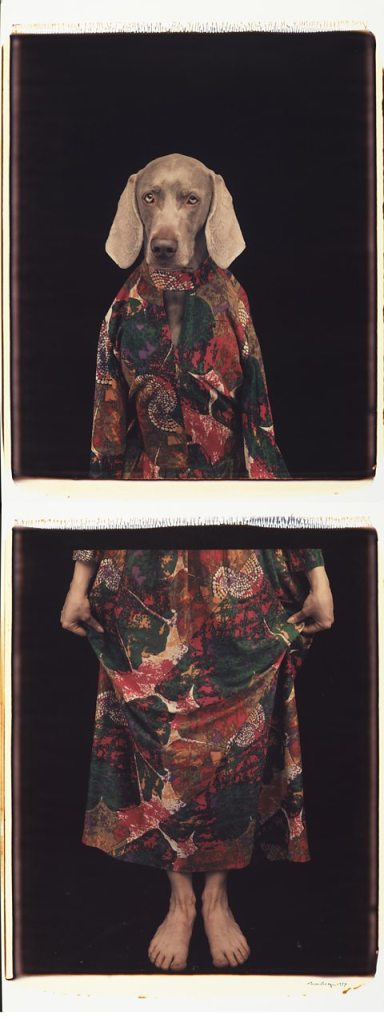
Dressed from Below, 1994 | © William Wegman, courtesy Huxley-Parlour Gallery
Buson poems (Haikai)
The short night—
patrolmen
washing in the river.
The short night—
bubbles of the crab froth
among the river reeds.
Brief, Process & Journey
….My ideas tend to develop in a circular and multi-pronged manner – I keep wanting to cross-reference these posts across the different columns and weave this content so it can be read in a more interactive way. There’s a mother template that seems to allow a even less linear – more diagrammatic use fo padlet. I may need to explore that…
Brief, Process & Journey
Pulling the threads together
I’m coming to the end of this psychogeography commission and reflecting on what I’ve learnt. This is where the different columns here each lead to some joint concerns. I’ll try to summarise them:
1. Developing very short stories /prose poems
2. Exploring different strategies to combine a collection of short writing fragments, in both linear and non-linear narratives structures (novel’s that include poetry and other text fragments[*2], as audio for an interactive multi-media installation, as poetry…)
3. Working with ideas of highly specific places AND more generic place ‘types'[*1] (key settings in my novel – a library, a river edge, a windowless archive, a hospital)
4. Exploring themes of closeness and distance – both within plots (intimacy, love, relationships, tension, being apart) in formal techniques (use of gaps, cuts, time and PoV leaps, geographic distance within story) and in relation to artistic strategies I use to respond to place (making site visits, making up fictional spaces, drawing inspiration from repeat visits to well-known places, using google maps and internet research about distant places (Naropa), reading about places and times I can’t visit (17th c Japan).
5. This last thread of ‘closeness and distance’ has also helped inform my practice as a tutor and learning designer with OCA and starter culture. I have been co-developing a series of thematic learning visits with fellow tutor Melissa Thompson with an Arts & Environment theme. Students re been requesting us to develop learning materials to enable them to engage with site visits when they could not physically attend. This idea was piloted with a V-Crit Hepworth visit by Helen Warburton. Melissa and I took inspiration from that to develop site-based learning materials that could be applied to equivalent sites close to student’s home’s internationally. This was a direct request made on the OCA forum by student Sibylle Herzer. [see her learning log here]. This challenge really resonated with my own concerns about closeness, distance and specificity of place so we applied for some funding to really explore this as part of a pilot study for OCA. The result was a set of learning materials for a ‘remote study visit’ [could add link to this once confirmed] Padlet now seems a useful tool for that resource.
In summary I think this commission has helped move my work forward in various areas.
1. Helped identify radio and audio podcast as means to present linked very short stories / prose poems.
2. Focus attention on theme of ‘closeness and distance’ across different aspects of my practice
3. Enable me to extend observation and creative responses at River Ure / Aldward site with help of Roxy the dog.
4. Enable me to extend observation and creative responses to Lindley Wood – small holding / horse therapy site.
5. Nurture cross-fertilisation across writing, art and teaching practices.
6. Find my own way to reconnect my recent fiction writing practice with my previous artistic practice.
[*1]
Perec, G. Species of Spaces and Other pieces.Trans. John Sturrock. London & New York: Penguin, 1998.
[*2]
Stoker, B. Dracula.
Morrison, B. The Executer.
Remote viewing (RV) is the practice of seeking impressions about a distant or unseen subject, purportedly sensing with the mind.[1] Typically a remote viewer is expected to give information about an object, event, person or location that is hidden from physical view and separated at some distance
Remote viewing. (2023, March 13). In Wikipedia. https://en.wikipedia.org/wiki/Remote_viewing
Whenever I got on a bus in Leeds there was always this chocolate wrapper, behind a glass pane, near the front door. I never see them anymore, I don’t even know if the new buses have that same window. It was sort of like that window above the driver, where you could see the destinations backwards, only this one was nearer the door. Anyway it was just this kind of window onto nothing, with a light on, and there was always this wrapper just sitting there. It was nearly always a Toffee Crisp, and it would look totally natural like it had just landed there on its own. It took some time to realise someone was carefully placing them, and after a while I’d be disappointed if the window was empty. If I was away and met someone from Leeds, I’d ask them about it, and when they’d noticed, it was always a good sign. But the other day someone said it was Harvest Crunch, and that sounded familiar. And he said he saw one last week.”
Short story poster by Dan Robinson, published by Centre for International Success in association with [shift] Leeds, 2004
Suzannah Evans – Meers Brook, Sheffield, UK
Read poet Suzannah Evans’s psychogeographic exploration of the submerged tributary, Meers Brook in Sheffield, Yorkshire.
Evans references the poem The Science of Cartographic Limited (Boland, 1955) in her initial ideas.
Suzannah documents her visit in the Case Study: Exploring Meers Brook – Suzannah Evans Padlet.
The Lost Brook
We know it was here once
rolling itself up the gardens
of Albert Road. We have seen
the flood surveys, the maps
we know the culvert is high-ceilinged
and finite, and the brook
runs under the lowest dip of our streets
falling down stairs that were built for it
we dream about it ripping
through tarmac, rippling out
surfacing with a burp
From its concrete chambers
we think we hear it
in the dripping of cellars
hissing radiators
the breathing of boiler flues at dusk
when we open our windows
to listen closer, there’s nothing
but cars reversing on puddled streets
neighbours wheeling their bins out.
section
Responding to Meers Broo
Reflection
After viewing the case studies, reflect on the following questions:
- How might taking a psychogeographic approach to mapping the location offer alternative readings?
A psychogeographic approach, as the term suggests, is the study, the description of the effect of a geographical location on the emotions and behaviour of individuals. Mapping on the other hand is a diagrammatic representation of an area or sea showing physical features: roads, rivers, lakes buildings etc. To summarise, a psychogeographic approach is like a filter of an actual map: it focuses on certain features that feel important to the reader. Using this point of view helps to study and understand a place using a filter that emphasises more on human activity (emotion) and the outcomes are based on the point of the viewer. Having said that, an observation of the place in interaction with it creates unlimited outcomes and as the brief suggests alternative readings.
- Why would a map omit certain facts/figures or emphasise certain parts?
A map is there to give information about places and landmarks. It has to be brief and accurate. It cannot confuse people or give useless details.
- Can you think of an example of a map that is limited or omits certain facts/figures?
Map of USA states minimum wage: Gives only certain information.
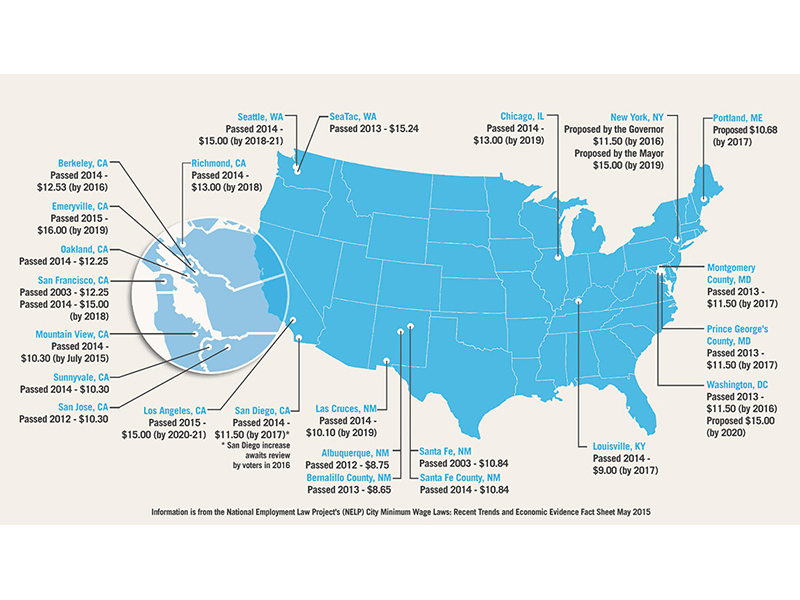
- Could you subvert it?
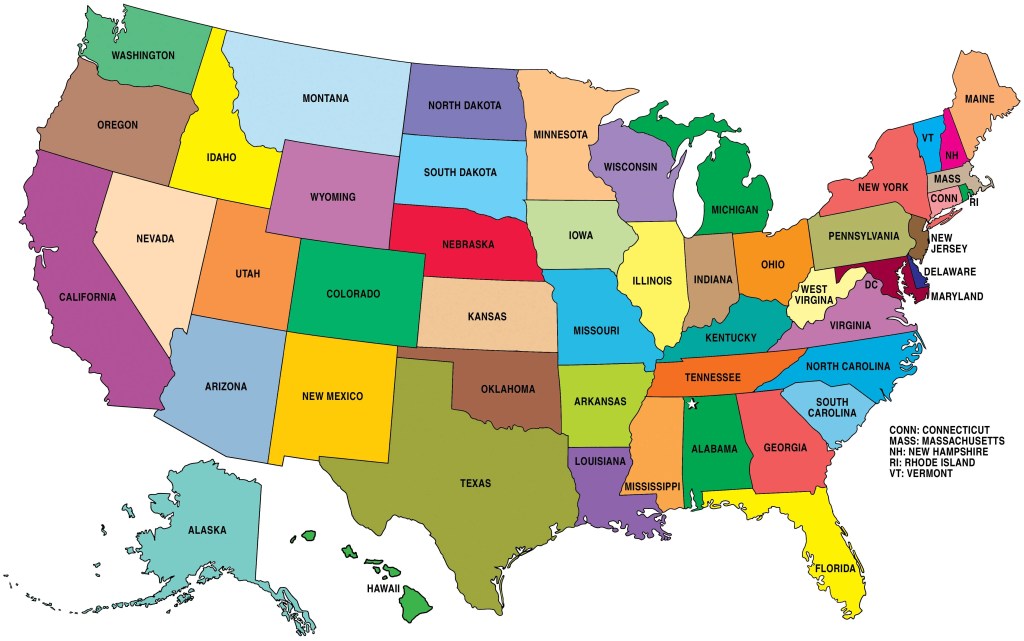
Map of the states of the USA.
- What are the methods that Dan and Suzannah consider and what approaches do they use in their case study?
They are using the method of the drifter, the flaneur, who becomes the first-hand witness of their study: they visit the place they want to write about but they do in the way of a stroll, a dog walk, a wander in the area, without a particular goal to look and examine about.
- Both Suzannah’s and Dan’s case studies reflect the geographical features that affect a creative response to place in the form of poetry. Suzannah gives us a glimpse of a world in change, where urban development has altered the landscape under her feet. Suzannah applies the approach of ecopoetry to her research and creative work, what can you learn about ecopoetry from Suzannah’s case study and references?
John Shoptaw in his essay ‘Why Ecopoetry?’ says that a poem requires two things to make it an ecopoem:
1) However self-aware and self-reflexive it may be, an ecopoem must be tethered to the natural world.
2) The second way in which an ecopoem is environmental is that it is ecocentric, not anthropocentric. Human interests cannot be the be-all and end-all of an ecopoem.
Therefore there are lots of poems about landscapes, or about animals, that exist without being ecopoems. Although a very famous landscape/nature poem, Wordsworth’s ‘The Daffodils’ is mainly about the way in which the daffodils serve the human mind, that they exist in the poet’s memory. What would that poem be like without the human viewpoint so strongly foregrounded? How do the daffodils experience the scene, the lake, or even the cloud (does it experience loneliness?)
As the notes suggest, it is a very thin line between an ecopoem characterised as one. It is down to the writer’s perception to find the border and define what is to be ecopoetic and what to be not.
- How might the ideas around ecopoetry affect your exploration of place?
<<As ecopoetics has become established, certain practices and expectations of the ecopoetic process and content have also become established. These predominantly presuppose able-bodied practitioners, who can conduct energetic field work and outdoor workshops, focusing on walking, running or swimming as both a poetic process and a means of connecting with the wider ecosystem>>.
Dr Polly Atkin, in her essay ‘Why is it always a poem is a walk?’ : Towards an Ecocrip Poetics’ (New Welsh Reader, ed. Emily Blewitt, forthcoming May 25 2019 )
This sentence summarises everything about eco poetry. When you go out in nature, it is not only about enjoying the place as a visitor or someone who is intrigued to discover. You have to embrace your feelings and your thoughts, and after an internal process, combined with the brain’s endorphins generated from the physical activity, you give birth to what really mattered to you, the outcome of the whole experience.
- Dan’s case study considers walking as his method of investigation. What is it about Dan’s idea of ‘to walk’ that is distinct from say a derive or flaneur?
Dan’s walks are more channelled to a certain place, doing certain activities whereas a flaneur is a wanderer who walks from place to place in order to observe and discover.
- Can you make some observations about Dan’s engagement with the geography of place and how this might affect your creative work?
Dan is creating prose-poetry responses to Yorkshire riverside locations. These places are familiar to him as he visits them regularly and inspired him to create settings for his previous work: he is connected to them in many levels.
Writing about a place you know about, care and feel, helps you put your psyche into your work and create outcomes that contain your soul. In that way, it makes me understand the importance of the relationship between the creator and the subject of study and the impact of this correlation on its outcomes and quality.
Make notes and summaries of responses to the questions above in your learning log and consider if you can employ these ideas in your own creative practice.
 Alexander's blog