Exercise 4: Breaking Rules: Letting Go of the Framework
Artistic practice begins with an impulse, but often finds safety in structure. In my earlier phases of this course, I clung to a framework built around emotional honesty, visual symbolism, and a poetic voice rooted in mythology and memory. My manifesto in Part Two reflected this: I would work metaphorically, emotionally, and with reverence toward personal truth, often rendered through visual stillness, soft line, and lyrical text.
These rules served me for a time. However, as I progressed through later exercises, especially in The Bird Who Came From Afar, Aeolus and Nausicaä, and The Rare She-Cell, I began to notice repetition. Nostalgia, solitude, longing: I was creating a shrine to absence. My materials became too comfortable. The pain is too aestheticised. I was staying within emotional boundaries that no longer served me in my transformation.
In this exercise, I gave myself permission to break my own rules.
Disrupting Form and Tone
The first thing I broke was form. In the revised visual narrative of The Bird Who Came From Afar, I abandoned my usual approach of elegant melancholy. Instead of using classical or ambient music, I introduced a solo piano version of Guns N’ Roses’ “November Rain.” It was imperfect, raw, and full of restrained chaos, echoing the inner turbulence of the narrative.
“I’ve seen many reflections, but you are real.”
This was a crucial frame I had forgotten in an earlier version, and its return marked a shift, not to resolution, but toward exposure. I realised I had been working in cycles of controlled expression, always curating pain. This time, I let it be uneven, even unresolved.
From Polished to Primitive
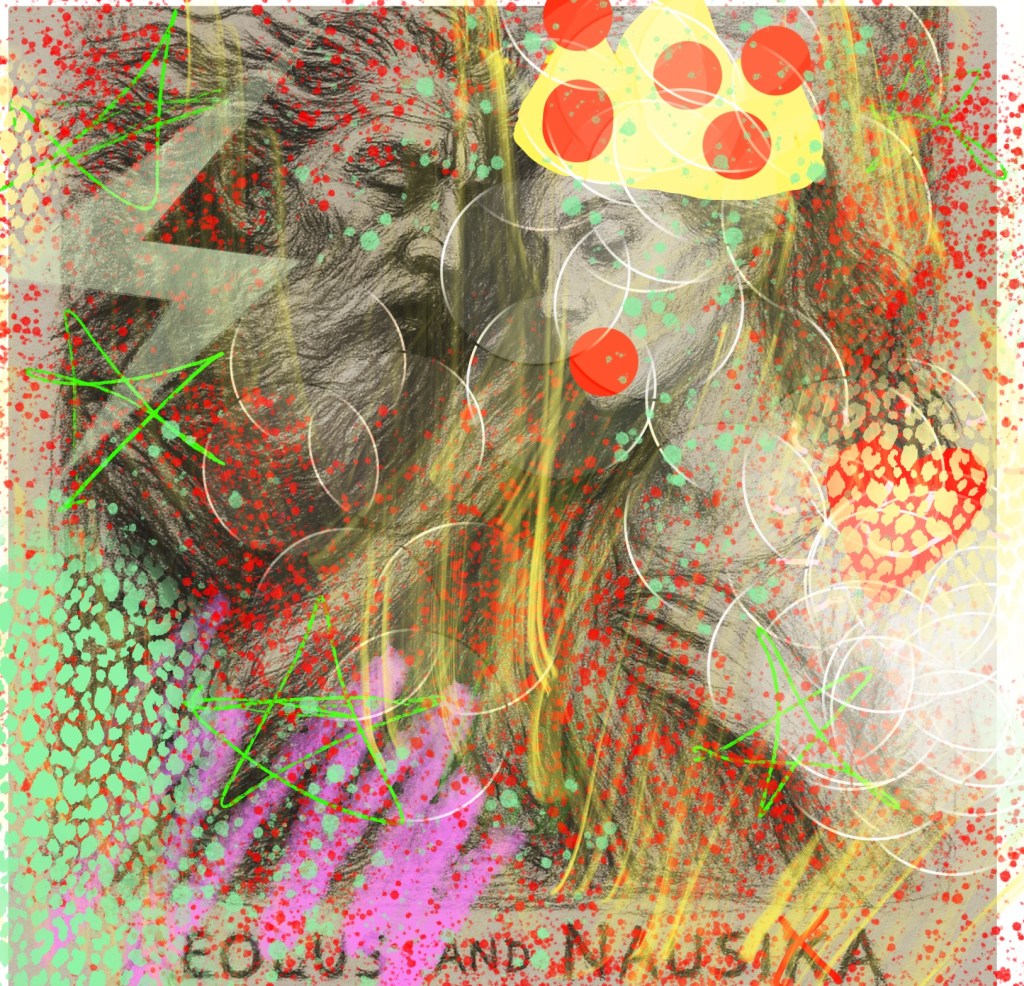
With Aeolus and Nausicaä, I turned further from control. Drawing inspiration from Anselm Kiefer’s raw, monumental approach, I abandoned smoothness in favour of scratched layers, monochrome distress, and fragmented anatomy. The myth was no longer narrated, but scattered across a sea of lines and textures. I gave Nausicaä a crown, hastily scribbled like graffiti, and used splashes of sea blue and rust-red across a blackened sea.
“She lifted her gaze, not to be seen, but to rise above the storm.”
The visual echoed the narrative: the wind (Aeolus) circling around her, never quite arriving. For the first time, the piece wasn’t about romantic destiny, but about emotional movement: spiritual tension.
Symbolism Rewritten: Letting the Seashell Go
In another work, inspired by The Rare She-Cell, I AI-painted a figure by the sea. Usually, I would create my figures holding something: a token, a shell, a symbol of memory. But this time, he was empty-handed, watching as the seashell floated away with the tide, under a storm-heavy sky.
“And I let it go. Not because I wanted to, but because the sea asked me gently — and I had no strength to say no.”
This act (of letting go) became the image that guided my tone. It embodied restraint, but also quiet acceptance. The figure didn’t resist. He simply stood, empty but full-hearted. Breaking my own rule of emotional climax, I allowed the visual to end in silence.
Letting Imperfection In
I also broke stylistic habits: I allowed visual noise, graffiti textures, and raw collage-like energy colour splashes to enter my AI drawings. This echoed the amateur street art aesthetic I usually avoided. I used charcoal-style base layers and layered over them symbolic chaos — waves, wind, and fragmented text. In one iteration, I turned Aeolus and Nausicaä into a visual poem, battered by time and tension, its edges fraying like a memory not yet healed.
This process was about letting imperfection speak.
Breaking the Emotional Frame
Previously, I worked within a fixed emotional voice: often male, melancholic, romanticised. But with this exercise, I tried to change it: Nausicaä spoke now. So did the shell. So did silence. I learned that not all work has to end in revelation. Some things just pass through.
Reflection: Toward a New Practice
What I’ve learned is that breaking rules is a practice of freedom. It doesn’t mean abandoning truth: it means deepening it. Sometimes, the most honest expression is messy or unfinished. Sometimes it looks like a storm on a piece of paper.
I still value the lyrical, the symbolic, the personal: but now I know these don’t have to be tidy. My new manifesto might be this:
- Let the storm in.
- Paint before you understand.
- Let symbols emerge instead of planning them.
- If the frame is too clean, dirty it.
- Not everything beautiful must be gentle.
- Speak with your whole body: even if your hands shake.
This breaking of rules has offered me space — emotional, visual, and personal. It’s not a conclusion. It’s a first breath in a new direction.
 Alexander's blog