Exercise 3: Fieldwork
Now you are to build on the collected materials from your walk and your understanding of the context of place by broadening your engagement with a particular place significant to you.
“My work is about drawing attention to the way the world around us frustrates and surprises us. All sorts of things happen that make me intrigued about our everyday choreography within the urban landscape.”
Phyllida Barlow.
Identify a place that you are inspired to investigate, this may be from your walk or somewhere entirely different. Make some notes on the following:
- What interests you about the place that you want to investigate?
- Which of the approaches have you found of interest and why?
- How might applying a psychogeographic approach affect your creative response to place?
- What form might a psychogeographic investigation take if it were done purely online?
Visit the project forum and discuss some of the above ideas.
Gather some initial research material on this place (off and online), depending on where you have chosen to investigate this could be; images of tourist maps, popular scenes/views, old postcards, advertising, examples of local history, quotes, ephemera, song lyrics etc. What can you find online that is associated with this place in the popular imagination?
Collate your material and save images/links into a folder and then print them.
Pin the work up on a wall and play around with the positioning of the research over the coming weeks.
Re-photograph it (a phone camera is fine). Post the image to your learning log. Observe the patterns that emerge, both visual and text-based… Is there a dominant narrative/point of view of this place?
View Gina Lundy’s Case Study: South Uist Padlet.
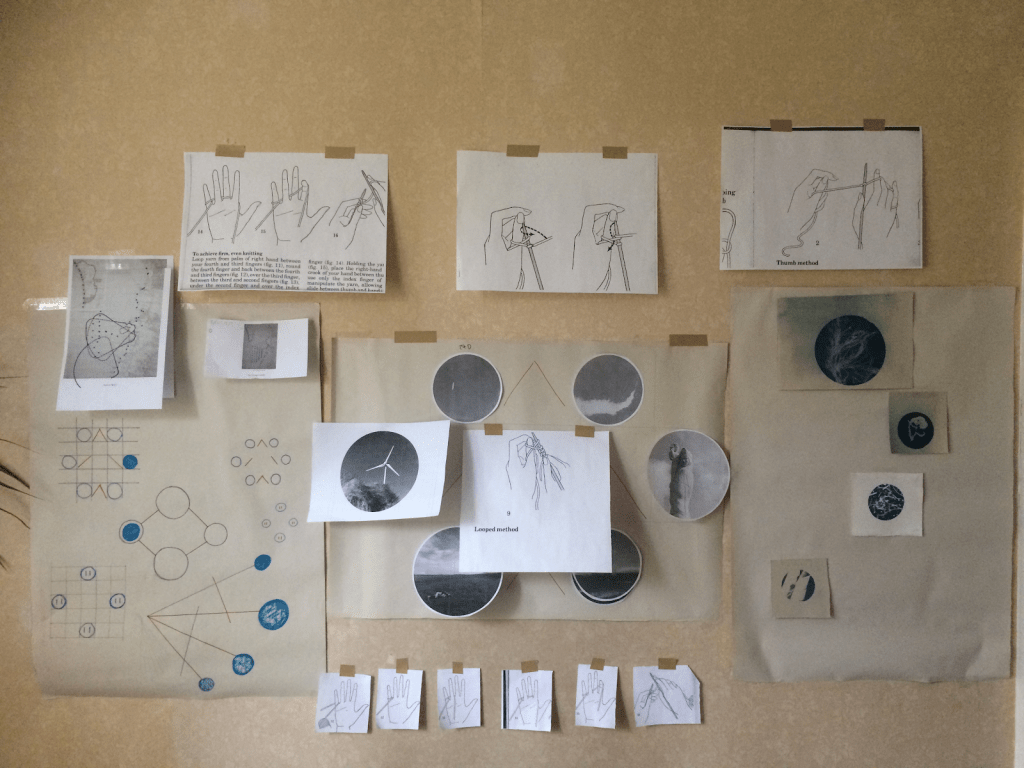
Through my research, I learned about the rich heritage of Loughborough knitwear and its fascinating history. From what I understand, Loughborough was once a hub for the knitwear industry in the UK, producing high-quality garments that were in high demand around the world. The craftsmanship and attention to detail that went into each piece were truly impressive, and it’s amazing to see how that tradition has carried on to this day. I’m looking forward to exploring more about this unique aspect of British fashion history.
Because of my background, I was intrigued to find out about the knitting machines that were made in Loughborough. They were of excellent quality and were highly sought after by knitting factories around the world. I am amazed at how advanced the technology used in these machines was, and how they could produce intricate patterns in a fraction of the time it would take to knit them by hand using revolutionary and innovative technology. I am seriously considering finding one of these machines myself, as I am always looking for ways to improve my knitting skills and create more intricate designs by observing older machinery.
My padlet is dedicated to the knitting factory, an idea that started in Loughborough UK and is shaping the world of fashion today.
Made with love https://padlet.com/alexander5201041/exercise-3-fieldwork-yiupznc9w9gb18tx
 Alexander's blog