At this point of the course, you will begin to self-direct and choose the activities and exercises you need to pursue in order to move your practice further.
This exercise revolves around forming synergy between your thematic case study and your practical work. Using the ideas and connections in your study, develop an outcome that complements and speaks to the themes and ideas you are engaged with.
This shouldn’t be a didactic illustration of your case study and should be a creative interpretation of ideas and connections. It is up to you to reflect on these connections and seek to understand how your practice and research are beginning to marry and work together.
Add reflection on your ideas, evidence of the working process, and documentation of outcomes to your learning log. Send a link to your tutor to update them on your progress. They will then schedule a time for a 1:1 feedback tutorial.
RHAPSODOI: FLANEURS OF THE ANCIENT TIMES.
<<The theme of language. Fashion is about various narratives, blissful stories and playful fiction. A mythology of a parallel universe that is all about show and tell: when one appears in attire, they speak of who they are to the world. >>
As the brief suggests, there is a definite synergy between ideas and research that takes my spirit on another journey where thoughts are becoming a basic principle to start looking into the uncharted waters of my being.
Reflecting on the above postulate and considering the outcome of it, I feel the power of the words: Mythology, Fiction, and Story intriguing me to dig deeper and search for better conclusions. I want to exceed the limit outlined by fashion and consider the definition of the Story with the view of a Rhapsodos(a minstrel).
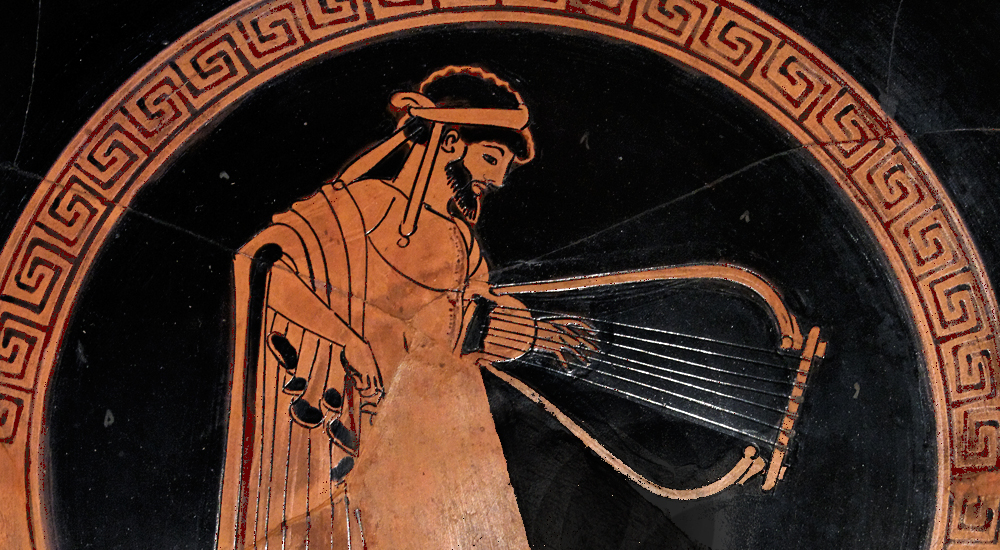
A Rhapsodos, using the element of language, would compose rhapsodies. The word rhapsode comes from the Greek <<ravo>> (sew) and <<ode>>. As the translation implies, the Rhapsodos, a language artisan, would cut and sew stories. When his tale was complete, he would wonder with his lyre
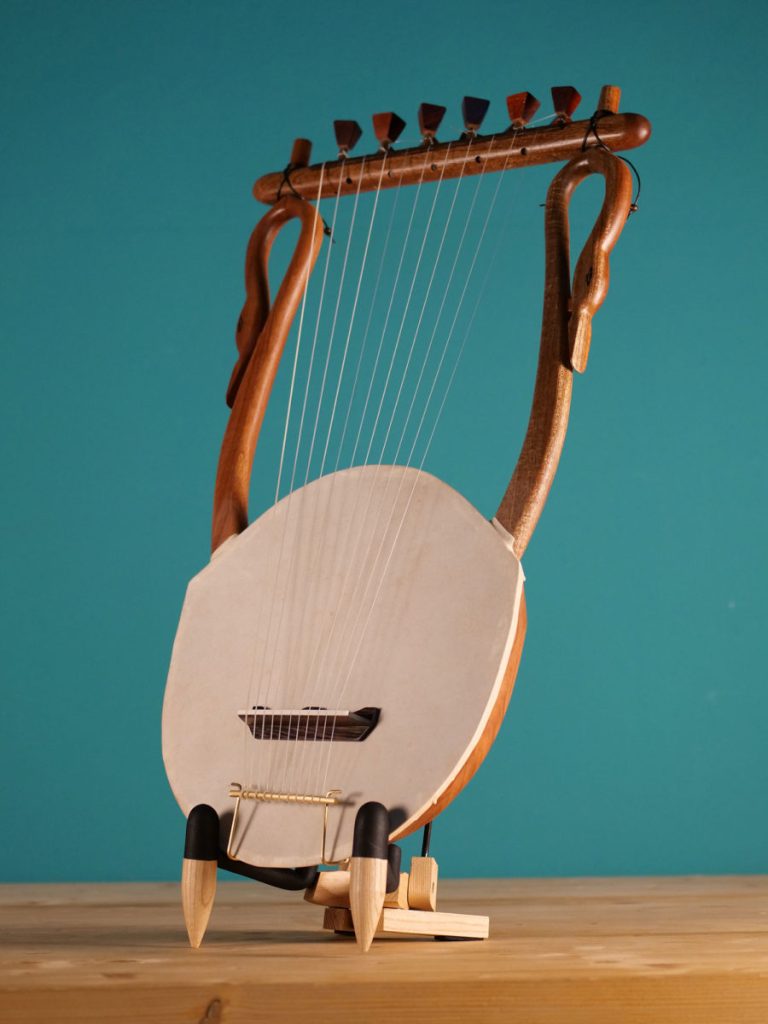
and narrate about his heroes and their epic stories.
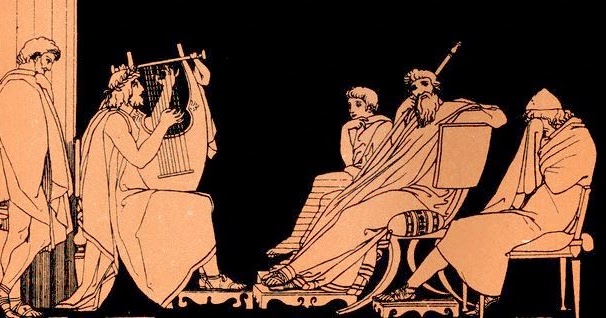
He would sing to palaces and marketplaces about heroes and their passions. He would speak about Gods and their wrath, their love stories and their human frailties. He would inspire many people of his time. The mythology created by this person would affect how his audience would think, act, love, hate, revenge, and fight.
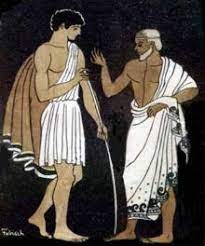
Then, when older, our Rhapsodos would pass his art to his students, who would eventually become lyricists. They would carry on, by following their unique path by cutting and sewing their own stories, creating a line of tradition that saved these unique tales up to date.
Ancient Greek:ἄνδρα μοι ἔννεπε, μοῦσα, πολύτροπον, ὃς μάλα πολλὰ πλάγχθη, ἐπεὶ Τροίης ἱερὸν πτολίεθρον ἔπερσεν πολλῶν δ᾽ ἀνθρώπων ἴδεν ἄστεα καὶ νόον ἔγνω… |
andra moi ennepe, mousa, polytropon, hos mala polla
planchthē, epei troiēs hieron ptoliethron epersen:pollōn d’ anthrōpōn iden astea kai noon egnō…
Above are the first verses of Homer’s Odyssey. He is the composer of the oldest rhapsodies known to us: the Illiad (the war between the Greeks and Trojans) and the Odyssey. Homer is also the father of what we call epic poetry. He set the standards for heroism, honour, love for the country and respect for the deities.
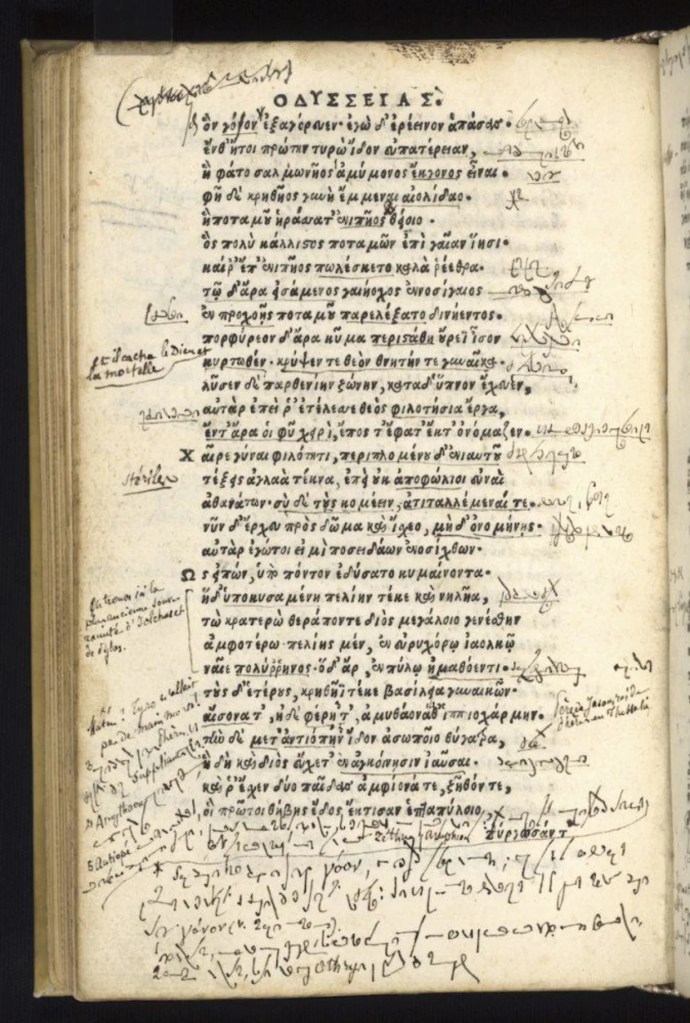
A rare 16th-century edition of Homer’s “Odyssey” at the University of Chicago Library includes handwritten annotations in a mysterious script.
It is fascinating to consider these people’s impact on the masses using just the verbal factor. Even kings wanted to be like the heroes of these epic stories. Aristocrats and commoners with their actions, they wanted to inspire men of the lyre so they would be part of future mythology.
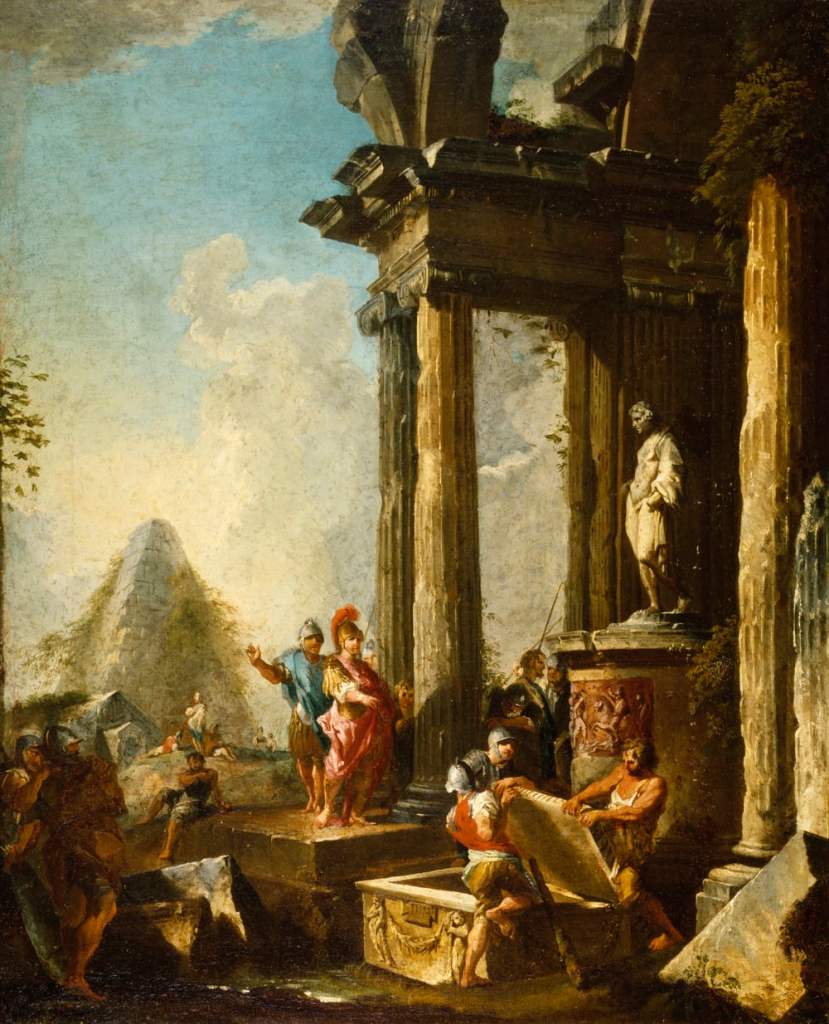
Alexander the Great at the Tomb of Achilles, Giovanni Paolo Panini, 1718-1719
To summarise, a Rhapsodos, in my opinion, is the epitome of the marriage of various ideas and creating a fruitful outcome. Their influence, Homer’s first, is still strong, and their voice echoes today after so many generations; their passion for storytelling has created a time capsule for humanity. A guiding light for all of us who want to use language to create our own heroes and daemons.
THE OLDEST COMPLETE SONG IN THE WORLD–ANCIENT GREEK MUSIC TODAY
This is probably how Rhapsodists sounded like.
The Song of Seikilos is the world’s oldest complete surviving music composition engraved in a marble stele that served as a flower stand. The beautiful arrangement, also known as the ‘Seikilos epitaph’, dates from around the first or second century AD, and was inconspicuously kept in the garden of a Turkish woman before its current placement in the National Museum of Denmark. It was discovered carved on a marble column-shaped stele in Tralleis, near Ephesus in Turkey, in 1883. Although short in length, this piece of the past has remarkable historical value in its rarity as an artefact. It is not the oldest song in the world, which is attributed to a Sumerian hymn, but it is unique as the sole composition which has remained complete throughout history. The song was originally engraved on a tombstone, a stele, accompanying the message ‘from Seikilos to Euterpe“, together with a poem. Most researchers seem to agree that the song was a dedication by a man, named Seikilos, to his wife, possibly named Euterpe, who had passed away.
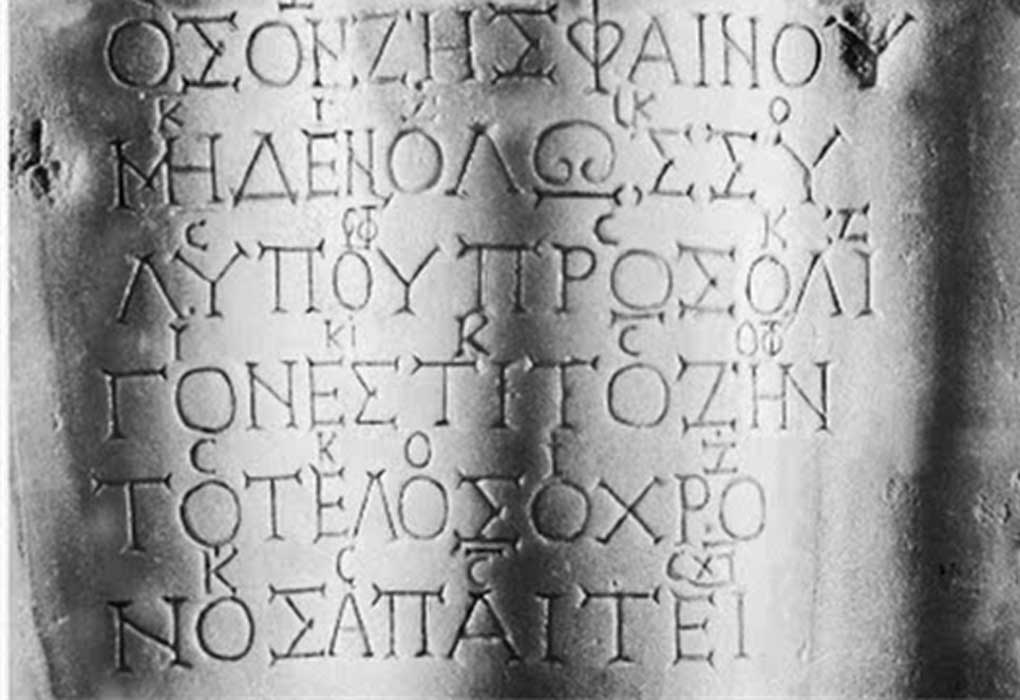
📌Lyrics (translation from ancient Greek in English):
While you live,
Shine has no grief at all
life exists only for a short while
and Time demands his due
Language: The sound of Ancient Greek today.
A study of a dialect, still spoken today in a remote part of Turkey based on Archaic Greek, the language that brought us among others, the wonders of lyric poetry.
SOURCES:
Britannica, The Information Architects of Encyclopaedia. “Homer”. Encyclopedia Britannica, 13 Jul. 2023, https://www.britannica.com/facts/Homer-Greek-poet. Accessed 13 July 2023.
Walbank, Frank W.. “Alexander the Great”. Encyclopedia Britannica, 3 Jul. 2023, https://www.britannica.com/biography/Alexander-the-Great. Accessed 13 July 2023.
Wikipedia contributors. “English translations of Homer.” Wikipedia, The Free Encyclopedia. Wikipedia, The Free Encyclopedia, 4 Jul. 2023. Web. 13 Jul. 2023.
Walbank, Frank W.. “Alexander the Great”. Encyclopedia Britannica, 3 Jul. 2023, https://www.britannica.com/biography/Alexander-the-Great. Accessed 13 July 2023.
Britannica, The Information Architects of Encyclopaedia. “Homer”. Encyclopedia Britannica, 13 Jul. 2023, https://www.britannica.com/facts/Homer-Greek-poet. Accessed 13 July 2023.
Britannica, The Editors of Encyclopaedia. “rhapsode”. Encyclopedia Britannica, 16 Mar. 2016, https://www.britannica.com/art/rhapsode. Accessed 13 July 2023.
Wikipedia contributors. (2023, July 3). Seikilos epitaph. In Wikipedia, The Free Encyclopedia. Retrieved 22:39, July 13, 2023, from https://en.wikipedia.org/w/index.php?title=Seikilos_epitaph&oldid=1163277656
Britannica, The Editors of Encyclopaedia. “rhapsode”. Encyclopedia Britannica, 16 Mar. 2016, https://www.britannica.com/art/rhapsode. Accessed 13 July 2023.
INFLUENCE–IMPACT

The duel of Hector and Ajax on an Attic red-figure cup, 5th-4th century B.C., via The Louvre Museum, Paris
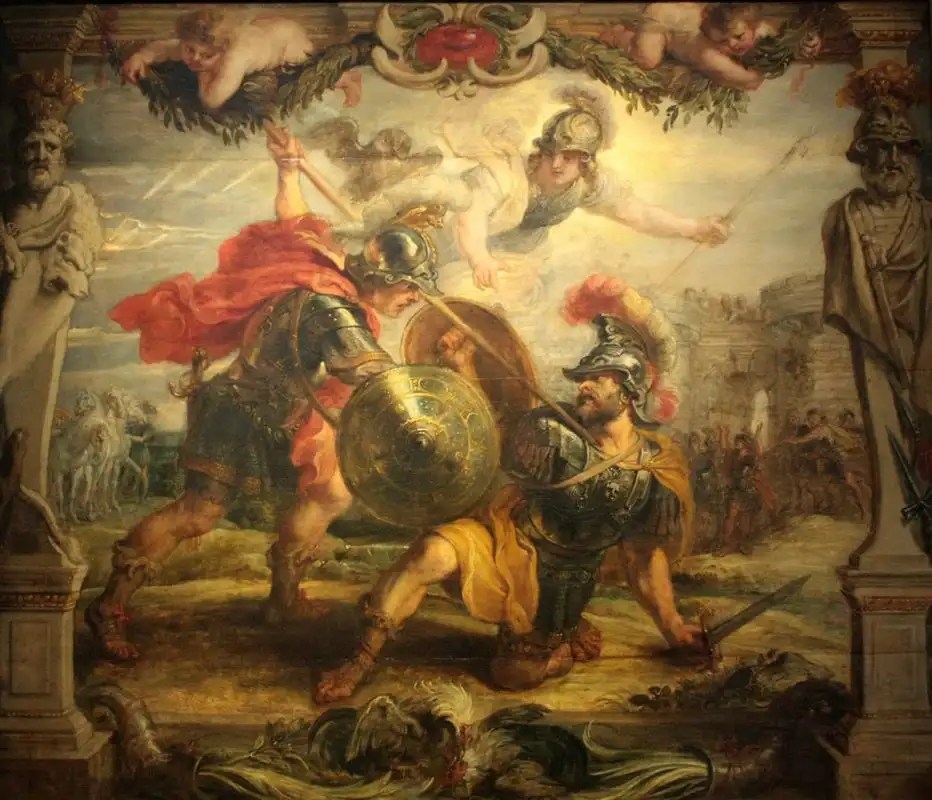
The Death of Hector by Peter Paul Rubens, 1630-35, via the Boijmans Museum, Rotterdam
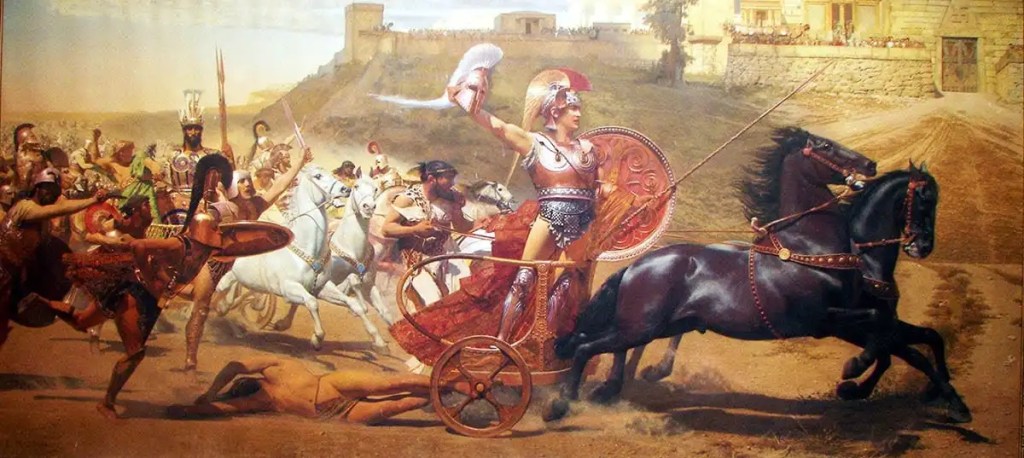
The Triumph of Achilles by Franz Matsch, 1892, via the Corfu Achillion Museum

The Triumph of Achilles by Franz Matsch, 1892, via the Corfu Achillion Museum
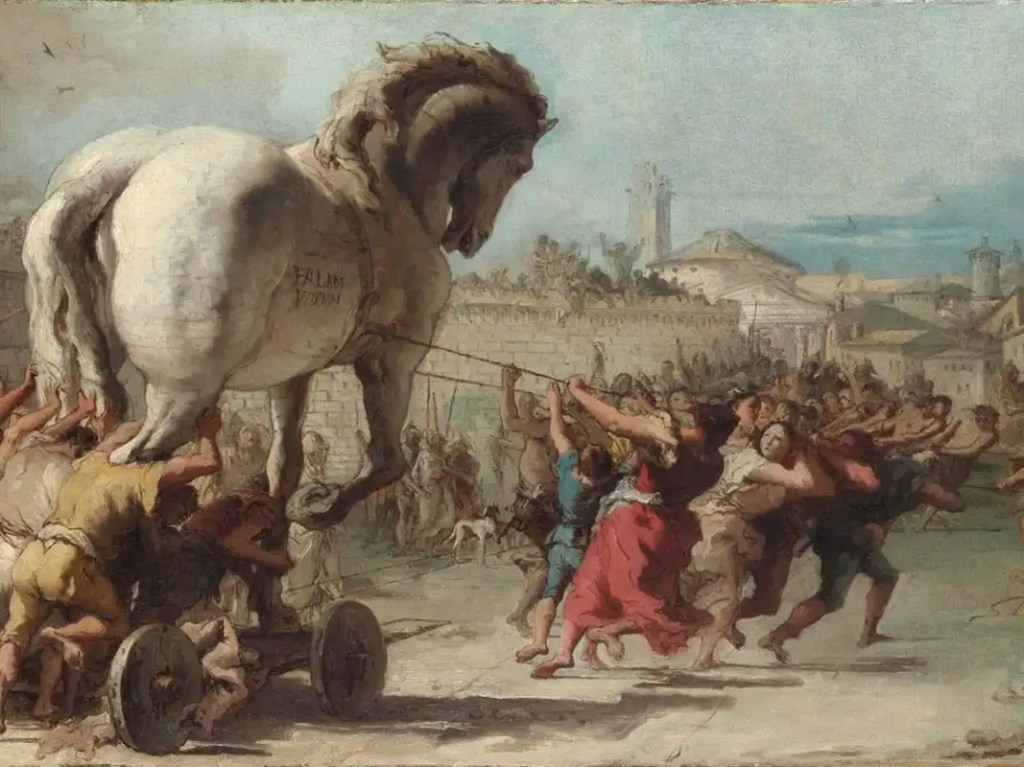
The Procession of the Trojan Horse into Troy by Giovanni Domenico Tiepolo, around 1760, via the National Gallery, London
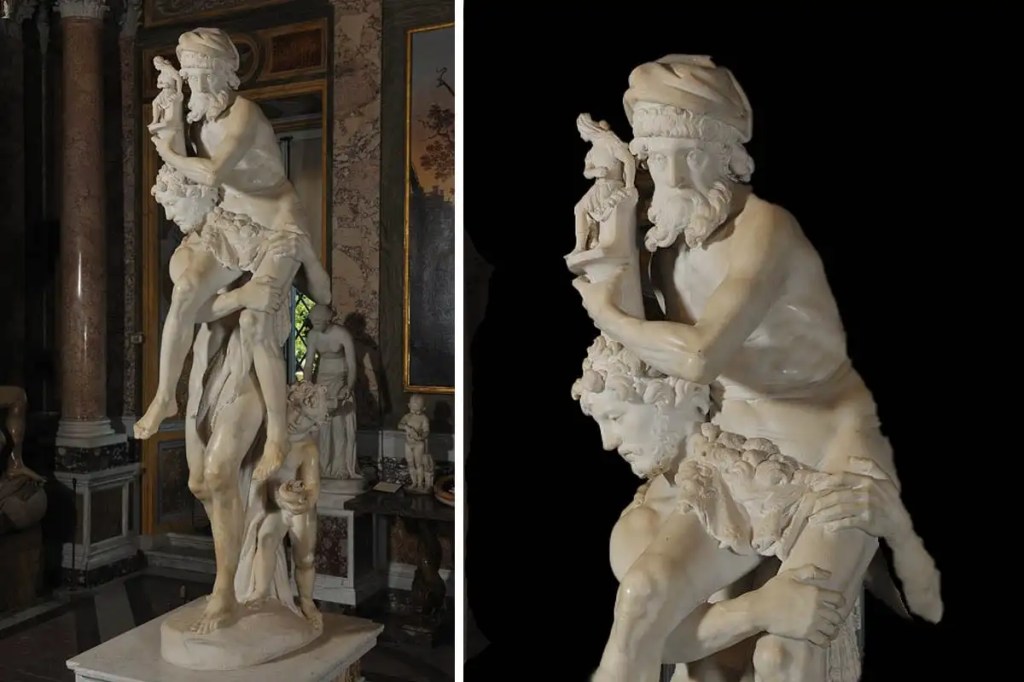
Aeneas, Anchises, and Ascanius by Gian Lorenzo Bernini, 1618-19, via the Borghese Gallery, Rome

Odysseus and the Sirens. Attic red-figured stamnos, by the Siren painter. From Vulci, c.480-470 BC. British Museum, London, UK. Leemage/ Universal Images Group/ Getty Images

Ulysses is a modernist novel by Irish writer James Joyce. Parts of it were first serialized in the American journal The Little Review from March 1918 to December 1920, and the entire work was published in Paris by Sylvia Beach on 2 February 1922, Joyce’s fortieth birthday. It is considered one of the most important works of modernist literature[3] and has been called “a demonstration and summation of the entire movement.”[4] According to Declan Kiberd, “Before Joyce, no writer of fiction had so foregrounded the process of thinking.”[5]
Ulysses chronicles the appointments and encounters of the itinerant Leopold Bloom in Dublin in the course of an ordinary day, 16 June 1904.[6][7] Ulysses is the Latinised name of Odysseus, the hero of Homer‘s epic poem the Odyssey, and the novel establishes a series of parallels between the poem and the novel, with structural correspondences between the characters and experiences of Bloom and Odysseus, Molly Bloom and Penelope, and Stephen Dedalus and Telemachus, in addition to events and themes of the early 20th-century context of modernism, Dublin, and Ireland’s relationship to Britain. The novel is highly allusive and its prose imitates the styles of different periods of English literature.
Since its publication, the book has attracted controversy and scrutiny, ranging from an obscenity trial in the United States in 1921 to protracted textual “Joyce Wars”. The novel’s stream of consciousness technique, careful structuring, and experimental prose—replete with puns, parodies, and allusions—as well as its rich characterisation and broad humour have led it to be regarded as one of the greatest literary works in history; Joyce fans worldwide now celebrate 16 June as Bloomsday.
SOURCE: Wikipedia contributors. “Ulysses (novel).” Wikipedia, The Free Encyclopedia. Wikipedia, The Free Encyclopedia, 10 Jul. 2023. Web. 14 Jul. 2023.
REFLECTION
Exploring the outcomes of exercise two, I got involved in an engaging loop of conclusions that I felt very affiliated with. My research was about stories, language, and ancient Greece: themes that engage my interest. To my great surprise, I find them an infinite pool of inspiration and case studies. The unknown Greek storytellers of the Greek classical times and the era before are, to a matter of tragic irony, the unsung heroes of their own lives. Even though their lives play a minor role in their rhapsodies, they have passed to the generations to follow theirs, a lively tradition of heroic times where their protagonists were the main criterion of the ideal life.
The song of Seikillos, written for his late wife in the language of the great lyricists, is always pleasant to listen to. The whole context of the Seikilos love story, even though it is sad to read about, is about enjoying life. Eighteen centuries have passed since it was born, but it is still thrilling and engaging.
Finally, the idea that people in the world we live in today are still talking about the language Homer and his ancestors were communicating with is thrilling. It is worth mentioning not only as a matter of tradition and language but as a heritage of a civilisation that thrived and brought the Western world a spirit that still thrives today.
 Alexander's blog