Exercise 2: Relations with the Wider World
“A set of artistic practices which take as their theoretical and practical point of departure the whole of human relations and their social context, rather than an independent and private space.”
Relational Aesthetics, pg. 113.
You have now explored ideas of interdisciplinary practice and the relation creative practice can have with the wider world, expanding your awareness of a range of creative practices. For this exercise, you are to collate and formulate your understanding by creating a learning log entry that outlines your understanding and demonstrates the connections you have discovered between your work and the relations to the wider world.
For this exercise you will need to:
- Research and select examples of relational practice and interdisciplinary making. Reflect on what interests you about these works and summarise your learning from this project.
- Collate a range of resources into a presentation format. Perhaps a Padlet, slideshow, video, PDF document; incorporate images, sound, text, video, drawing, etc.
- Embed your creative practice within the presentation, creating connections and synergy between your past and current practice and your contextual research.
- Add your presentation to your learning log in preparation for feedback during your upcoming 1:1 tutorial.
Interdisciplinary – Integrating the study of two or more disciplines with concepts from both the arts and broader global views
GOING BACK TO MY ROOTS
Reflecting on the brief about the past, the present and the future, I have decided to dig into the past, look at the present and used the findings to think a bit about the future. The point of my interest, inspired by my previous work (exercise 1:alternative forms) is my pace of origin.
I was born and grew up in Thessaloniki. A beautiful city in northern Greece, named after the sister of Alexander the Great.
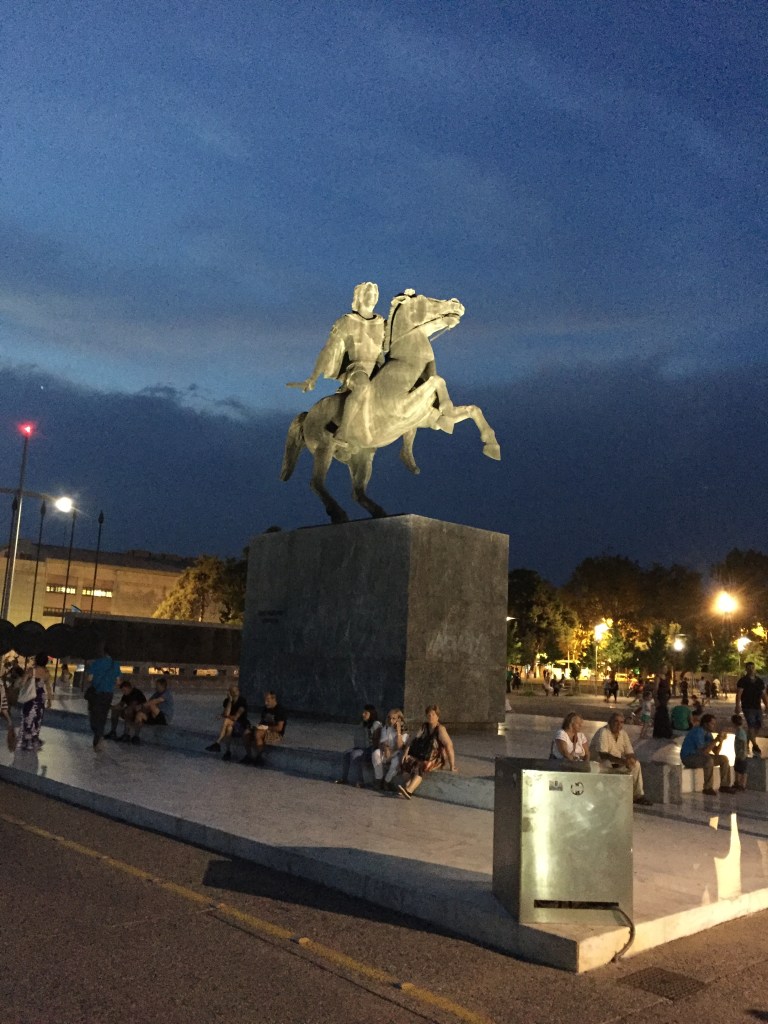
Since I remember I was intrigued to find out about the long history of my birthplace.
Wherever your look at the city’s historical centre, you will be fascinated to discover more about the past and its rulers or conquers: Greeks, Romans, Byzantines, Francs, Ottomans. All these, plus the city’s geostrategic position as the port to the Balkans and Europe, have made it an attractive place to live and visit. In the 15th century, the city accepted a large Jewish population from Spain who escaped the country to avoid Inquisition. These populations, along with the native Greeks and Slavs, Ottomans, Armenians and Europeans, have lived peacefully for centuries, creating a Cosmopolitan and prosperous city. Among other nicknames, the city was also pronounced as the Jerusalem of the Balkans.
In 1922 thousands of Greek refugees from Anatolia came to Thessaloniki, bringing customs and traditions from their lost lands and enhancing the city’s unique aura.
After WWI and WWII there has been a huge shift in the populations: the Ottomans and Slavs were forced to leave the city where the Jew population perished in German concentration camps: Salonika’s 54,000 Jews were shipped to Auschwitz and Birkenau. More than 90% of the total Jewish population of the city was murdered during the war. Only the Polish Jews experienced a greater level of destruction.
My goal is to do a study on Thessaloniki’s recent past, using various principles.
A leap in the past with some nostalgic music playing in the background…
In the spring of 1913, Albert Kahn’s photographers arrived in a multicultural city at a huge turning point in its history. Salonica (or Thessaloniki in formal Greek) was no longer a part of the Ottoman Empire collapsing in the Balkans… Here is a part of BBC’s documentary with the first true-colour photographs ever taken of the Bride of the Thermaic Gulf. Early true-colour photographs of Thessaloniki at the dawn of the 20th century. The clip is taken from BBC’s Documentary: “Edwardians in Colour: The Wonderful World of Albert Kahn – Episode 3: Europe on the Brink”
”Dig anywhere in the city and you collide with history.”
An interview with an author who lived and worked in the municipality of Thessaloniki.
—————————————————————————-
Thessaloniki’s Indian cemetery, dedicated to those who fought in the Balkan Front during WWI
On the other hand…
DESTROYED JEWISH CEMETERY IN SALONIKA
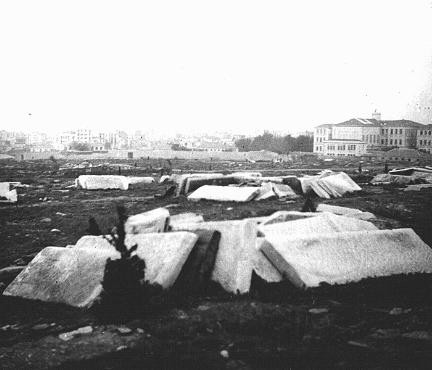
View of the destroyed Jewish cemetery in German-occupied Thessaloniki. The tombstones would be used as building materials.
On December 6th 1942, German occupation forces and Greek collaborators confiscated the Jewish cemetery of Saloniki, which was the largest in Europe with approximately 500,000 graves. Immediately, the tombstones were used to build a swimming pool for German soldiers. The majority of the stones, however, were handed over to the general population. Today, one still finds pieces of gravestones on city walls, stairs and particularly on the campus of Aristotle university, which is built on the cemetery. These gravestones are silent witnesses of a forgotten past in a city that suffers from some kind of amnesia. The film tells the history of the destruction of Jewish and Muslim life in Saloniki – a cosmopolitan city, where Muslims, Jews and Christians coexisted. Consistently most people in the Christian community were Greeks, who lived under Ottoman rule until 1913. Since the Ottomans welcomed Jewish refugees from Spain in 1492, the Sephardim became the majority of the Jewish population of the city and also advanced its commercial importance. Unfortunately, the Jewish presence was nearly wiped out completely after the German SS deported more than 50,000 Jews to Auschwitz in 1943.
The March of the Living brings students, Holocaust survivors, educators and distinguished leaders from all over the world to Poland to commemorate Holocaust Remembrance Day. In Poland, their program includes visits to once-thriving sites of Jewish life and culture as well as sites of Jewish persecution and martyrdom. Then, on Holocaust Remembrance Day, the student’s march arm in arm with Holocaust survivors from Auschwitz to Birkenau. They are joined by thousands of other people of goodwill – of diverse backgrounds and faiths – as they march side by side in memory of all victims of Nazi genocide and against prejudice, intolerance and hate. From Poland, many participants travel to Israel, the birthplace and homeland of the Jewish People, where they commemorate Israel’s fallen soldiers on Yom Hazikaron and celebrate Israel’s independence on Yom Ha’atsmaut.
A nostalgic song, sung in Greek and Hebrew is stating homecoming for the holocaust survivors.
Greek Lyrics:
My sweet Thessaloniki
my glorious homeland
when will the time come
for us to live united?
And to tell you
about the suffering, I had over there
in Poland’s dark shallow streets,
at Birkenau day and night.

Thessaloniki is a city that marks you... its lights, its streets, the memories of the past that have been engraved on it. It is no coincidence that so many songs have been written about her.
English lyrics:
Since I was seeded by an imperial fate
an ancient Macedonian womb brought me to life
with empty quiver I fight the winter
from the castle, to Platamona’s (a fortress under mount Olympus) heart.
Since a Phanariot (area in Constantinople that many Greeks used to live) path brings me (Thessaloniki was a sister city to Constantinople)
a backstreet of Salonika keeps me
come one night to get my promise
before the wind erases it with a sponge I’m looking for you
I’m looking for you in Salonika
in the dawn
your glance is missing from the colours of the daybreak
I’m looking for you I’m looking for you with a violin and a moon
dream is missing, you and the bow
Since I get drunk with a wine from Holy Mountain (Agion Oros)
and with a longing from Constantinople
I’m upset find the knife which separates us in two
and come here in the bulwark of sighs
Since Gods in Olympus have decided
it they gave to the cold the keys and they killed themselves
now the day is waking up and is sleeping alone
with moped, computer and flute
I’m looking for you I’m looking for you in Salonika
in the dawn
your glance is missing from the colours of the daybreak
I’m looking for you I’m looking for you with a violin and a moon
dream is missing, you and the bow.
English lyrics:
It was that night that Vardaris was blowing*
Fathom by fathom, the bow was winning over the waves
The guy sent you to go check the water**3
but you are thinking of Smaro and Kalamaria***
You forgot that rhythm that the Chileans would sing,
St Nicholas and Holy Lady of the Sea, protect us
A blind girl is guiding you, child of Modigliani,
loved by the trainee sailor and two guys from Marmaras
On your small nest, a lazy snake is sleeping
and the monkey is going around looking for your clothes
apart from your mother, nobody remembers you
in this scary journey of loss
Under the red lights, Thessaloniki is sleeping
Ten years ago, you told me “I love you” when drunk
Tomorrow, like then, without gold in your sleeve
you will be looking in vain for the way to Depot.
* Name of a powerful wind that blows in Thessaloniki
** literally “graders” means checking the density of the water using a hydrometer-type of tool
*** Smaro: female name/Kalamaria: name of a seaside neighbourhood in Thessaloniki
**** Depot: working-class neighbourhood in Thessaloniki.
Today, Thessaloniki is a buzzing beehive, with lots of young people studying in the city’s big universities, making it a highly attractive destination.
A small video about the city’s shift from the 20th to the 21st century.
Thessaloniki’s past had a major impact on its gastronomy. All this mosaic of cultures and diverse civilizations contributed to the city creating a unique and diverse cuisine; in the year 2021, Salonica was declared (among others) the Greece’s City Of Gastronomy by UNESCO.
Food brings comfort and unites people; Thessaloniki signifies the fusion of the past and the present and welcomes the visitor to embrace that feeling.
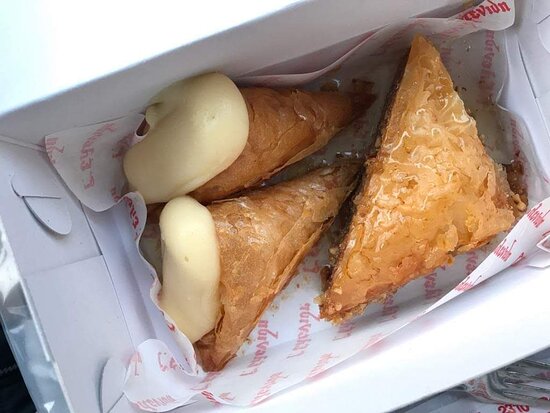
Delicious pastries with custard: trigona (triangle). Traditional sweet of Thessaloniki
I cannot be more thankful for having the opportunity to do this study! It was something that was on my mind, and I was always intrigued to discover more. From the point of view of a Thessalonian, I tried to scratch the surface of my birthplace’s rich history. There are many layers and ways of interpreting facts and incidents, but I tried to make research and highlight the city’s 20th century to find out a bit more about my homeland’s recent past, using videos with historical facts, music and poetry. My goal is to appreciate and understand Thessaloniki’s marvellous journey through the centuries and be a humble observer of this wonderful city’s history.
 Alexander's blog