ALEX Owns Odyssey
Documentation & Reflection
For this exercise, I chose to own the word “Odyssey” because that’s exactly what my creative process has felt like—especially during my time living in China. The experience wasn’t just about relocation or travel; it was a deep, emotional, and often disorienting journey of personal transformation. Like the mythical Odyssey, mine was full of unexpected turns, cultural challenges, moments of awe, and constant self-reflection.
During my stay in Dongguan, Ningbo, and Shanghai, I encountered huge cultural differences—some exciting, others overwhelming. The language barrier was one of the biggest challenges. Even simple daily tasks sometimes became stressful, and I often felt like I was drifting between worlds. But that discomfort pushed me to observe more closely. I became more sensitive to non-verbal cues, symbols, colours, rhythms—basically everything that couldn’t be spoken. This way of “listening” through visuals really influenced my artistic voice.
I was especially drawn to Chinese mythology—stories like Chang’e and the Moon, the Mid-Autumn Festival, the Dragon Boat Festival, the immortals, and the symbol of the dragon. They carried emotional power, and I began to see parallels between those mythologies and my own journey. I realised I wasn’t just documenting a place—I was forming a narrative that mixed reality, symbolism, and memory. That’s where the idea of “Odyssey” really clicked. My journey through culture, time, and identity became a creative path I now see as part of my voice.
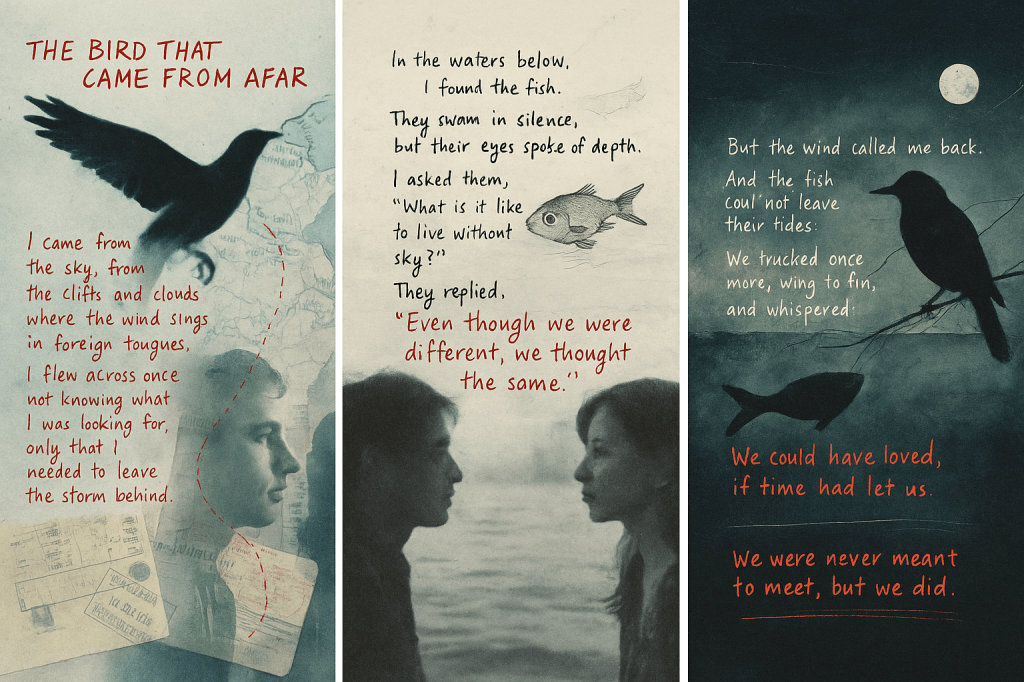
To visualise this, I created a mixed-media piece—a kind of personal triptych. Each section represents a phase of the journey: Departure, Immersion, and Transformation. I layered my own photographs from China with handwritten reflections and myth-inspired imagery. I also experimented with integrating digital elements, like QR codes, to reference the highly technological life I experienced in Shanghai. I wanted the work to feel layered—just like my experience.
The process was really fluid. I tried not to over-plan and instead followed instinct. I started with photography, then experimented digitally, combining fragments of journal entries with images, and weaving in mythological symbols. I worked with texture and transparency to build depth. It felt important to not make everything too polished—because the journey itself wasn’t.
The title, “Alex Owns Odyssey,” is a way of claiming this space in my creative practice. I might not own a material like wire or pleats, but I feel like I’ve developed a style rooted in personal storytelling, cultural observation, and myth-inspired reflection. My creative practice is a constant journey—one that transforms as I do.
This piece isn’t about arriving at a final answer; it’s about showing where I’ve been, where I am, and how I translate those experiences into visual language. It’s the first time I’ve fully seen my lived experience reflected in my work—and that makes it feel honest and grounded.
Inspiration & Research
This idea was influenced by Vuk Vidor’s Art History print, where artists are listed alongside what they symbolically “own.” I was especially drawn to how Donald Judd “owns” shelves and how Pop Art or Kitsch have become shorthand for an entire practice. I asked myself, “What do I own that defines the way I create?” And for me, it was clearly Odyssey—a constant movement between ideas, identities, and cultural frameworks.
I also drew inspiration from:
- Marcel Duchamp, who said, “The creative act is not performed by the artist alone” (Duchamp, 1957). My surroundings, the people, the discomfort—they all played a role in creating this work.
- Rick Rubin’s reflection that “to live as an artist is a way of being” (Rubin, 2023, p. 5), which helped me understand that the process is the art.
Final Work
Title: Alex Owns Odyssey
Medium: Mixed media collage (photography, handwritten text, digital elements)
Format: Triptych (digital or printed)
Themes: Migration, transformation, mythology, digital culture, identity
References
- Duchamp, M. (1957). The Creative Act. Convention of the American Federation of Arts, Houston, Texas. Transcript via The Marginalian
- Rubin, R. (2023). The Creative Act: A Way of Being. Penguin Press.
Based on my China journey, the people I met and left behind, using AI as a premium draft and visualise what I had in my mind, I wrote this story.
“The Bird That Came From Afar”
A visual and emotional triptych inspired by a journey across distance, identity, and impermanence.
This is not just a migration — it is an odyssey.
The bird comes from afar, crossing unknown skies, landing briefly in the deep, strange ocean below.
There, he meets the fish — creatures of another world, yet somehow familiar. They share stories:
the bird speaks of the heavens, the fish of the depths.
There is affection. There is understanding. But not permanence.
This is not a battle against gods or monsters —
this is a battle against time, the god of today.
Unbeatable. Unstoppable.
We do not defeat time —
we learn to trick it, to bend around it,
to carve out moments that linger longer than they should.
This work is a tribute to the fleeting connections that leave a lasting mark,
to the places we don’t belong but momentarily feel at home in,
and to the people we meet — not to keep, but to remember.
This is a first draft.
I want this idea to resonate with me and slowly grow into something significant.
It is the first breath of something bigger that is brewing inside me and needs time to be born.
What began as a metaphor — a bird from afar meeting another world —
is, in truth, the beginning of my story.
This collage, these words, this small odyssey —
they are fragments of my own journey,
the people I met, the moments I cherished, the pain of leaving,
and the wonder of being seen in a place I never expected to call home,
even if only for a short while.
This project is my way of giving shape to what I felt,
to the quiet storm inside me,
and to the beauty of fleeting connection —
the kind that changes you forever,
even if it doesn’t stay.
It will grow.
It must grow.
Because this story — my story —
is not finished.
A Note – A Brewing Fragment
This piece began its life as a thought — or perhaps a memory from another life — scribbled down during a flight from Ningbo to Guangzhou. I saw an image of a small fish near a coral reef, and in that quiet, suspended moment above the clouds, something opened inside me.
Words poured out, almost without thought.
A fish.
An anemone.
A ritual of giving.
A forced goodbye.
Only now, months later, do I realize how prophetic it was. It has become part of a larger story I’m still discovering — a story about journeys, mismatched worlds, and the ache of parting.
It’s not finished.
But it’s breathing.
And it lives inside this project.
Fragment: “The Anemone” — A Memory Shared by the Fish
“I once fell in love with an anemone,” said the Fish, his voice drifting like bubbles through the sea.
“Each day, I brought her coral and shells — small gifts from the ocean floor.
And each time I nestled beside her soft arms,
she embraced me with a gentleness only she possessed.”
“But one day, I had to leave.
Predators had found our reef.
The school was moving.
The danger was real.”
“As we passed the reef for the last time,
she called out to me:
‘Don’t forget me!’
But I didn’t turn back.
I couldn’t.
It would have broken me.”
The Bird was silent.
Even from above, he could feel the weight of that memory,
sinking deep into the dark, warm heart of the ocean.
Inspiration
The story of Ceyx and Alcyone, from Ovid’s Metamorphoses. When Ceyx dies at sea, Alcyone throws herself into the waves to join him — but the gods take pity and transform them into seabirds (kingfishers), so they can remain together. Their story is the origin of the phrase halcyon days — a time of calm and peace.
Seabirds symbolise transformation, mourning and divine mercy. They appear as intermediaries between worlds: the moral and the sacred, the land and the sea, life and death.
They are silent witnesses of storms, the first to rise after the calm returns.
Here’s a bird’s memory-text inspired by that myth, fused with my own narrative of the bird and the storm :
Memory/ draft of the Bird and the Sea – After the Myth
I flew toward the sea to escape the sky.
I saw beauty under the waves,
in coral hearts and voices that shimmered like scales.
But I could not stay. The air calls me back.
The storm waits behind me. And so I rise again—
not because I want to, but because I must.
The fish and I, we are kin now. Bound by sorrow,
by longing, by the refusal of the gods to let us go.
And maybe, one day, the sea will forgive us both
and let us rest…
DRAFT: The Moment They Saw Each Other
They came from different elements — the bird from the windswept sky,
the fish from the deep hush of the sea. In a quiet moment, when the tides paused
and the clouds held still, they saw each other.
The bird had flown far, worn by storms, searching for something it couldn’t name.
And the fish, drawn by a stirring in the currents,
rose — not to leap, but to look.
No words, no touch. Just a glance held between two worlds.
The bird hovered, wings trembling above the surface.
The fish lingered, just beneath the veil of water.
For a breath, they stared into each other’s eyes —
not as strangers, but as something softer. Familiar.
Then the fish drifted back into the depths,
and the bird rose slowly to the clouds.
Another fish, watching from below, asked,
“Who was that?” But the fish said nothing.
Some moments are not meant to be explained.
Only remembered.
 Alexander's blog