Critical Review – Between Lands, Languages, and Different Media: The Bird Who Came From Afar — An Ongoing Odyssey

Alexander Papanikolaou
Introduction: Between Shores, Between Tongues
What happens when the language of memory no longer matches the language of the land? How does a creative voice evolve when identity stretches across countries, histories, and artistic media?
This Critical Review reflects on the development of my Negotiated Project The Bird Who Came From Afar, an interdisciplinary practice combining poetry, myth, visual design, multilingual typography, and autobiographical fragments. The project emerged from living “between worlds”—Greece, the UK, China—and explores exile, longing, reinvention, and the struggle to articulate a voice shaped by many languages.
The work sits between visual poetry, sound, and digital collage, blending “Greenglish,” mythic symbolism, and experimental layout. In what follows, I examine how theory, contemporary art, and my lived experience shaped the work and how a single metaphorical bird became a container for memory, identity, and survival.
Myth as Method: The Bird as Personal Archetype
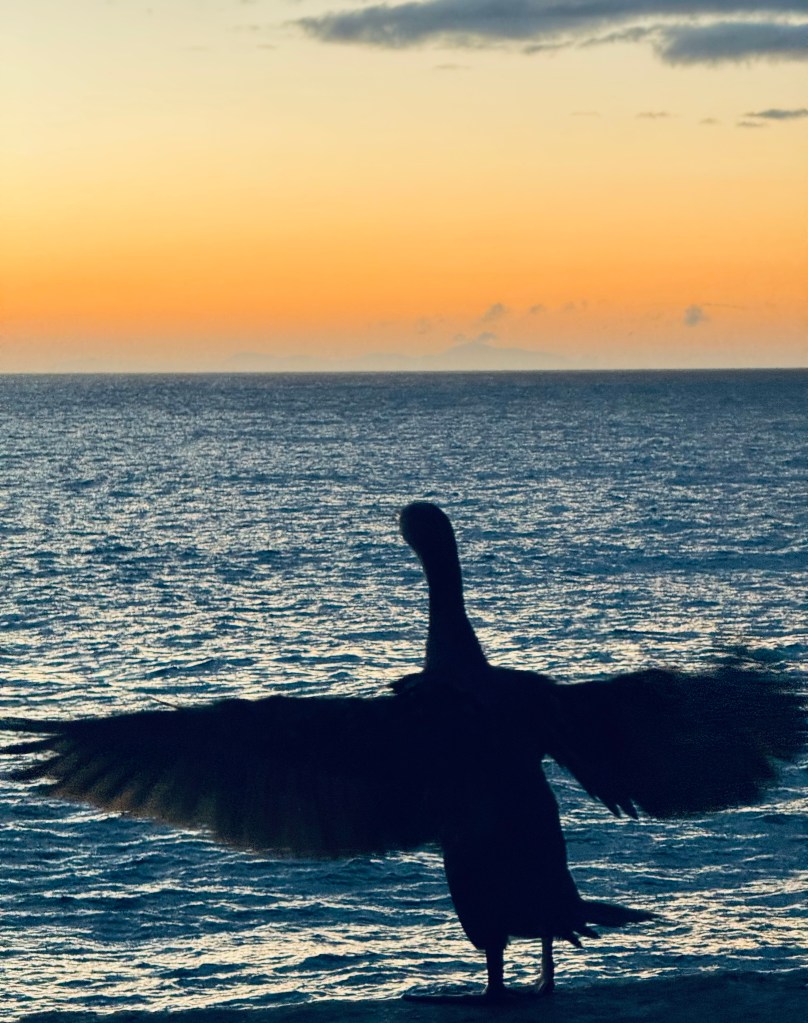
The central metaphor of the bird did not appear through planning but through emotional necessity. It embodied the sense of hovering between places: never fully arrived, never fully gone. Like Odysseus, the bird wanders; unlike Odysseus, its return is uncertain (Homer, 1996).
The bird became a myth-making tool: a creature of many tongues, carrying fragments of homes that no longer exist in the same way.
I designed poems where stanzas mimic wing-beats: short, breath-like lines arranged in mirrored forms. Some texts scatter like feathers across the page, representing fragmentation; others flow vertically, like a migration path. This approach draws on diaspora poetics, where identities remain in perpetual negotiation (Matalas, 2015).
A useful parallel from contemporary art is Caroline Bergvall’s “Drift” (2014), a multilingual work blending Old Norse, English, live performance, sound, and visual typographic structures. Bergvall’s hybrid method, a crossing of languages, media, and geographies, mirrors my own process. Her “Seafarer” sound piece in Drift influenced the way I thought about the bird not as a symbol but as a voice-body, echoing across linguistic thresholds.
Language Plying: Between Scripts, Between Selves
A major methodological strand was what I called “language plying”: the intertwining of Greek, English, phonetic spellings, visual typography, and emotional cadence. The poem:
“Na sou po ti skeftomai
With half a voice and
No syntax, just sea.”
became a foundational experiment. It merges two languages without translation, reflecting what Bhabha calls the “third space,” a zone where identity is continuously negotiated (Bhabha, 1994). This bilingual tension is not decorative; it enacts displacement on the page.
To develop this visually, I studied multilingual and typographic artists:
- Xu Bing’s “Book from the Sky” (1988), which uses invented characters to question meaning and language authority.
- Shirin Neshat’s “Women of Allah” series, where Farsi calligraphy overlays photography to express cultural fracture.
- Concrete poets like Eugen Gomringer, whose spatial text helped me think about silence as structure.
Among literary influences, Joe Brainard’s I Remember (1970) shaped how I treat memory not as a linear narrative but as fragments: a method reflected in my own visual-textual layering.
Poetic Form and Interdisciplinary Presentation
My project experimented with how poetry behaves across media: page, voice, image, and hybrid forms. This was in dialogue not only with traditional poets like Cavafy and Seferis, but with contemporary creators working across installation, performance, and digital tools.
Below, I discuss two:
1.
Caroline Bergvall – Drift (2014)
Bergvall’s work interweaves sonic landscapes, historical text, and multilingual typography. Her visual pages mimic the rhythm of waves — repeated phrases drifting across the page. This directly influenced my piece The Rear Sea (She) Shell, where text washes in and out like a tide. Bergvall demonstrates how form can perform meaning, not just describe it: a principle I adopted consciously.
2.
Simon Willems – Reflection/Fiction Practice
From the OCA case study, Willems’ blending of fictional narrative, visual metaphor, and painterly experimentation helped me understand how autobiography can be mediated through artistic strategies. His emphasis on material storytelling inspired my hybrid pieces where photography, collage, and text interact, particularly in Tales from the Pearl River: The Bird Who Came From Afar.
Case Study: Visual Poem Analysis
To integrate images into analysis, I focus here on a specific work from my project that was influenced by my stay in China and generated other pieces of work in the past.
“Tales from the Pearl River” (Digital Collage Series)
This series combines:
- Photographs taken in China,
- Photos from the UK, Italy and the Isle of Man
- A narrative, a myth to bring the lands together: a fictional story.
- Music to marry all the above
Below is a reflective evaluation:
Strengths:
- Intermediality: The collision of text and image invites multiple entry points for the viewer.
- Cultural layering: The bird moves through Chinese cityscapes, reflecting my own displacement and longing, meeting characters inspired by people I met.
- An emotional journey between lands, cultures, and languages: our hero cannot speak the local land’s language, and the Koi fish can’t speak the bird’s tongue. Two parallel universes: the world of the deep versus the world of the sky. But then comes what Aristotle used to call “apo mihanis Theo’s’’- Deus ex machina- to solve the problem. A local bird who can speak both languages and becomes a bridge between the two worlds.
Challenges:
- Some images rely heavily on atmospheric abstraction; a few could benefit from stronger conceptual anchoring.
- The hybridity sometimes risks overwhelming the poem’s subtle emotional tone.
Still, the experiment successfully shows how image and text can co-author meaning: not merely illustrate each other.
Autobiography, Myth, and Masculinity: The Personal as Political
Autobiography runs through the project, but not in a confessional sense. Myth becomes the structure through which I reinterpret personal experience.
For example:
- Aeolus becomes not a god but a man I met in a bar in China.
- Nausicaä becomes a moment of human recognition that helped me survive emotional collapse.
- Penelope becomes me, the one who both waits and travels.
- The local bird is an Italian friend of mine who speaks Chinese.
- The Koi fish becomes China’s hidden beauty.
Such transformations align with autofiction, where truth is refracted through symbolism (Felski, 2008). Through myth, I could speak about vulnerability, migration, masculinity, and longing without being constrained by literal narration.
This mirrors Cavafy’s strategy of blending myth with personal desire; poems like “Ithaka” and “The City” resonate with my own experience of wandering and return (Cavafy, 1984).
Cultural Positioning and Artistic Lineage
My work participates in a wider lineage of diasporic and multilingual creators. To meet my tutor’s request for specific examples:
- Ocean Vuong mixes English with Vietnamese cadence and memory-fragments, a model for emotional hybridity.
- Chimamanda Ngozi Adichie uses mother tongue inflections to explore identity friction.
- Elena Ferrante’s use of dialect suggests how language carries social and emotional history.
These creators taught me that language is not a barrier but a bridge: a tool for holding multiple selves together.
Conclusion: Ongoing Flight
This project helped me recover and redefine my creative voice. It taught me that:
- Poetry is not an escape from life but a response to it.
- Myth is not an abstraction but a lens for emotional truth.
- Multilingualism is not fragmentation but expansion.
- Interdisciplinary practice allows meaning to move freely between media.
I return to the bird.
It still flies to the unknown.
It still sings a tongue not everybody understands or comprehends.
It still seeks ways to express, to experiment, to discover.
But now it understands its flight not as exile, but as pattern: a choreography of departures and returns, of languages crossing, of identities continually rewritten.
To survive beautifully.
To discover in a drifting world of uncertainty.
To speak, even when the words must be invented.
References
Aristotle. (1987) Poetics. Translated by R. Janko. Indianapolis: Hackett Publishing.
Bergvall, C. (2014) Drift. New York: Nightboat Books.
Bhabha, H. K. (1994) The Location of Culture. London: Routledge.
Brainard, J. (1970) I Remember. New York: Angel Hair Books.
Cavafy, C.P. (1984) Collected Poems. Translated by E. Keeley and P. Sherrard. London: Hogarth Press.
Felski, R. (2008) Uses of Literature. Oxford: Blackwell.
Hanisch, C. (1970) ‘The Personal is Political’.
Homer. (1996) The Odyssey. Translated by R. Fagles. London: Penguin.
Language is a Virus (2023) ‘Creative Writing Techniques – Oulipo and Visual Tools’.
Matalas, D. (2015) C.P. Cavafy and the Poetics of Exile. Athens: Kastaniotis.
Neshat, S. (1996) Women of Allah [photographic series].
OCA (2023) ‘Case Study: Simon Willems’. OCA Learn Platform.
Xu, B. (1988) Book from the Sky.
 Alexander's blog