Project 8: Independence
Continue your self-directed project by selecting and utilising the resources available to you. For example, do you need to spend time researching and using the OCA Library? Do you want to develop and expand new skills using a micro-course from the Skills Hub? Do you need more feedback and discussion about your ideas and outcomes so far – in which case, have you shared your work on the course forums or external network?
Remain close to your project plan, yet allow your ideas to evolve and flow freely. Follow your creative instinct and embrace the challenge of working independently to grow and develop your learning through trialling and experimenting with ideas.
-
Exercise 1: Work in ProgressContinue to work on your project. Use the questions below to reflect on your progress:
- Are you meeting your aims and objectives?
- Has your project plan helped you navigate through different tasks?
- How are you synthesising your practical work and research activities?
- Have you discovered anything new or unexpected?
RESEARCH
Leukothea, White Goddess: the nymph of the foam of the waves.
Rhapsody V of the Odyssey tells the story of Odysseus’ return from the island of Calypso to the island of Phaeacia, which is very close to Ithaca. This return is also a return to the human world. After the gods decided to let Odysseus return, and their message was conveyed by Hermes to the nymph, it was necessary to organize the hero’s departure. He had to set about building a small advantage in a few days, equipped with a foresail and a rudder, as well as a mast and sail. For seventeen days and without any sleep, Odysseus sailed straight ahead, with the Great Bear in his left hand. Although Homer mentions the Great Bear in conjunction with the polar star, the route follows a constant easterly direction. On the eighteenth day, Odysseus sees the land of the Phaeacians and its dark forests. He is therefore almost there. At that moment, Poseidon, returning from Africa and seeing the situation, realizes that his old enemy has almost managed to return to good conditions. Then the god unleashes a storm where the winds blow simultaneously from the four points of the horizon.
If he drowns, the sailor fears a fate harsher than if he died on land, in front of Troy, because then he would have a funeral with all the honours, praising his glory. At that moment, a large wave throws him into the raging sea and breaks up his ship. He is drowning, unable to surface due to the weight of his soaked clothes. He tries to grab what he can from the remains of his raft. But then the four winds push him here and there, each in its own direction. At this point, a goddess, Leucothea, takes pity on him and offers him a sure way to save his life: a veil (Rhapsody V, v. 184). Offering this veil to Odysseus, Leucothea advises him to swim steadily by spreading it across his chest. This veil is “immortal”, since it comes from a deity and protects from death. After this, the goddess dives back into the sea, which “covers” her.
Odysseus does not rely on this promise of salvation and prefers to hold on to what is left of his raft for as long as it lasts. No matter how much the veil protects him, he will ultimately decide to swim only when he cannot do otherwise, that is, soon. At this point, he takes off the clothes that Calypso gave him. He then covers his chest with the immortal veil and throws himself into the water: “he dives headlong, both arms open and begins to swim”. Poseidon can leave in peace: Odysseus has no chance of surviving.
However, he swam for two days and two nights. On the morning of the third day he is very close to the shore, but the force of the waves hitting the sharp rocks of the coast prevents him from reaching land. Another big wave throws him onto the rock, from which he is holding on, scalding his fingers. And then, as the wave abruptly recedes, he is swept out to sea and the sea covers him. Then Athena decides to help him and he is able to swim again, looking for an accessible shore. When he finally steps on land, he takes off Leukothea’s veil and sends it back into the sea, as the goddess had requested, and she takes it. Odysseus may then think that it is time to rest. He makes a bed of dry leaves and covers himself with them.
In this entire scene with Odysseus’ swimming, the saving veil stands out, which, worn around his chest, will save him from the wave that could cover him, or even swallow him. He throws himself into the water with this veil only on him, as if he absolutely needs it to swim, that is, to avoid being completely covered by the water. When he reaches land, he makes a cover of leaves and the veil of sleep covers him.
References:
Homer. The Odyssey. London : New York :W. Heinemann; G.P. Putnam’s sons, 1919.
Inspiration and thoughts
My China Odyssey keeps on inspiring me.
Reflecting on the original story, I can’t help but make connections all the time, parallelising my adventure with Homer’s work. Since the beginning of my journey Leukothea was a name that kept on coming to my mind, not only as beautiful name but as a redemption: The Goddess that saved Odysseus.
Leucothea.
Desperate from the hunt of the wild Poseidon,
I fell into the sea to save myself.
The journey ends here! I said.
I should not have left the certainty of Calypso,
asking her to sail away!
And then she appeared before me.
Take off your clothes! She said.
This veil will save you!
She threw the garment at me and disappeared.
I did not believe her, I confess.
With the storm around me,
The winds blowing from all sides,
I thought I would find a way.
But there was no way.
The raging Sea swallowed my raft.
I took off my clothes.
‘Thus naked I will face you, Poseidon!’ I said.
With the transparent veil girded
And with my gaze towards the Phaeacian Land,
I did not stop swimming.
…That morning, she found me with my face in the sand.
I had reached the shore.
And then she reappeared before me.
Could you give me back the veil? she said.
I returned it to her with respect.
This piece of cloth saved me! I said.
You saved yourself alone! You just had to believe in something!
The veil gave you the certainty that you would be saved,
But the one who swam and came to shore was you.
I knew it from the beginning. I said.
I wanted to have someone who would believe in me.
Who would offer something of themselves and give me faith?
Leukothea turned and disappeared into the foam of the now-calm sea.
Now that I think about it, life always needs a Lefkothea,
who will wrap you in her veil and fall into the void,
sure that you will always be saved,
even if you are walking towards destruction.
Reflection
The poem above belongs to my China project, and comes as part of a greater scheme that evolves along with the journey.
In real life, being isolated and stranded somewhere in China, having the language barrier, unable to communicate appropriately and being through complex tasks, it would be very logical to lose faith and quit: Forget this journey and get back to the safety and the comfort of home and family.
It is like living in the perfect storm Odysseus faces, as described by Homer. But the crucial moment, the time faith is lost, there is an unexpected visit. In Odyssey, a goddess orders Odysseus to strip naked and use a veil to save his life.
My veil is art: the force and the powerful light that comes with it is my saviour who holds my hand and becomes my refuge until the storm passes.
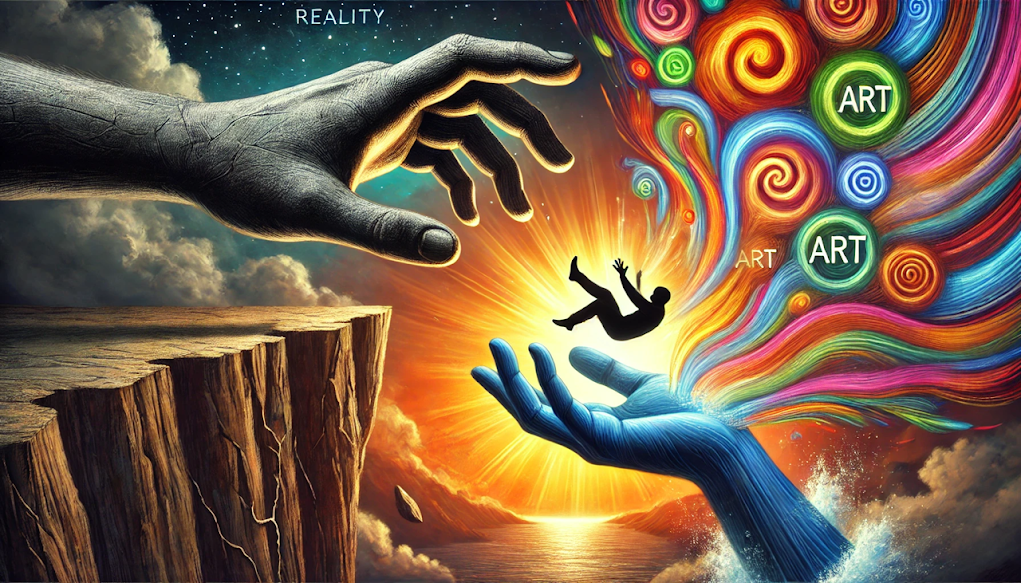
The image above depicts what art means to me. Created using AI.
This journey of mine as a European person who happens to visit a country that is not only far away in terms of distance but also in language and culture. However, this is not the only case. This Odyssey is a lonely, esoteric trip of an individual who uses art to explain how he sees and understands this adventure and how he endures and perceives what he is dealing with: the artwork is the fruit of this labour.
My studies with OCA have helped me in realisation and creation of this project, as an outcome of the whole deed. The assignments are the vehicle on this occurrence because they drive me and take me deeper more and more in this wonderful turbulence.
The skills and tools I have acquired through my study (photography, storytelling) as well my continuous practise on poetry are the brushes and the canvas that shaping what I see, hear, touch, taste and smell.
 Alexander's blog