During this project, you will select and strengthen the technical skills and creative methods necessary to broaden your developing creative language and expand the possibilities to explore the personal and contextual parameters of your practice.
At this stage of your degree, you will have begun to form a Personal Framework of methods that you employ to achieve creative ideas and outcomes. Your methods may be defined by the disciplines that you work with and inspired by particular aspects of interests and aspirations. During this project, you are asked to explore and define your framework and seek to diversify and combine alternative methods to open up new creative possibilities to explore your creative language.
“[…] what is the work of an artist—say, a painter? To produce an eye. The eye is not simply that which is found in the eye socket in the skull. No more than the tongue is only in the mouth. The tongue [la langue], the organ that is in our mouth, is our tongue, not a cat’s tongue [langue de chat], only inasmuch as it also produces language [la langue]. As for our eye, it is painting, sculpture, architecture, the entire visibility of that which has been seen by those who have seen it only to the extent that they knew how to bring it to sight, that weaves it into a noetic eye—and by which it transindividualizes itself.
Just as the tongue/language [la langue] is constructed, the spiritual eye that visible works give us to see is woven by the hands of artists. Therein it appears that a noetic organ always forms a system with one or several other organs that are themselves as such noetic, and that what links them passes outside the body, through a social body that is woven by a tekhnē: the tongue with the hand of the writer, the eye with the hand of the painter, the ear with the hand and the eye of the musician, and so on —all of which is articulated by words, papers, brushes, pianos, and other instruments.”
Exercise 1: Multimodality
- Multimodality refers to the interplay between different representational modes, such as between images and written/spoken words. If you have started on 1.1 Experience Creative Arts, you will have already encountered the case study by Karenjit Sandu, but please look again in the context of what we are presenting to you here. If you have migrated onto Stage 2, we would like to share this case study. Case Study: Karenjit Sandu, Poetic Fragments from the Irritating ArchiveWe can describe multimodality very simply; it is how the human world communicates to us through a combination of different modes (text, image, sound, colour, etc.) in a single form. A valuable person to bring in here is Gunther Kress; a semiotician who defined much of the thinking around this term. He gives us a helpful example as a starting point which can be paraphrased like this: Take a piece of visual communication, a sign for a supermarket you encounter on the street; it contains colour, image, and text, all communicating to you in an instant a complex set of instructions. For example, car park here, there’s the store entrance there, which is what we are (branding). Consider how different modes of representing something can become unified in a single thing.
Google street view image [screengrab].What these multimodal forms of communication do to us and how they make us think or feel gets more complex and trickier to define. For now, we will go on to consider what multimodality means for us as a method for engaging with different modes of creativity.Within the context of the creative arts, multimodality can be seen as the simultaneous exploration of two or more artistic disciplines, regularly alternating and experimenting with various creative practices to maintain imaginative agility. The theory is that by expanding your range of creative engagements, such as creating a drawing and then writing a poem about it, you can deepen your connection with imagination and decentre thought processes from regular linear consciousness. Multimodality also explores the connections between knowledge, skills and practices with outside worlds and communities, essentially understanding how different modalities play different parts in various domains, for example, how digital media has given rise to new domains of modality and transformed old ones.
- For this exercise, consider your interests and work so far.
- Then make a learning log entry highlighting some examples of multimodality. This could be through visiting your local high street or from an exhibition or your previous work.
- Additionally, review the following OCA blog posts and Karenjit Sandhu’s case study and summarise your understanding of the key aspects of multimodality within your Learning Log.
- Add your thoughts on multimodality and your practice in the Multimodality Forum.
- Creative Arts ‘Crossing The Boundary’
- Crossing the Boundary Padlet
- Writing in 2020: Multimodal writing and the pandemic
Multimodality
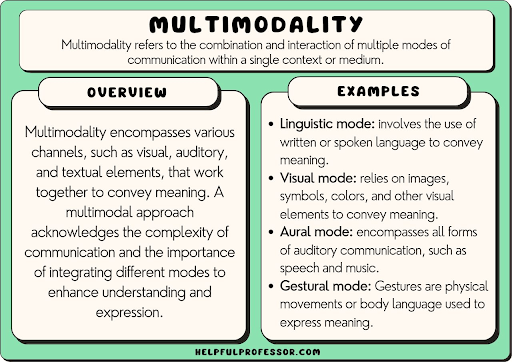
Multimodality incorporates a diverse range of channels, such as visual, auditory, and textual elements, which collaborate to convey rich and intricate meanings. Embracing a descriptive multimodal approach underscores the significance of integrating these different modes to vividly enhance communication and expression.
Multimodality can be observed in various forms of media and communication.
Some examples include:
1. A presentation that combines spoken words with visual aids such as slides, charts, and videos.
Presentations expert David JP Phillips shares key neurological findings on storytelling and, with the help of his own stories, induces in us the release of four neurotransmitters of his choice.
2. A website that integrates text, images, videos, and audio to convey information and engage users.
The website above provides information about its collections and inside information about yarns and how they are sourced using videos, music, pictures and storytelling.
3. An advertisement that combines visuals, music, and text to create a compelling message.
4. A film or video that incorporates dialogue, music, sound effects, and visuals to tell a story.
5. A museum exhibit that utilizes artefacts, labels, images, and interactive displays to educate and entertain visitors.
Multiple communication modes can work together to strengthen and enrich the overall message. In today’s digital world, multimodal communication is widespread and vital for effective communication in diverse settings. In my opinion, in view of the fact of human diversity, the more disciplines one uses to communicate one idea, the more the chances are to be adopted by a larger audience.
 Alexander's blog