“Once you see the boundaries of your environment, they are no longer the boundaries of your environment.”
Marshall McLuhan, Understanding Media: The Extensions of Man (1964) New York: McGraw-Hill. P11.
During this project, you will continue to build and expand your creative language by developing greater synergy between your choice of disciplines and creative ideas. By augmenting your framework of creative methods you are expected to encounter the boundaries of your practice and navigate ways in which to test and reinforce the relationships between your making and your engagement with thematic ideas.
As McLuhan suggests above, in identifying our boundaries they cease to be boundaries as such, and we can open new doors of exploration, both practically and conceptually. During this project, you will map the connections and boundaries between the elements of your work in order to form more specific points of engagement with personal and unique configurations of practice and research activities.

Jeppe Hein, Why are you here and not somewhere else (2004) (Neon) The Booth School of Business Art Collection, Gift of Dean Valentine and Amy Adelson.
-
Exercise 1: Diagrams and Mapping
- The use of diagrams, visual representations, mind maps, etc., is about understanding the concepts and ideas we are exploring in a concise and convenient manner. The use of diagrammatic reasoning to visualise the various aspects of creative practice is useful in identifying the boundaries in which we work and possible pockets that remain unexplored. Begin this exercise by creating a Venn diagram with yourself in the middle. Create a connecting area indicating the disciplines you are engaged with, followed by another area outlining the thematic ideas and research interests your work seeks to explore.
Example diagram indicating the connections and boundaries between disciplines, thematic ideas and research interests seen in the work of Tacita Dean.The image above is an example of a Venn diagram; however, you are encouraged to be creative with yours and use diagrammatic techniques in the best way to map and visualise the current aspects of your practice. Aim to form links and connections between your practical activities and the thematic ideas inherent in your work. Any isolated elements may indicate gaps and thresholds you can begin to bridge during the forthcoming exercises and projects.
My Venn diagram
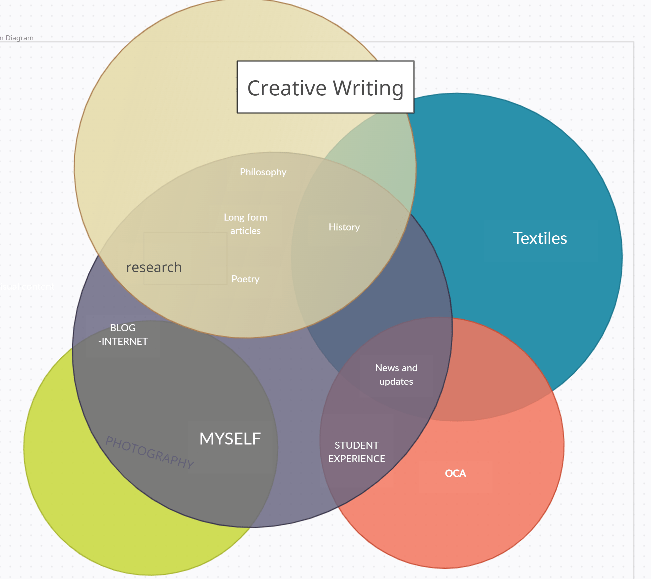
My Venn diagram demonstrates my Creative Arts experience. In other words, it is how I perceive and understand the world of OCA through the prism of my studies. I aim to align the circles completely: all three disciplines must harmonise to dance to my needs and point of view, creating an experience that satisfies my needs to express myself and fulfil my creative passion.
The hardest part is finding the path to understanding the process. I’m logging in to open the right doors, get to the right pathway, and discover new forms and codes.
I know that I will often get demotivated and disappointed because halfway through, I will realise that the road I had chosen to walk is different from the one for me and that I had wasted my time wandering around without any practical benefit. It takes work to find treasures and riches. But when you do:
<<what pleasure, what joy,
you enter harbours you’re seeing for the first time>>
I discovered that no element stands alone in contemplating the forces that drive and influence my learning journey. I suggest, in addition, improving the techniques and shining the surface of the medium used to achieve a better context and a result that is more pleasant to the eye.
The driving force is that there is more to come, more to learn, more to stumble on and find out. That element alone is the strongest feeling a person like me can use to push himself more rigidly and robustly. The journey is still on, and the flame is flickering, highlighting the way forward in the dark.
References:
ITHACA, CAVAFI, CP. (1911)ONASSIS CAVAFY ARCHIVE THE DIGITAL COLLECTION OF THE CAVAFY ARCHIVE . Available at: URL https://cavafy.onassis.org/object/429h-6h86-99hw/ (Accessed 23/06/2024 ).
 Alexander's blog