I worked really hard on that project,but the hard work,in my opinion, paid off; I’ve managed to walk a lot further on my Gnostic path by experimenting on brand new and exciting assignments.
Making a study on Vincent Van Gogh’s masterpieces , got me onto a track of understanding the different layers of a painting and above all ,the reasoning and the search for answers on fundamental questions through fine arts, which in my point of view is the definition of art of any kind.
To explain a bit more,by exploring creative activity and what is all about, it had been made clear to me the fact I had shown a significant change in the way I perceive, the way I embrace, the way I endeavour , the way I indicate a subject and this process, as mentioned before, helped me to go a lot further than expected and show a significant advance .
First of all Project 1 in drawing: I would say this is the area I had demonstrated the most progress above all.
I know there can be a debate on this subject but considering my starting point where I had never ever created anything similar to gauche painting and the steps I went up the ladder on this field, I would say I had learned a lots of new and fascinating techniques in order to be able to create a piece on an acceptable level:
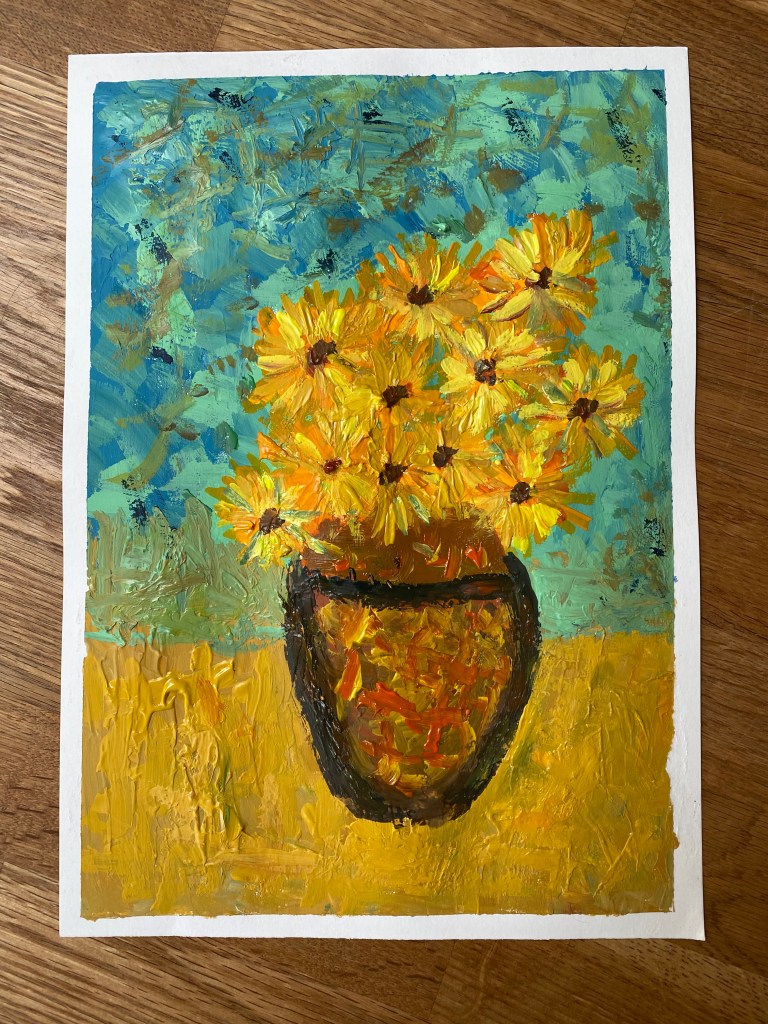
sunflowers in a vasemy cypresssunflowers in a vase zoom detailsunflowers in a pot
I thoroughly enjoyed the drawing process but in that assignment there has been a lot more than just sitting down and drawing :
I have been working in the knitwear industry for more than 25 years . My job, as I was going down the learning curve, has been to create, innovate and demonstrate knitting surfaces. With Project 2 I realized there is a whole new perspective beyond what I was doing so far. To my great surprise, I’ve noticed where in the past I was concluding my job saying my part is finished lets move on to the next project ,I can say now ,that moment in some cases, can be the starting point for something new ;the best part is by reusing the old knit down and whilst working on a ready made fabric I may end up following different rules .What was wrong to do on the knitted piece when the garment had been knitted, could be right after all I had comprehended on assignment 2 and that point can be the annihilation of the new reworked piece with its form and consistency changed and be taken to a whole different direction .Very exciting -thinking-out-of-the-box discovery which can be explored a lot more in the future as its an alternative, an option worth to be considered.
coin wrappingcut out to reconstruct the fabrictea bag dyeing process
Finally, building a collection having in mind all the multiple aspects of seeing beyond a fabric’s surface, Project 3had introduced to myself a new way of putting all components together with the exterior on the fabric not be on the focus but in cases to be completely disappeared :
sometimes in layers
other times reconstructed
and some other times certain areas vanish to be replaced with something totally different:so absence creates surface!
As you set out for Ithaka hope your road is a long one, full of adventure, full of discovery. Laistrygonians, Cyclops, angry Poseidon—don’t be afraid of them: you’ll never find things like that on your way as long as you keep your thoughts raised high, as long as a rare excitement stirs your spirit and your body. Laistrygonians, Cyclops, wild Poseidon—you won’t encounter them unless you bring them along inside your soul, unless your soul sets them up in front of you.
Hope your road is a long one. May there be many summer mornings when, with what pleasure, what joy, you enter harbors you’re seeing for the first time; may you stop at Phoenician trading stations to buy fine things, mother of pearl and coral, amber and ebony, sensual perfume of every kind— as many sensual perfumes as you can; and may you visit many Egyptian cities to learn and go on learning from their scholars.
Keep Ithaka always in your mind. Arriving there is what you’re destined for. But don’t hurry the journey at all. Better if it lasts for years, so you’re old by the time you reach the island, wealthy with all you’ve gained on the way, not expecting Ithaka to make you rich.
Ithaka gave you the marvelous journey. Without her you wouldn’t have set out. She has nothing left to give you now.
And if you find her poor, Ithaka won’t have fooled you. Wise as you will have become, so full of experience, you’ll have understood by then what these Ithakas mean.
It has been a great voyage. I might have faced many difficulties on my way , my own Cyclops, my own Laistrygonians the angry Poseidon,but using the knowledge acquired on my footsteps through ATV I’ve managed to keep my route still and find my way around . I kept ”Ithaca” in my mind and I tried not to rush at all but be patient and with persistence and hard work << with what pleasure and joy I got into harbours never seen before>> and by embracing all the new encounters I had realized what all of this kind of experiences mean!
Gathering the pieces I have created on project 3 and reflecting on them I thought there was a room for further improvement in order to be more happy with the outcome .
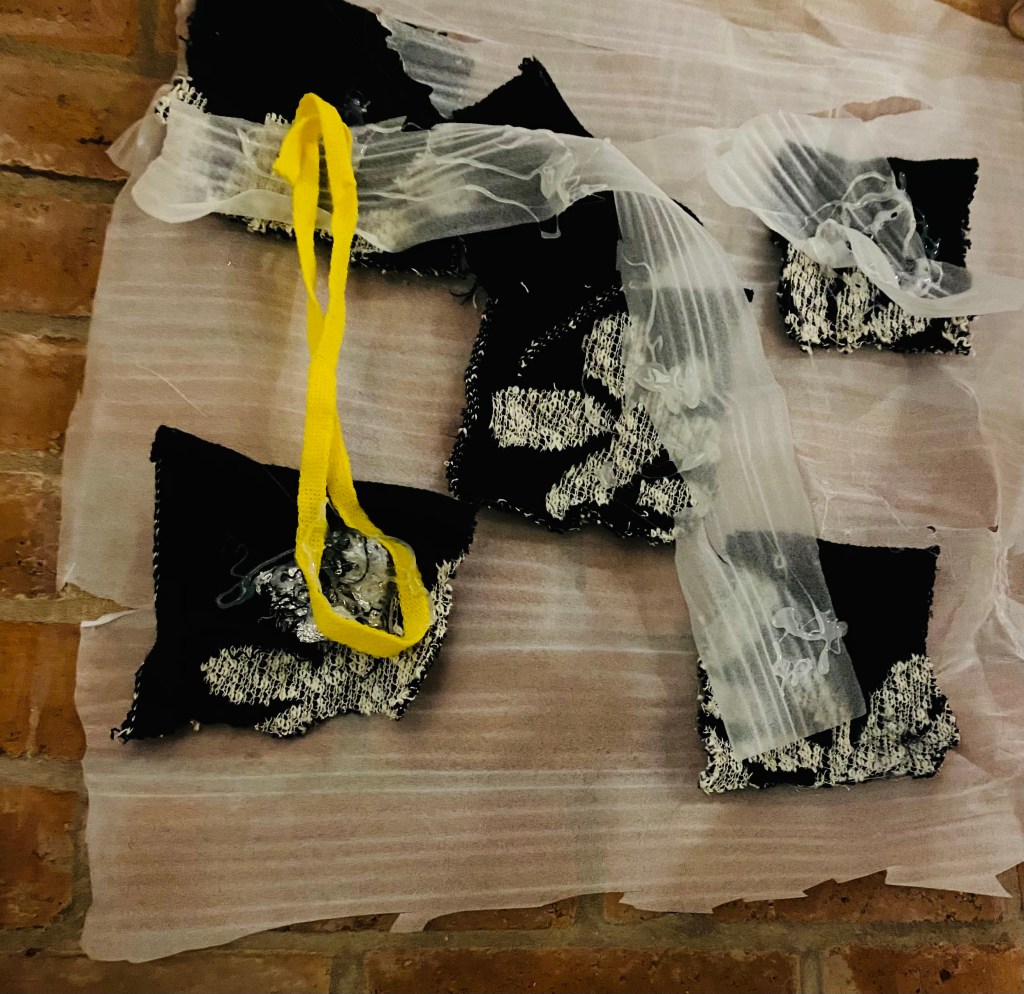
I wanted to give more texture in certain surfaces and in order to achieve that I looked back on a previous experiment I worked on project 2.
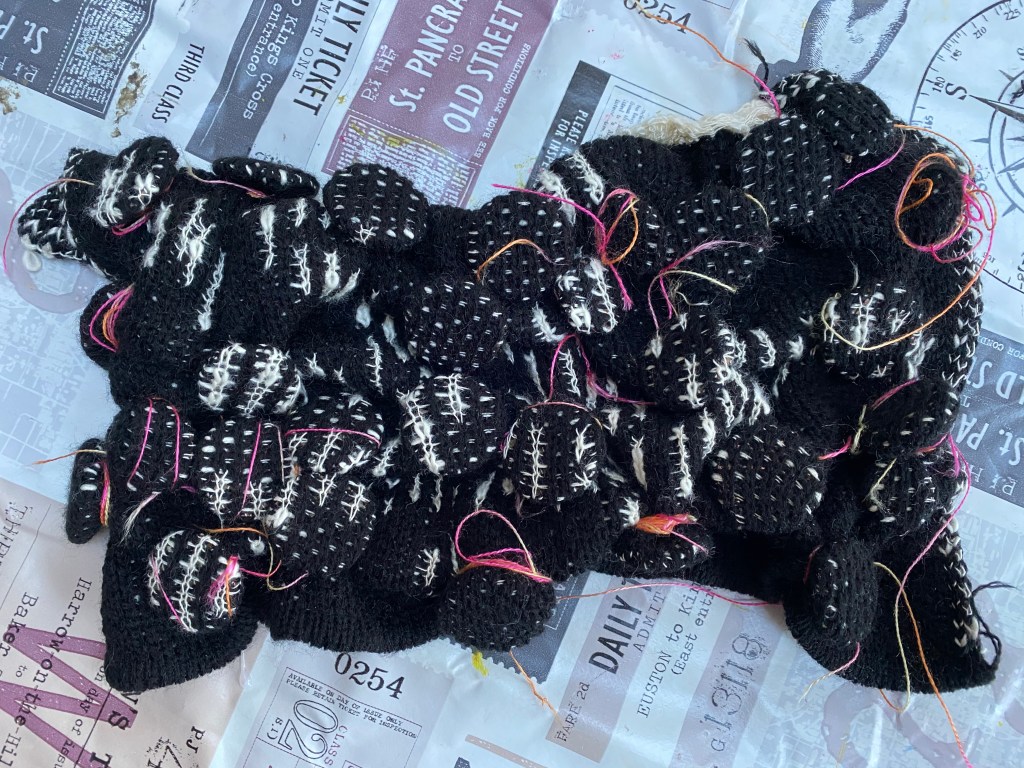
In that specific case I had wrapped coins with yarn on a piece of own knitted fabric.
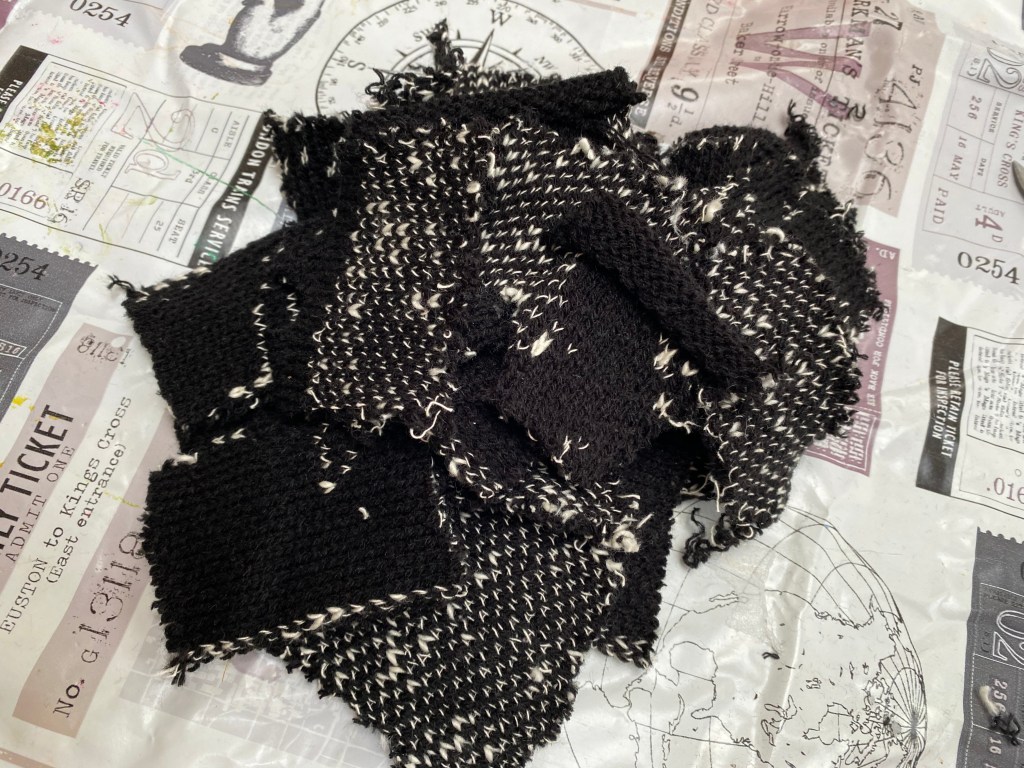
I was really happy with the result , but because the coins were heavy I wanted to take them out and I had cut the area around them which had created a nice circular motif.
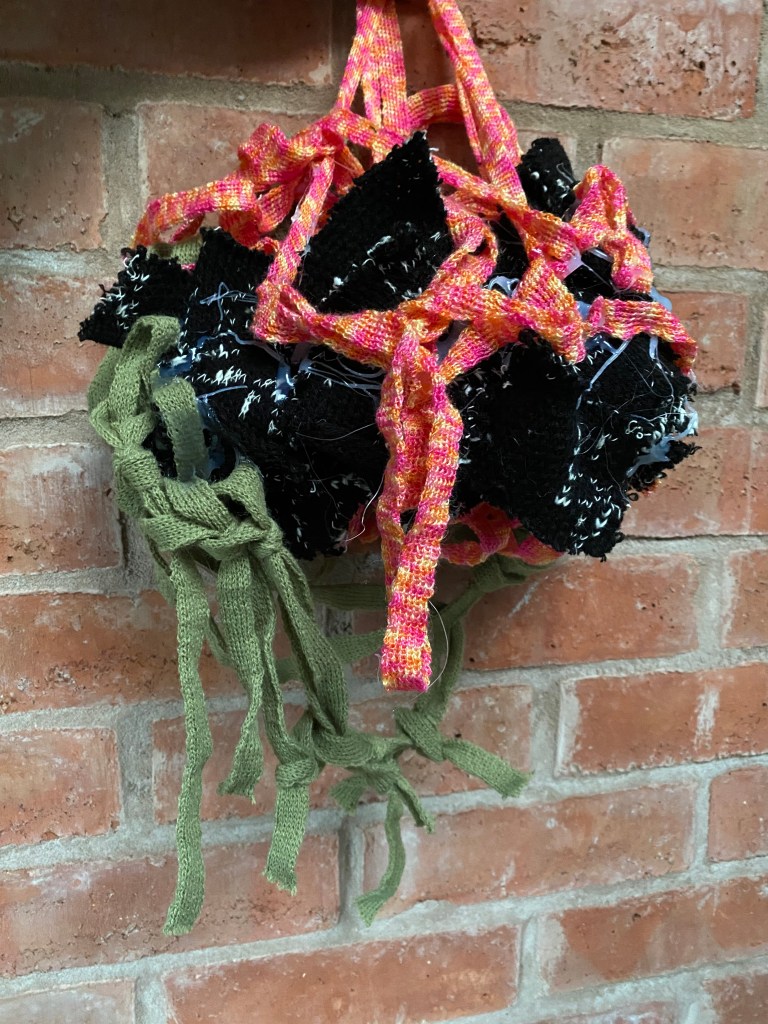
Following this idea I had sourced lightweight buttons along with a nice pink sequin yarn as well as a thick wire .
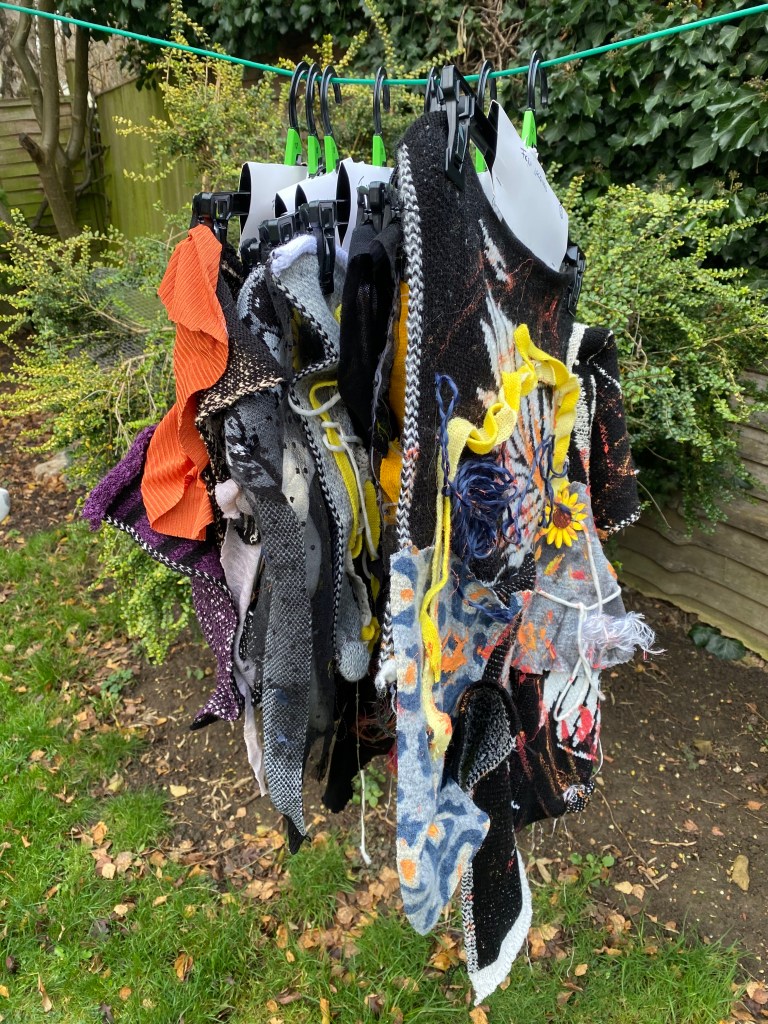
I had hanged my fabric collection in order to be able to have a better overview of my collection as well as I was able to see how the garment on each sample was draping as it was hanging free.
PIECE #1
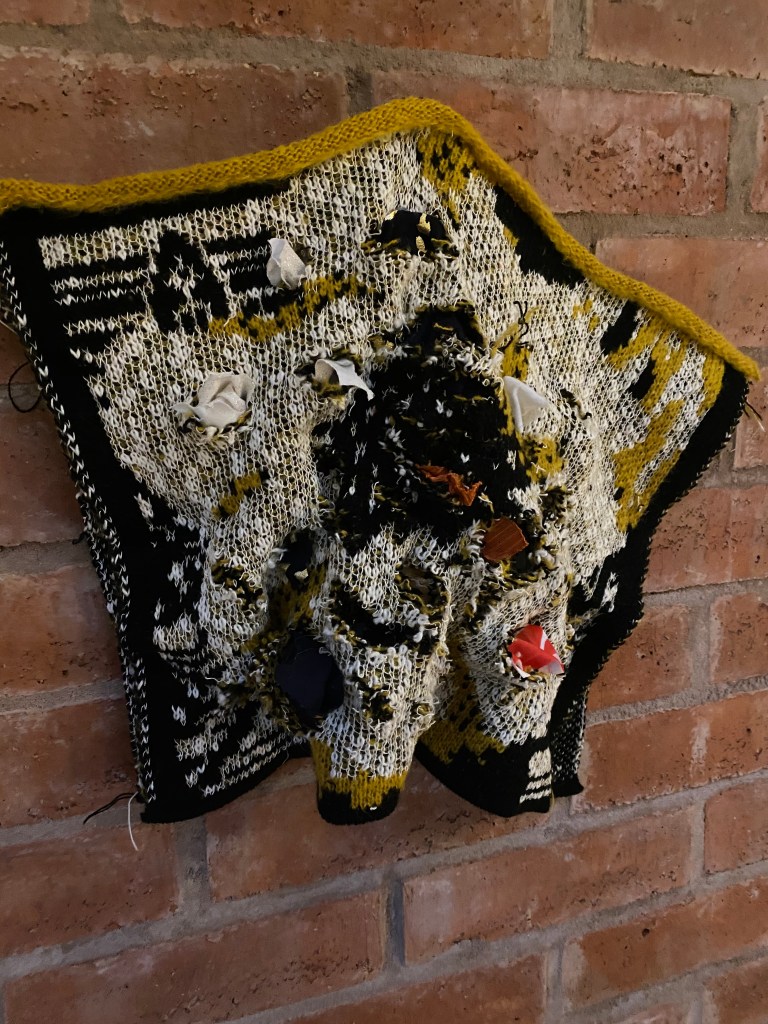
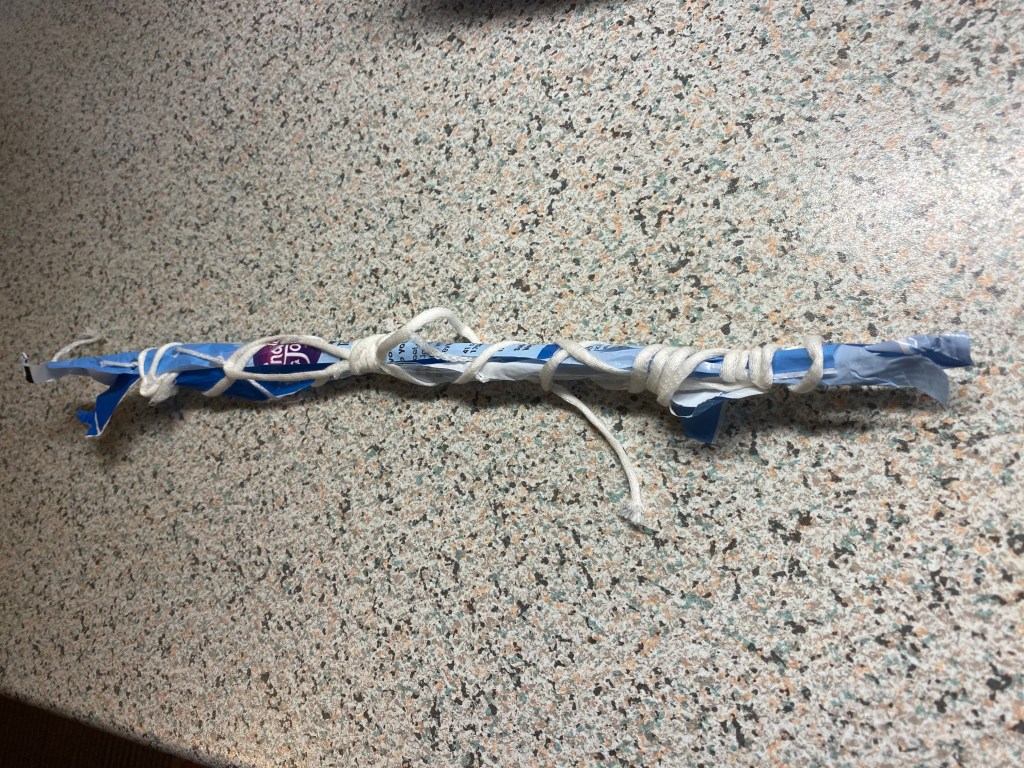
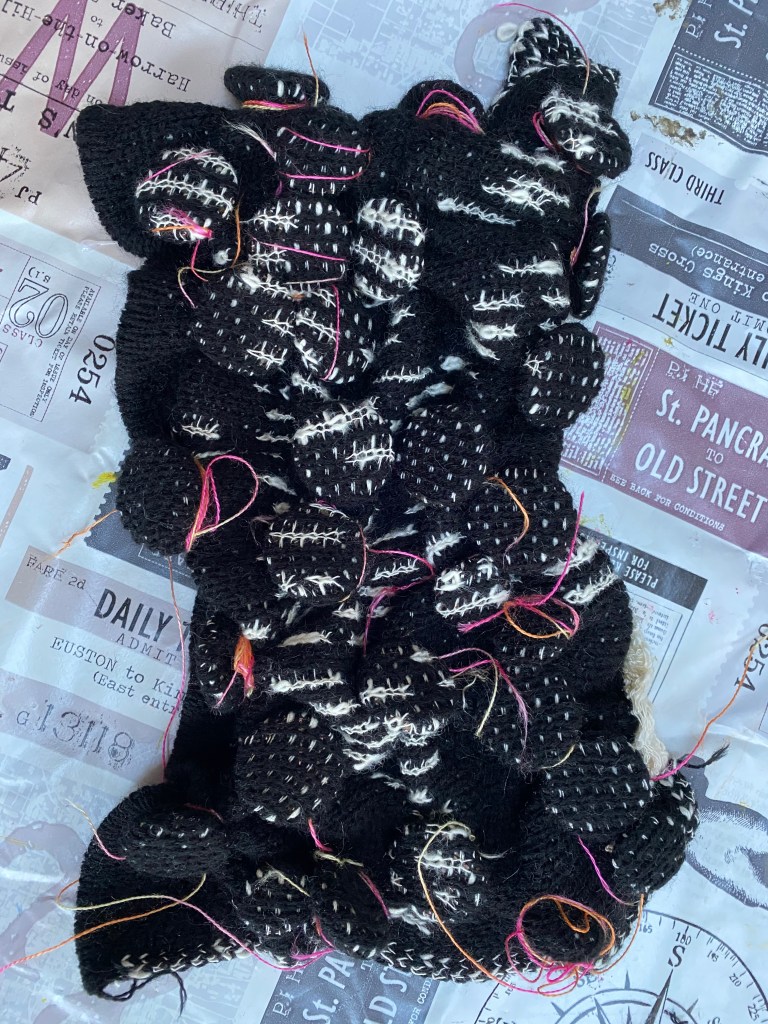
I’ve used my buttons in order to run a continuous single yarn so it is not glued onto my sample.
It has been used to pull set-loose certain areas as well as to distort them.
PIECE#2#
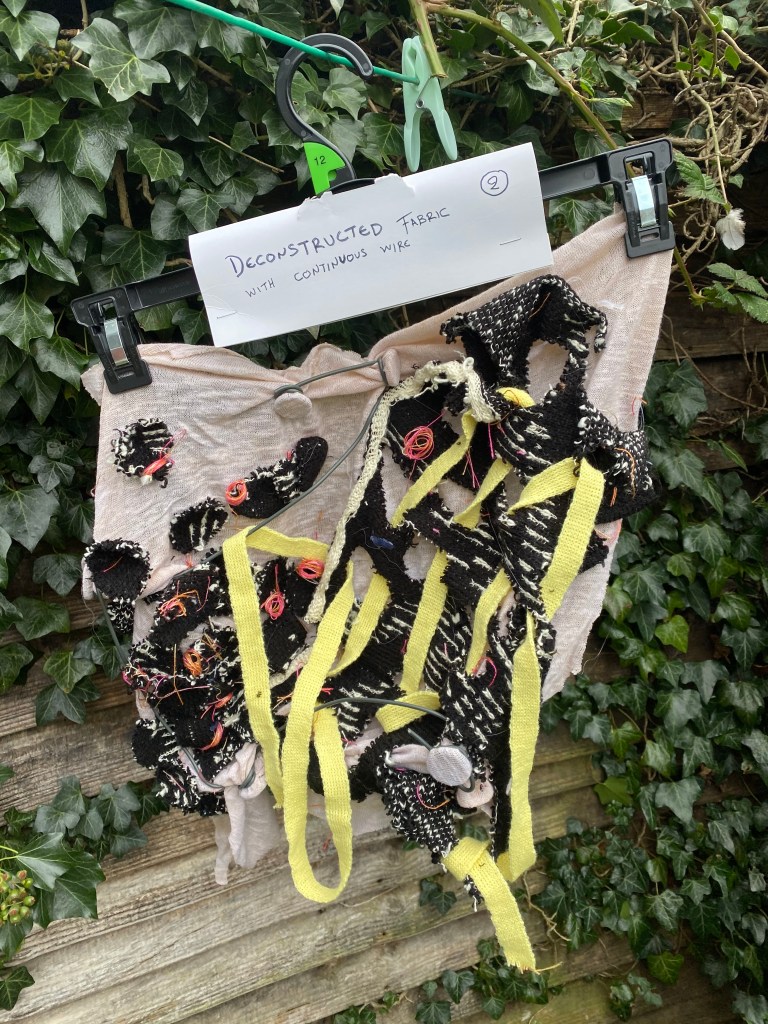
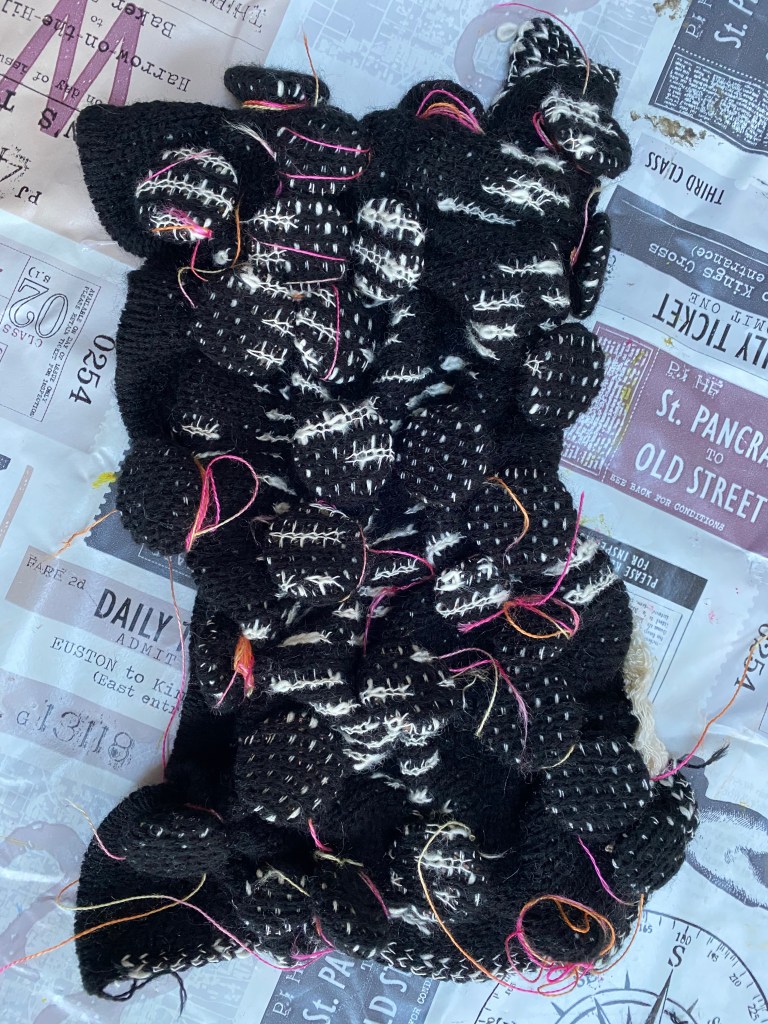
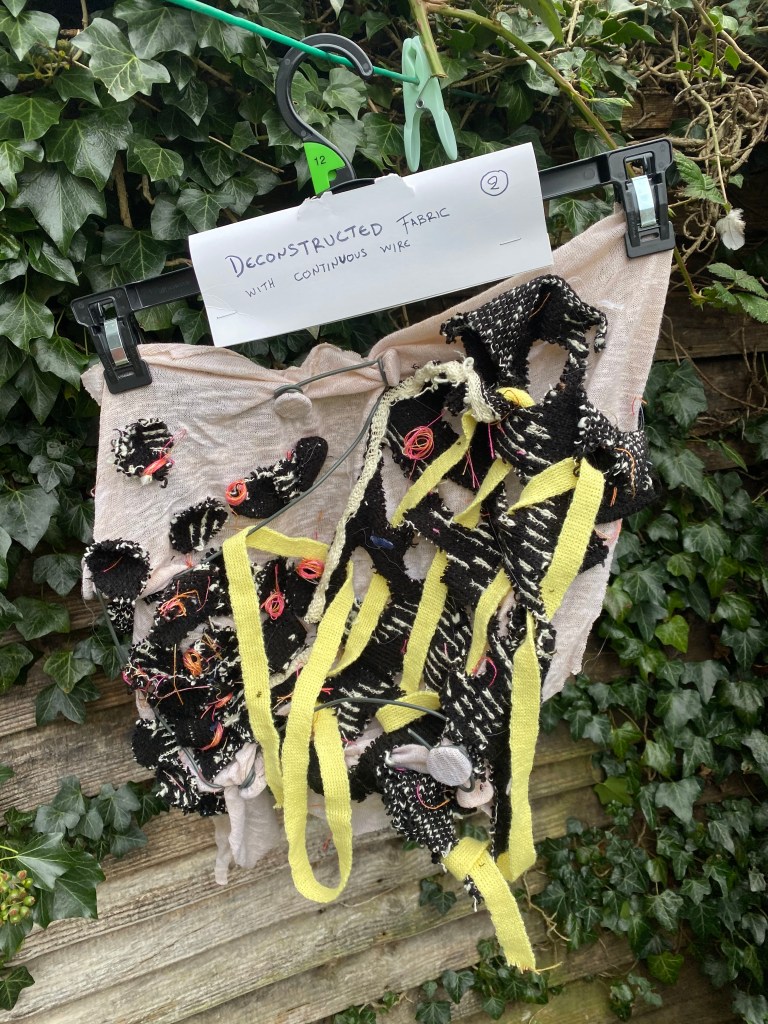
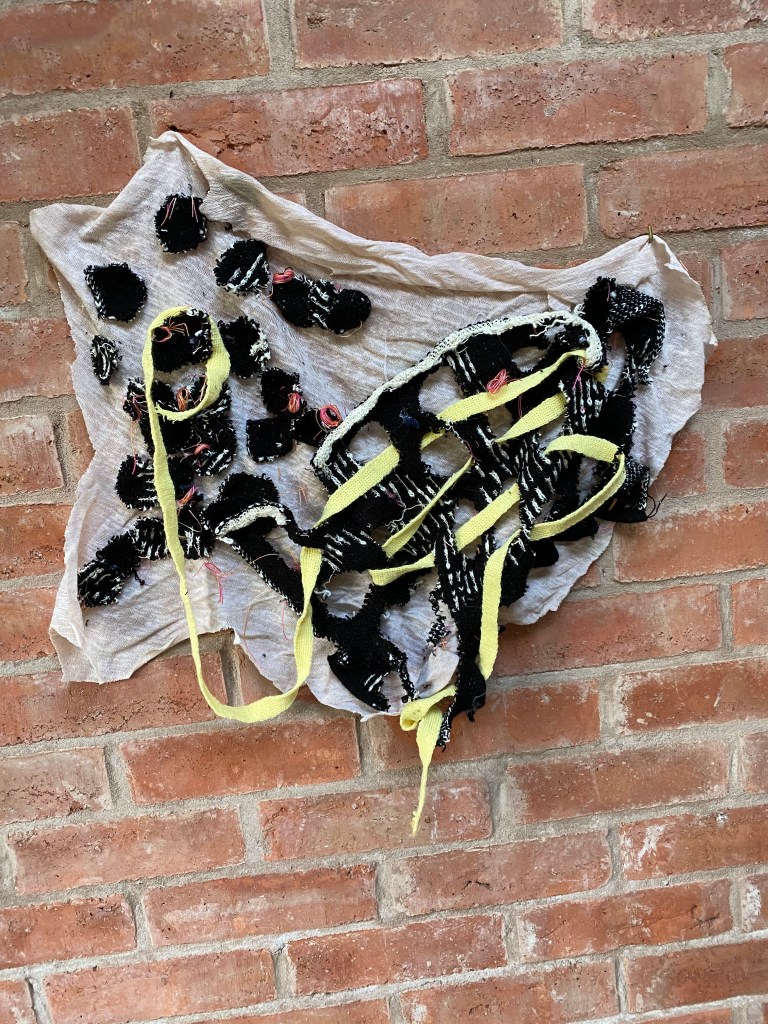
Sample number 2 includes my coin inspiration piece with the cutouts been placed on the side of a tea dyed fabric surface, with a stiff and solid wire in addition of the embellishment and the the garment deformation playing the ”exoskeleton” role as it is keeping the fabric still and steady.
PIECE#3
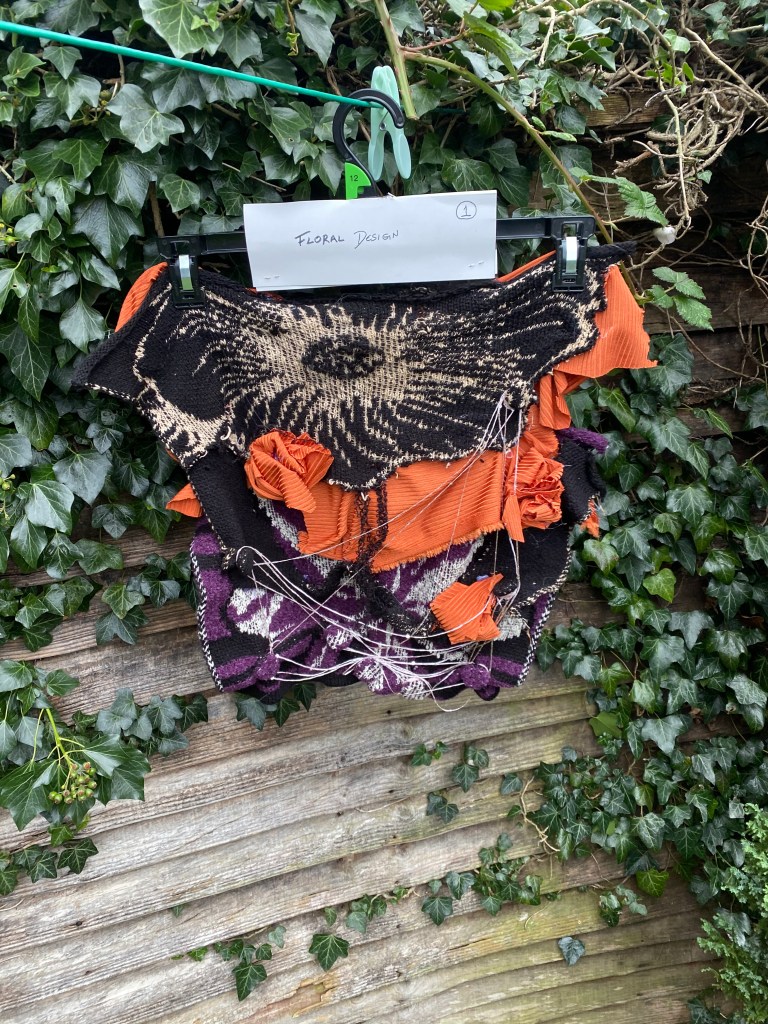
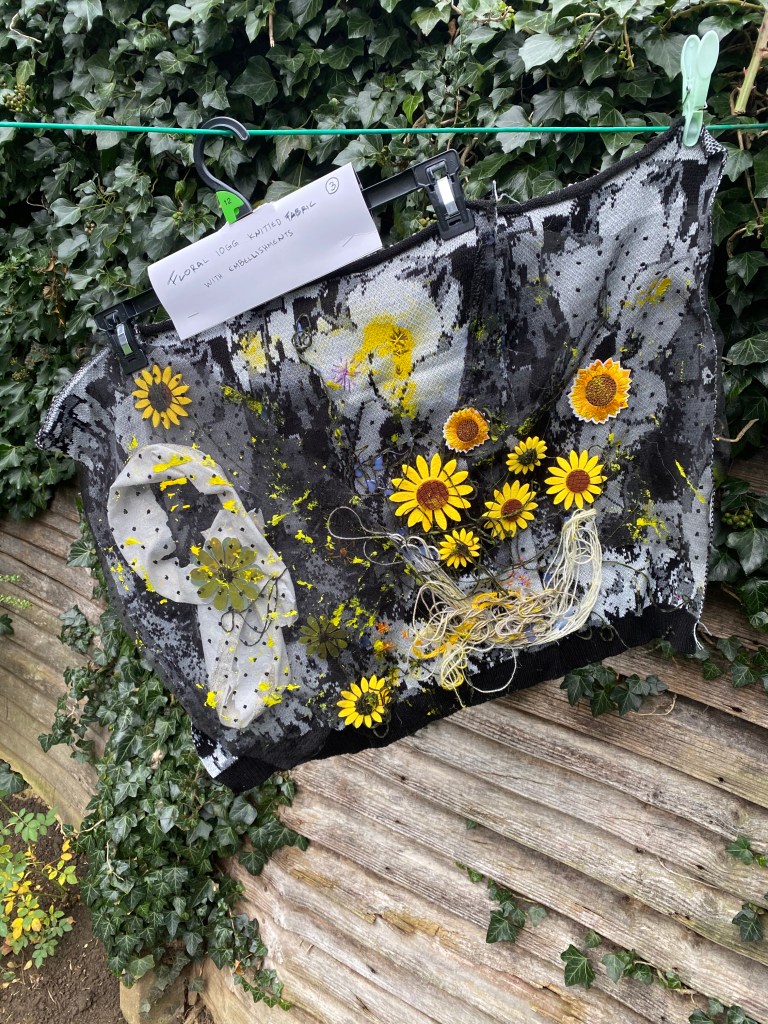
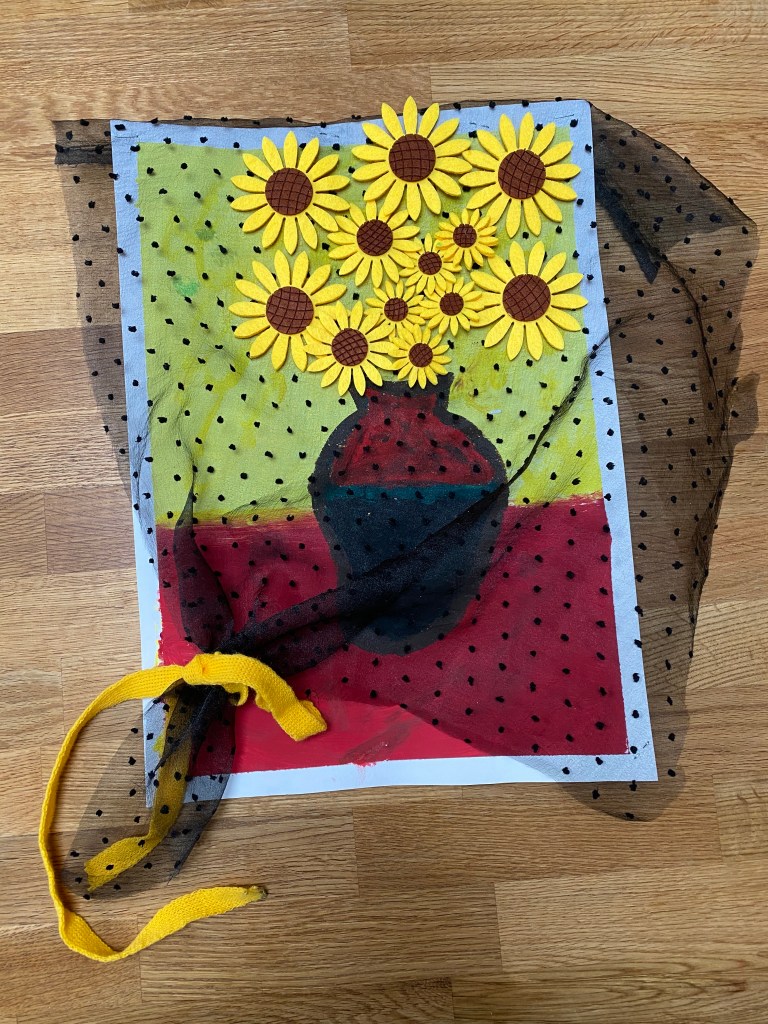
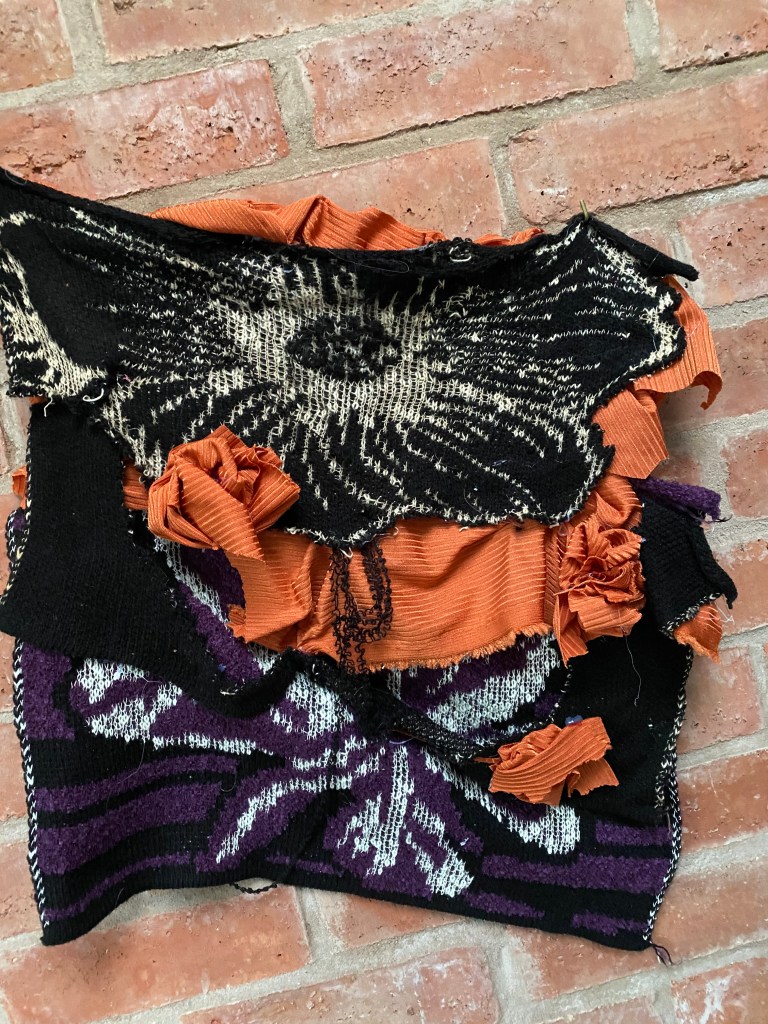
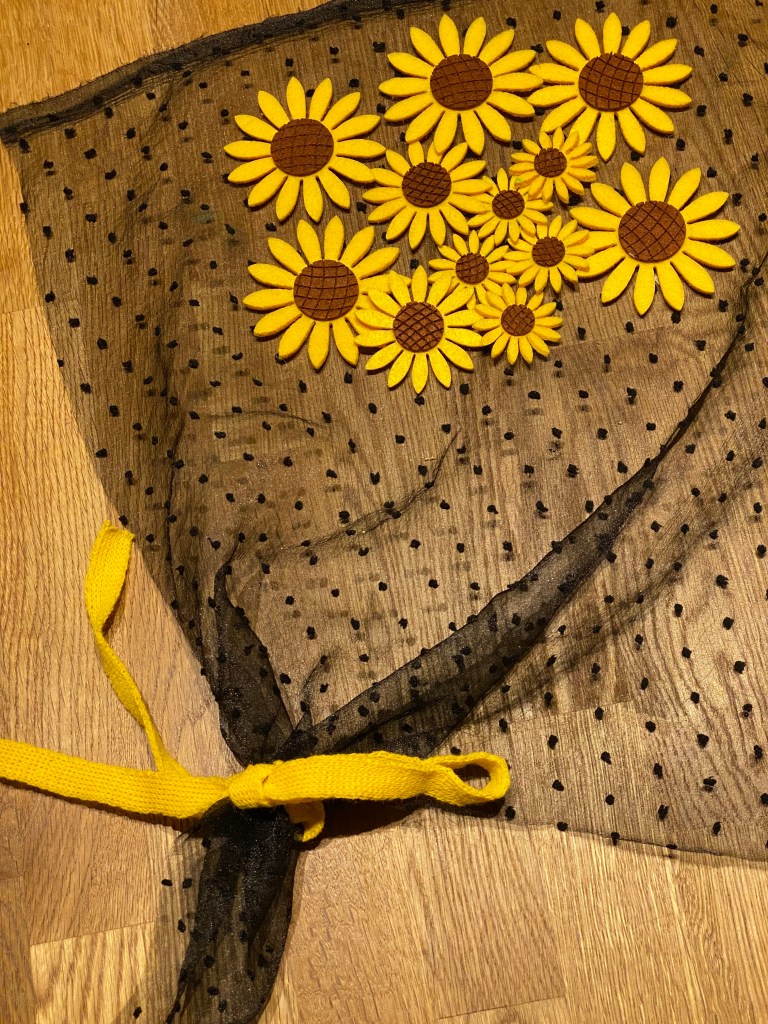
My Sunflower pot with organza and a 10 gauge floral jacquard background.
PIECE#4
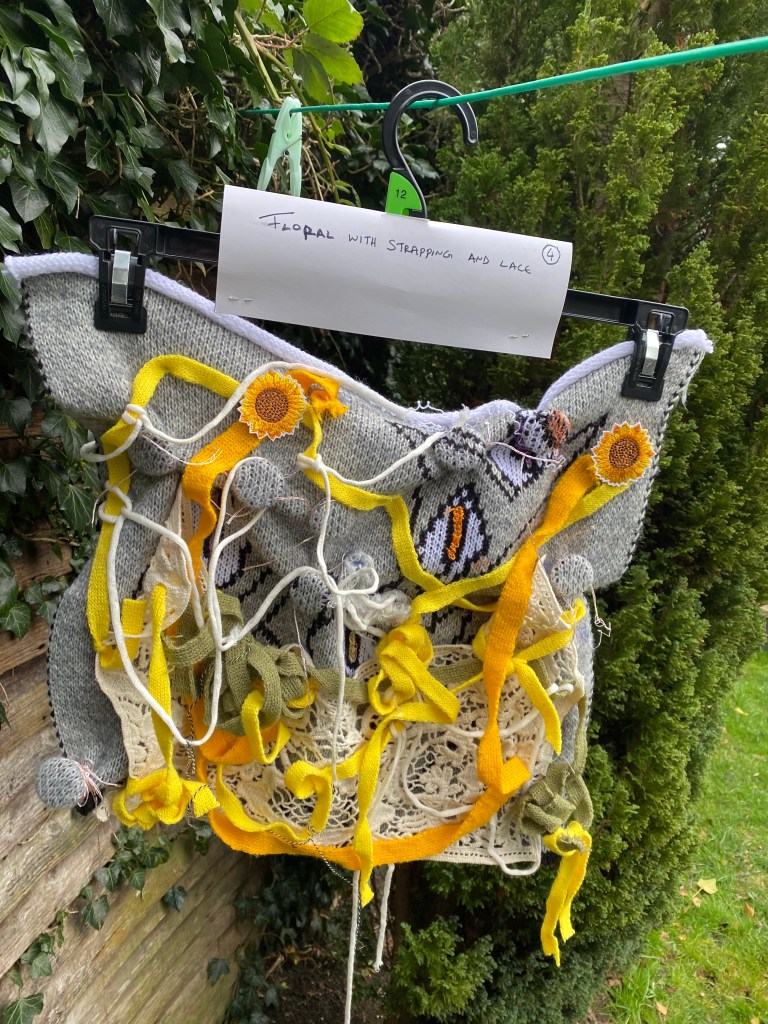
Hand embroidered 5 gauge tulip buds along with tape yarn and lace with the buttons been individually wrapped this time .
PIECE#5
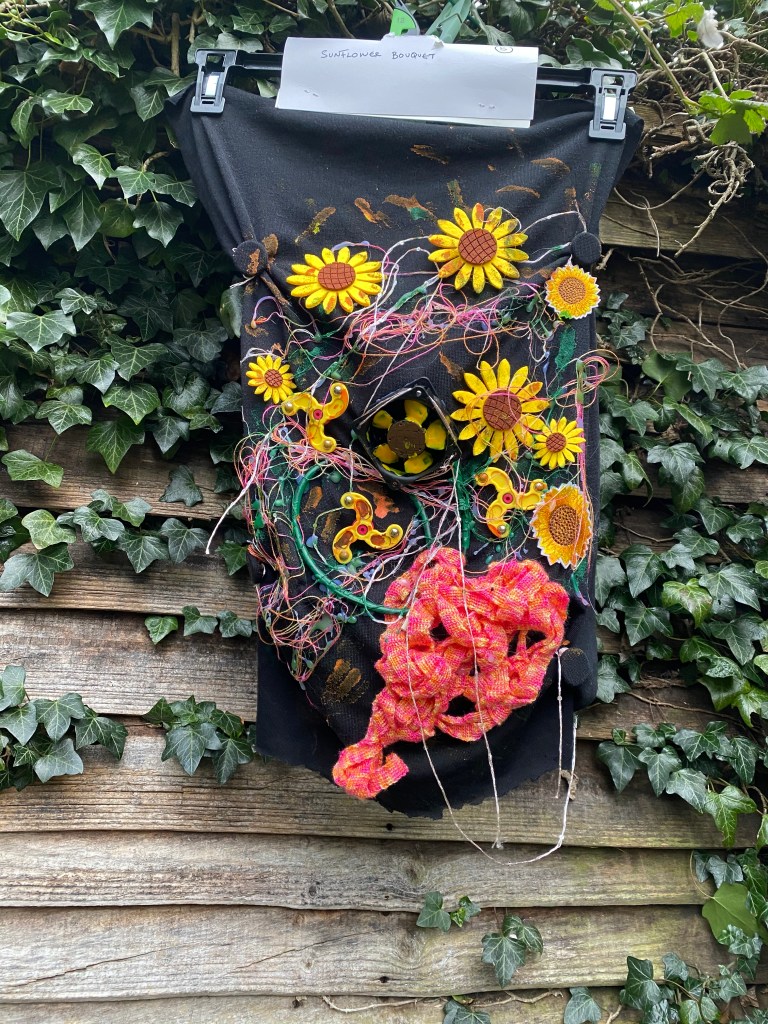
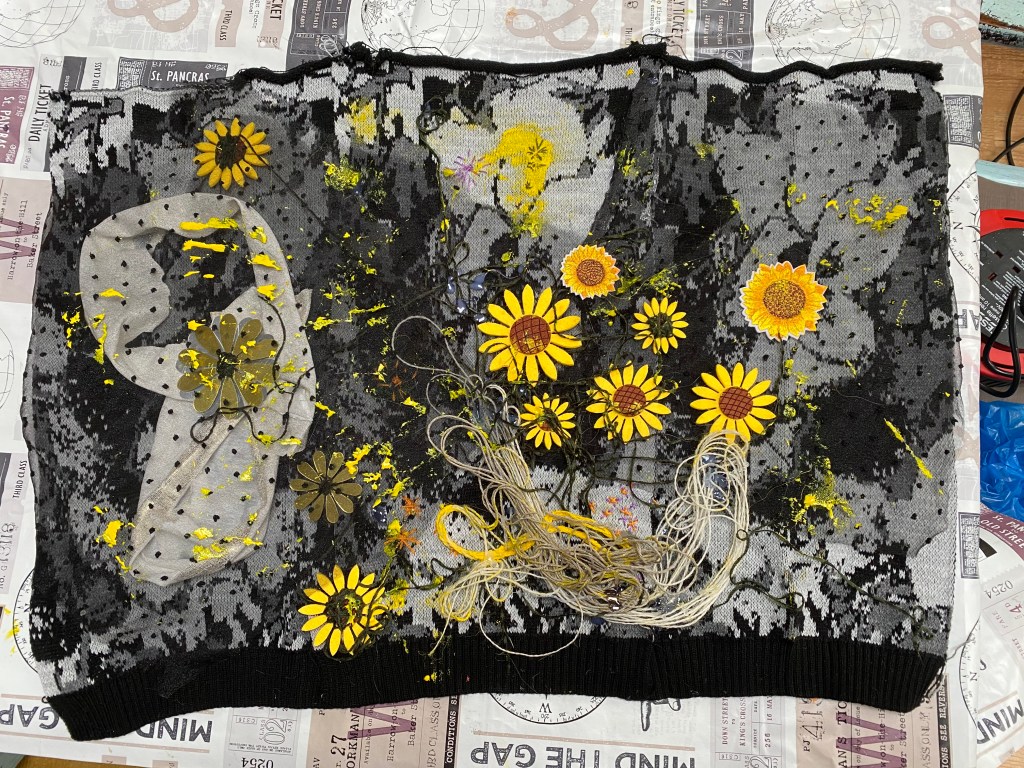
Sunflower finger knitted bouquet , with the button wrapping formations creating a rectangular frame .
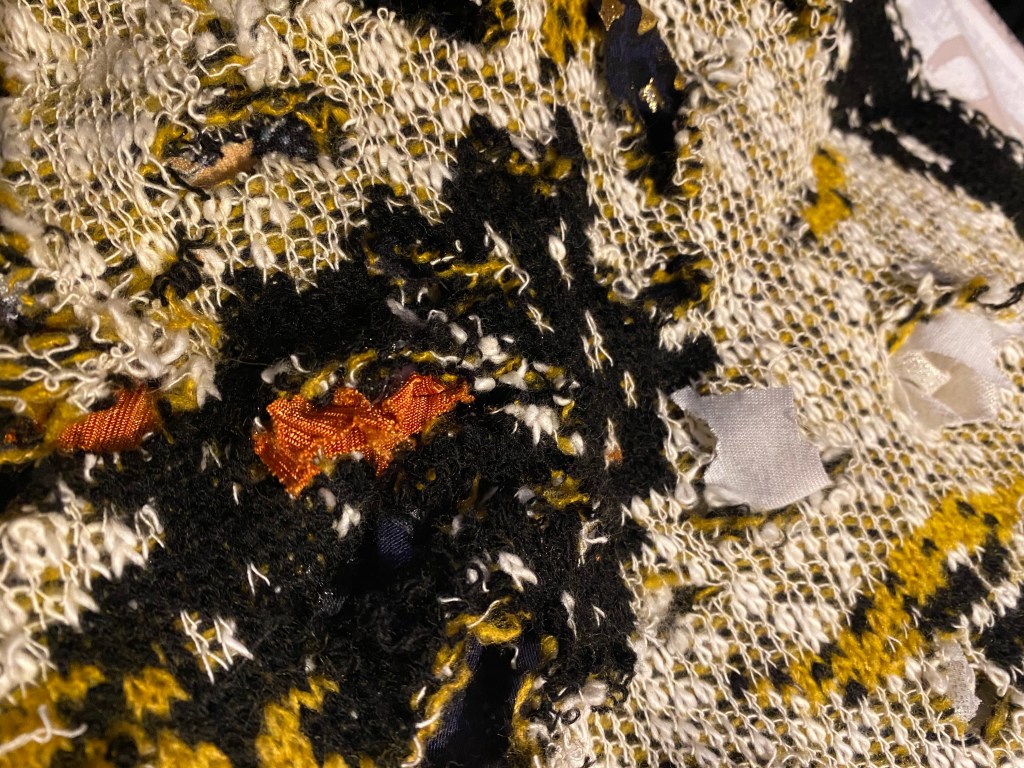
a close up vew of the various embellishments which in my eyes they all resemble sunflowers.
PIECE#6
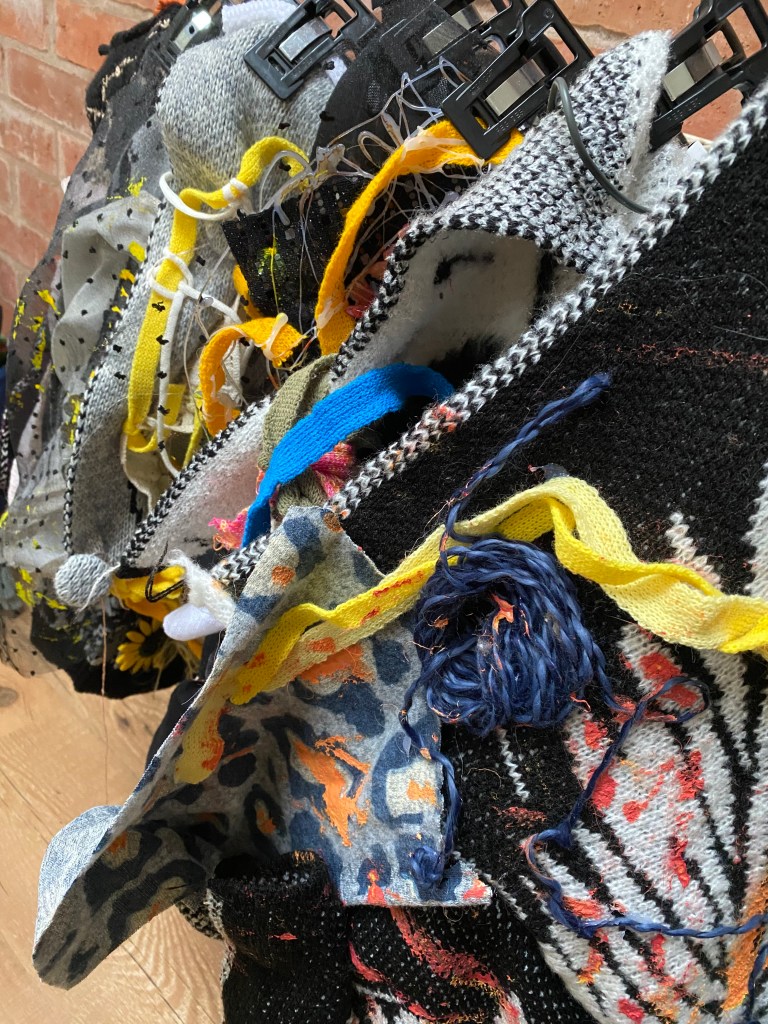
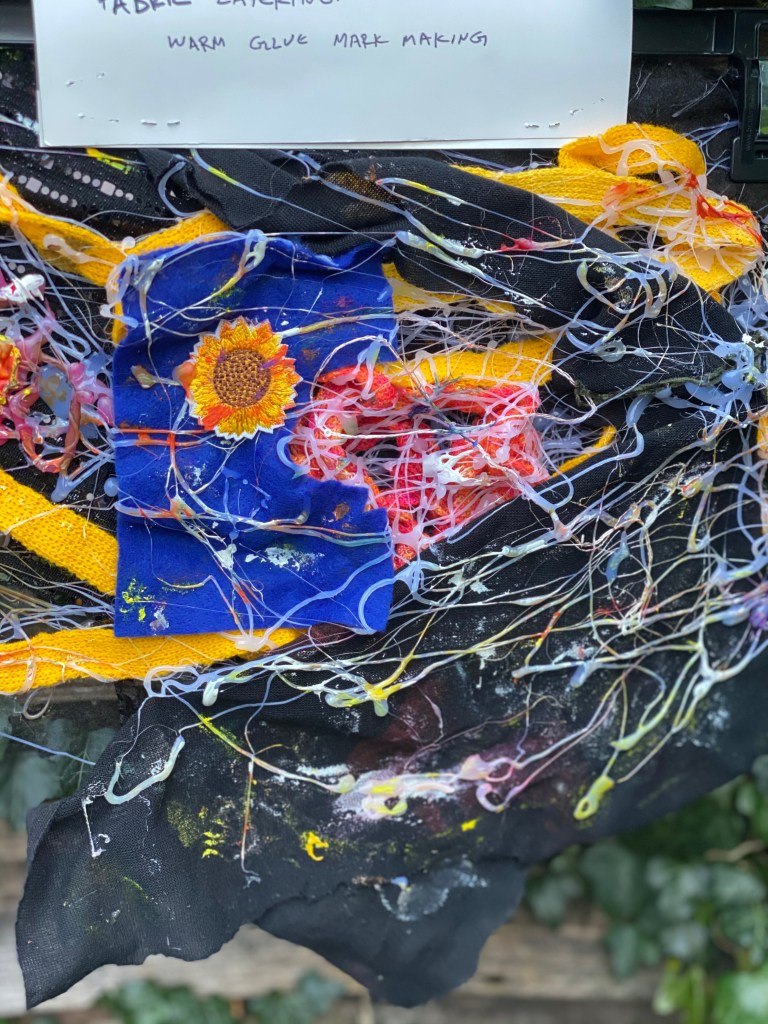
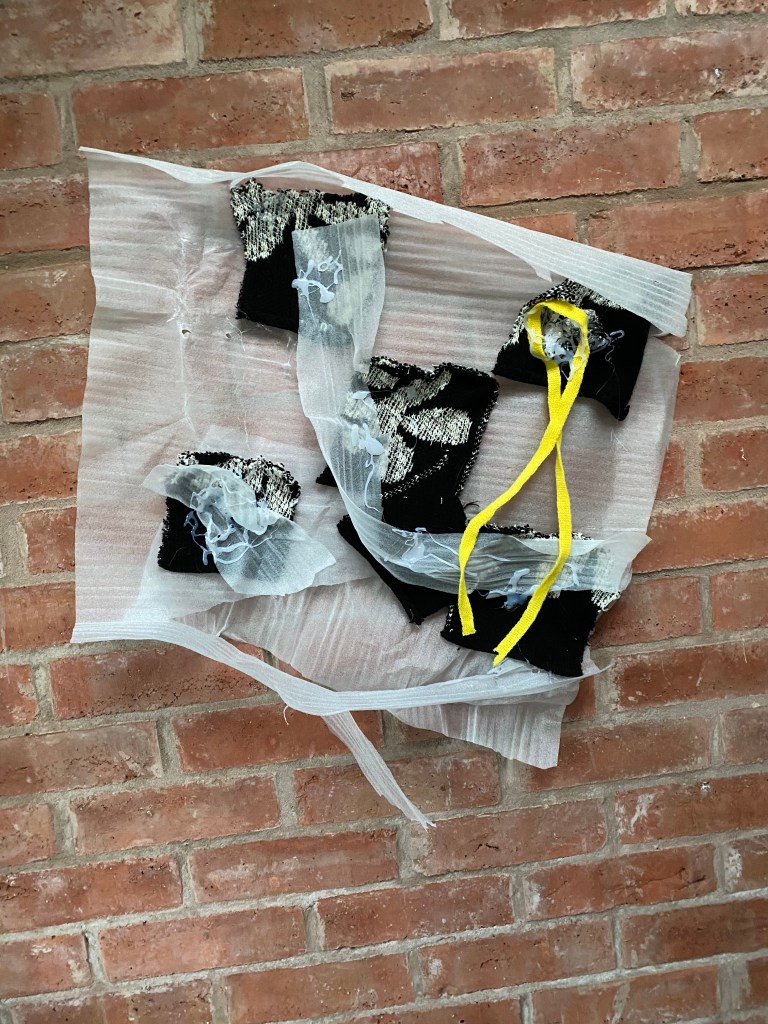
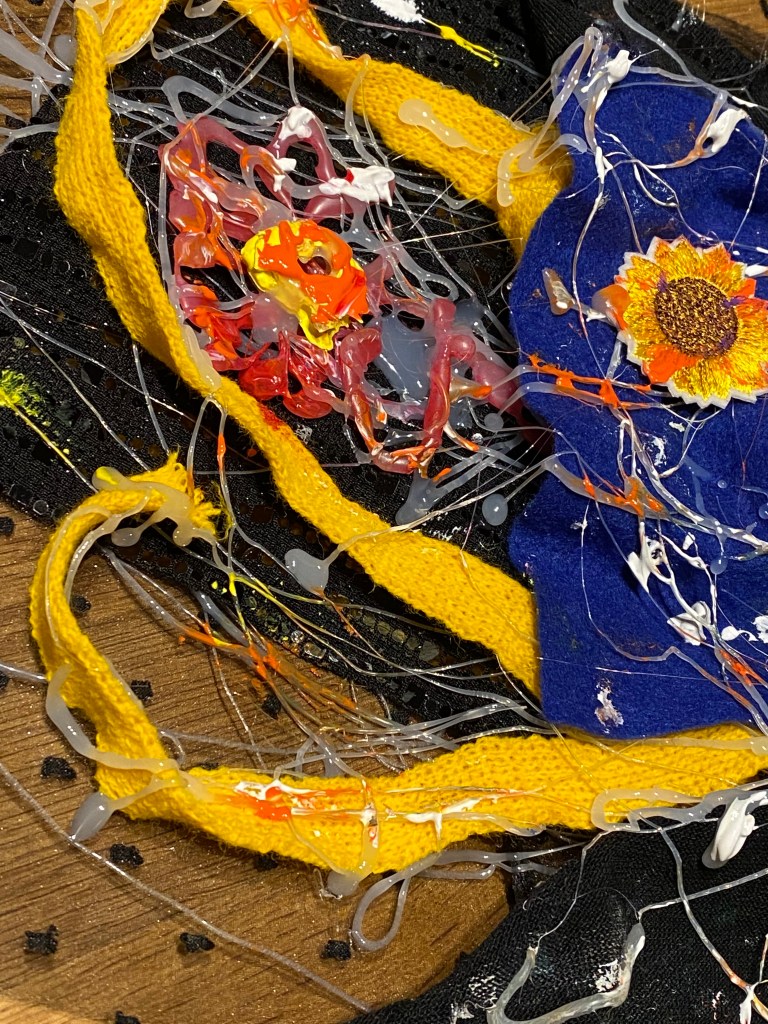
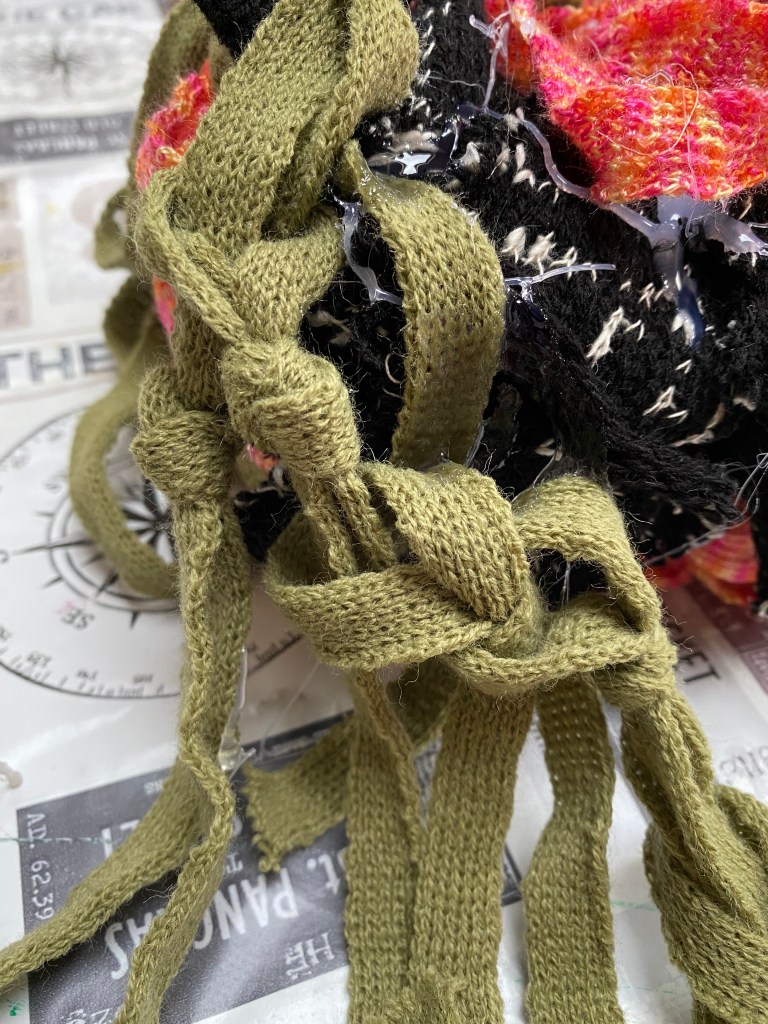
Various fabrics layering with warm glue mark making.
A zoom into the sample and onto its surfaces.
PIECE#7
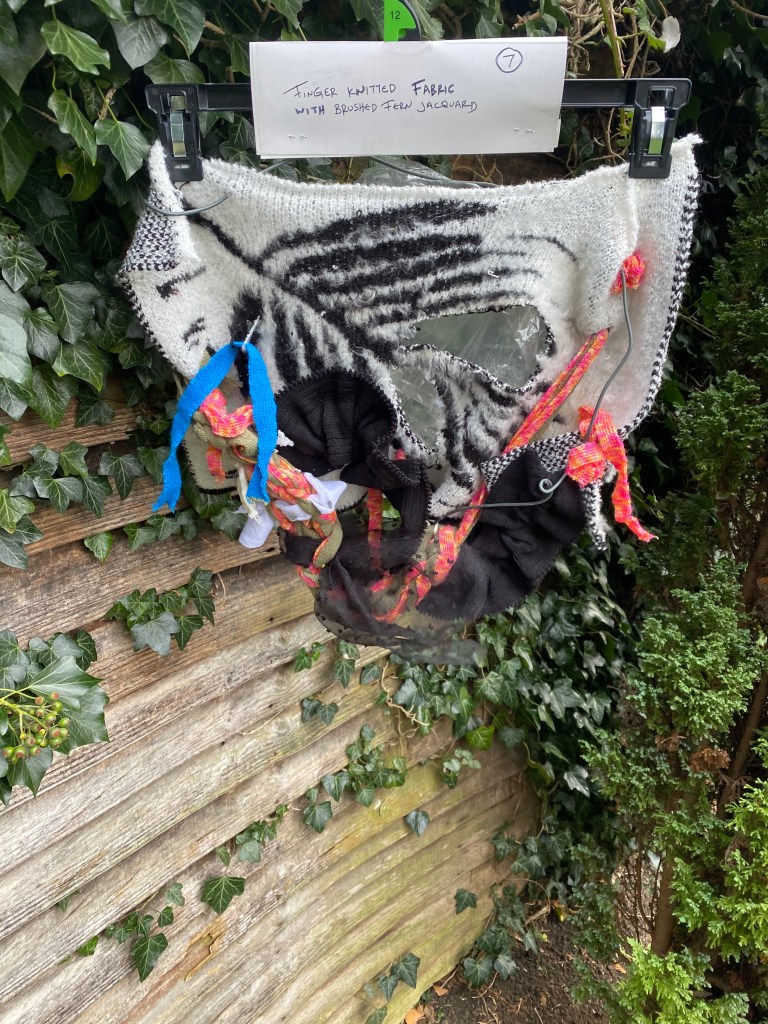
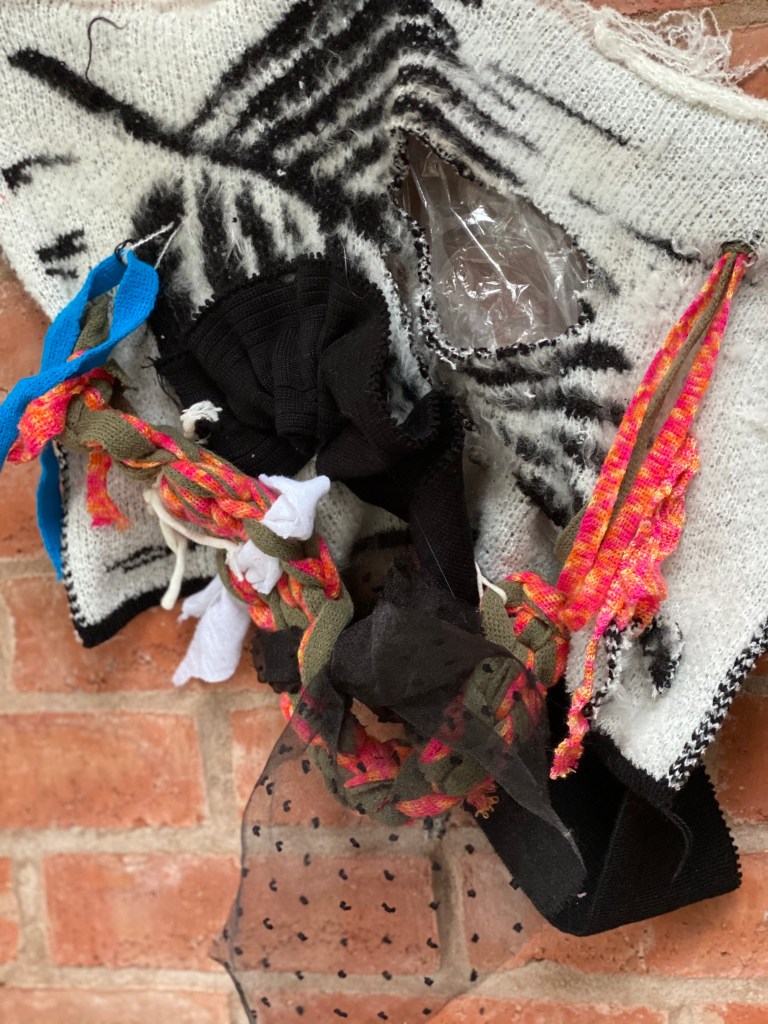
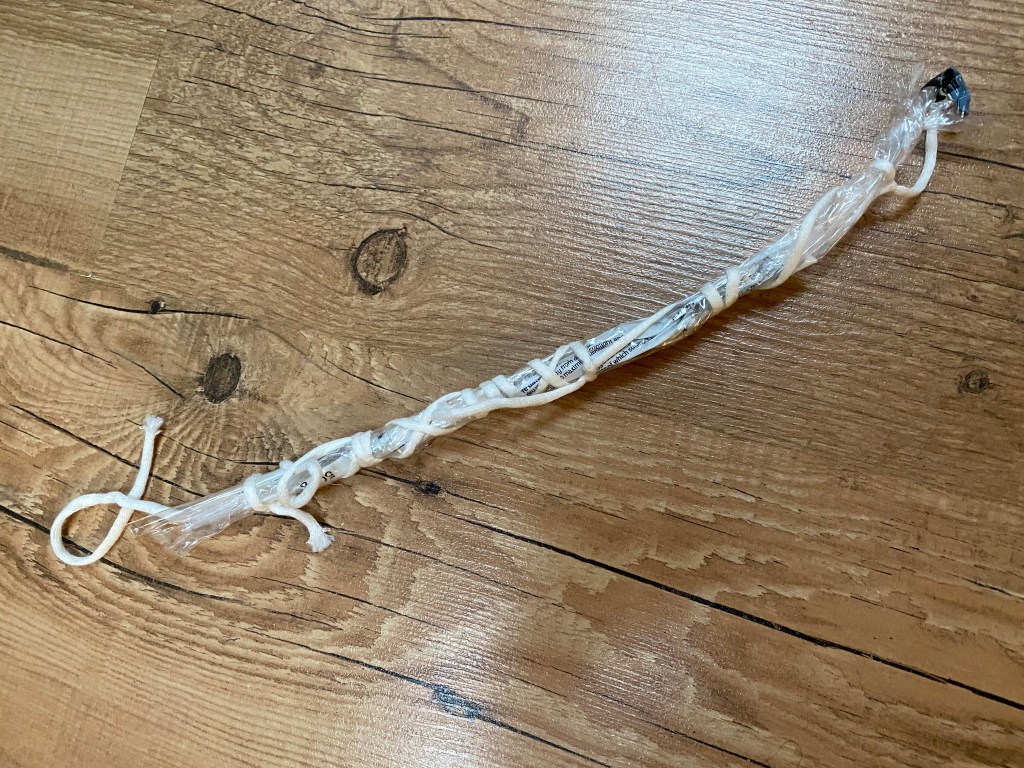
I have managed to feed the solid wire through my black band channel and then I had run it around the garment in order to pleat the band and stabilize the brushed fabric a lot more.
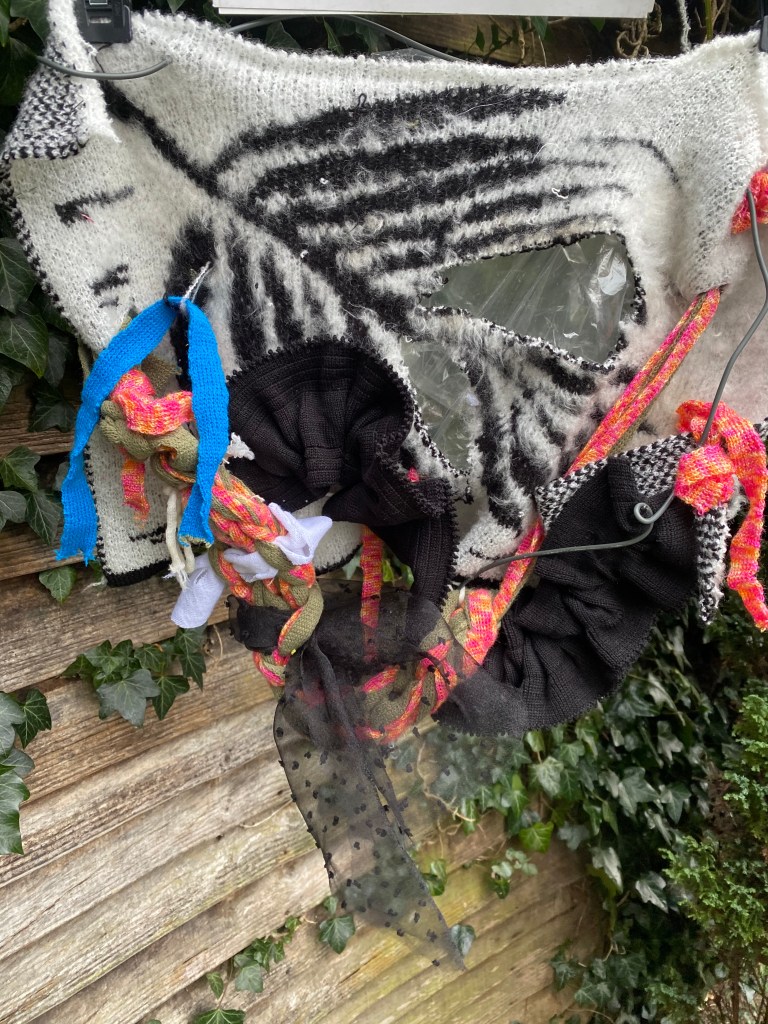
see through detail
PIECE#8
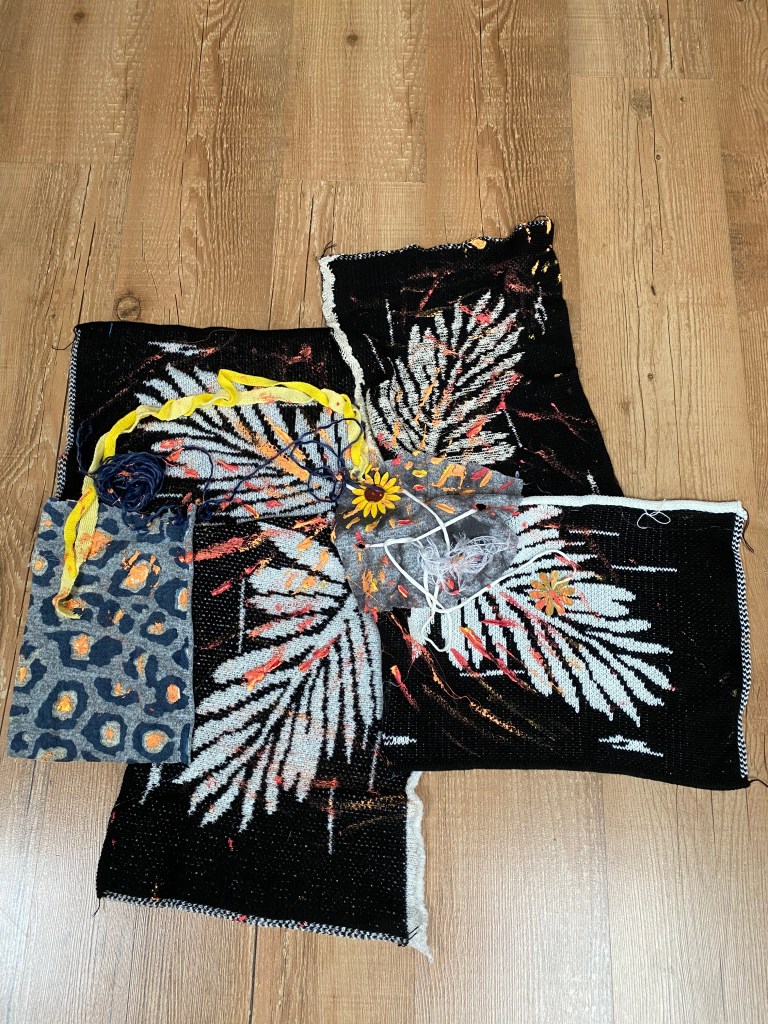
My fern design.
Because of the fabric layout it wasn’t very stable on the hanger .
I had used buttons to distort the right bottom corner having wrapped long sequin threads .
This is where it concludes.
Building my own collection was a journey which had started in a mainstream way but then it had taken off to be a very personal piece of effort,a wonderful encounter, a stressful initially but relieving eventually experience.
Working on my own knitted fabrics gave me more connection and meaning to my study and using them as surfaces to build onto , thinking out of the box and re inventing them gave me a very useful experience.
Hope in the future I will be able to work towards this direction a lot more and be able to learn and work on more exciting projects.
So I wanted o demonstrate few exciting skills I have acquired while working through projects all this time.
Mark making with glue gun:
I found warm glue really exciting material to work with.
I have combined : monochrome geometrical pattern along with floral printed fabric but I have also drawn onto my main white fabric-canvas as I wanted to show a dandelion, a sunflower and gold plaited blooded rose.
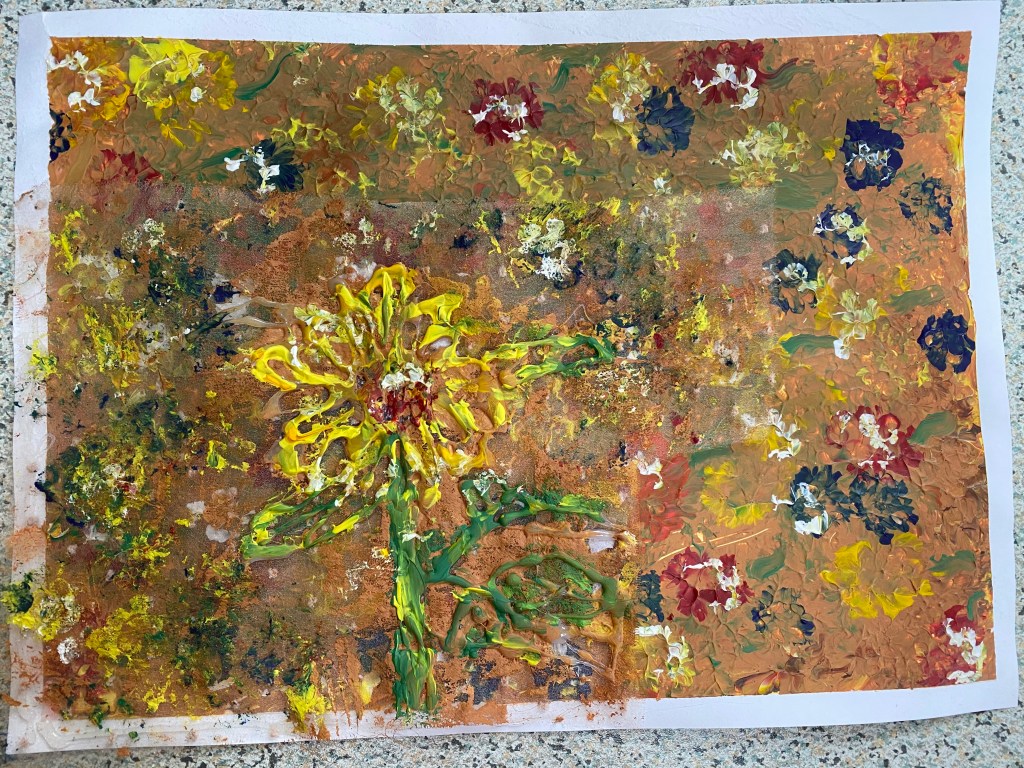
I have then combined my sunflower with the organza glued sunflower , were I liked the colour and the paper/fabric combination: A sunflower in a field of flowers.
Which I applied on the next project:
Vase and organza sunflowers bouquet.
I wanted this time to have clean finish , therefore, I didn’t use any colours at all, just to show the organza effect in combination with my drawing.
Talking about a bouquet , what if I had created an abstract one?
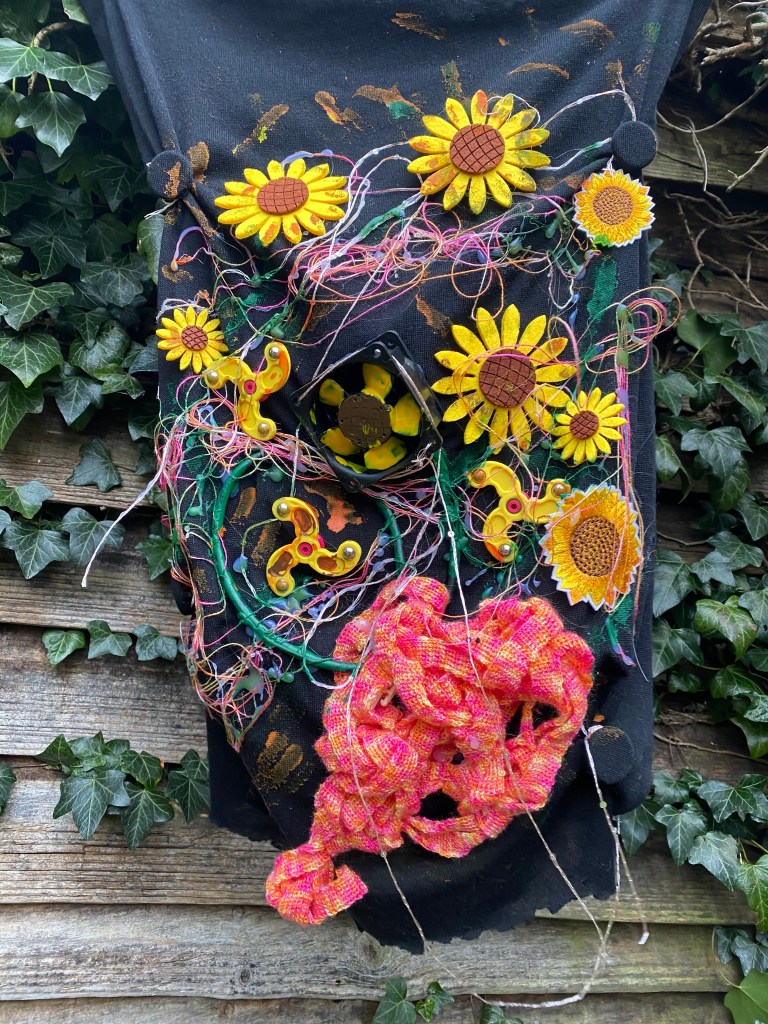
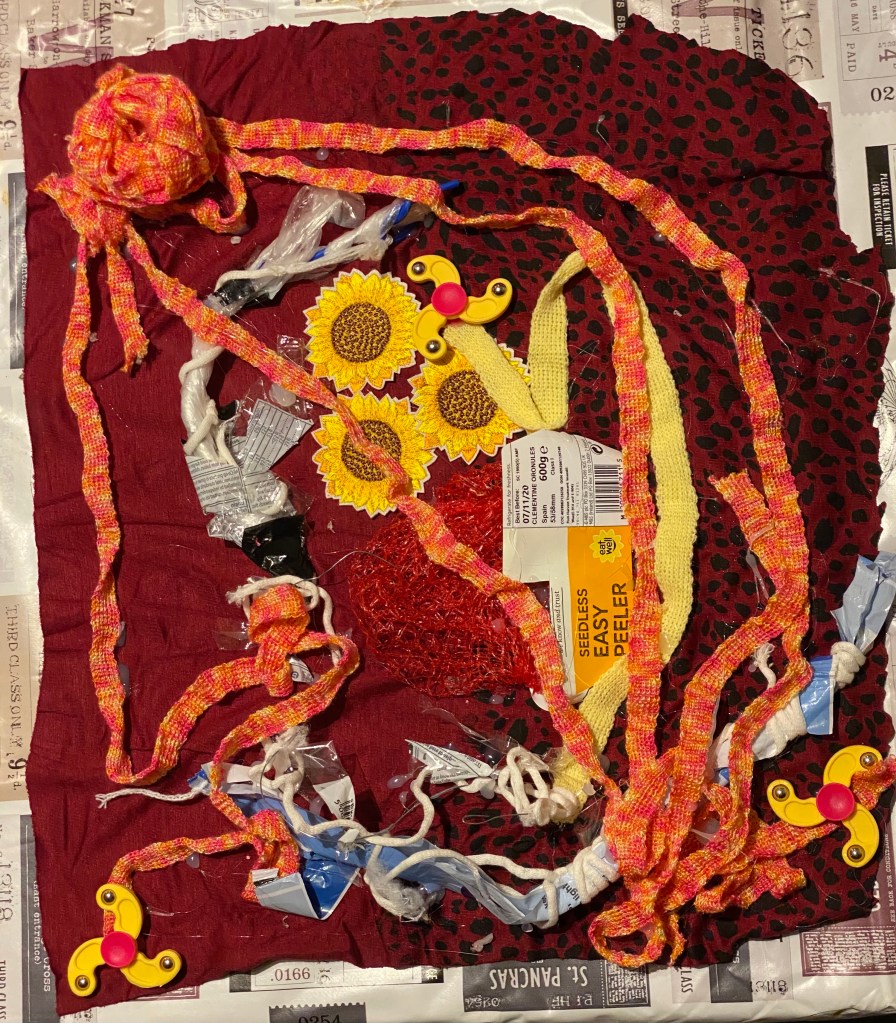
I’ve created knitted bouquet by using more felt sunflowers but then , to be more spontaneous, I’ve used the same yarn I’ve used to knit my strapping-turned into yarn to do mark making on a black fabric. A fun painted as as sunflower as well fidget spinners were used to demonstrate that concept.
Layering: A technique I’ve never practiced before.It was interesting to demonstrate all these different coloured fabrics and yarns using a sunflower badge as well as a warm glue generated flower.
Another example of layering where I have used different fabrics as well yarn I have created on assignment 4.
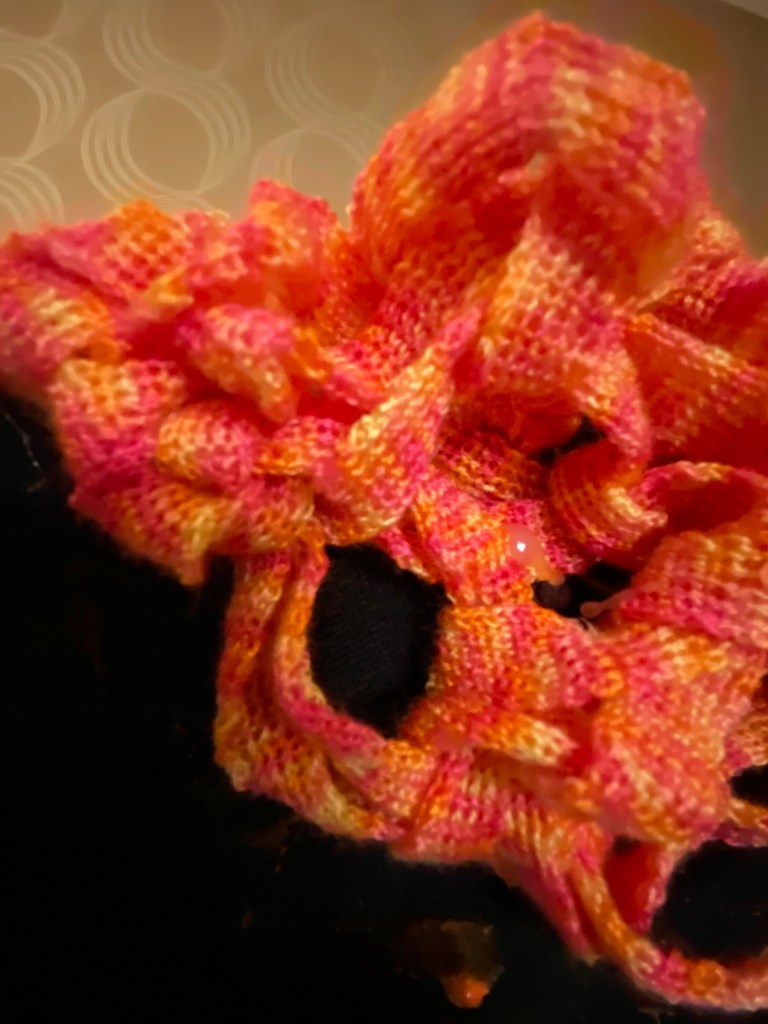
On the following piece I wanted to demonstrate a 3 dimensional fabric without layering , so I’ve considered the option of using 2 extra yarns I have created on assignment 4 as well as accessories and pieces I wanted to be recycled and have a second life plus space dye yarn strapping wrapped and unfolded in such way that in my eyes resembles the sun and its rays:
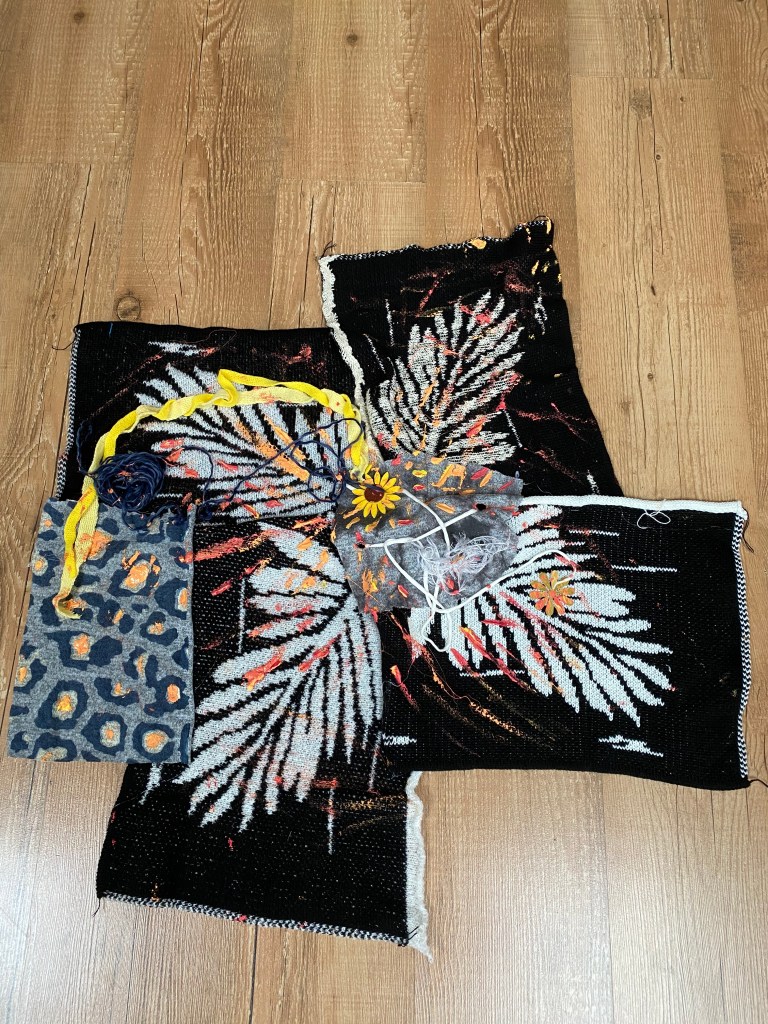
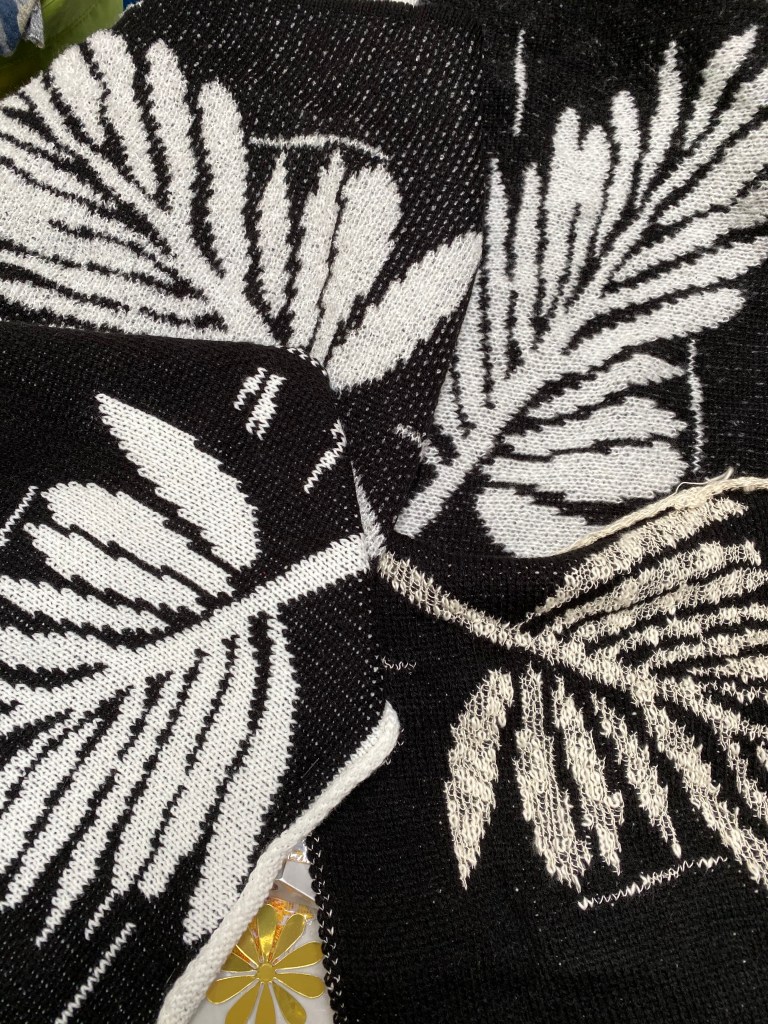
Regarding my ferns I have drawn programmed and knitted on a flat knitting machine, I have placed them in a way they look they are spinning, they sort of create a whirlpool.
I couldn’t stop myself from not brushing all the way across the new created fabric.
I have positioned an acid washed fabric cutting in order to cover the position where all the garments meet where the whole new concept can be perceived as a flower and then I have placed a sunflower on the center.
I’ve an animal print to compliment my work as well as to give extra colour and variety and to show a loose reference on the natural world :the flora and the fauna.
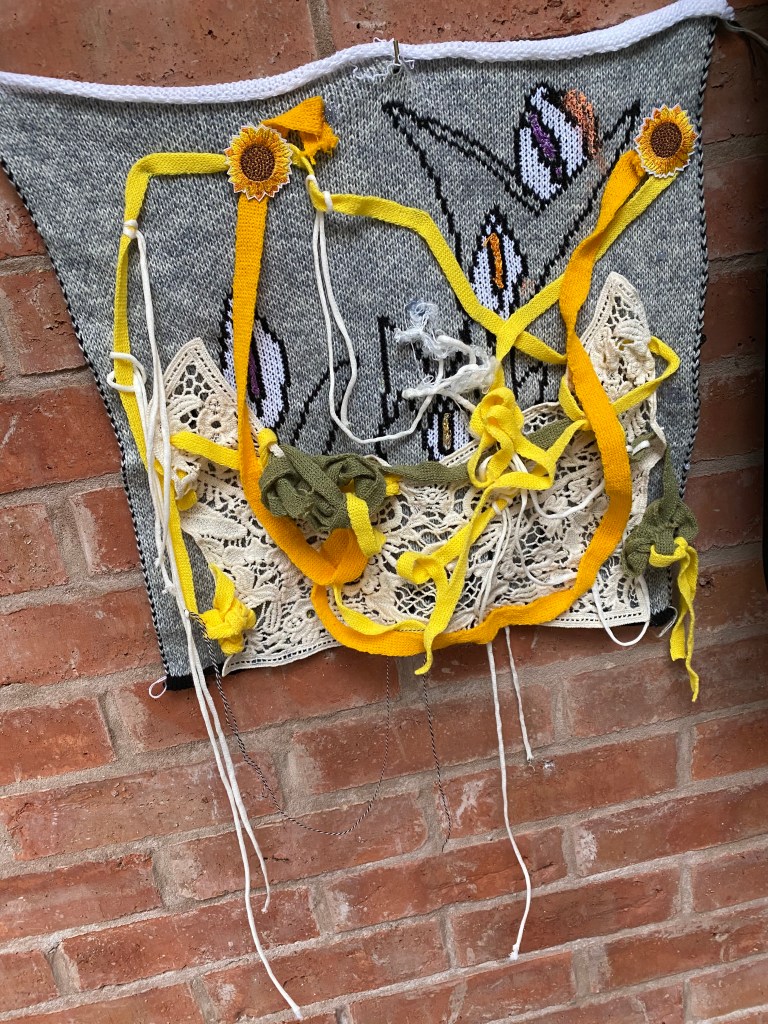
The following two pieces have been hand embroidered and on my first one I wanted to see how draping works when I tie up various pieces of yarn together. To demonstrate this effect I had hanged it on the wall.
5 gauge knitted tulip buds.
Where in this case I had 3 pieces of the same knitted jacquard I have created joined together along with organza fabric , yarn wrappings , colour brushed and sunflowers with yarn (on some of them winded around and placed on the fabric in order to create a mark making effect.
The sunflowers as well as the yarn has been positioned in such a way they resemble a flower pot, a vase formation .
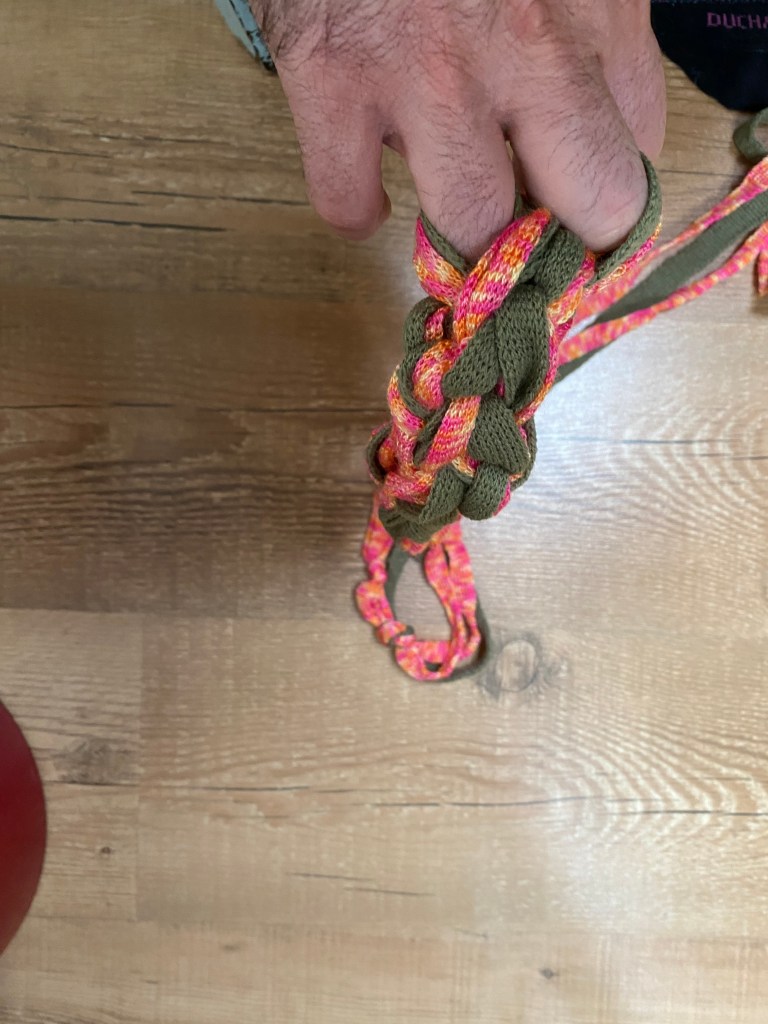
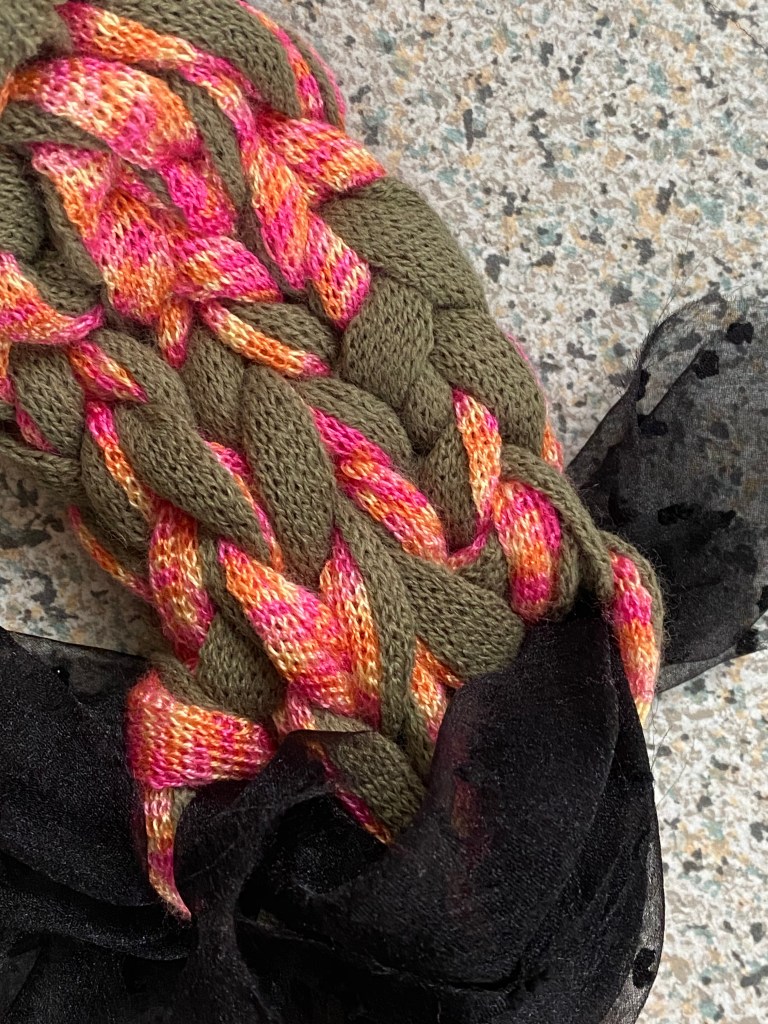
Being encouraged to use my own created,machine knitted mainstream pieces I ‘ve combined some own knitted surfaces: A heavy finger knitted one with the pleated ribbon on combined with the brushed fern :
I have hanged it on the wall in order to let gravity work its own way, where organza looks like it is floating in the air.
Interesting how its about to collapse when I turn an angle .
Talking about surface change and gravity, I have knitted the following piece
And then I have deconstructed it and placed it on a very delicate piece of paper with a piece of strapping on to show the ground level: Firstly as I thought it would be set
and then upside down.
Playing with gravity again ,I have sandwiched in two knitted pieces different jersey fabrics and its interesting how they come out when I’m cutting/destroying the own knitted fabric:
one side is black and white where in the in between layered fabrics is showing the reverse side.
and that is the colourful side.
Surface detail.
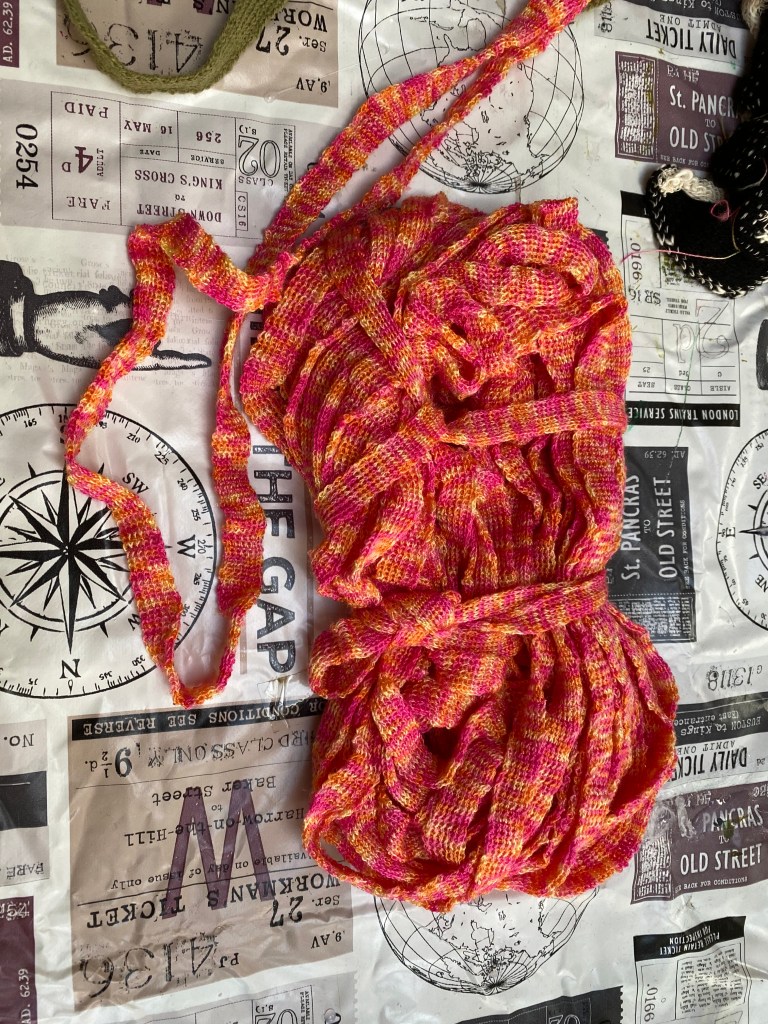
Creating more unstable surfaces, I have arranged two strapping piles put together in a way they came from a spinning wheel along with the cut out fabric in order to create a new surface:
Then, I had used the dyed fabric as a host of the the next piece which is a cutout of the coin created circular forms on one side along with the remains of the original knit out.
in the following work I had cutout the outline of the dyed flower in a way it starts deconstructing where I I had combined it with a jersey rib piece folded on the background mainly , as well as with a jacquard piece to add more colour onto my fabric combination.
That was my final piece.
What an exciting experience that was!
Looking forward to concluding ATV by making my own collection!
Choosing option 3 which is suggesting to draw floral designs and create new sketches and new material, the old thoughts about depiction and how much I was haunted from drawing, have came back in an instant! But then ,reflecting on everything I have created during my study on ATV so far, pieces in quantity beyond my imagination ,in an extend and a variety than I have never (ever) done in my life before, made me confess that this has been a fear I have mastered, a fear that is not there any more!!!
Being relatively new to the whole painting process, it was difficult to know where to start initially. My way to overcome this standstill moment,that hesitancy ,is to choose, as a starting point, a subject that means something to me: a subject that excites me and inspires me.That way I would like to get involved even more , to feel impelled to express myself and in my opinion, my work would be more authentic and heartfelt.
Considering of what the brief is asking me to do having in mind my research in my previous page , my thoughts went straight to Van Gogh’s flowers again!
Vincent’s vision and drawing perspective has been a great inspiration for me.
I share the same interest on sunflowers as he did .
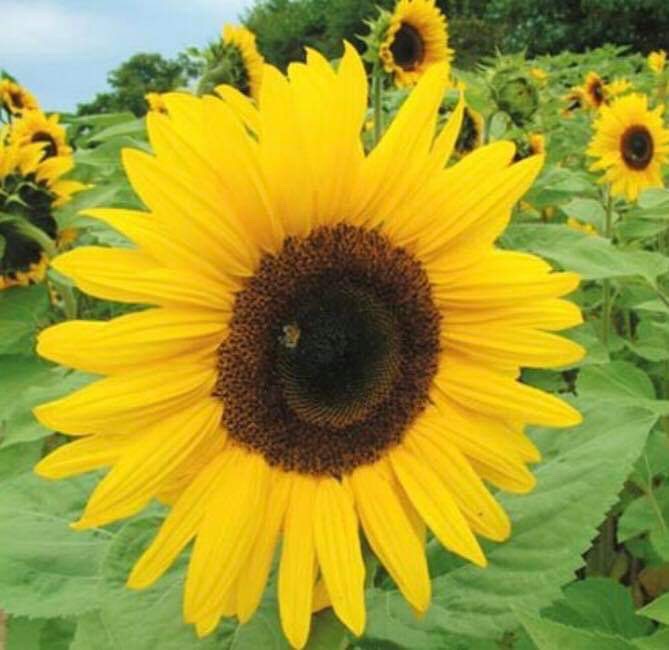
I find them such unique and graceful magical blooms that follow the sun’s route on the sky during summer time where they are in their prime! How beautiful the Greek landscape looks like when you are driving through yellow fields , noticing them standing tall and proud worshiping the sun! So many sweet memories, too many beautiful pictures from the past coming in front of me thinking about them!
Having nothing planned, I’ve made my research of Vincent Van Gogh’s use of colour and drawing techniques (things utterly unknown for me initially). Then, I’ve uploaded the following piece of art as a guideline to my hand and fantasy.
Sonnenblumen Sunflowers third version: blue green (Munich museum). Artist Vincent van Gogh Dating 1888
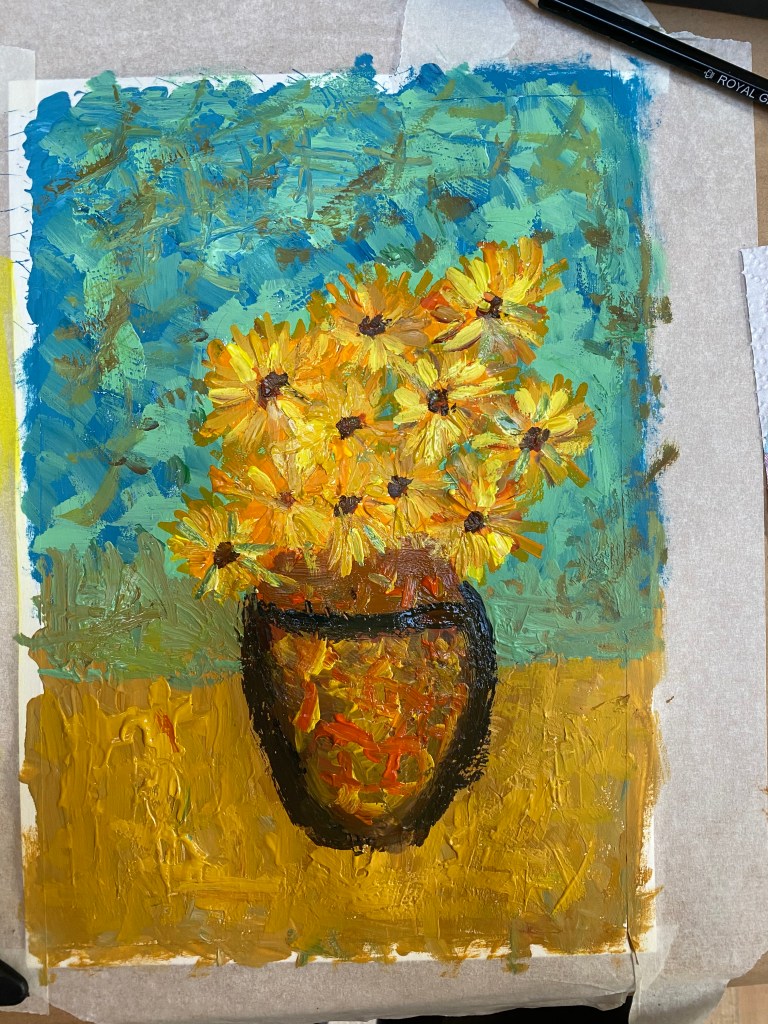
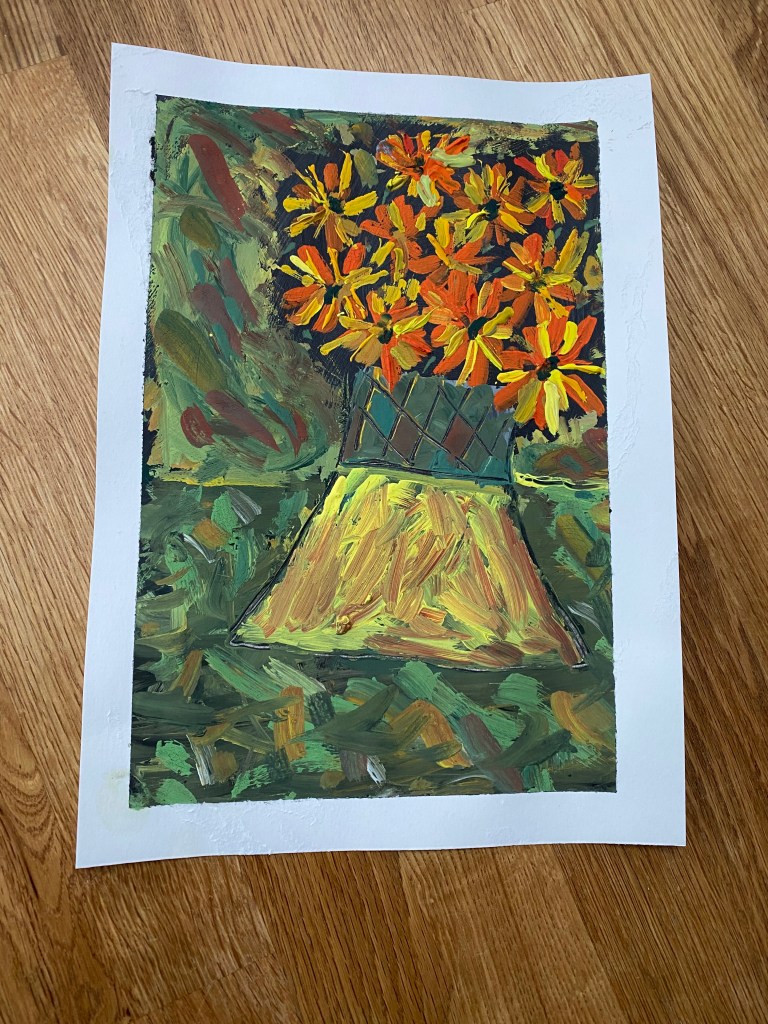
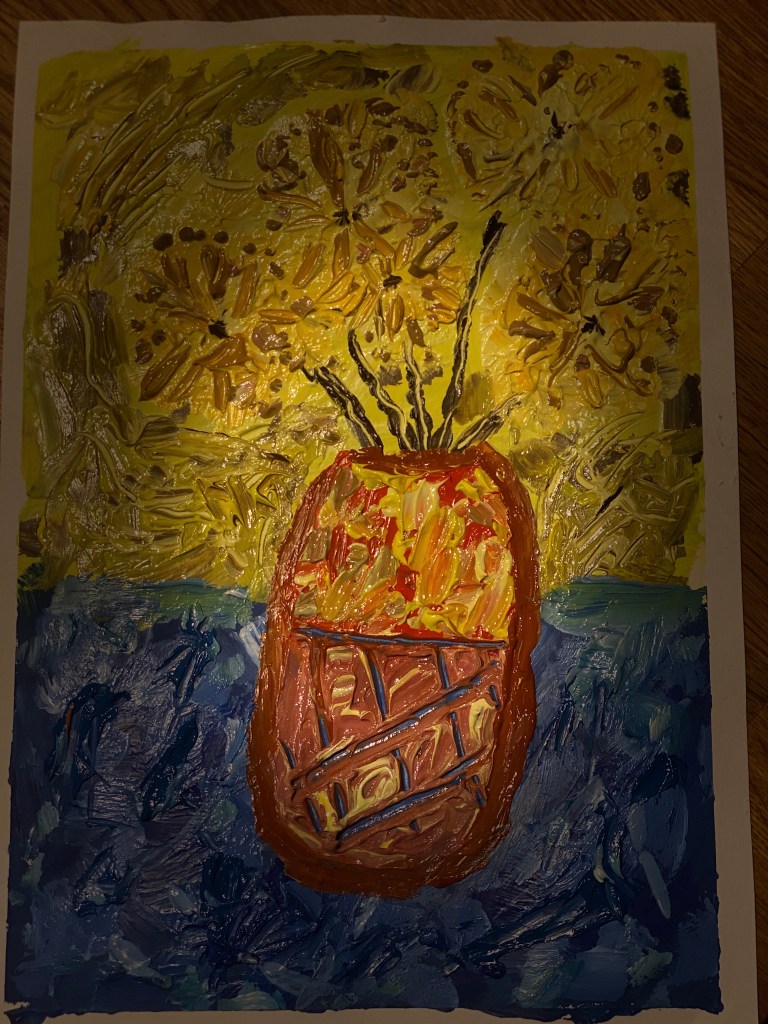
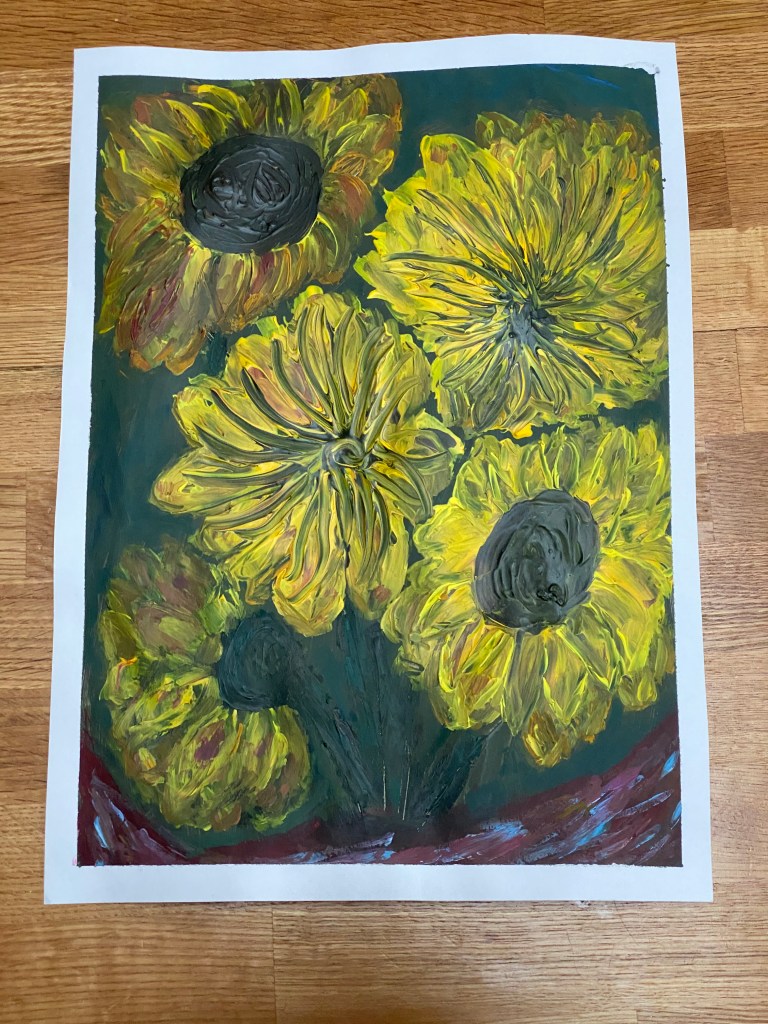
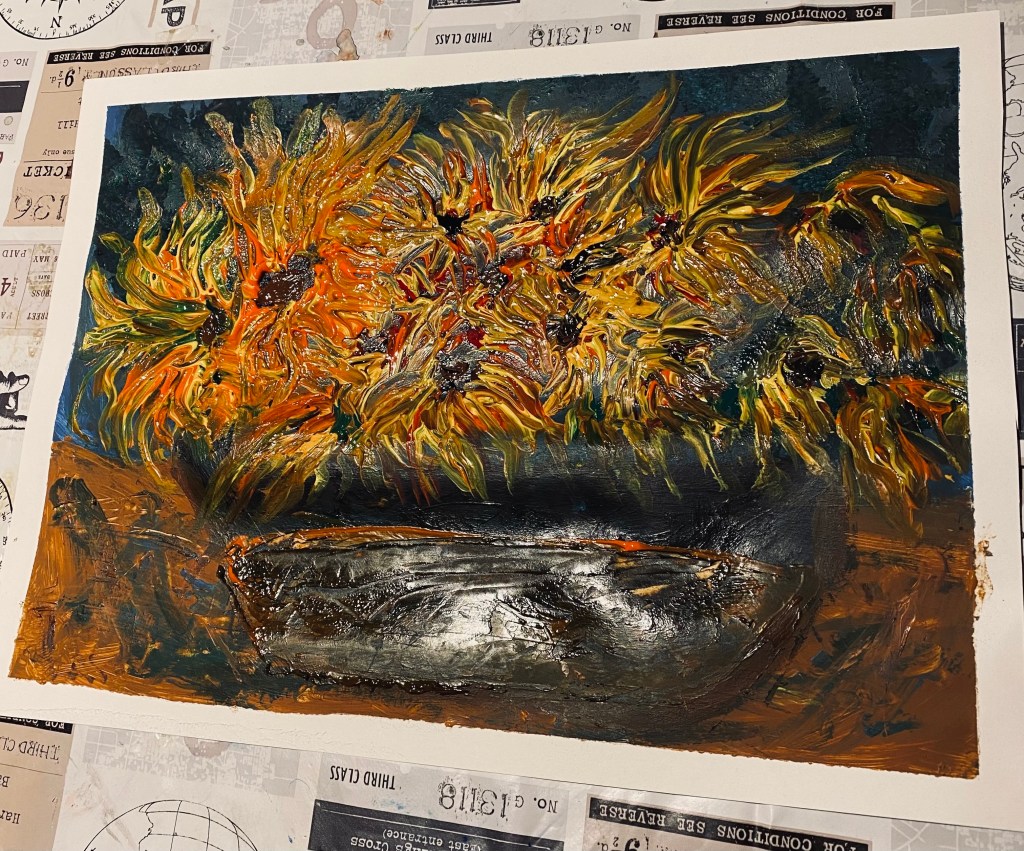
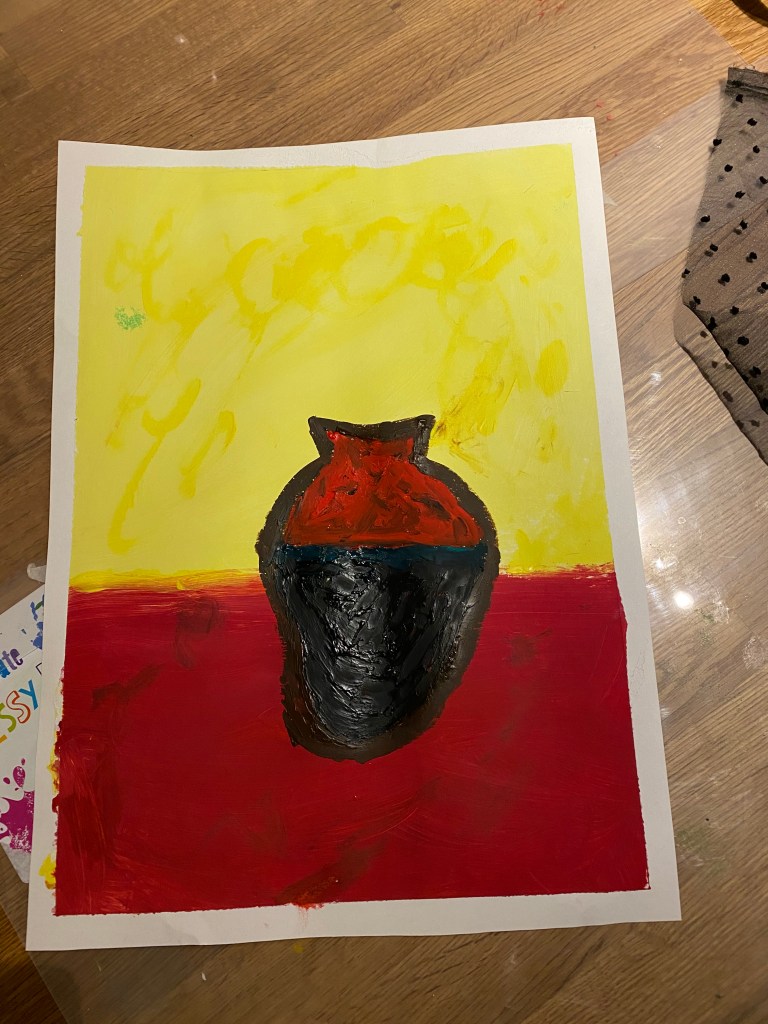
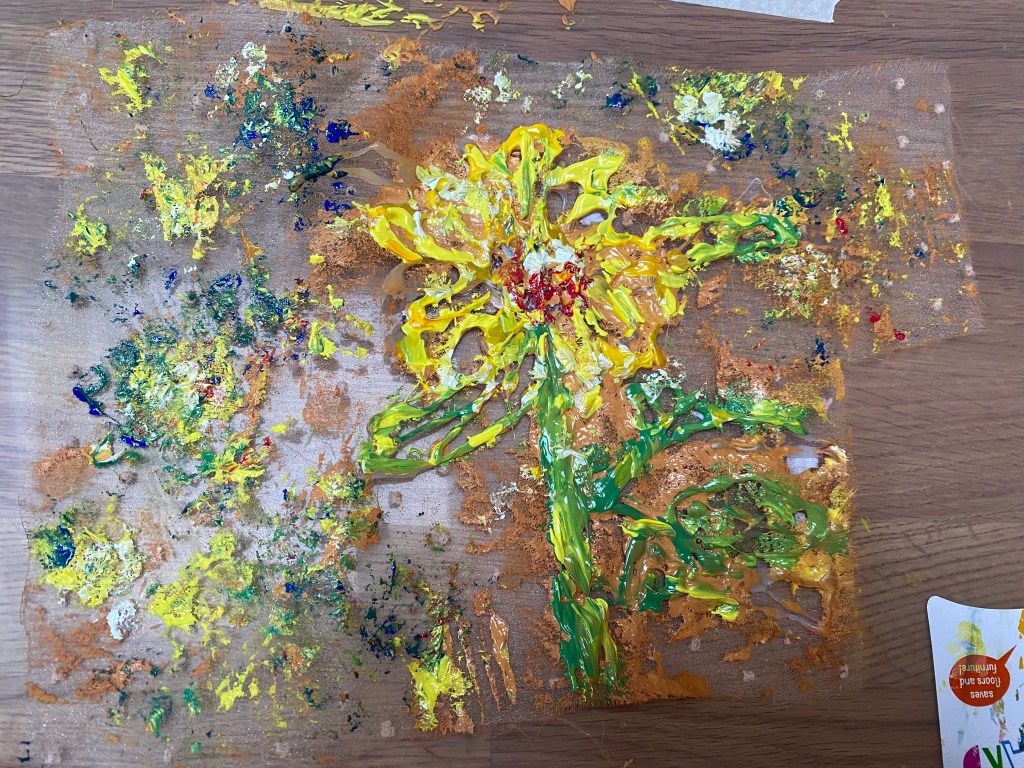
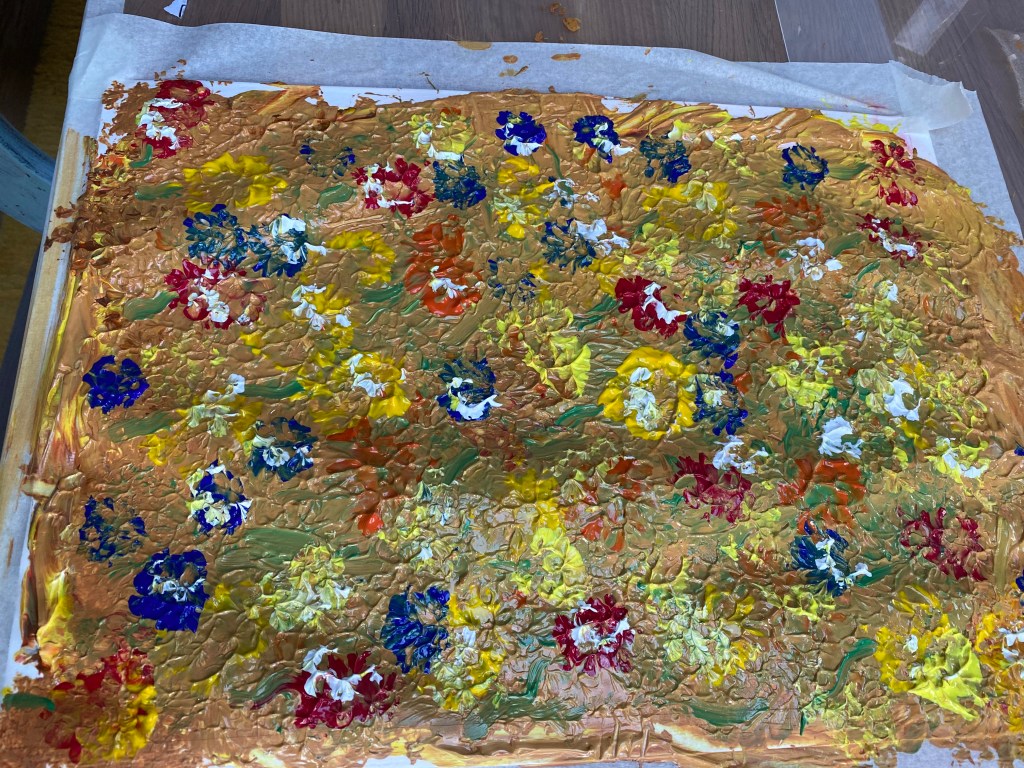
The concept is simple: a vase, sunflowers , and lots lots of colours (shades of his favorite ones in particular)! Yellow ,ocher, mustard, piccalilli… all sorts! Wanted to be playful and experimental with pigments but also with brushes , sponges or even bubble wrap!
Here is my version of it:
Then, going forward, I’ve started asking myself questions to challenge my creativity in order to push my work even more,further down to see where this goes ,by querying : What if?
What if I make the vase longer?
What if I use grey and yellow background?
What if I make the floor the vase stands on a darker colour?
What if I change the background where the flowers displaying into black?
What if the vase is in a trapezium form?
What if I make the background colour tonal to match the sunflowers this time?
more dramatic photo shooting!
what if I zoom into the vase and have a closer look of the sunflowers?
what if I have a fern wreath around my sunflowers placed in a boat like pot?
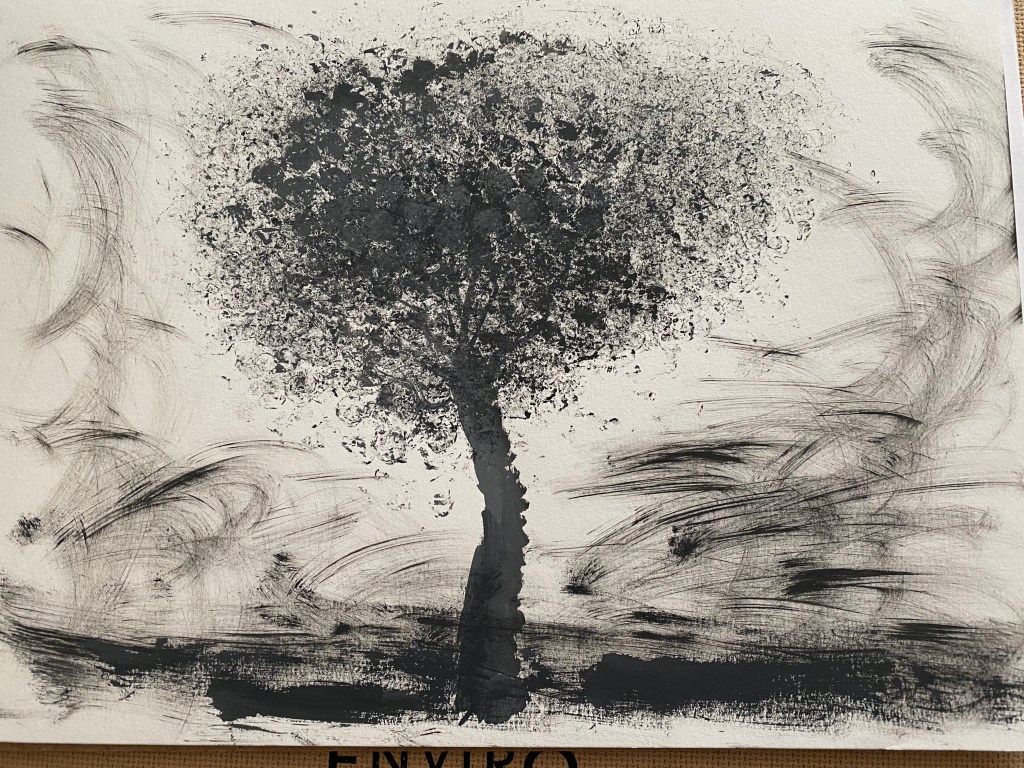
Having a sense of fulfillment and the impression the subject is covered, I went back to a previous drawing I’ve done during my early stages on ATV, showing a single tree, using black and white only and asked myself the same question: What if I apply the technique I’ve used to draw the vases?
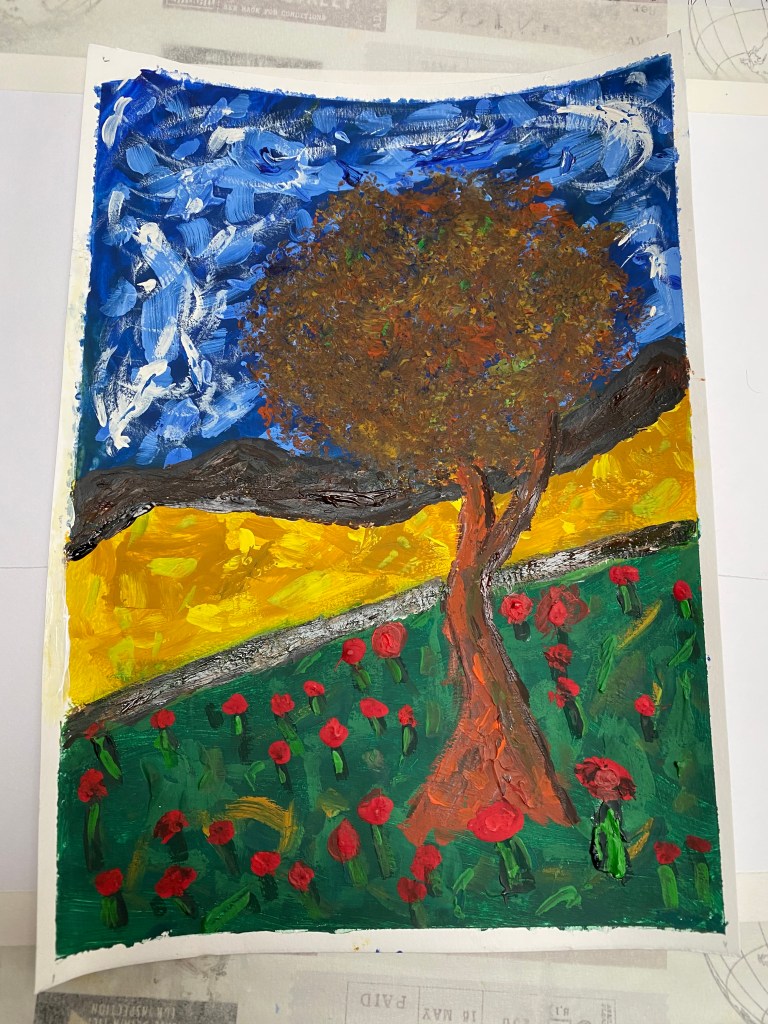
Setting is different this time. Portrait form instead of landscape.
Scenery is different as well. Blue sky and the tree stands on the top a hill.
Poppies and yellow fields and mountains are surrounding the tree.
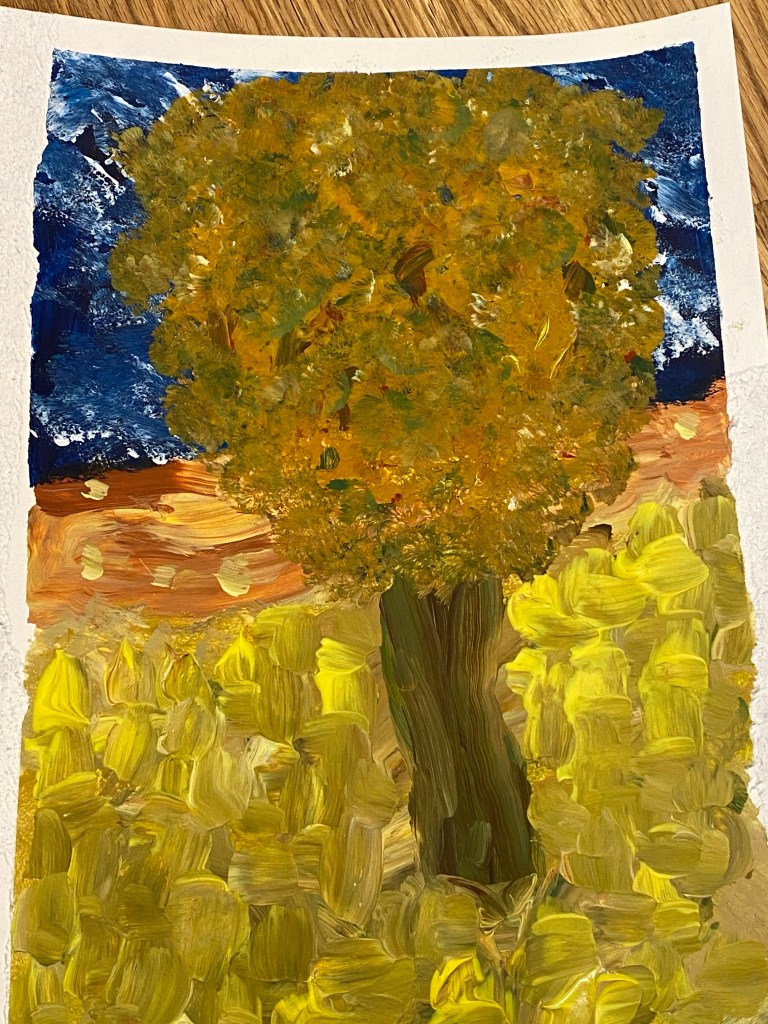
What if I make the tree trunk wider?
What if I made the tree bigger?
What if the sky is darker?
What if the field where the tree stands is Van Gogh’s yellow?
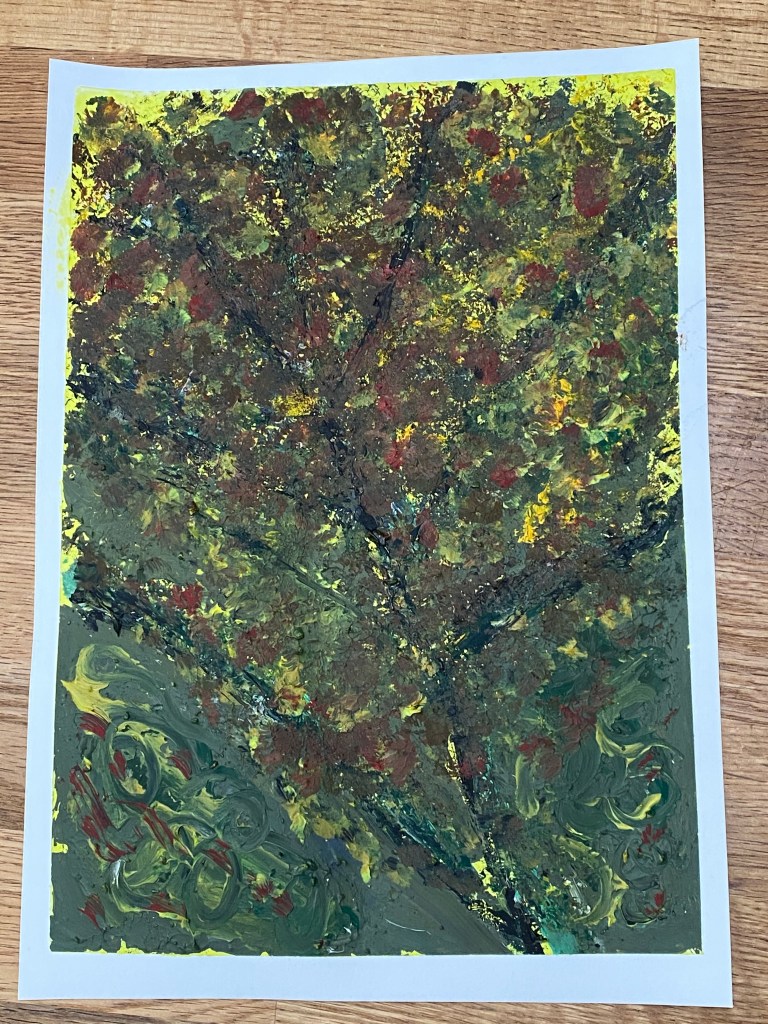
What if I zoom into the tree and look into the branches?
————————————————————————————————————————————
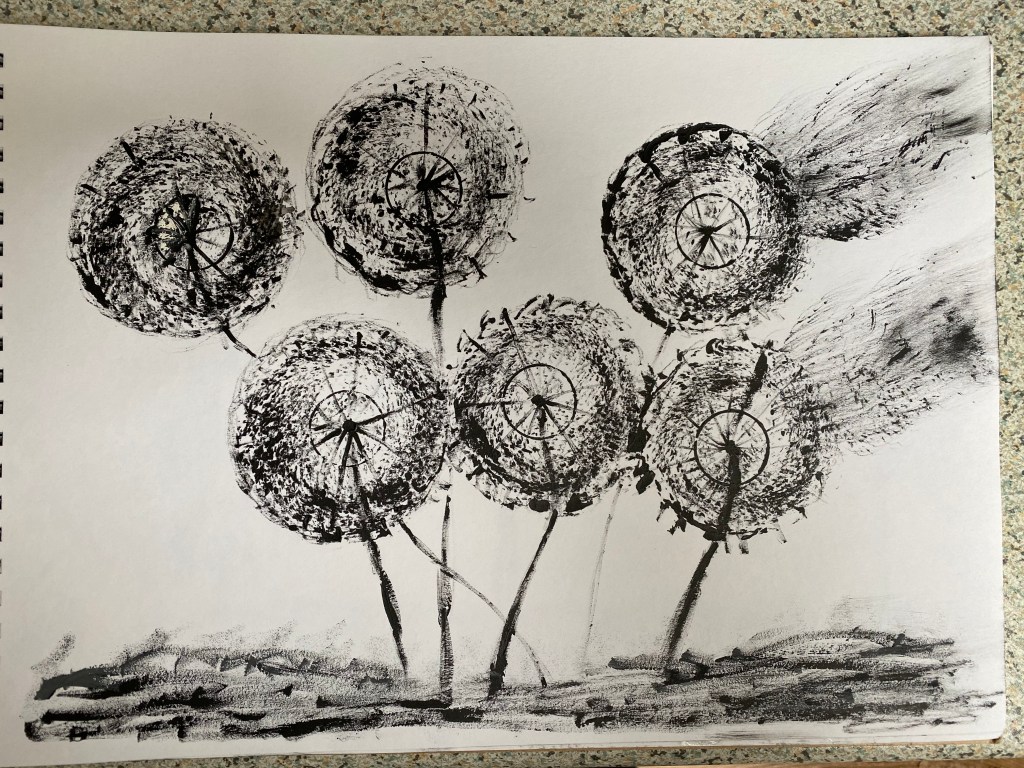
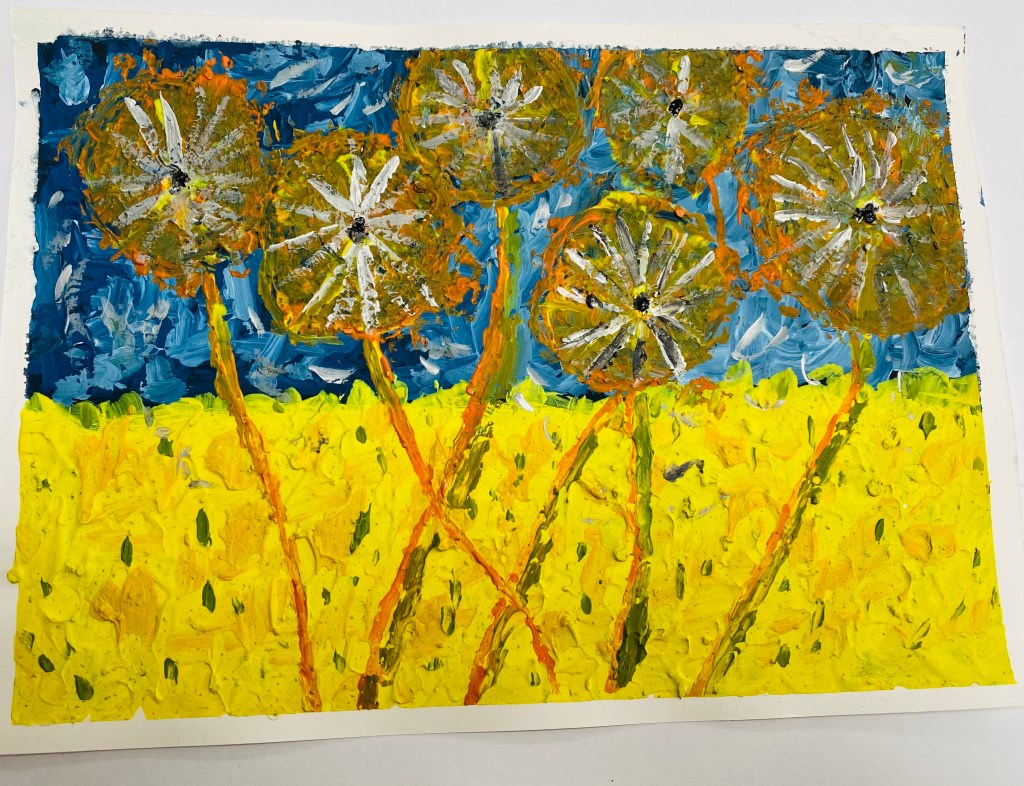
Another project I wanted to take forward and re work on it is my dandelions:
What if I used the same pallet as the one I’ve used for the vases as well as the same drawing technique?
—————————-
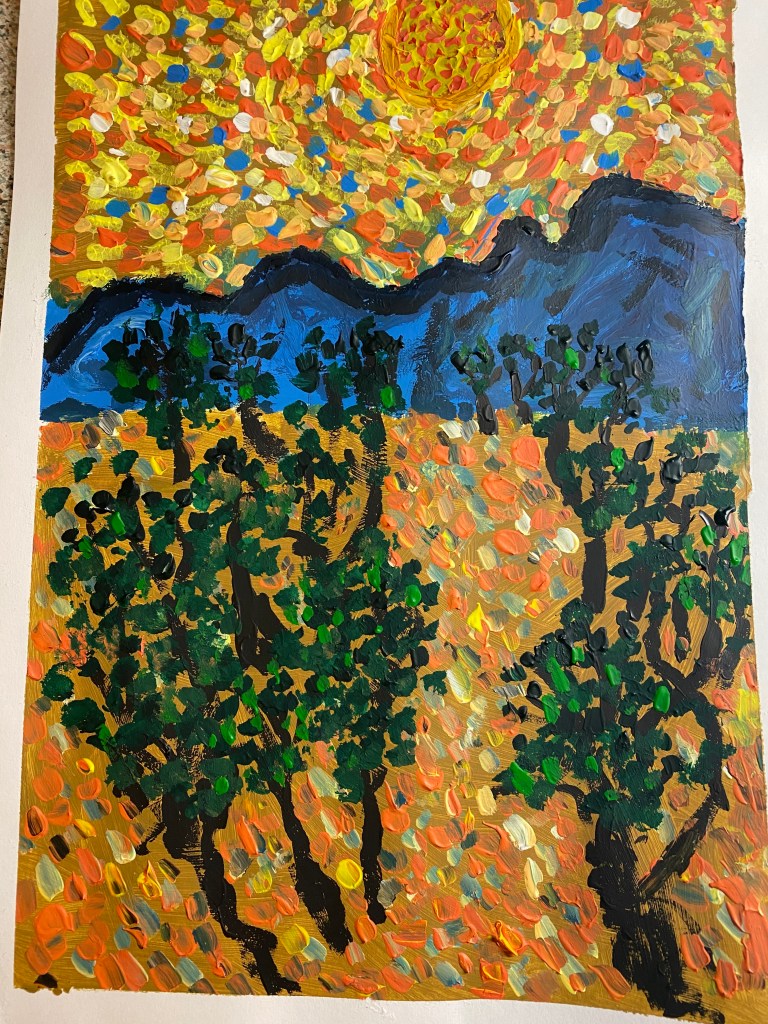
Going back to trees and landscapes , always filtering through Vincent’s work I came up with my last few pieces:
The first one is loosely referred to Van Goghs olive trees under the sun series of paintings , which again brings to me a lot of memories of the glorious Greek summer . The sun is the king of the scenery and it is blessing the world under it’s warm rays.
My illustrated saplings loosely refer to olive trees (another element of a Greek landscape) but, my intention wasn’t to replicate the paintings or the olive trees themselves: I was intrigued to play with colours and to show a bit of life in ,what I think, an interesting landscape. Trees are again my focus as we were asked to work on floral elements, but having the whole scenery as a frame I think it adds more depth and detail into it and I think it will give me more components and ideas to work on my next assignments. Sun was deliberately drawn like a sunflower so it creates a straight connection to the previous work.
For for my next piece of work I had no doubt on what I wanted to focus on …
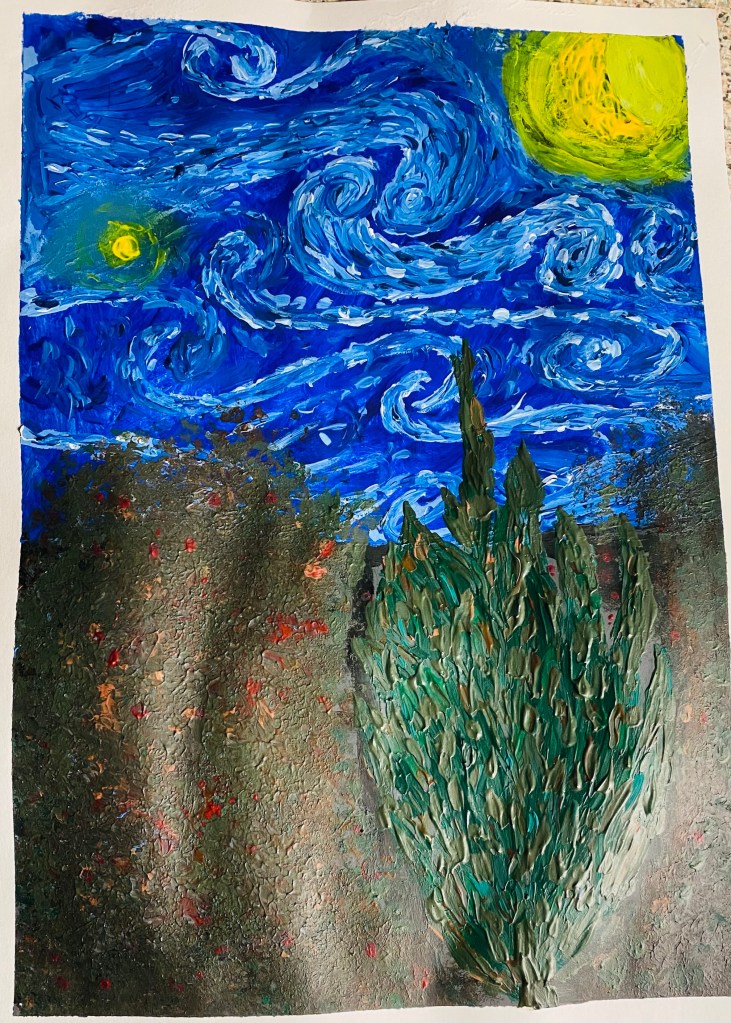
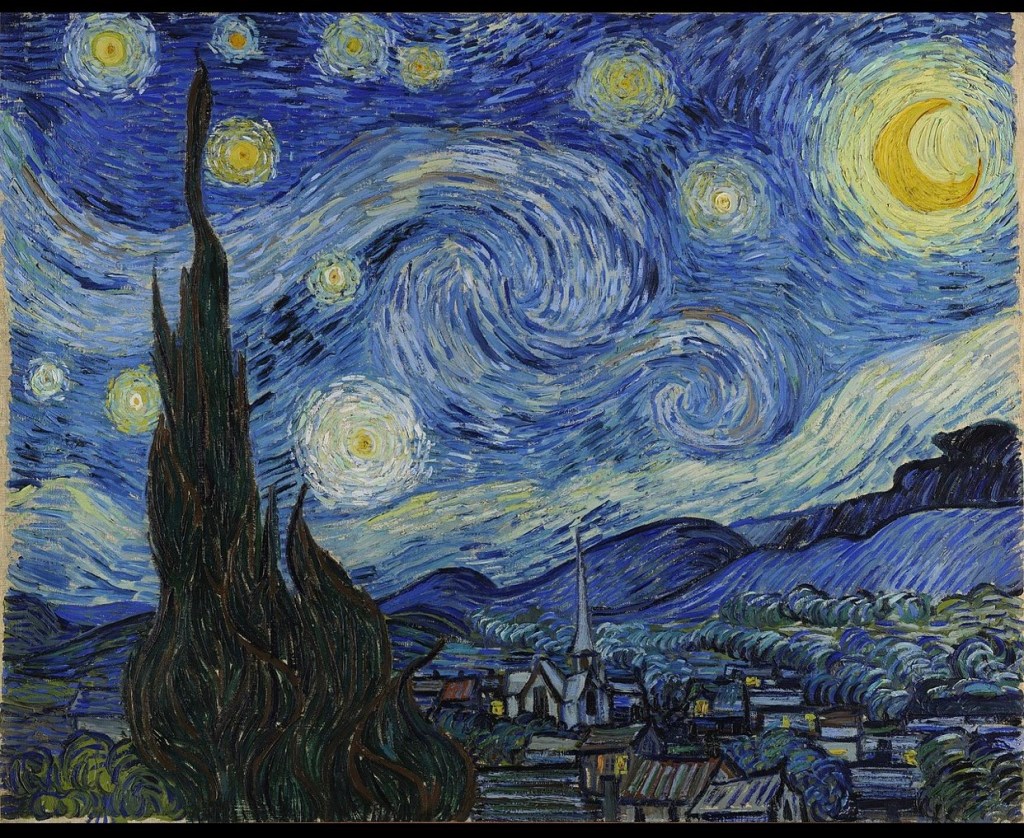
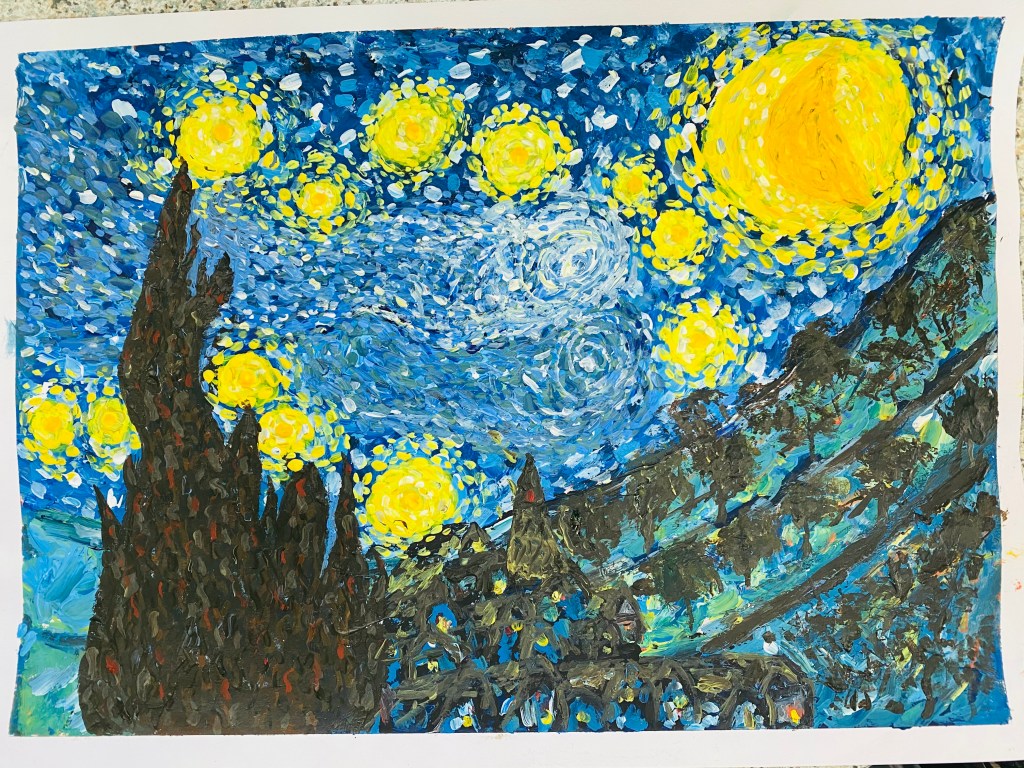
I couldn’t resist to experiment on one of his most acclaimed and famous paintings:STARRY NIGHT!
Since day one when I conceived the idea of working on Vincent Van Gogh’s genius masterpieces as a reference, looking back and forth on his paintings I couldn’t help my urge to work on this particular one:
The Starry Night is an oil on canvas painting by Dutch Post-Impressionist painter Vincent van Gogh. Painted in June 1889, it depicts the view from the east-facing window of his asylum room at Saint-Rémy-de-Provence, just before sunrise, with the addition of an imaginary village. It has been in the permanent collection of the Museum of Modern Art in New York City since 1941, acquired through the Lillie P. Bliss Bequest. Widely regarded as Van Gogh’s magnum opus,The Starry Night is one of the most recognized paintings in Western art.
source: Wikipedia
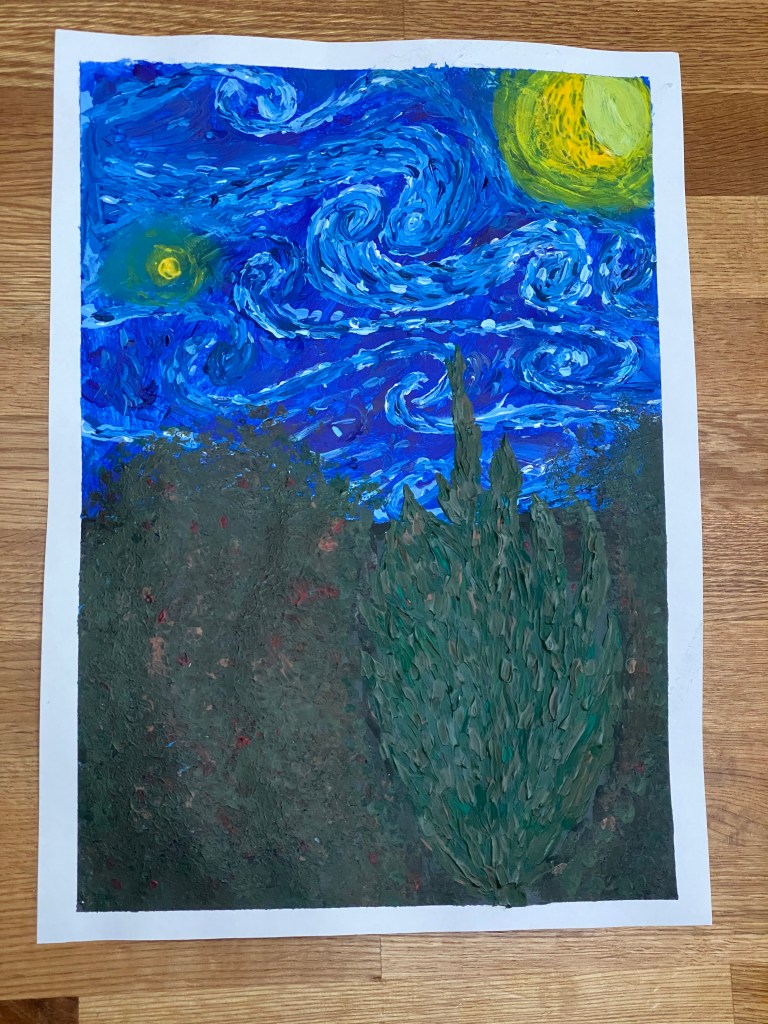
There is a tree silhouette on display , a cypress, a plant where I feel in my current circumstances very close to me and it can link back to my assignment, so, I thought it would be worth to give it a try and make my own version of it with full respect on what I’m dealing with as I didn’t want to confront ,or even assault with artistic audacity this magnificent piece of work in any way but to make a study on it by (in a way) deconstructing it (so I find how it is made) and reconstructing it under my own view.
My own version doesn’t capture the same scenery exactly. I find illustrating the best way to study a painting and in this case was the use of colour my main interest as well as the drawing technique.
I had to go back and forth on this piece many times: I had to add more or change details , reshape the cypress many times, add more colour and depth to it ;all this work helped me understand the process a lot more, gave me more patience on the procedures , made me understand the use of gouache and allowed me to realize what trial and error is and how I’m able use it to learn more.
“Nobody is born with a style or a voice. We don’t come out of the womb knowing who we are. In the beginning, we learn by pretending to be our heroes. We learn by copying.” ― Austin Kleon, Steal Like an Artist
There is a lot of explanation on why for my last piece I didn’t use my own voice to create something unique and why I got into the mood of following other peoples work.
In Greek mythology, Cyparissus or Kyparissos (Ancient Greek: Κυπάρισσος, “cypress”) was a boy beloved by Apollo, or in some versions by other deities. In the best-known version of the story, the favorite companion of Cyparissus was a tamed stag, which he accidentally killed with his hunting javelin as it lay sleeping in the woods. The boy’s grief was such that it transformed him into a cypress tree, a classical symbol of mourning. The myth is thus aetiological in explaining the relation of the tree to its cultural significance.
source: Wikipedia.
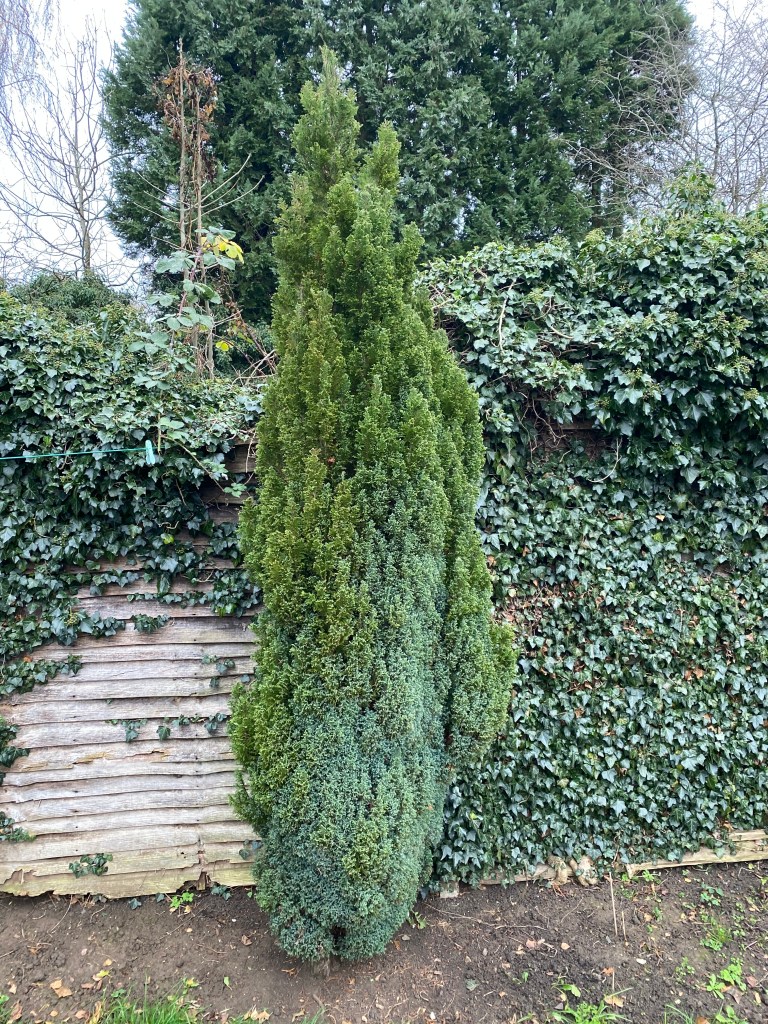
A cypress growing in my garden inspired me to capture my own version of it under the influence of
”Starry night”
Where I’m coming from, cypress has a great substance . It is an evergreen tree you can spot in grave yards all over the country. People plant them when they are grieving a loss, not only because of the old tradition related to the myth mentioned above, but also, because its resin weeping bark resembles human tears…In my case, I didn’t plant any cypresses at all, but, I’ve managed to use this opportunity, this painting, to draw one: I’ve lost my mother few months ago and my own Cyparissus , cypress, painted on my version of ”Starry Night”, is dedicated to her memory…
Vincent was suffering for his sanity and drawing became an escape for him ; drawing had offered to me in this occasion the same feeling.
————————————————————————————————————————
Concluding project 1 and reflecting on my work , I’m able to spot that there can be lot of big/small objections on my drawing style and on my paintings: I’ve never claimed to be a painter anyway.
I find the fact I got carried away with my enthusiasm and I ended up drawing multiple vases and flowers which are familiar but they have a twist in all of them a fruitful study.
Some might bring doubt and skepticism to if my work is adequate and its lacking imagination and personal voice.
But then,considering where I’ve started and where I’ve ended up to, a poem came to my mind which captures what I’m realizing when I’m looking back to my study:
The young poet Evmenis complained one day to Theocritus: “I’ve been writing for two years now and I’ve composed only one idyll. It’s my single completed work. I see, sadly, that the ladder of Poetry is tall, extremely tall; and from this first step I’m standing on now I’ll never climb any higher.” Theocritus retorted: “Words like that are improper, blasphemous. Just to be on the first step should make you happy and proud. To have reached this point is no small achievement: what you’ve done already is a wonderful thing. Even this first step is a long way above the ordinary world. To stand on this step you must be in your own right a member of the city of ideas. And it’s a hard, unusual thing to be enrolled as a citizen of that city. Its councils are full of Legislators no charlatan can fool. To have reached this point is no small achievement: what you’ve done already is a wonderful thing.”
CONSTANTINE P. CAVAFY (Greek poet 1863-1933)
—————————————————————————————————–
Someone else could also say I have turned the whole study too personal and too emotional. But in my opinion this what art is.
Depending on the circumstances helps people express their feelings, takes people journeys to the unknown(their own subconscious) becomes a safety net ,offers comfort, redemption , catharsis, support and solace.
Project 1 has offered me all the above ;
As far my learning curve is concerned,
I can confess I have acquired drawing in my arsenal of skills and I’ve got the confidence that can I apply this (up to a certain point) expertise to express myself .
I have the sense I’m learning in a faster pace covering a broader area of different subjects .
I have discovered that there is a universe of brewing beliefs and objectives waiting to be created : getting in the mood of conceiving an idea and using art as a medium gives birth to them.Working on the drawings displayed above, made me realize I have just scratched the surface!
Drawing ,as an creative art has certain procedures certain steps ,certain rules.
Last , but not least ,by analyzing and observing(even copying), I’ve got a glimpse of Vincent Van Goghs everlasting genius !!!
When I sat down to start working on project 2 only thing I was thinking of, is find the best possible way to link it to project 3 (which concludes assignment 5 along with my own selection section) and show how this journey took me to my goal achievement.
Being excited but a bit worried as I didn’t know how to start , I decided to gather all sorts of materials , in order to get inspiration from them and help me go further down with my thoughts and ideas .
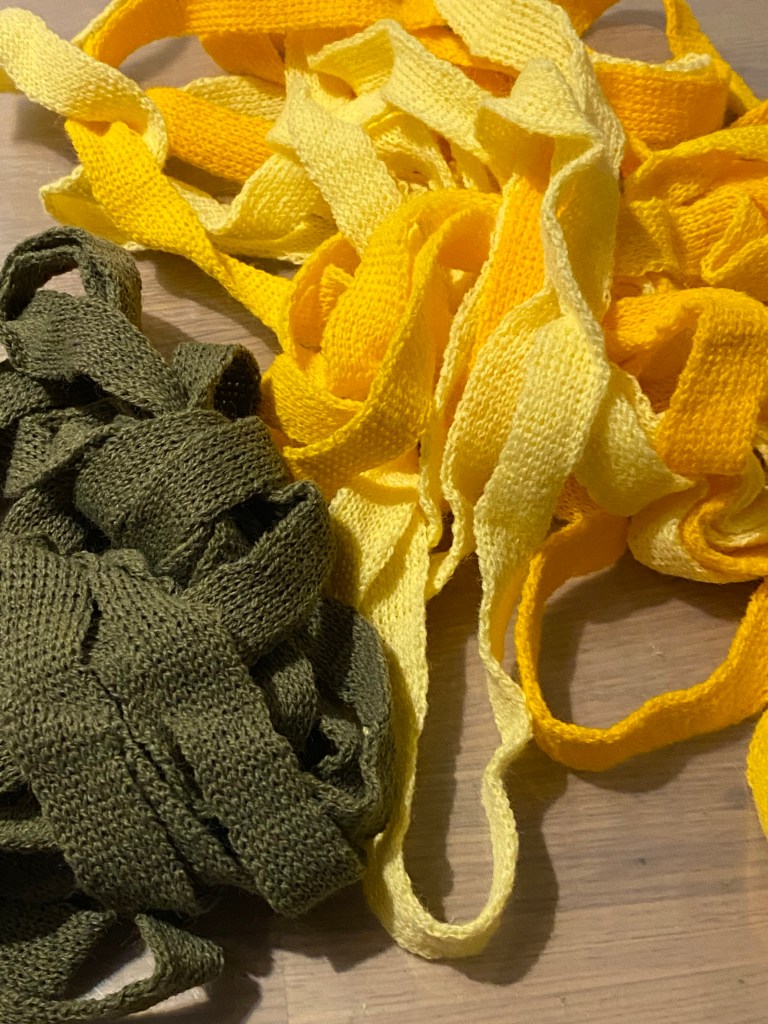
So, first of all I’ve got my strapping machine to knit different colours of strings but always having in mind my sunflower concept I have worked on project 1 :shades of yellow along with some khaki, as my whole perception, my whole inspiration comes from Vincent Van Gough’s work and it’s loosely related to it where what I really liked in it is his celebration of colours .
Individually knitted acrylic yarn
…And space dye bright acrylic yarn…
..Which I have decided to knit using again pegs as needles.
Another knitting project would be 3 ply strapping , 2 finger and knitting forward , 4 finger knit:
Really happy with the result.
Managed to feed through (when it turns from 2 finger to 4 finger knitting) an organza fabric
When I finished my knitting concepts made me think I was creating pieces of puzzles , puzzles that haven’t a form yet but they will guide me to give birth to them when I will feel there is no need to gather more materials.
First of all, fabric.
Lots of it !The more, the better!
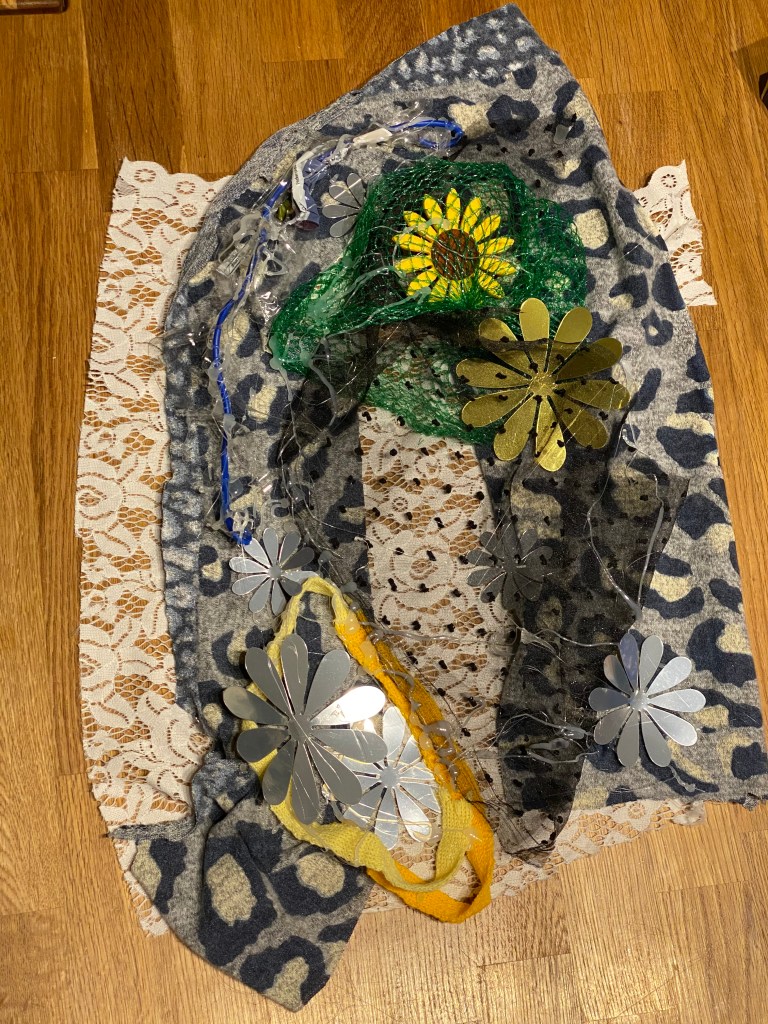
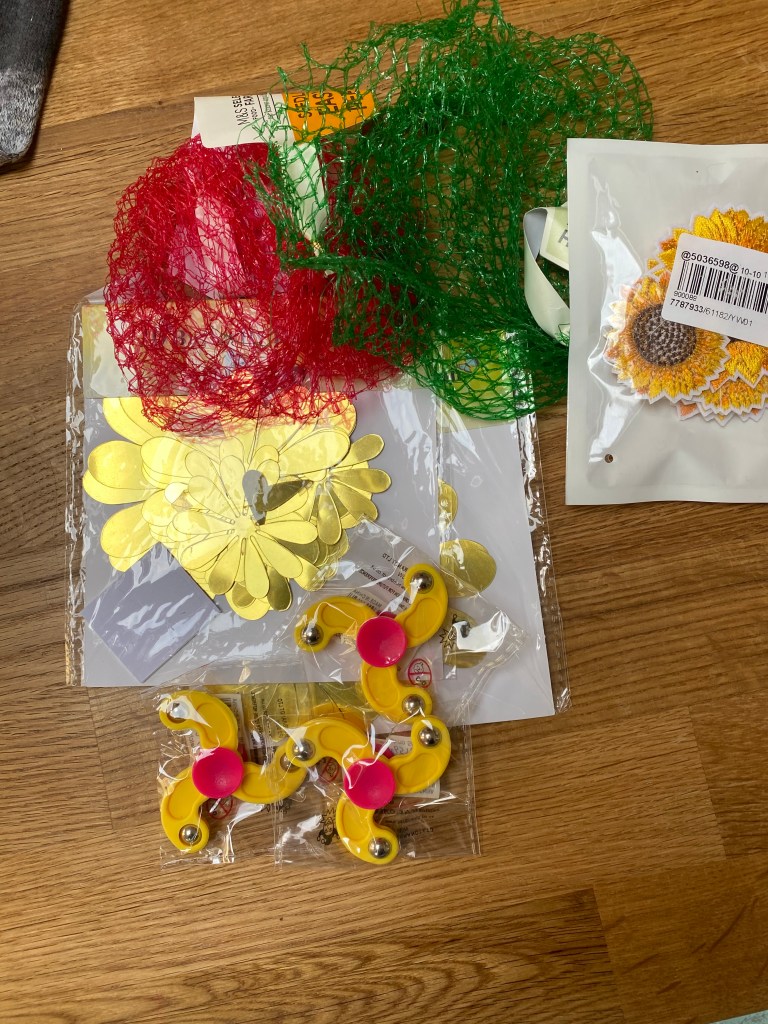
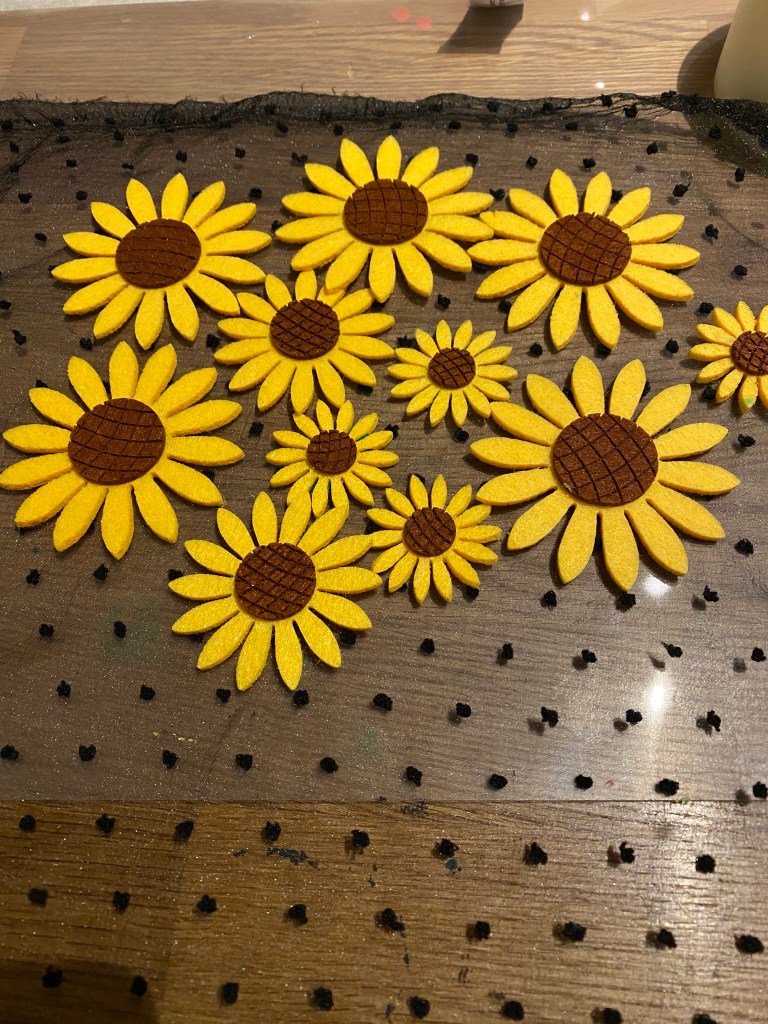
I’ve also (as demonstrated before )sourced organza fabric which I liked the transparency of it, as well as I found an old computer cooler which in my eyes resembled a sunflower;Talking about my main subject I bought felt sunflowers in different sizes.
Furthermore ,I found more inspiring items like swirling fidget spinners, fruit nets, and two faced (gold-silver decotative flowers).
and then stared arranging them on the fabric, in sort of a bouquet form.
Then, to finish it off , I’ve used my string to shape it as such : a sunflower bouquet.
One idea takes you to the other.
What would we need for the concept ?
A vase, which I’ve drawn using yellow to match my story.
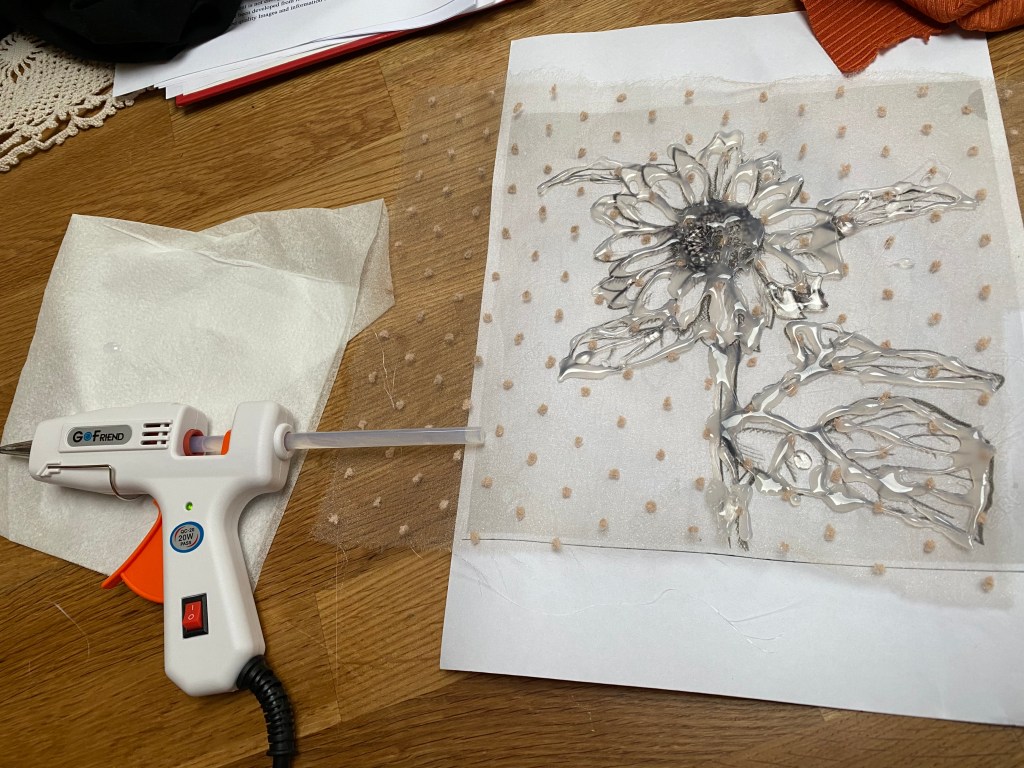
then I took a glue gun to create linear forms and trace down a sunflower sketch I’ve made .
I had found pink organza and I have decided to glue it on and then , because it was a bit blunt, I’ve coloured it up.
Then in order to make it more interesting I have used the same colour palette on the organza fabric.
Then I asked myself, what if that sunflower was in a field of flowers?
Using the the warm glue pistol, what if I create lines onto fabric layers , to do sort of mark making?
What if I use painted dried warm glue, dried acrylic colour (yellow circular shape and embroidered sunflower formations , along with lots and lots of colour and fabric?
I have considered to use yarns as well so I’ve gathered few odd cones of various counts and qualities.
Thinking about yarns , what if I used some of yarn formations I had created on assignment 4?
Ribbon surface especially knitted with a twist:
A middle channel with a hole in the middle so I can feed a string through and pull in to create a pleating ,accordion effect.
When I had finished assignment 2 , drawing with stitch , I was told I was going wrong direction.Therefore I had to redo it all the way from the beginning.
My tutor told me not to throw away my work but keep it for future reference:
I feel now is the time to do it!
The flower concept fits perfectly to my story.
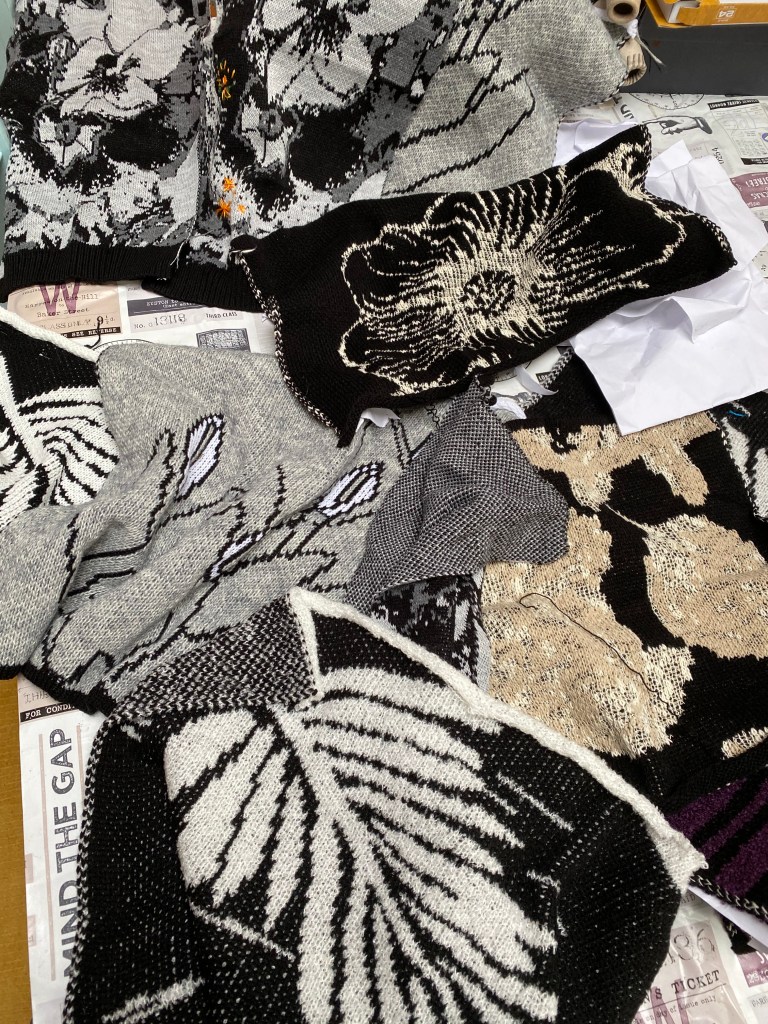
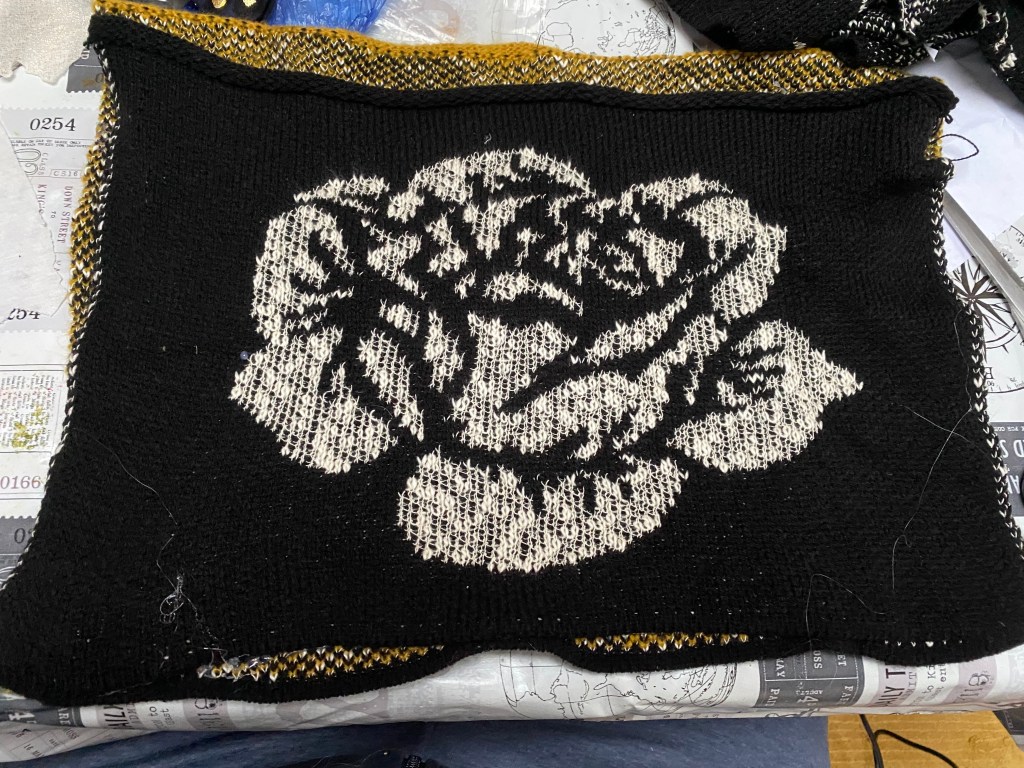
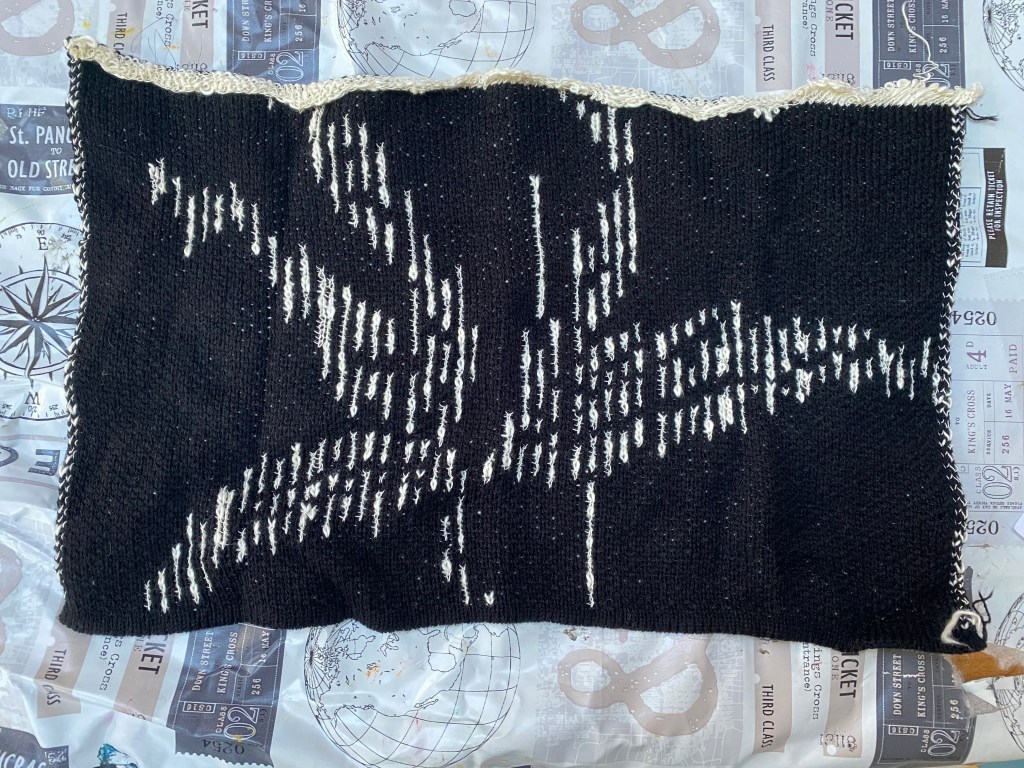
I had produced a fern jacquard using different yarns in order to show the texture and different look of the outcome.
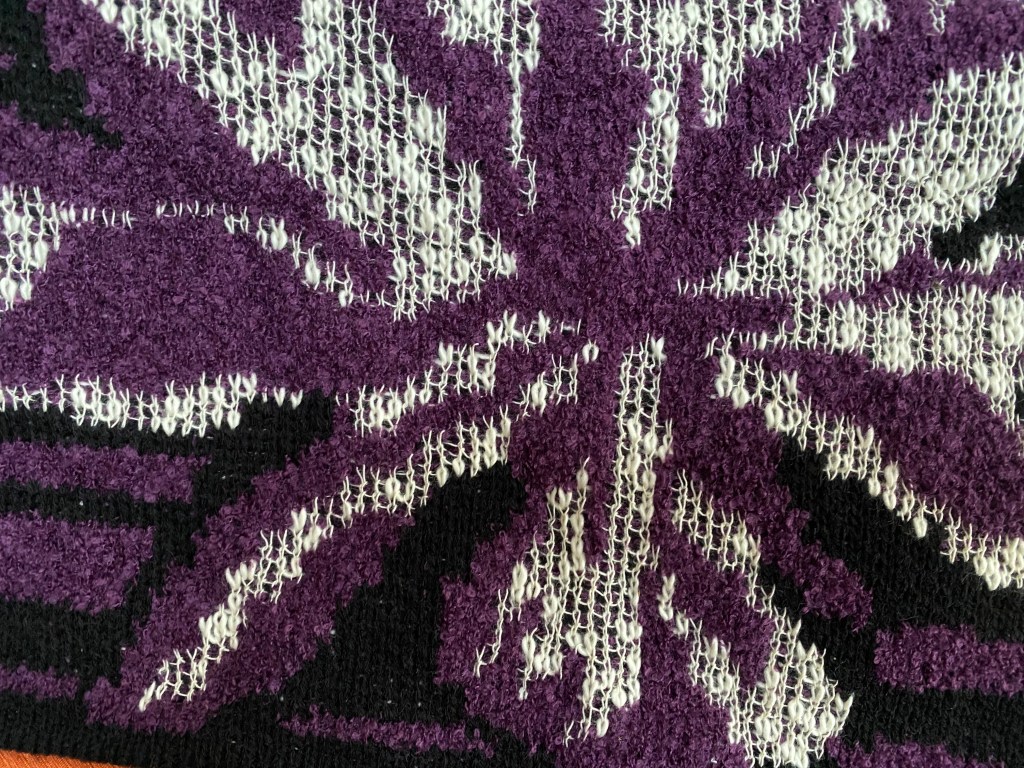
Having an extra piece of the same image but in different colour and different yarn quality (boucle yarn) I thought what if I scratch the surface and brush it?
The surface has changed noticeably mainly on the boucle yarn area and I find a nice contrast between the two knitted colours where the black part stays non hairy .
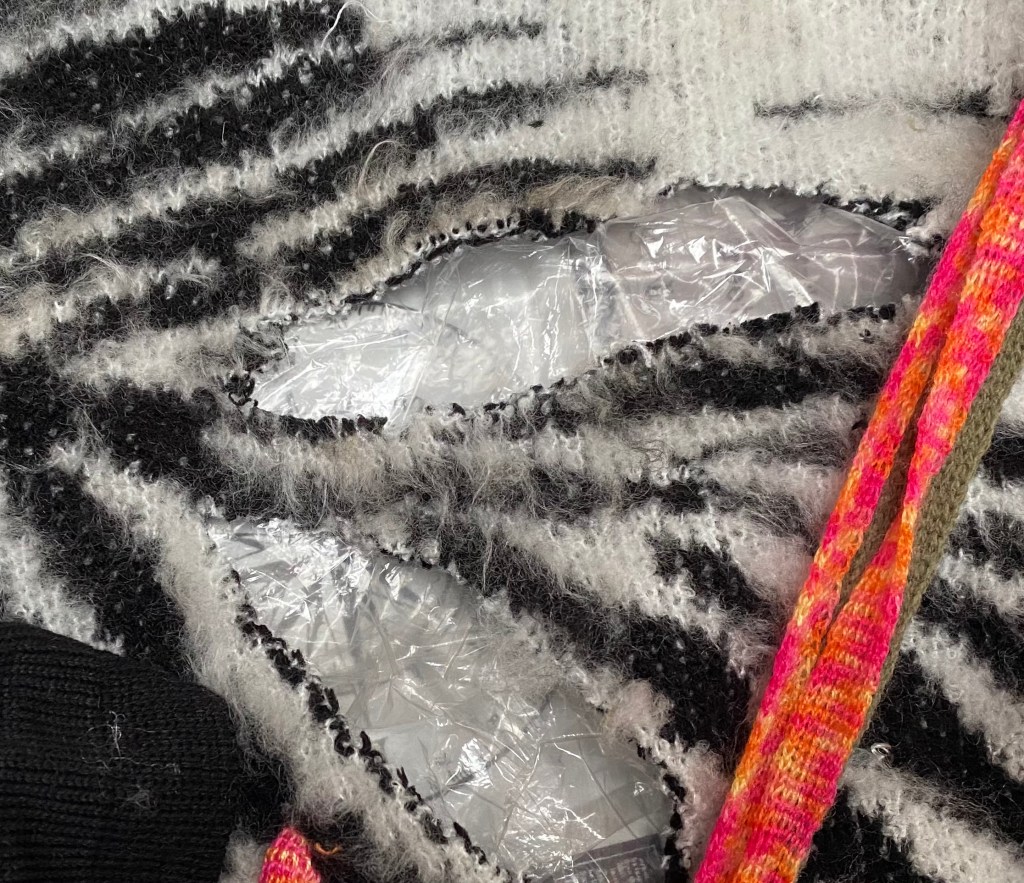
And to push my boundaries a bit further, what if I cut out some leafs and replace them with a nylon, transparent material?
Encouraging myself forward , I wanted to work with colour and surfaces a bit more:
First experimentation was with cotton fabric,
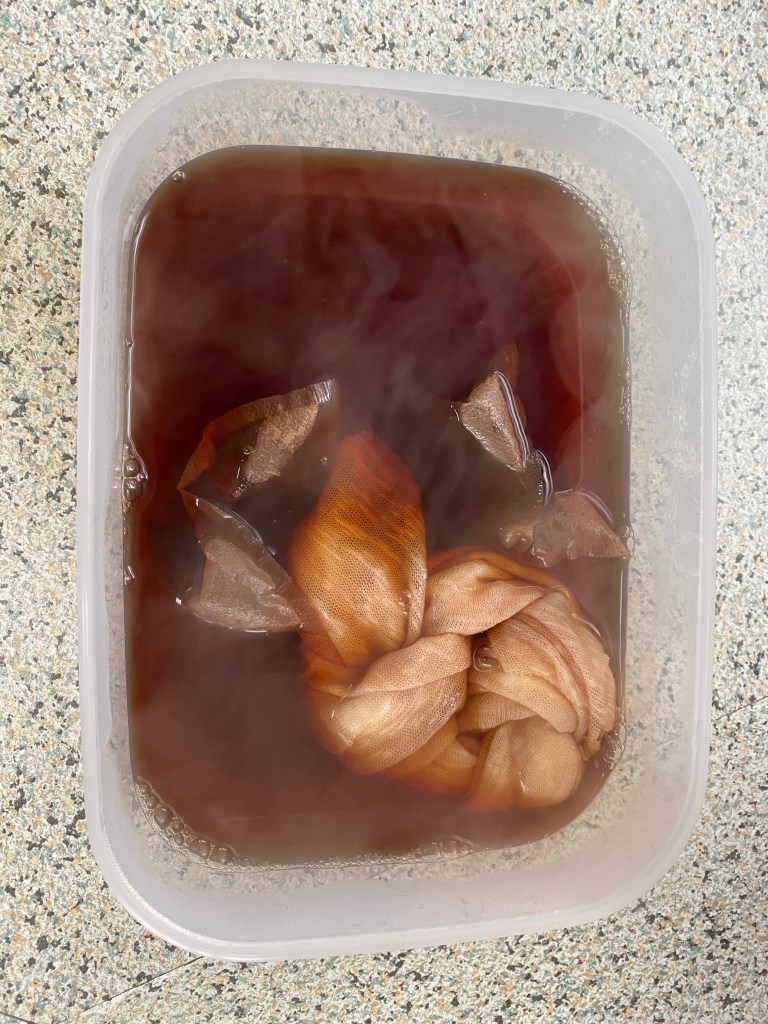
my pigment would come from tea bags
The fabric came out in a nice uniform beige tone.
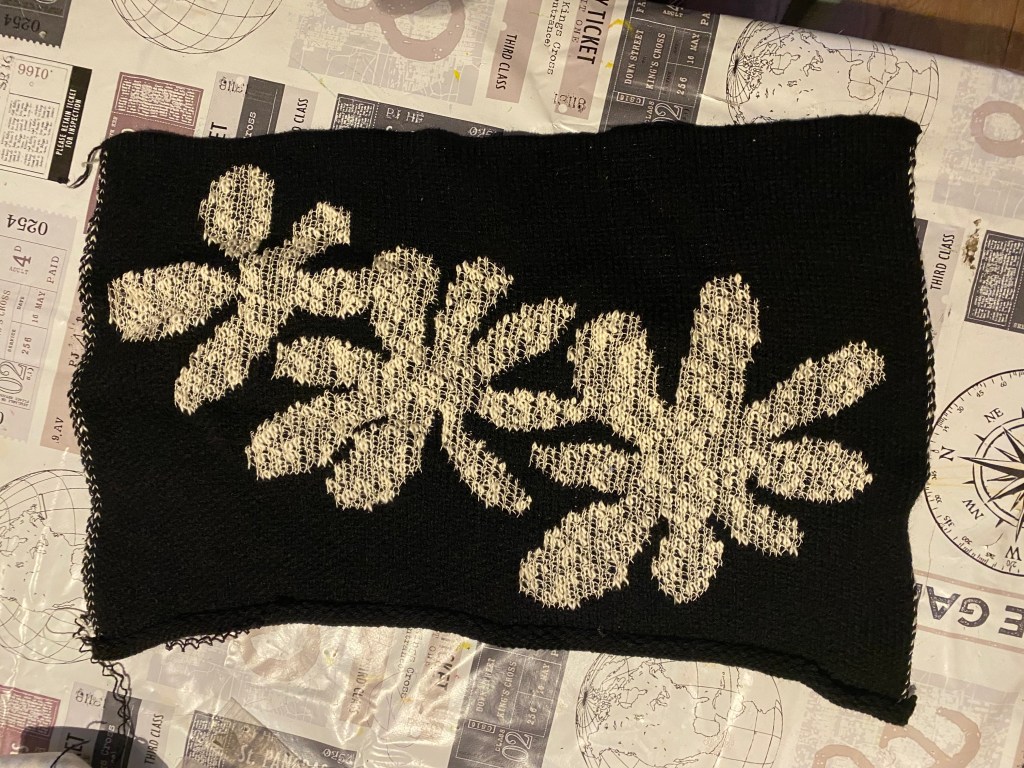
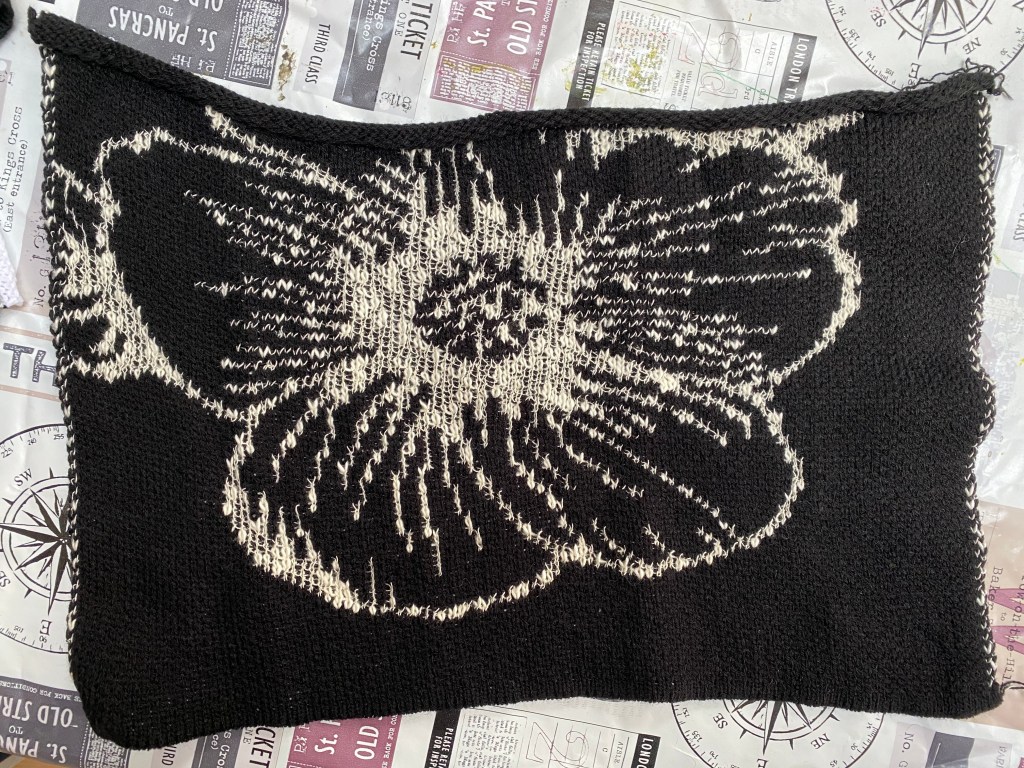
Then I have tried to do the same thing with a commercial fabric I have knitted:
I had intentionally used black acrylic yarn for the background colour and ecru cotton slub (thick and thin yarn) to do my jacquard.
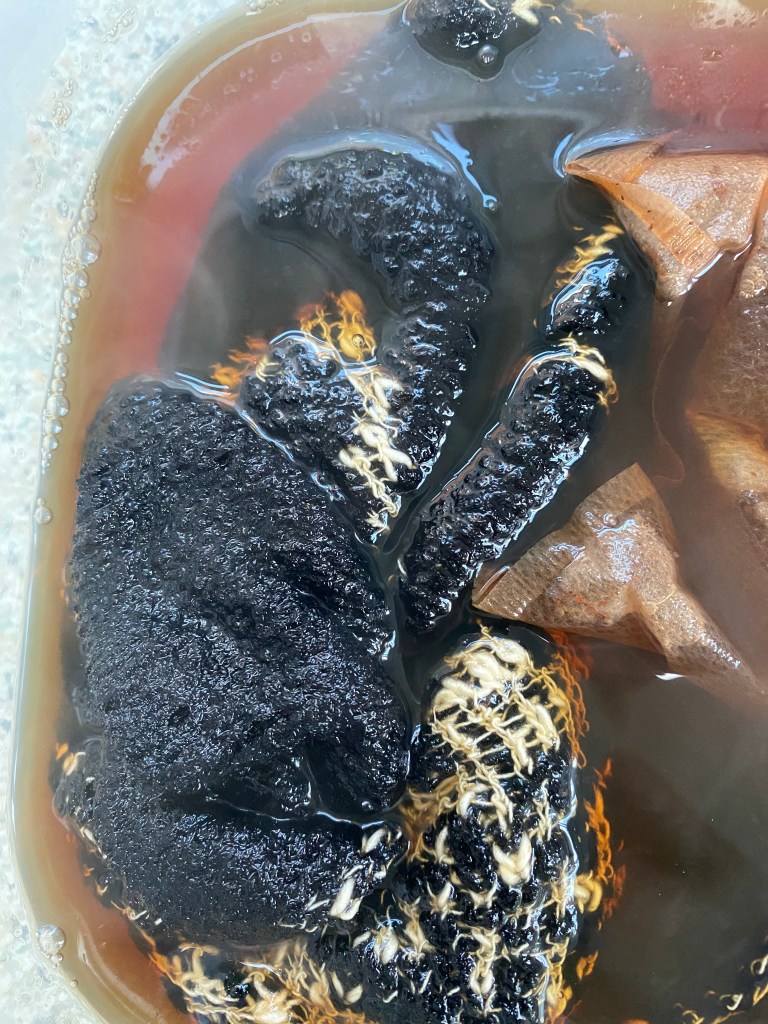
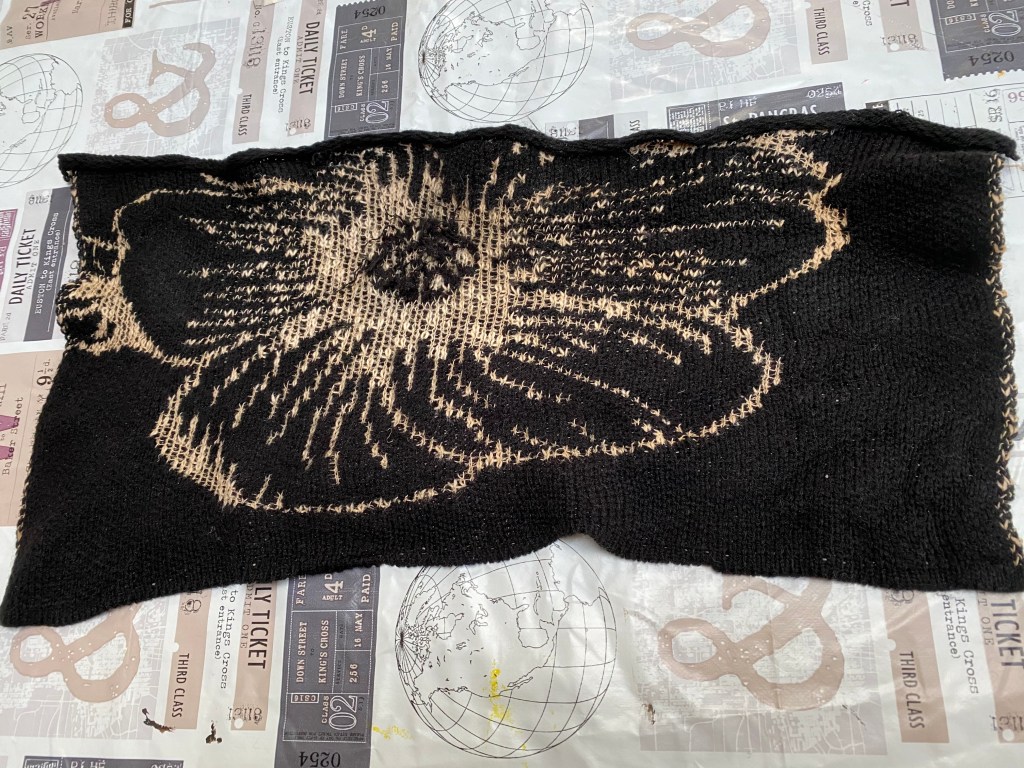
To my great satisfaction, the pigment was absorbed ONLY by the natural fiber which turned again the colour into a uniform beige.Also , because cotton slub is an unprocessed yarn it followed the natural shrinkage process.
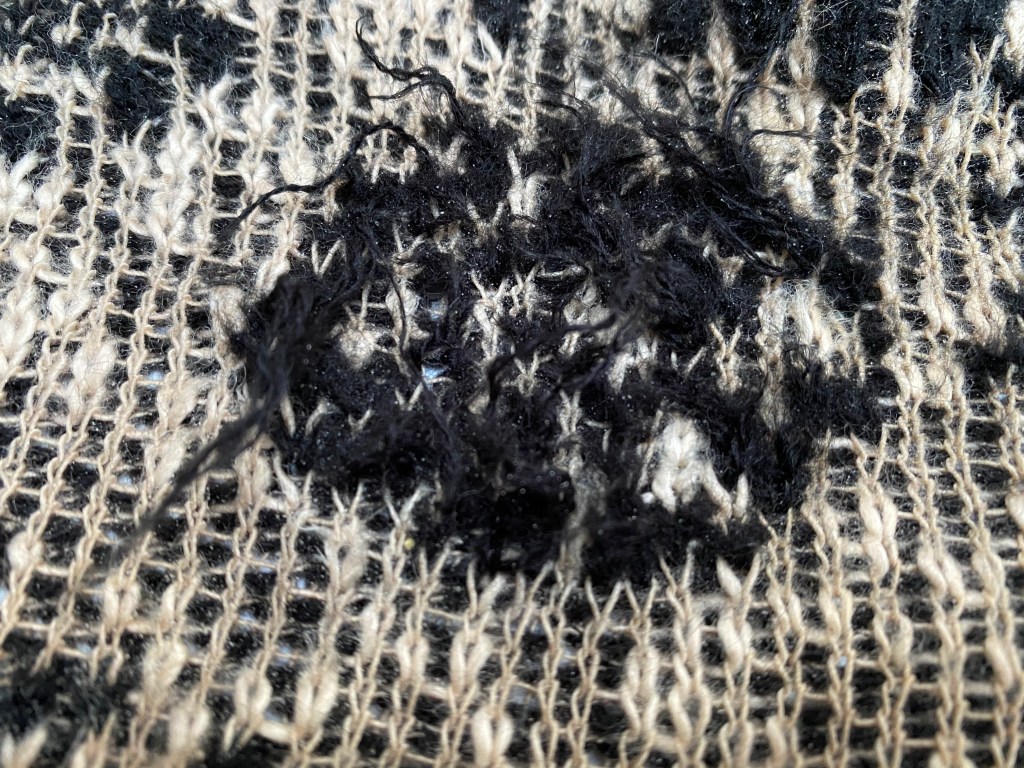
Then to work on the surface a bit more, I have used a nail to scratch and destroy the surface on the flower center a little bit; I had also used a sand paper to scrape the black surface but it didn’t work out as it seems it brushing works out only with hairy fancy yarns.
On my next piece
I had followed a different route:
I had wrapped coins around the surface in such extent where it got completely distorted.
What if I cut the following in order to reconstruct it ?
and in order to support it would be good idea if I would create strapping surfaces:
and some individual loops ,stitches knitted in a way they create a line:
—————————-
….Inspecting my materials and my accessories I strongly believe I’m ready to move onto project 3 where I would utilize as many as possible and have the best result possible.Just looking forward to it!
The studio is a laboratory, not a factory. An exhibition is the result of your experiments, but the process is never-ending. So an exhibition is not a conclusion.
(Chris Ofili)
Considering Ofili’s statement , I’ve started my research with the axiom mentioned bellow:
Inspiration is all around us and art can be seen and applied everywhere.
Then, sitting on the sofa, I end up staring at this:
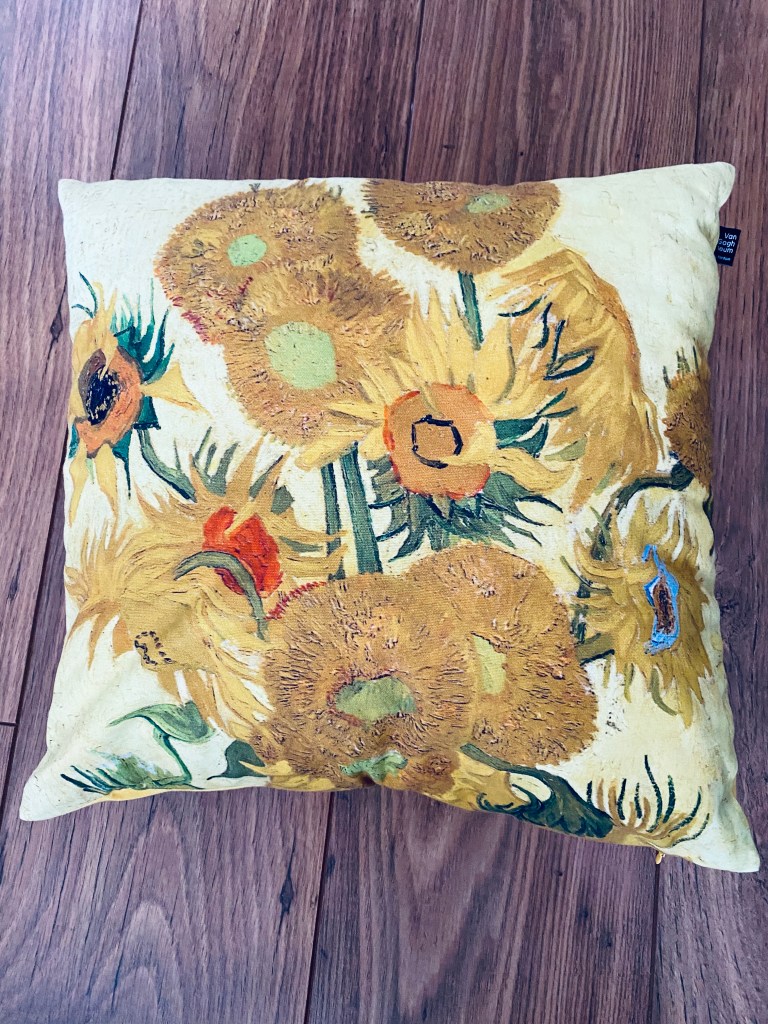
I recently bought a pillow cover: a version of Vincent Van Gogh’s legendary sunflowers printed on.
Van Gogh’s paintings of Sunflowers are among his most famous. He did them in Arles, in the south of France, in 1888 and 1889. Vincent painted a total of five large canvases with sunflowers in a vase, with three shades of yellow ‘and nothing else’. In this way, he demonstrated that it was possible to create an image with numerous variations of a single colour, without any loss of eloquence.
The sunflower paintings had a special significance for Van Gogh: they communicated ‘gratitude’, he wrote. He hung the first two in the room of his friend, the painter Paul Gauguin, who came to live with him for a while in the Yellow House. Gauguin was impressed by the sunflowers, which he thought were ‘completely Vincent’. Van Gogh had already painted a new version during his friend’s stay and Gauguin later asked for one as a gift, which Vincent was reluctant to give him. He later produced two loose copies, however, one of which is now in the Van Gogh Museum.
(source: Van Gogh Museum)
The brief above , comes to compliment my view: Even by using exactly the same materials you are still able to follow different routes and have different outcomes, different answers. The dialogue is constant and the work as a result is just a snapshot of the idea the artist is working on that particular moment .To be more specific and to analyze a bit more, I have come to the conclusion that our experimenting work is like a photo shot :we capture what we feel and what we are inspired from that particular moment. I strongly believe if we deal with the same concept few days later we would have totally different pieces, totally different developments. An idea is always on the move and is with us brewing in our subconscious . It is sometimes so fragile, that slips off the edges of our brain.Even though when we are finished can see there is always room for improvement.That is not what a factory is. Factory is constantly producing in mass scale ideas that have been tested in a studio.Whilst manufacturing in mass production ,is very hard to experiment , to test ,try new things.
Baring in mind all the above I knew what I my next step would be…


































 Alexander's blog