This assignment builds upon the research you conducted in Project 3 ‘Clouds and Pillars, where
you explored the contextual qualities of textiles and their wider use. You will now investigate a
textile and critically examine its formation, placement, use and other properties. (See below).
Project 3: Clouds and pillars
Textiles as a discipline is unusual in that the textile is rarely the end-product but rather becomes
part of a further making process. That may be towards fashion, interior, installation, furniture,
sculpture, architecture, product, automotive or any number of final solutions, conclusions or
contexts.
Whether large scale or small scale, textiles can offer durability and flexibility, both visually and
through their physical properties, to suit a broad range of applications, whether within an
artistic or design context.
- Textiles may be created specifically to fulfil the needs or demands of specific contexts. For
example, a designer may work to a brief to develop a durable textile in a specific colour
palette for seating on public transport. - Alternatively, a textile may exist already and be selected to meet a particular end use.
Fashion designers and brands often build their garment collections after selecting textiles
presented by manufacturers at specialist trade shows.
Project 3 is about the context for textiles. When you’re analysing the context in which textiles
appear, you’ll find it helpful to think about these main qualities:
ART or DESIGN
Consider the intention of the textiles. Do they serve as a commercial design outcome, are they
being used within a functional context, or are they presented as works of art?
TEMPORARY or PERMANENT
Is the installation or placement of the textiles intended to be temporary, or do they form part of
a long-term or permanent structure?
LARGE SCALE or SMALL SCALE
Do you perceive the overall scale to be large or small? Think about how you might relate to the
work in its context.
TRANSFORMING and/or DEFINING and/or FORMING
How do the textiles work to change the context they are placed within? Do they TRANSFORM
an existing space or place? Do they function to DEFINE or perhaps emphasise a place or space
in some way? Do the textiles FORM their own shape, space or place? Or do they do more than
one of these?
IMMERSIVE and/or DISTANT
Are the textiles made to be experienced close-up and in an IMMERSIVE way? Perhaps they’re
designed to be touched or the viewer is placed within a textile environment. Or are they
viewed from a DISTANT location? A distant location could be from across a room – or from a
plane in the sky.
PATTERN and/or COLOUR and/or REPETITION and/or SHAPE
These four qualities are key factors in the design and creation of textiles. Consider if they’re
dominant or important in the context the textiles are placed in.
These qualities are by no means exhaustive, but should be a starting point for you to analyse
the contexts of the works that follow.
You have two options for this assignment, in which you are required to write a short essay
where the overall focus is to select an environment where a textile, textiles or textile qualities
plays a key role
Select a public or commercial space and focus on a textile that is being used in a functional
manner. This can either be an exterior or interior; comment upon its practical use and presence
within/around that environment.
Select an art installation where its primary medium is considered a textile. Analyse its formation
and contextual presence; question the creation of the piece and if it has been informed by
the space it inhabits or if there is no connection and the gallery/environment is a secondary
component.
Below are some further questions and pointers to consider, don’t worry if you can’t answer
them all.
• Criticality – An important element is that you need to form a critical argument.
• What are the physical qualities and properties of the textiles?
• Have the textiles been created specifically for the context?
• Is scale important, and in what way?
• Do distances play a part in the appreciation of the textiles, (immersive/distance)?
• Have the textiles been transformed/customised beyond their original purpose?
• Does the pattern, colour, repetition or shape influence its presence?
• Are the textiles commercially made or handcrafted, does this make a difference?
• Do the textiles transform the space?
• Consider the notion of time, are the textiles intended to be permanent or temporary?
• Do the textiles form part of a story or narrative?
• What is your personal response to the textiles and their context?
Develop your findings into an essay (around 1,000 words). Include image(s) in your account but
make sure they’re relevant to the discussion.
Your research is vital and should be informing and developing your practice. At this stage you
need to be investigating both primary and secondary sources. Move beyond basic Internet
searches and physically engage with your environment, visit galleries and museums, but
remember to evidence all of your findings in your learning log and within your essay
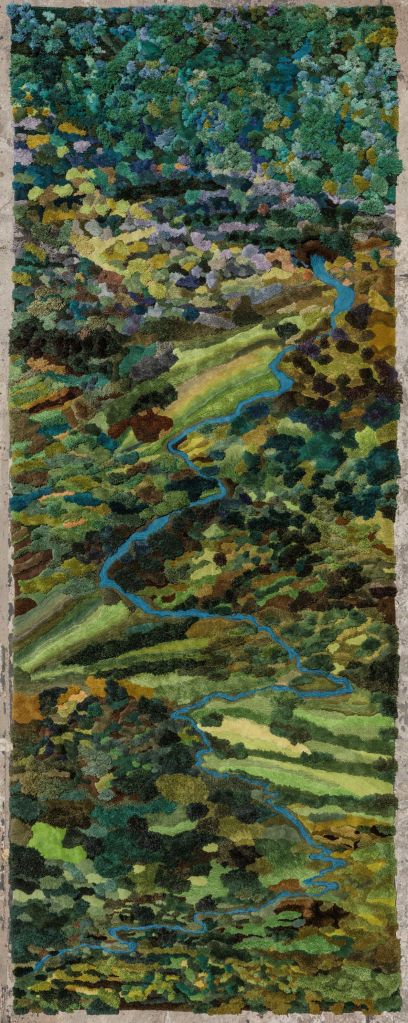
Alexandra Kehayoglou (Buenos Aires, 1981) is a visual artist who works primarily with textile materials. She creates her pieces in her studio in Buenos Aires, utilizing a wide array of technical skills with which she produces works combining textiles, sculpture and installation. She is primarily interested in production processes bringing together art and craft, and develops functional works as complete works of art, in which knowledge of the materials, the technique, and spectator are inseparably intertwined.
The pieces are made with surplus materials, weaved with the handtuft technique using a machine which the artist manipulates upon vertical frames, inserting stitch by stitch. The production process is arduous and long, requiring much physical effort and a very precise technique.
Kehayoglou’s repertoire includes memories of various native landscapes that the artist has visited and desires to preserve over time. Her renowned pastizales (grasslands), fields, and shelter tapestries are like sublime realities which the viewer can contemplate or utilize. Each one is unique, with a texture, weave and palette that will not be repeated. Each piece is created from an ancient family tradition that nonetheless gives new meaning to the craft of weaving by hand.
In 2014, Kehayoglou created a major collaboration with Belgian designer, Dries Van Noten. She developed a carpet of fifty metres long inspired on John Everett Millais’ Ophelia. The textile installation was first used as a catwalk at Paris Fashion Week, and later as a place for the models to rest at the Spring Women’s Collection of Van Noten. This so-called ‘magic carpet’ was exhibited in 2015 in PMQ, Hong Kong, and in Berlin as part of the Berlin Gallery Weekend.
In 2016, Kehayoglou presented the ambitious installation No Longer Creek at Design Miami/Basel, decrying the decimation of the Raggio creek in Buenos Aires. The interactive large-scale work was developed in response to the fair’s focus on landscape featuring both conceptual and industrial innovation.
In October 2016, the work Repoussoir for a New Perspective was exhibited at the Onassis Foundation, New York, as part of the festival Antigone Now. In visual terms, this carpet treats the exploitation of geological phenomena on the island of Milos in the Cyclades, which through mining and industrial use, has witnessed the extinction of enriched minerals.
At the end of 2017, The Triennial of The National Gallery of Victoria, Melbourne, included Kehayoglou’s work Santa Cruz River. The work is an interactive installation part of an extensive research project about the future damming of the Santa Cruz River in the Argentinian Patagonia. This project showcased her critical vision of a disappearing landscape, and premonition of a future ecocide in one the most significant glacial rivers in South America.
Alexandra Kehayoglou’s work has become renowned as an outcry against deforestation and devastation, and for its call for environmental awareness. It is also a warning against the extinction of the wilderness, as well as a strong voice for changing a complacent society which does not seem sufficiently worried about the drastic climate changes brought about by mankind’s intense presence on Earth.
In September 2018, Kehayoglou presented the work What if All is at the Chiostro del Bramante, Rome, in the context of the exhibition ‘Dream’, curated by Danilo Eccher. Her new large-format site specific tapestry explores the disappearing tribes of Patagonia, and their relationship with cave-like landscapes and rock paintings.
Selected exhibitions include: Borderline – Miniartextil, Textile Museum, Varese, Italy (2017); Tissage/ Tressage…quand la sculpture défile, Villa Datris, L’Isle sur la Sorgue, France (2017); Borderline – Miniartextil, Le Château du Val Fleury, Gif sur Yvette, France (2017); The Sunshine Eaters, Ontario College of Art & Design University, Toronto, Canada (2017); NGV Triennial, National Gallery of Victoria, Melbourne, Australia (2017); 27th International Exhibition of Contemporary Textile Art, Arte&Arte Associazione Culturale, Como, Italy (2016); Art in Art, Museum of Contemporary Art MOCAK, Krakow, Poland (2016); The Veterans, Dio Horia – Contemporary Art Platform, Mýkonos, Greece (2016); Wall to Wall: Carpets by Artists, MOCA Cleveland, USA (2016); No Longer Creek,, Design Miami/ Basel, Basel, Switzerland (2016); Glacier, Human Nature, Chamber NY, New York, USA (2016); Pastizal DVN, PMQ – The Qube, Hong Kong (2015); Pastizal DVN, Berlin Gallery Weekend, Berlin, Germany (2016); Senderos, Journeys of the South at Friday Late Nights, Victoria and Albert Museum, London, UK (2016); Pastizales, Praxis International Art, Buenos Aires, Argentina (2012); About Change, World Bank, Washington, USA (2011); Troqueles vaca, Praxis International Art, Buenos Aires, Argentina (2008).
Alexandra’s work is created from an ancient family tradition that gives new meaning to the craft of weaving by hand. A publication featuring an overview of her projects will be published by Verlag der Buchhaundlung Walther König, in 2022.
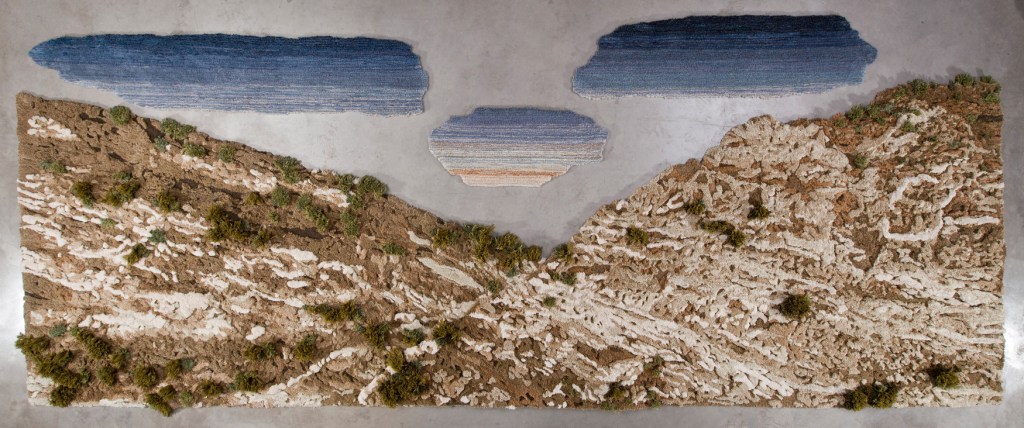
Repoussoir for a new perspective, 2017
Textile tapestry (handtuft system), wool
200 cm x 120 cm
Presented at Festival Antigone Now / Onassis Foundation, 2017 | New York, USA.
Commissioned and acquired by Onassis Foundation.
Criticality – An important element is that you need to form a critical argument.
• What are the physical qualities and properties of the textiles?
• Have the textiles been created specifically for the context?
• Is scale important, and in what way?
• Do distances play a part in the appreciation of the textiles, (immersive/distance)?
• Have the textiles been transformed/customised beyond their original purpose?
• Does the pattern, colour, repetition or shape influence its presence?
• Are the textiles commercially made or handcrafted, does this make a difference?
• Do the textiles transform the space?
• Consider the notion of time, are the textiles intended to be permanent or temporary?
• Do the textiles form part of a story or narrative?
• What is your personal response to the textiles and their context?
Develop your findings into an essay (around 1,000 words). Include image(s) in your account but
make sure they’re relevant to the discussion.
Your research is vital and should be informing and developing your practice. At this stage you
need to be investigating both primary and secondary sources. Move beyond basic Internet
searches and physically engage with your environment, visit galleries and museums, but
remember to evidence all of your findings in your learning log and within your essay
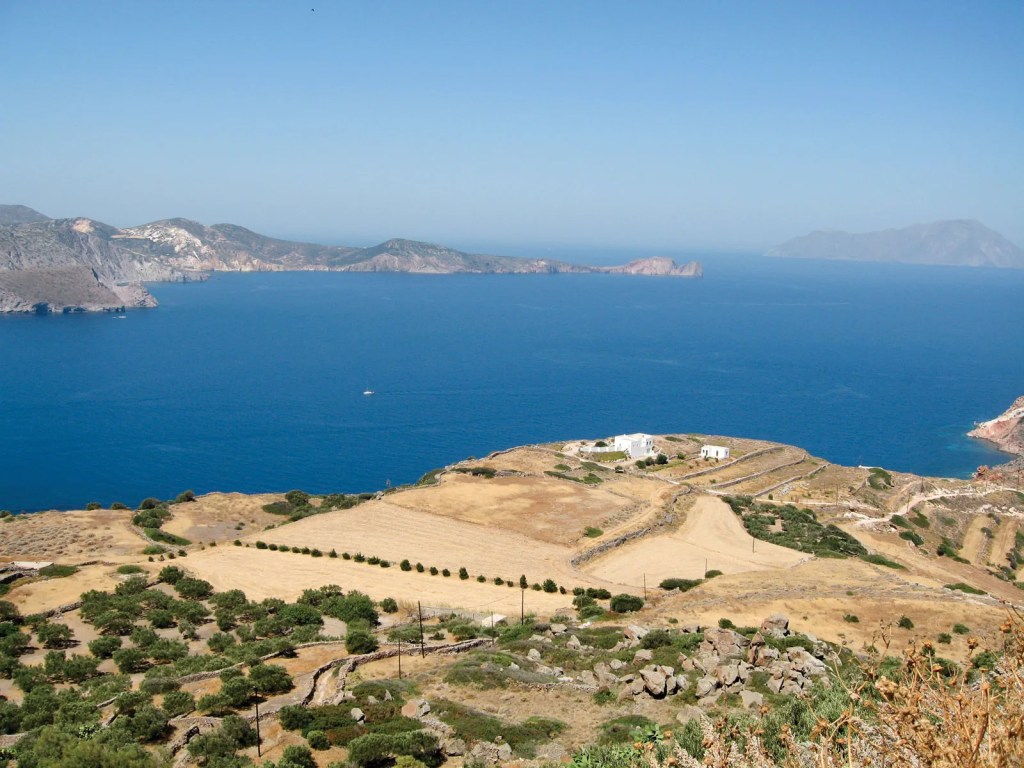
Milos Island, Greece
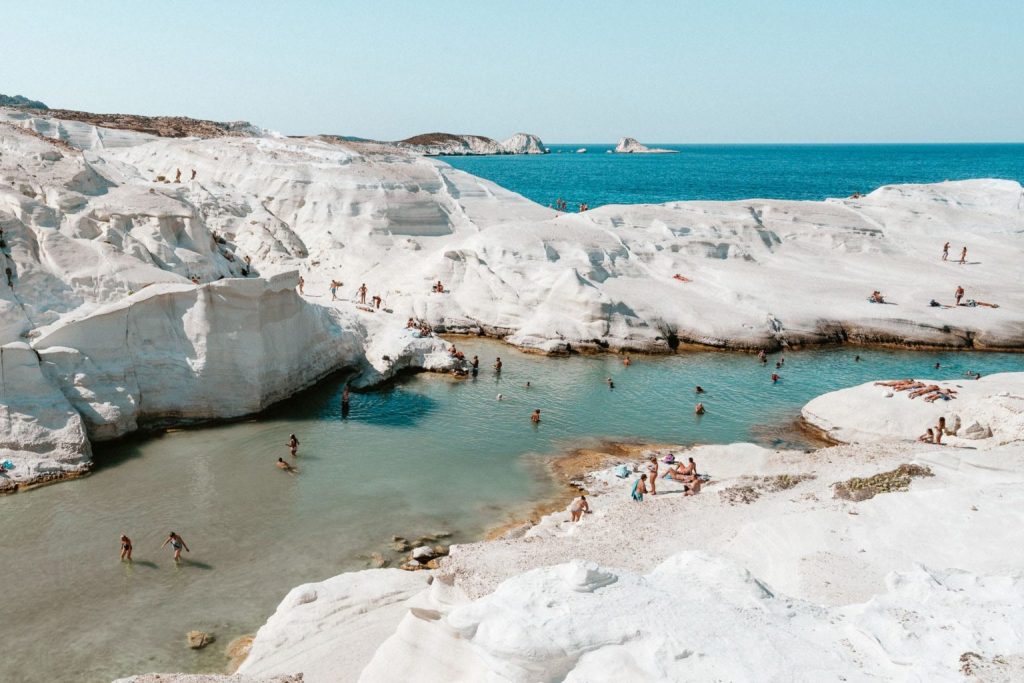



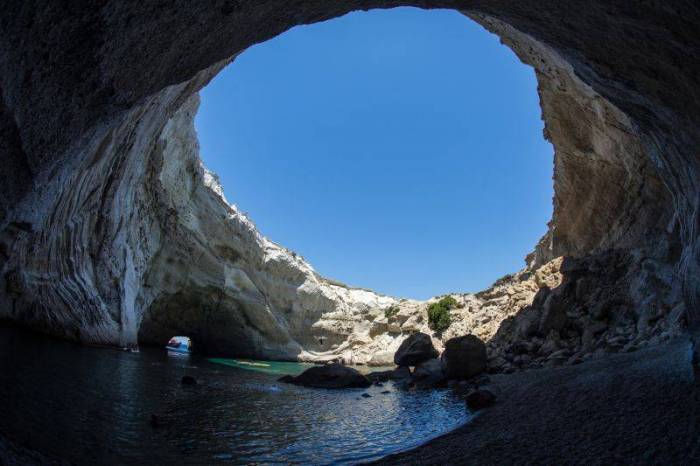
Alexandra Kehayoglou is a Greek- Argentinean textile
artist. She has been active since 2008 and has presented her artwork in various exhibitions around the world. In 2017, under the umbrella of Greek artists exhibiting their work in New York, she has been commissioned by Onassis Foundation (founded and named after Aristotle Onassis, the famous Greek-Argentinean shipping magnate) to bring her own view inspired
by the story of Antigone—a teenager who sets out to do what she believes in
morally right—and creates provocative installations that serve as platforms for
reflection and discussion. Kehayoglou considers the balance between natural and
civic law in an intricate topographical tapestry.
Repoussoir for a New Perspective,
Kehayoglou’s installation on the Art Wall in the
Olympic Tower Atrium is a multi-part hand-woven sculptural tapestry, 23 x 8’.
Executed in earth tones using tufted wool—discarded thread from her family’s
carpet factory in Buenos Aires—the sculptural form represents the cave
formations and volcanic activity that produces intricate outcroppings and
patterns in the landscape on the Greek island of Milos in Cyclades, Greece. The
minerals being extracted from this fragile ecosystem for industrial use are
currently in danger of vanishing. The work reveals how the artist
weaves tragedy into her practice as she explores the nexus of natural (moral)
and human-made law like Antigone’s story does.
According to Britannica, repoussé is a method of decorating
metals in which parts of the design are raised in relief from the back or
the inside of the article using hammers and punches; definition and detail can
then be added from the front by chasing or engraving. The name repoussé is derived from
the French pousser, “to push forward.” This ancient technique,
which has been used extensively throughout the history of metalworking,
achieved widespread popularity in Europe during the 16th, 17th, and 18th
centuries. Repoussoir on the other side is a technique in painting, printmaking, photography, or even in metalwork. It has the same origin, French, meaning pushback, and refers to compositional techniques used to make the distant parts of an image look further away and deeper into the picture.
Utilizing this technique, Alexandra Kehayoglou is trying to
get the viewer to concentrate on the piece of the tapestry that stands out: the
the landscape of the island being carved by the elements and human activity. Her
medium is textiles: a very versatile and flexible material, that can be very
easily manipulated, knitted, weaved, or stitched onto. Having the ability to
utilize and apply any possible colour, the tapestry, and the blanket becomes a canvas
where the structure reveals the island’s volcanic scenery, surrounded by
the magnificent blue of the Aegean Sea.
Kehayoglou tends to create larger-scale carpets in the form of a landscape. The
carpet itself is a conductor, a channel. It runs over walls, but it also can
be walked onto forming a physical and interactive experience for the user
and spectator. The work’s larger scale also emphasizes the texture and surface. When one’s body touches the soft woolly elements of the carpet it automatically becomes bonded with it. It creates a feeling of cosiness and comfort. It feels like home; that is what Kehayoglou is trying to achieve with the use of textiles. She is creating a bond with the audience
through her commonly used medium and its qualities.
As a decorative element, the carpet tends to transform the occupying space. With its colourful qualities, it becomes a feature and a celebration of most of the senses; vision, touch, and scent. These elements have been transferred from its very minimum elements: wool tends to be odourless but when it is washed to soften down, it becomes soft and versatile. The raw material is easy to use but needs skill and experience to employ its qualities to its full potential.
Creating pieces on such a scale requires a lot of skill, precision, craftsmanship
as well as patience, and time. Utilizing leftovers from her family
carpet business, discontinued dye lots, scrap yarn, or unwanted colours and applying them on a surface to create a 3dimentional landscape, has resulted a work impossible to be replicated. This fact underlines the fascinating feeling
of experiencing a one-of-a-kind piece, the product of the genius of an artist who
was improvising according to the materials and the workforce available at the time; But in my opinion, to appreciate Kehayoglou’s work is to zoom into it and be captured by the attention to detail and the true replication of the topography of the terrain it represents.
Most of Milos Island’s mines have been abandoned after being exploited since antiquity. What has been left behind is a land full of scars, manipulated by human activity. Milo’s story can be linked with another tragic one: the sovereign island state of Nauru. For about a century since 1899, the whole island had been heavily mined causing a huge environmental catastrophe. In fact, 80 percent of the island has been stripped, with the deposits of mines being exhausted by the year 2000. Unluckily for Nauru, the island’s resources and profits were not beneficial for its habitants. Milos still contains minerals, but because of people’s awareness and touristic activity, the island has managed to reduce or even eliminate mining activities.
Going back to the original idea, the myth of Antigone who defied the law and followed her morals, I can see Alexandra Kehayoglou’s vision and link of the story creating a chain reaction and resulting in her artwork. Milos has been a cause of debate, the battlefield between two opposite creeds. It is greed against balance: a balance that comes from a world of respect and understanding. Respect for the environment, and consideration about the whole world surrounding us. Understanding because in absence of it we will not be able to see that without our awareness and action, we will have more Nauru cases with fatal results for humanity.
Words:978
References:
Alexandra Kehayoglou. (2022). Biography. Retrieved from
https://alexandrakehayoglou.com/BIOGRAPHY
ARTFIXdaily.com. (2016). ONASSIS CULTURAL CENTER NEW YORK PRESENTS NEW COMMISSIONS BY THREE INTERNATIONALLY RECOGNIZED ARTISTS IN NYC
from https://www.artfixdaily.com/artwire/release/7868-onassis-cultural-center-new-york-presents-new-commissions-by-thre
Milos Mining Museum. (1998). The Mining History of the Island of Milos: John N. Economopoulos,[Brochure].
Milos Mining Museum. (2018). 20 Years Mining museum 1998-2018: Dr. Eleftheria Dimou-Chonianaki [Brochure].
Britannica, The Editors of Encyclopaedia. “repoussé”. Encyclopedia Britannica, 9 Feb. 2018, https://www.britannica.com/art/repousse. Accessed 12 December 2022.
Britannica, The Editors of Encyclopaedia. “relief”. Encyclopedia Britannica, 3 Oct. 2019, https://www.britannica.com/art/relief-sculpture. Accessed 12 December 2022.
Britannica, The Editors of Encyclopaedia. “chasing”. Encyclopedia Britannica, 20 Jul. 1998, https://www.britannica.com/art/chasing. Accessed 12 December 2022.
186 Visual Studies 1: Creative Arts Today
Send your assignment to your tutor along with a 500-word, ‘Reflective Commentary’ describing
your experience of Part Five of the course, based on your learning log.
Part Five has offered me a very interesting approach to the world of textiles.
To be more precise, I want to emphasize the fact I live in a world of commercial textiles for the last 35 years. I cannot say I can be easily surprised. Going through the pages of Part Five, textiles, I admit I was very pleasantly and charmingly lured into a parallel universe of something so familiar but so distant at the same time.
Textiles have been revealed to me as a medium of great flexibility that can be utilized in various applications and in uncountable alternatives.
As with other parts I had the chance to be introduced to pioneering artists whose mesmerizing work had carved new paths and gave away new thoughts and views about our world. Their point of view through their artwork generated to me new ideas, as textiles have been a medium of great wonder and concern. The awakening continued as I was introduced to alternative textile techniques that their use had made me think differently: out of the box. That element alone is a big gain in my learning curve, as it helps me instantly to channel and tackle the challenges I face on daily basis: there are moments in fabric creation when it feels there is no more to give and create. Part Five through the different way of thinking process offered me a pressure relief valve, a way out.
Looking back at my learning log/blog and reflecting on the work I’ve done to answer the questions that occurred by the brief, I feel happy and fulfilled, as I had the chance to deal with and research elements I’m really keen on.
I have a great passion for unique raw materials and I pay huge respect to people/companies who manage to adapt old techniques and reintroduce them with the help of technology converting the world’s finest resources into yarn only to be changed into the fabric of unbelievable quality and craftsmanship.
I had the chance to debate the idea of sustainable sourcing and use my own experience as a filter to argue that matter and suggest a different alternative.
I also want to mention the chance to reflect on shoe-making using flat knitting machines and the opportunity to look deeply into it, learn and learn again about shaping, knitting, and all the amazing possibilities this relatively new technique can offer.
I suppose there is a lot more to find out and to take a look at. The world of textiles is incredibly big, irresistibly charming, and surprisingly unexplored.
With Part Five the whole course of Creative Arts Today concludes.
It has been an amazing year, full of adventure and discovery. I feel grateful and blessed to have crossed this path. As always, I have put all my effort and enthusiasm into my assignments and that alone gives me a sense of fulfillment and achievement.
<< And if you find her poor, Ithaka won’t have fooled you.
Wise as you will have become, so full of experience,
you’ll have understood by then what these Ithakas mean.>>
 Alexander's blog