- As you approach the completion of this unit, take time to reflect on your experience of the unit. Consider how your practice and research processes have informed, impacted and challenged you in new ways and set up new ground for the future. By this point in the unit, you should be able to articulate specific creative understanding that demonstrates in-depth awareness of personal practical and contextual knowledge. You should also have developed the beginnings of a sustainable practice. Do you feel you have achieved this? If not, what do you need to build upon in the future? Formal Evaluation Corresponding to Learning OutcomesAn evaluation is a key aspect of your final submission. The aim of the text is to help you critically reflect on your work and demonstrate your engagement with the progress you’ve made throughout the whole course. A good evaluation reflects on the past and creates aims for the future. This may be the end of a unit but you are nearing the start of the next. Looking to the future, how do you imagine research might function for you as a creative practitioner? What will you take with you from this unit to develop your practice moving forward? Write a summary of your experiences in your learning log including the role research, reflection, and feedback has played in the development of your ideas. Once you have made a draft covering all aspects of your learning, formulate a final version and illustrate with images, text, and/or audio your work and the work of others, to add to your learning log and send to your tutor. Writing an Evaluation: You should be familiar with writing evaluations, but this section outlines what we expect for the specific evaluation of this unit. As you’ll be taking this work forward into unit 2.2 there are a few things we would like you to consider. Look at the section on the presentation and think about the questions raised. Write about this for your evaluation. As well as looking back at the work you’ve done so far, suggest a plan for the work as you move on to Sustaining Your Practice.
- Looking back:
- Where have you come from?
- What have you learned?
- What mistakes did you make?
- What were the low points?
- High points?
- Who influenced you?
- How are you critically positioned as a result of your work on this course?
- How might what you’ve produced impact your future projects?
- Have you found a personal voice that you’d like to develop?
- If not, what have you learned about your personal voice and how will you go about discovering it from here on?
- How did your technical decisions impact, or impair the final outcome?
- Were you true to your artistic intentions?
- What did you learn from the sharing and discussion process?
- What are the main lessons you will take away as a result of this course?
- How would you like your audience to experience your work?
- Do you have any new ideas for display and presentation?
- What do you need to do for this to happen?
- Do you need to make any changes to your portfolio?
- Are you looking to earn income from your creative skills?
- Do you aspire to make your creative arts practice your full-time job or do you intend to pursue it as an interest?
- Do you want to take your degree forward into postgraduate study, for example by doing an MA?
- Do you see a clear line between commercial and personal work or would you hope to reconcile the two?
- How does your combined creative activity fit within the wider creative arts world?
- Will you continue to integrate your two specialisms beyond this course or do you intend to prioritise one discipline?
- How can the subjects you come across on a daily basis and have unique perspectives on, feed into your creative arts practice?
- Do any of the ideas you’re working with have currency?
- Are they being discussed in the media?
- How could you extend the discussion around these subjects through creative work?
- How could you make your project for this course work towards your future development, whatever that is?
- What have been the challenges you have faced or overcome?
- What aspects do you feel you have most enjoyed and where are your biggest achievements, or the areas where you feel you made the most progress?
- How did your critical essay develop your thinking?
- Which elements of your self-directed project were the most challenging, successful, or surprising?
- Which elements of the project failed? Why was that? Did you leave those elements behind or did you incorporate parts of the failure into your working methods to embrace the things you discovered?
The Terrible Deathless Beauty: Helen of Troy.
In this essay, my objective is to delve into the historical and cultural significance of Helen of Troy. I will discuss her role in Greek mythology and literature and her impact on art and popular culture throughout the centuries. Furthermore, I will showcase art inspired by the myth and present the research that led me to it. I aim to make links to how Helen’s perception of beauty is still alive and is functioning as a perpetual well of inspiration and innovation in art today. One of the oldest poets whose name survived through the centuries is Homer. In his epic poem, Iliad (a chronicle of the 10-year war between the Greeks and the Trojans) introduces Helen to the world. According to the myth, she was the most beautiful woman in the world. Her abduction from Paris-Alexander was the reason for one of the most famous wars known with tragic fate for most of the participants. Helen’s beauty has inspired the art world since the Homeric years and the following centuries.
One of the three greatest ancient Greek tragedy creators, Euripides, wrote the drama <<Helen>>, depicting Helen as a ghost. The lyric poet Stesichorus also wrote a poem about Helen, in which he blamed her for causing the Trojan War. As legend has it, he was struck blind and then composed another poem in which he defended Helen, describing her blameless decade in Egypt. Mysteriously, his sight was then restored. Helen is a complex character who can be both a loyal wife and an adulterous mistress. She can also take and return a poet’s eyesight, which shows her multifaceted nature. The Greek poet Georgios Seferis, who won the Nobel Prize, wrote a poem called <<Eleni>>, in which he wanted to show the futility of war. All of these writers speak of Helen’s eternal and immortal beauty.
On the other hand, there is another inconsistency to all this argument: In contradiction to Helen’s everlasting beauty, << Kallos>>, as ancient Greeks used to describe it, is ephemeral. There is a perpetual change in the world around us, constantly embodying different forms and values. Nothing stays the same. Natural beauty perishes. The colourful flowers and the sea disappear from our eyes even when we focus somewhere else. In addition, the way we look at and understand things changes over time.
The way to depict all this is art.
Art becomes a magnifying glass, a camera, a recorder of moments of beauty. It captures the magical moment of a genius outcome in the past. In other words, art is the amalgamation of moments that are gone forever. So, when we admire an artwork, we dive deeply into the creator’s soul and feel manner and purpose. Helen is a symbol of great significance. It inspired me through the course and guided our beauty search.
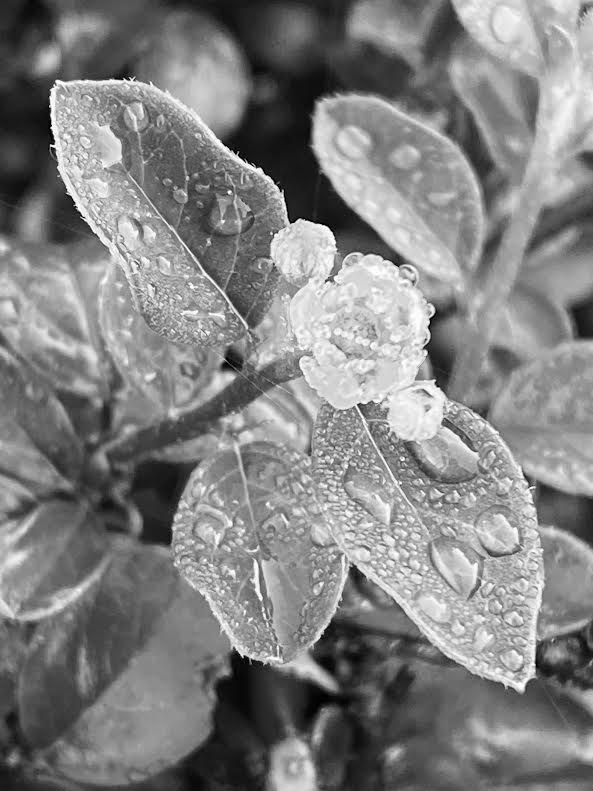
Following this influence, I have created pieces of work that include poetry, photography and drawing. I wanted to capture the aspects of beauty analysed above. Moments that passed and lost. The outcome of this research is some work under my filters and my point of view. I have captured many photos by focusing on the tiny instead of the big and pompous. My goal was to spot the beauty of the ephemeral everyday ordinary sights: a drop of water on a leaf, a rose, a spider web with the morning dew. I have shown our purpose using black-and-white filters.
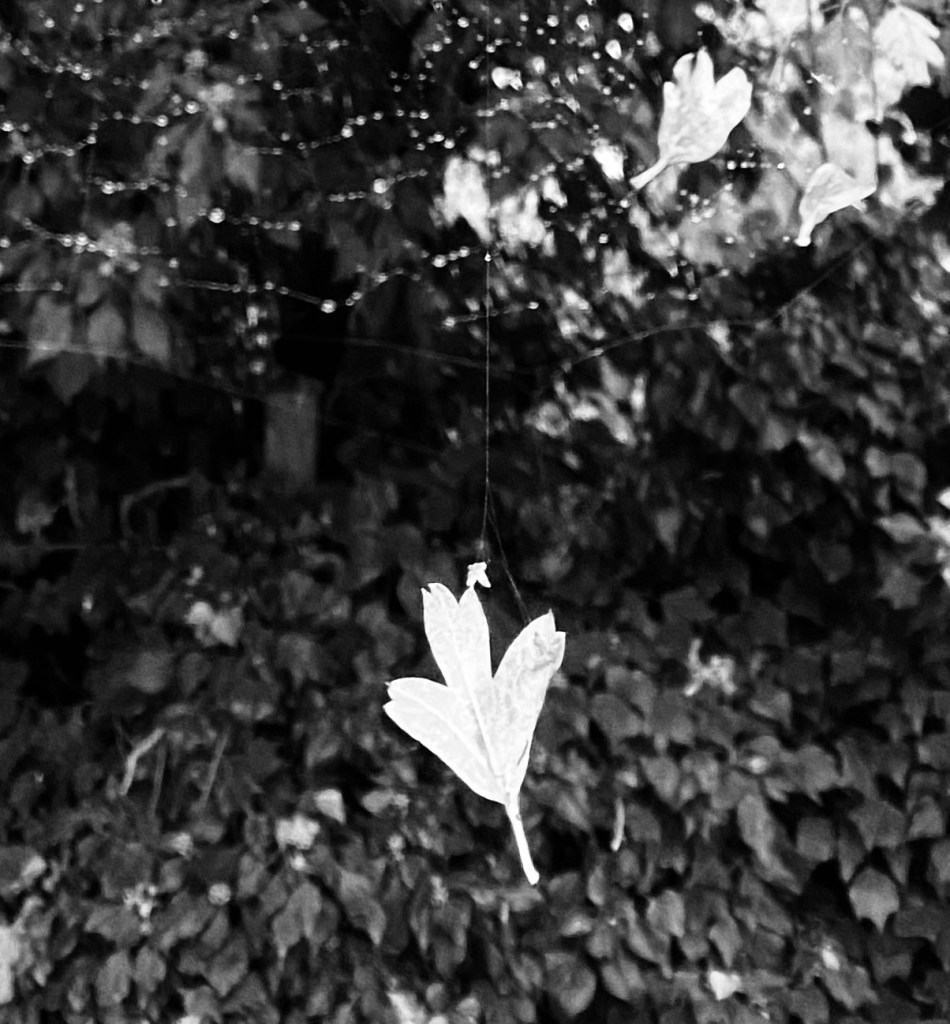
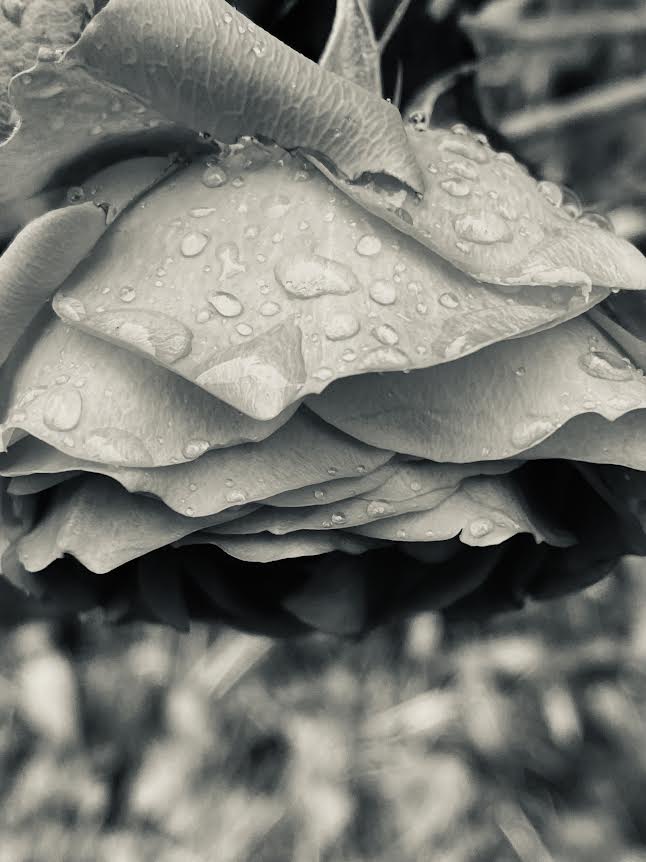
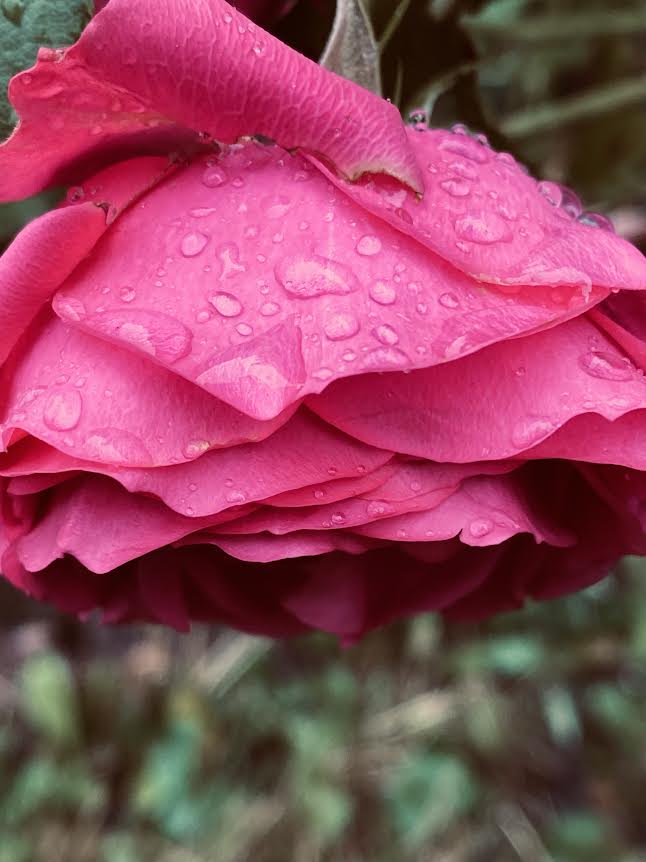
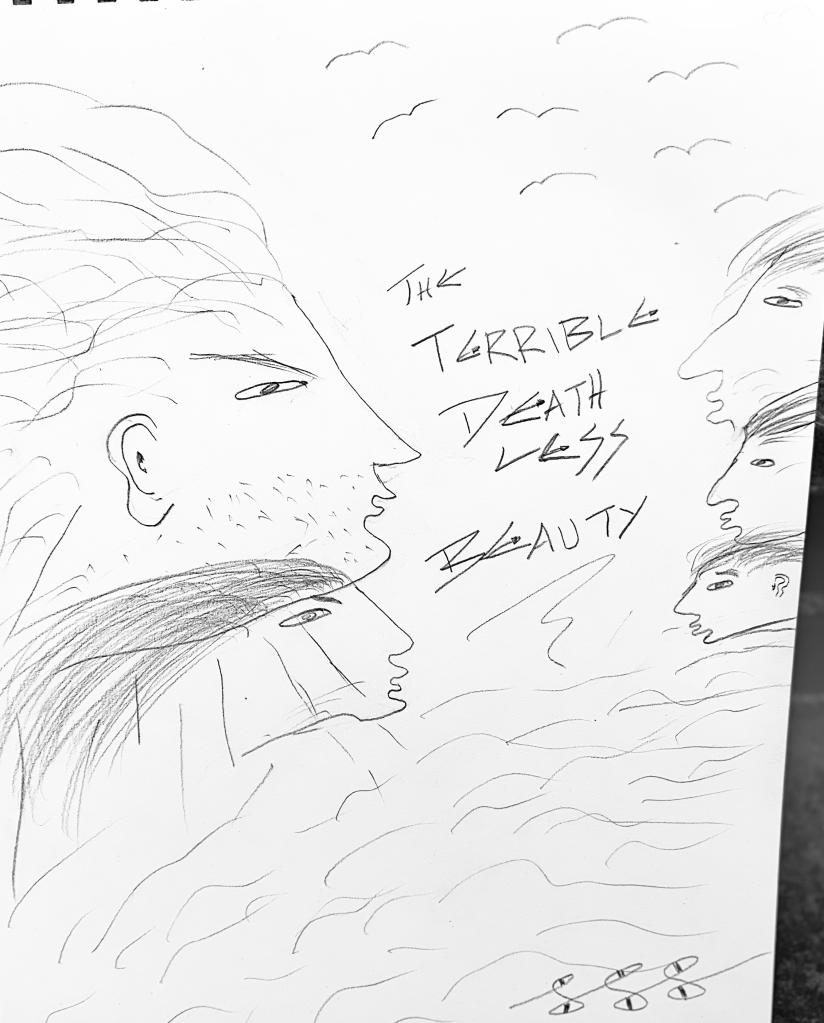
Then, reading in the Iliad about the incident between the senior people of Troy and Helen, where they saw her walking on the ramparts and admired her, I created a sketch and a poem: it was all about the terrible beauty. I wanted to add a twist to the poem so it could be read horizontally and vertically. Adding a new layer of complexity to a poem can make it more engaging and thought-provoking.
THE TERRIBLE DEATHLESS BEAUTY
As we get into the immortalising battle ——- We are singing full of joy
us the sons of Troy,———————–in strong shiny armour
being brave and proud, ——————–facing enemies, in millions
We fight for the Ilion,——————— defying the old ferryman’s duty
We fight for beauty ———————–for the terrible deathless beauty.
The stake is high————————-It is not God’s forbidden
Our destined fate is already written———-to fight for beauty
What a remarkable duty——————-is blessed and high
to be doomed and die——————— the old ferryman’s duty daring to defy
for the terrible deathless beauty————-for this terrible deathless beauty.
Exploring new ways of presenting artistic works is always exciting, and that approach
will make a poem stand out. On the other hand, my sketch artwork was strongly influenced by the Greek painter Alekos Fassianos.
https://alexandertextiles.blog/wp-content/uploads/2024/01/img_5484.bmp?w=824
His Ancient Greek vase painting, the Byzantine and folk traditions, the paintings of older Greek painters and various types of modern art are all to be found at the basis of Fassianos’s artistic creation, which, through precise and uniform colour, accessible and skilled draughtsmanship,a childlike, feeling, and sensitivity of rendering result in highly personal formations.

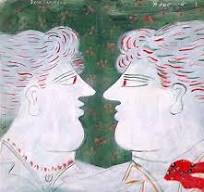
The human figure dominates his work – characteristic of the figure features that I find engaging and representative of contemporary Greek art, which we admire a lot. Later, using the same technique, I made a drawing of someone looking for Helen. It could be Euripides Menelaus who went to Egypt after the Trojan War. It could also be someone like me represented in the painting on the quest of Helen. Like Homer, I did not give any shape to my Helen. I looked online and, to my surprise, there is a flower named after her: Helenium(sneezeweed).
Heleni-um is what the hero of our drawing shouts out when he finally discovers it, having many seas under his sleeve.

Considering the abstract drawings of Pablo Picasso,
I have created a face mask of Helen:
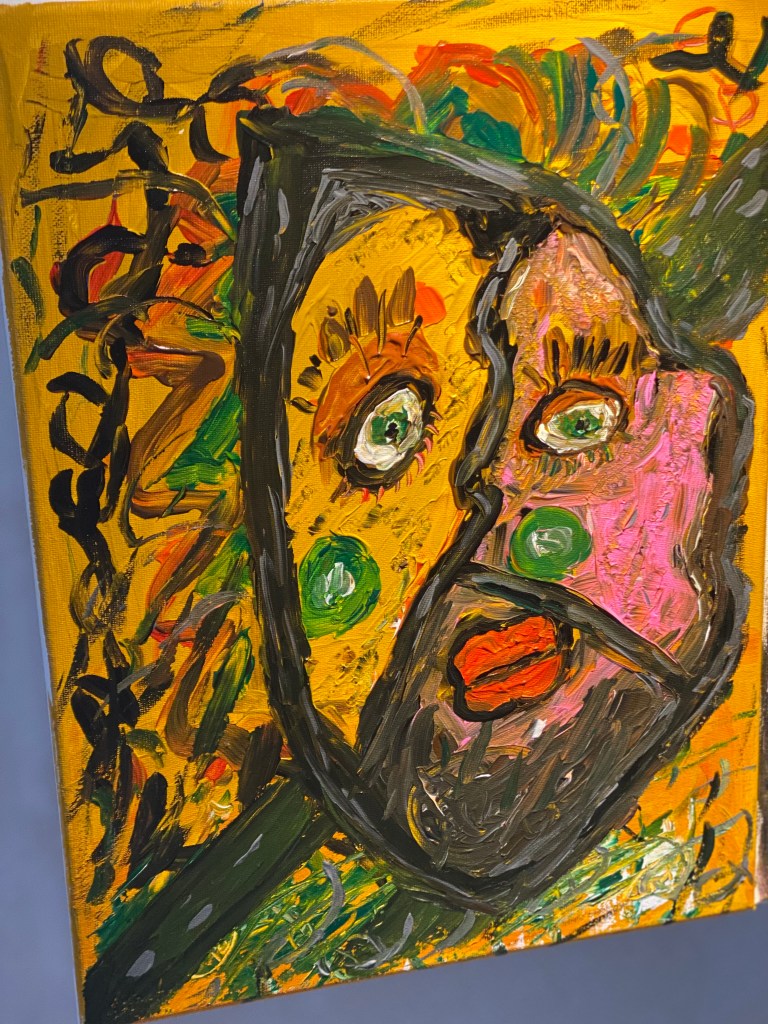
Divided into three different sections: the black fate Helen, the pink feminine and beautiful Helen and the yellow for hope, happiness and spontaneity that took her away with all the consequences mentioned above. The rationale behind my adoption of Picasso’s drawing style stems from my admiration for the simplicity of his lines. I am particularly drawn to his perspective of crafting an icon with vitality and significance with just a few lines on a canvas. Furthermore, my work is closely associated with my exploration of Helen of Troy, which has emerged as the primary source of inspiration throughout this study. Picasso’s vision resonates with my perception of beauty, favouring simplicity, rawness, and unpretentiousness.
After finding inspiration from previous Picasso-style artworks, I explored the possibilities of creating a computer-aided design (CAD) based on one of these pieces. I planned to produce knitted pieces using this CAD and combine the textiles with traditional illustrations on a white canvas.

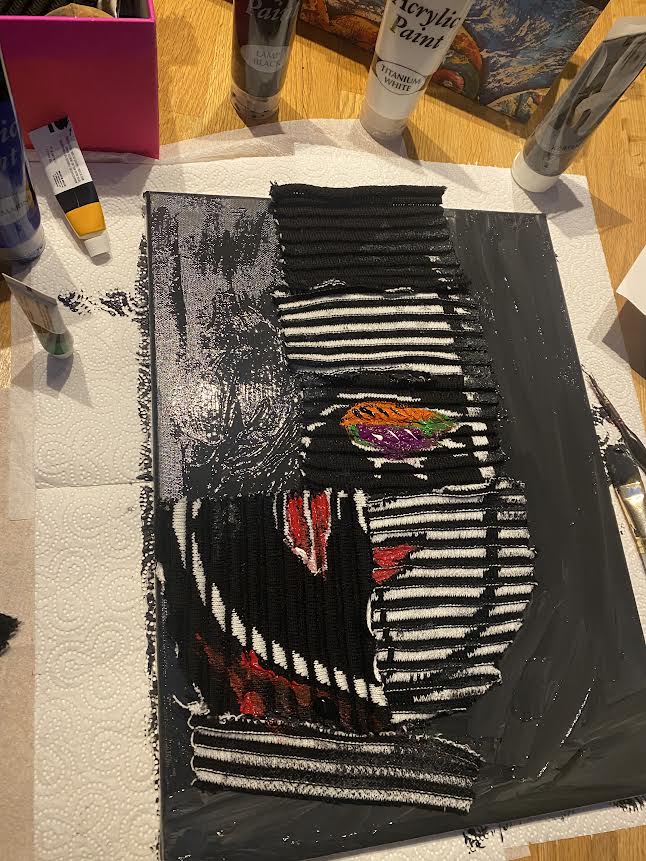


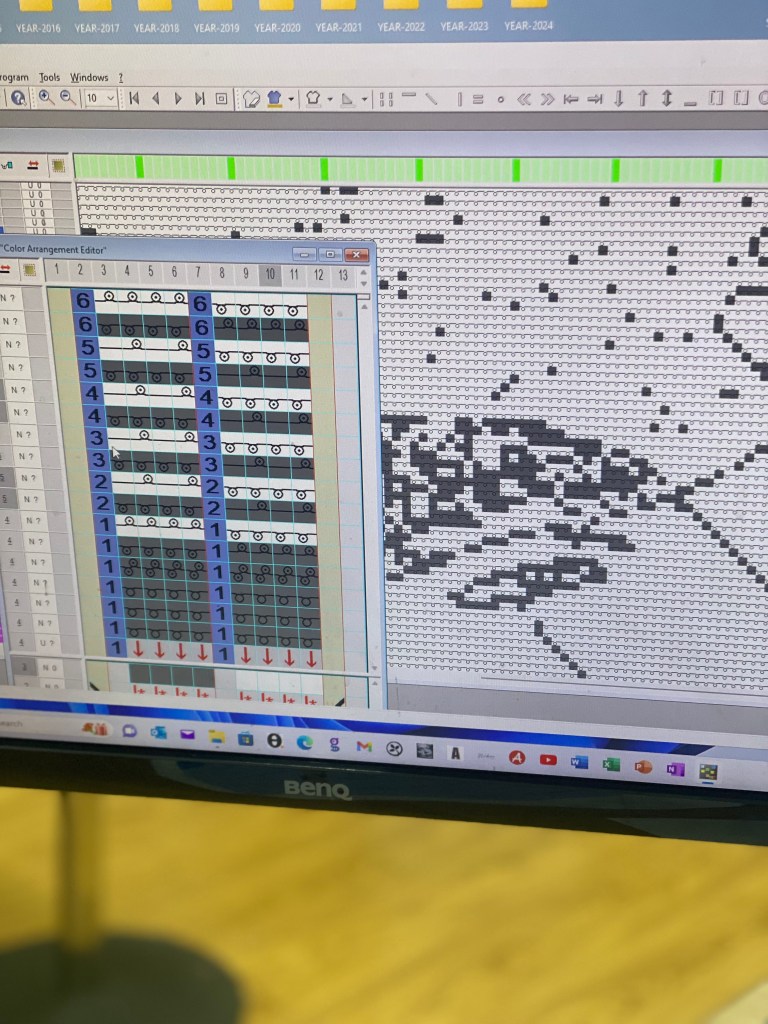
As someone with a background in textiles, I aimed to investigate the connection between these two seemingly different disciplines. Through this project, I understood the relationship between textiles and traditional illustration and learned valuable lessons.
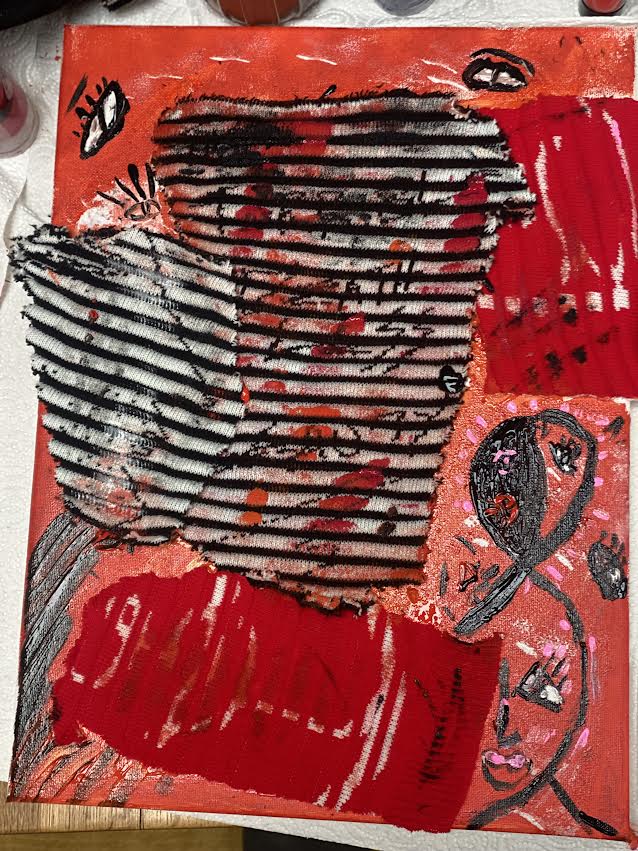
My last work was a fusion of a sketch and textiles. Using textiles as a primary medium made me explore the principle even more. Textiles can be especially practical with fabrics with a unique texture or pattern, as they can add an exciting
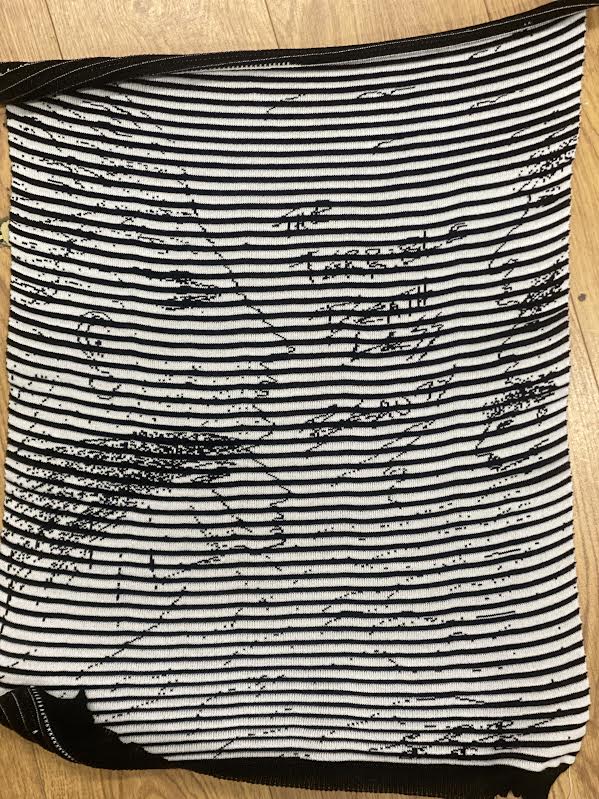
element to the final piece. Additionally, textiles can be used to create collages, where fabric pieces are cut and arranged into a design before being painted over. My final painting represents all the qualities I feel about art. Since I am an art lover, I consider art as the ultimate female, as the ultimate beauty, like Helen; her enchanting beauty and lures are dragging me into a world of passion.
Helen of Troy is a woman who has inspired artists and kings since Homer first depicted her name in the Iliad. Moreover, even if she had never existed, even if she had never been a person that ever stepped on the soil of Troy, I believe we needed to invent one. The world of art had to have a muse and a reference point. My work and case study has used her beauty as inspiration to investigate and learn. It has showcased many forms and expressions to describe my feelings when we see them and many paths to follow to make those feelings alive through art.
References:
Britannica, The Editors of Encyclopaedia. “Iliad”. Encyclopedia Britannica, 10 Oct. 2023, https://www.britannica.com/topic/Iliad-epic-poem-by-Homer. Accessed 10 February 2024.
Helen by Giorgos Seferis – Famous poems, famous poets. – All Poetryhttps://allpoetry.com/poem/14330741-Helen-by-Giorgos-Seferis
Rivera, Michael L., et al. “Stretching the Bounds of 3D Printing with Embedded Textiles.” 2017, https://doi.org/10.1145/3025453.3025460.
Euripides. The Helen of Euripides. Cambridge [Eng.] :The University Press, 1925.
Stesichorus | Poetry Foundation https://www.poetryfoundation.org/poets/stesichorus
Picasso 2013 Wall Calendar. http://www.allcalendars.net/calendar/31527095.htmlPicasso 2013 Wall Calendar. http://www.allcalendars.net/calendar/31527095.htmlPicasso 2013 Wall Calendar. http://www.allcalendars.net/calendar/31527095.html
Helenium / RHS Gardening https://www.rhs.org.uk/plants/helenium
Britannica, The Editors of Encyclopaedia. “sneezeweed”. Encyclopedia Britannica, 11 Jan. 2018, https://www.britannica.com/plant/sneezeweed. Accessed 10 February 2024.
Celebrating the Life and Work of Alekos Fasianos. https://www.alekosfassianos.gr/en/
Britannica, The Editors of Encyclopaedia. “Helen of Troy”. Encyclopedia Britannica, 17 Sep. 2023, https://www.britannica.com/topic/Helen-of-Troy. Accessed 14 January 2024.
Wikipedia contributors, ‘Trojan War’, Wikipedia, The Free Encyclopedia, 28 December 2023, 17:17 UTC, <https://en.wikipedia.org/w/index.php?title=Trojan_War&oldid=1192299417> [accessed 14 January 2024]
Course Evaluation
This essay is an evaluation of my course 2.1 Creative Arts Relations. To begin with, Level 2 was a rollercoaster. I came from far away to explore new ways to express myself. There were a lot of discoveries and a lot of surprises. The most valuable lesson is that hard work works! Anything is possible with the proper tuition, time, and effort. There were times when nothing I was working on came as expected. Frustration followed because the feedback differed from what I thought it would be. Perseverance and belief in your goals are crucial to moving forward.
What mistakes did I make? Well, it is an easy answer. My perception of what the course requires is the first that comes to me, followed by the second misconception that I took every assessment personally: my tone was too personal without emphasizing what the brief required.
There were high and low points. The highest point was at the end of the course when I was revising what I had achieved and where I had gotten into. The lowest point was the nights I couldn’t think of a way forward. As a significant influence, I propose two pillars: my tutors, who gave me confidence and a guiding light, and my research on the internet, which inspired me never-ending.
From my understanding, my critical ability has improved due to my work and with my tutor’s guidance, which, as far as my experience is concerned, will impact my future projects and my approach to them.
My most outstanding achievement is that I have finally discovered my strengths, which, if taken seriously and used correctly, can become my voice—an artist’s psyche.
To achieve a better result in my work, I will need to improve my English language skills for poetry, and definitely, my drawing requires a lot of work. Fortunately, my bread-winning skills(textiles) are at the highest possible level, a great point to grow from and build on. Textiles will be like a vehicle that takes me further and farther: it will be the boat to Ithaca. Will those new skills help me earn an income out of it? I don’t know yet, but everything else follows when you do something you like and comes from your heart.
I started my journey with OCA five years ago. I’m almost halfway through, and I still don’t know where the tide will take me. Thinking about master’s degrees is wishful thinking. I want to take my precious university degree and consider the options and perspectives of my future studies. My combined creative activity of textiles, poetry, and drawing can fit in many ways in the more comprehensive creative arts world. Textiles are gaining recognition and appreciation as a commercial art form, and my skills in this area could help me explore new avenues.
As someone who values all disciplines, I intend to continue integrating my specialisms beyond this course. Though I may prioritize one depending on my current projects or goals, my commercial and personal work can inform and enrich each other. By incorporating my textile expertise into my creative arts practice, I can experiment with new materials and techniques, and by combining my creative skills into my textile work, I can create unique and innovative designs.
The subjects I come across daily and have unique perspectives on can serve as a source of inspiration for my creative arts practice. They provide me with new and different ways of thinking about the world around me, which can be reflected in my artwork. For example, my experiences and observations of everyday life can inspire me to create relatable pieces that resonate with others. Learning about different cultures, histories, and current events can broaden my understanding of the world and inform my artistic choices. By staying curious and open-minded, I can continue incorporating new perspectives and ideas into my work, ultimately making it more dynamic and impactful.
I’m not currently working on any ideas, but it’s always a good idea to keep up with the latest news and trends to stay informed about what’s happening in the world. If you’re curious about whether specific ideas are being discussed in the media, quickly searching online or flipping through a newspaper or magazine can provide some insights. Fortunately, my professional work regarding textile engineering is booming, and the outcomes are sold as knitted pieces on our customers’ websites, so I can prove that my ideas have currency and value. I need to discover ways to capitalize on them. Another way is to collaborate with other creatives interested in the same subjects and collectively create work that can spark meaningful conversations.
 Alexander's blog