In Part Four you’ve looked at the origins of photography, including its (continuing) uneasy relationship with the art world. This assignment asks you to look at some of the ways in which photography has become integral to artists’ practice, often without the photography element being immediately apparent. Read the six suggestions below and go online to find out more. If any of these categories particularly interests you, research it further. Alternatively, you may be able to come up with your own idea for an assignment topic on this theme. That’s fine, but please check with your tutor before you start writing.
Whichever option you choose, write a short essay (up to 1,000 words) that expands on your opinion of the relationship between the creative aspects of the artwork(s), the message that the artist is trying to convey and to what extent you feel photography is a necessary part of the process. You might also want to think about how the work you’ve chosen relates to any of the themes discussed in Part Four, particularly time and place.
- Photography combined with text to produce combined narratives, such as those by Duane Michals.
- Andy Warhol’s screen prints generated from photographs.
- David Hockney’s Polaroid photograph ‘joiners’, such as Pearl Blossom Highway 2 (1986), My Mother, Bolton Abbey (1982).
- Andy Goldsworthy’s (ephemeral) sculptures – see Project 3.
- The political collages of Peter Kennard, for example Santa’s Ghetto (2006), Union Mask (1981), Haywain with Cruise Missiles (1980).
Send your essay to your tutor together with a 500-word commentary about your experience of Part Four. Draw on your learning log or blog as the basis of your commentary. For example, you may want to reflect on a particular photographer or body of work that has impressed, intrigued or inspired you. Even if you don’t intend to pursue photography with OCA, how has this brief study of photography influenced the way you’ll look at photography in future? And how might it influence your own photography, at whatever level you choose to pursue it?
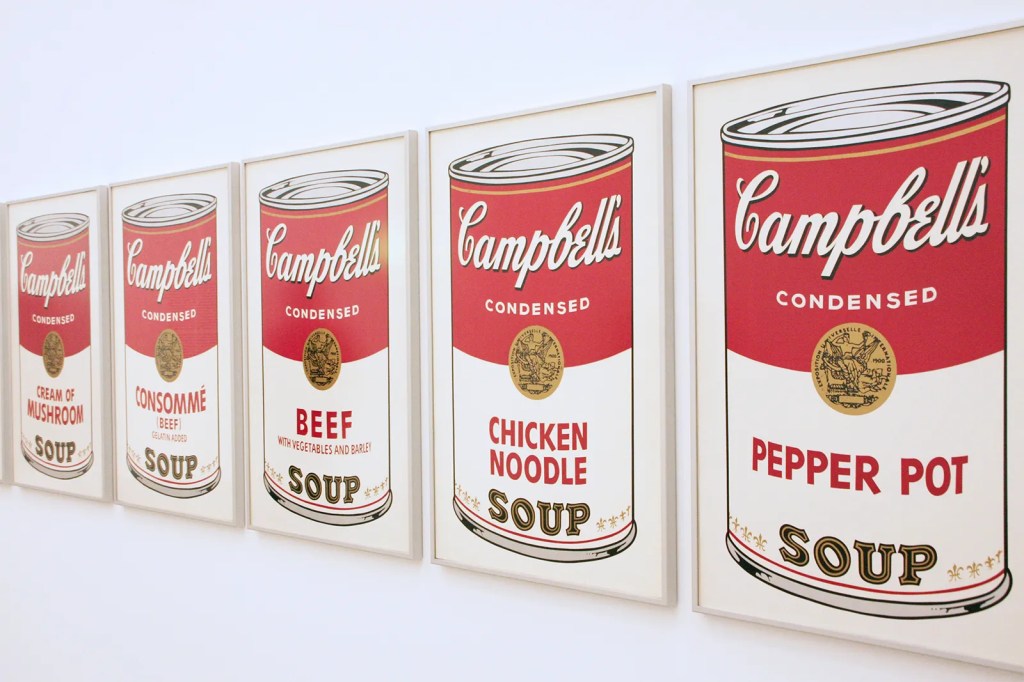
Campbell’s Soup Cans, polymer paint on canvas by Andy Warhol, 1962; a selection of five on display in the Museumsquartier, Vienna.

Andy Warhol, original name Andrew Warhola, (born August 6, 1928, Pittsburgh, Pennsylvania, U.S.—died February 22, 1987, New York, New York), American artist and filmmaker, an initiator and leading exponent of the Pop art movement of the 1960s whose mass-produced art apotheosized the supposed banality of the commercial culture of the United States. An adroit self-publicist, he projected a concept of the artist as an impersonal, even vacuous, figure who is nevertheless a successful celebrity, businessman, and social climber.
The son of Ruthenian (Rusyn) immigrants from what is now eastern Slovakia, Warhol graduated in 1949 from the Carnegie Institute of Technology (now Carnegie Mellon University), Pittsburgh, with a degree in pictorial design. He then went to New York City, where he worked as a commercial illustrator for about a decade.
Warhol began painting in the late 1950s and received sudden notoriety in 1962, when he exhibited paintings of Campbell’s soup cans, Coca-Cola bottles, and wooden replicas of Brillo soap pad boxes. By 1963 he was mass-producing these purposely banal images of consumer goods by means of photographic silkscreen prints, and he then began printing endless variations of portraits of celebrities in garish colours. The silkscreen technique was ideally suited to Warhol, for the repeated image was reduced to an insipid and dehumanized cultural icon that reflected both the supposed emptiness of American material culture and the artist’s emotional noninvolvement with the practice of his art. Warhol’s work placed him in the forefront of the emerging Pop art movement in America.
As the 1960s progressed, Warhol devoted more of his energy to filmmaking. Usually classed as underground films, such motion pictures of his as Chelsea Girls (1966), Eat (1963), My Hustler (1965), and Blue Movie (1969) are known for their inventive eroticism, plotless boredom, and inordinate length (up to 25 hours). Other movies include Poor Little Rich Girl (1965) and Lupe (1966), both of which featured Edie Sedgwick.
In 1968 Warhol was shot and nearly killed by Valerie Solanas, one of an assemblage of underground film and rock music stars, assorted hangers-on, and social curiosities who frequented his studio, known as the Factory. (The incident is depicted in the 1996 film I Shot Andy Warhol.) Warhol had by this time become a well-known fixture on the fashion and avant-garde art scene and was an influential celebrity in his own right. Throughout the 1970s and until his death, he continued to produce prints depicting political and Hollywood celebrities, notably Marilyn Monroe. He also involved himself in a wide range of advertising illustrations and other commercial art projects. His The Philosophy of Andy Warhol (1975) was followed by Portraits of the Seventies and Andy Warhol’s Exposures (both 1979).
Warhol’s work is featured in the Andy Warhol Museum in Pittsburgh. In his will, the artist dictated that his entire estate be used to create a foundation for “the advancement of the visual arts.” The Andy Warhol Foundation for the Visual Arts was established in 1987.
Source: Britannica, The Editors of Encyclopaedia. “Andy Warhol”. Encyclopedia Britannica, 2 Aug. 2022, https://www.britannica.com/biography/Andy-Warhol. Accessed 11 October 2022.
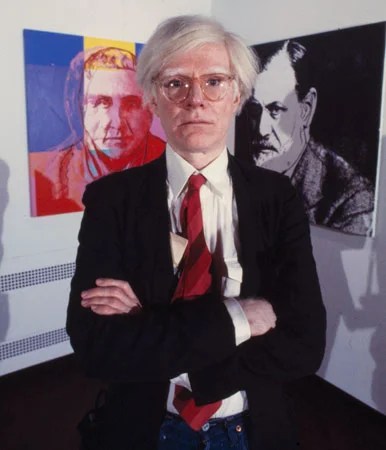
Bernard Gotfryd Photograph Collection, Library of Congress, Washington, D.C. (reproduction no. LC-DIG-gtfy-04543) Source: Britannica.com
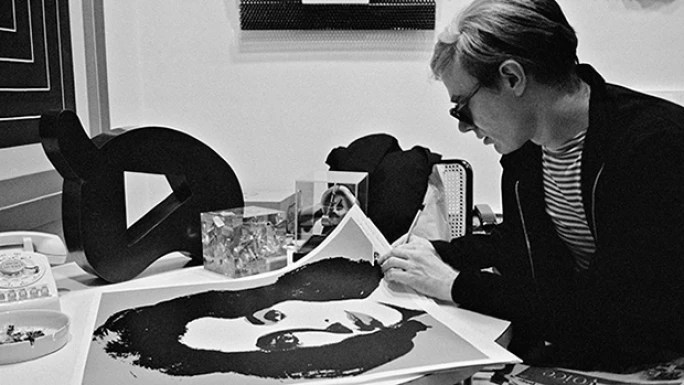
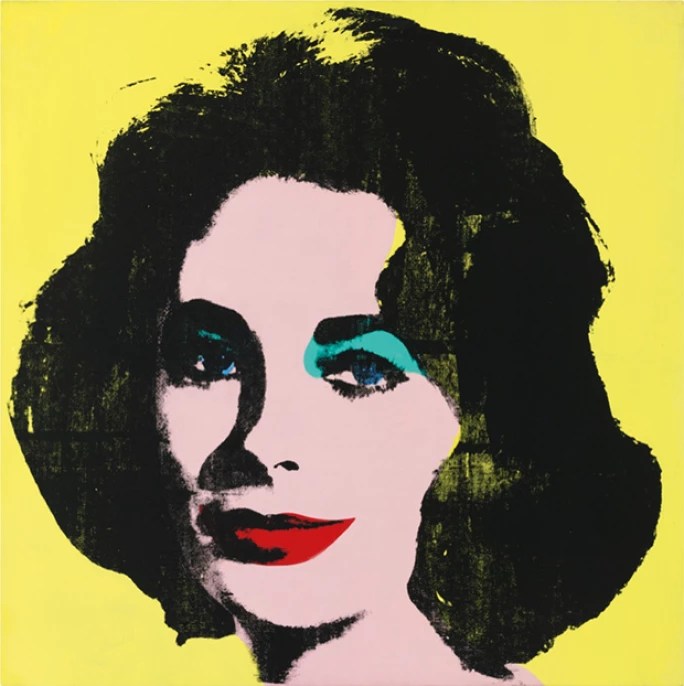
Here Warhol appropriated a 1950s publicity photo of Taylor as the source material for the silk screen. Warhol worked with professionals to have the photos he chose transferred onto the mesh of a silk screen. When Warhol passed an ink-laden squeegee over the mesh as the silk screen sat atop his canvas, ink would pass through the mesh and impress a print of his image onto the canvas. Areas of the mesh where a layer of glue has been applied – in Warhol’s case, the “negative” space of the photos he selected – keep paint from passing through to the canvas.
Observing the grainier areas of Liz’s hair, it’s clear that Warhol first applied the yellow paint before adding the layer of black ink that comprises her face. Her intense red lips and eye shadow were also applied during separate passes of the squeegee. To Warhol the noticeable “imperfections” – such as the faint areas of Liz’s hair and the way the lipstick bleeds onto her chin – weren’t signs of a poorly pulled silk screen-image but rather welcome indications of how chance influenced his work. As Warhol’s biographers Tony Scherman and David Dalton point out, Warhol “was not after a picture-perfect, sharp-edged result; he wanted the trashy immediacy of a tabloid news photo.”
By his use of the silk-screen process mixed with high-key acrylic paint, Warhol imbued Liz #1 (Early Colored Liz) with a kind of tragic radiance. And by re-using the silk screen of the ’50s publicity photo for other portraits of the film star and tabloid fixation, Warhol investigated through multiplicity the commodification of fame.
Kamholz, R. (2013) Andy Warhol and His Process. Available at: https://www.sothebys.com/en/articles/andy-warhol-and-his-process(Accessed: 11 October 2022 )
Warhol’s key concept as an artist was the “industrialization” of art. Screen Printing was a process. A process in duplication. In using other people’s work and expanding upon their original concept. It wasn’t easier which Warhol would claim throughout his career. Silk Screening just matched Warhol’s sensibilities. At the time Andy Warhol was surging in popularity as a leader in the Pop Art movement some people would refer to the Screen Printing device as a machine. This corresponded to an often expressed wish of Andy’s …to be a machine. To quote Warhol directly:
“In August of 62, I started doing Silkscreens. The rubber-stamp method I’d been using to repeat images suddenly seemed too homemade. I wanted something stronger that gave more of an assembly-line effect” (Andy Warhol and Pat Hackett POPism: The Warhol 60s
The first popularized Andy Warhol screen print was seen in 1962. It was his Marilyn Monroe’s, and we’ve already done a chronological order to those prints. Andy Warhol would use many mediums to produce art. Video, Sculpture, Photo Engraving and much more. Warhol would use screen printing from 1962 to 1987. Here are some prime examples of screen printed work spanning that 26-year period.
- 1962 – Uses hand cut silk screens and photo silk screens to make paintings. The first example is the Marilyn’s
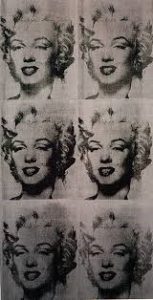
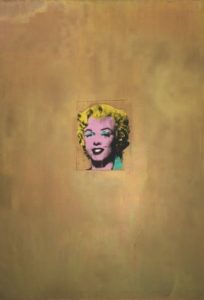
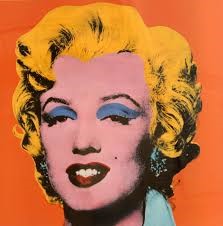
- Campbell’s Soup Can (Tomato) 1964
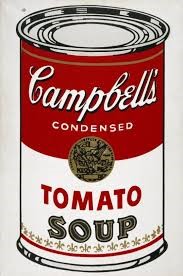
1970-71 Creates “Flowers” and Electric Chair


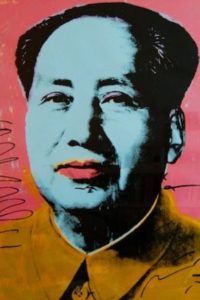
- 1973-74 Mao
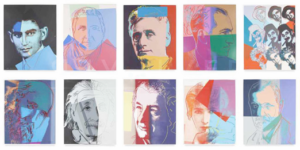
- 1980 – Ten Portraits of Jews in the Twentieth Century
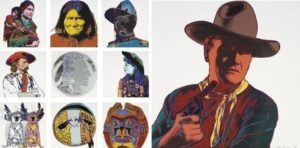
- 1986 – Cowboys and Indians
- Moonwalk – 1987
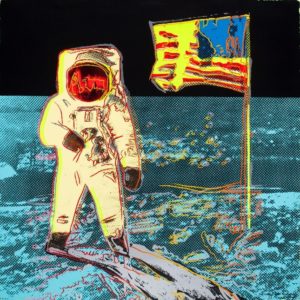
Warhol used a combination of individual and corporate printers as well as his facilities throughout his career. Here is an incomplete list:
- The Factory – His studio the address of which changed a few times over the years.
- Andy Warhol Enterprises Inc. – Again his studios later in his career.
- Styria Studis Inc.
- Alexander Heinrici
- Rupert Jasen Smith
- Salvatore Silkscreen CO.
- Aetna Silkscreen Productions.
Most of these individuals and companies were located in New York.
Source: ”Anonymous”. (n.d.) Andy Warhols Silk Screening Process. Available at: https://hamiltonselway.com/andy-warhols-silk-screening-process/ (Accessed: 11 October 2022 ).
Source: The Andy Warhol Diaries (2022) Directed by Andrew Rossi. Available at: Netflix (9 March 2022).
Source: ”Anonymous”. (n.d.) Andy Warhol and Merilyn Monroe. Available at: https://www.moma.org/collection/works/61240. Accessed 11 October 2022.
—————————————————————————————————-
Andy Warhol’s screen prints generated from photographs.
Andy Warhol’s screen prints generated from photographs.
Andy Warhol, (1928-1987) was an American artist and filmmaker, who is best known for being one of the co-founders of the trend called Pop art. His nickname was actually: Pope of the popular (pop) art.
Pop art, as an art movement, even though it does not have a specific style, has certain characteristics: it utilizes vibrant, bright colours. It mostly uses recognizable images (icons from popular media and products). It is ironic and satirizes current events and challenges the status quo. It is innovative and uses everyday features in a new and sometimes provocative way.
Many artists of the era it was first introduced (early 1960ies), through experimentation and by exploring new ways to express their ideas, found themselves engaged in printing which enabled them to mass-produce icons in large quantities and carve new paths into the new cult.
Andy Warhol was one of the first who applied silk printing, a process through which ink is transferred onto canvas (or paper) through a mesh screen with a stencil.
His obsession with celebrities inspired him to use their photos as his tarp, as wallpaper, creating tweaked images of them to communicate his point of view. His brilliance allowed him to patronize world stars in a way today’s gossip blogs would: he produced ironic and flamboyant pieces of their portraits using vibrant and fluorescent colours. On top of that, his scribble over the prints became his unique signature making the piece of work ironic and iconic. As a result, he gradually managed to make their myth bigger by immortalizing their figure and a create a story around them. Throughout his career, Warhol silk-printed commissioned portraits from photos, turning them into prints. So, using celebrity photo portraits instead of paintings gave Warhol the advantage of instant material that is easy to access, easy to manipulate it, as well as cheap to afford to have” wonderful errors” in being playful with it.
His first portrait was of Marilyn Monroe. Marilyn, Hollywood’s brightest star of her time, had just died from a sleeping pill overdose on August 5th, 1962. Her shocking, sudden and unexpected death inspired Andy Warhol to create her silkscreen portrait later the same month. By the beginning of 1963, he had made 23 different Marilyn paintings-prints. Marilyn’s photo inspiration, his template, is based on a publicity photo for the 1953 film Niagara; at this point, she was 26 years old and at the peak of her career. She looked stunning and sensational. Her face was spotless and world known.
One of the reasons Warhol had chosen Marilyn is because she was a carefully made-up personality, a fake identity; so, using his art and by repeating her perfect face so many times, he managed to turn it into a consumable product that can be manufactured and used for any given purpose: “The more you look at the same exact thing, the more the meaning goes away, and the better and emptier you feel.”
Andy Warhol’s work turned him into a world phenomenon and a guru, a trailblazer of the new-born art movement, gaining fame and recognition but also dealing with issues of vanity, identity loss, despair, anxiety, depression, and death (there was a murder attempt from Valerie Jean Solanas-artist and writer in 1968).
Along with photographic-inspired profiles based on celebrity portraits, he produced both comic and serious works. Subjects of his inspiration could be anything: from a soup can to a photo of an electric chair. Nevertheless, Andy Warhol never stopped recreating versions of Marilyn’s picture. In 1979 he created a negative film cut version by turning the dark sides into light and the light into dark creating more attraction and sensation around his work.
It is obvious that photography in Andy Warhol’s case was the trigger of an artistic chain reaction: It had been his starting point and the reason for his use of it as an expressive medium. He had been in constant dialogue with the photographic camera. However, it wasn’t only the power of the photographic film that helped Warhol achieve his goal; it was the features that came along with it as well. It was also very easy to reproduce copies of the original one; Repetition was something that had always captivated Warhol. Being able to mass-produce copies of the same icon helped him establish this strategy as well as underline the deeper meaning for him. Seriality implies desolation: emotional, cultural, and social. When something is mass-produced most of the time loses its value; Warhol’s clever approach and eccentric touch have reversed the viewer’s experience. Photography in his hands had become an icon and a part of a whole contemporary movement on its own: having the privilege of the creator’s support and exposure to the public eye as something unique and not as a medium of capturing a moment. It was his personal triumph; He turned photographic portraits from unbearable, static, and indisputably boring into a playful scandal: a piece of art with unique handwriting, easy to copy but hard to be different from. It was Andy Warhol’s style.
His methods and his point of view were followed by other artists, who evolved his techniques and made their pop art pieces look so human but so inhuman at the same time. During the 1980s following the Pop Art revolution, new styles were emitted.
After Pop art, it was the time for a new era to rise and shine. Street art became a new cult and artists like Banksy were a lot easier to be accepted and to be understood. The public eye was trained by artists like Warhol to embrace the new with endurance and enthusiasm.
Art has become an integrated everyday life feature. It is living with people, being part of their everyday lives and by any means is making their purpose more essential. Warhol, had managed to bring art to the masses. Photography was the main medium that helped him to achieve this.
Andy Warhol died in 1987. His work is very much alive and popular as it has ever been.
NUMBER OF WORDS: 1011.
REFERENCES -SOURCES
”Anonymous”. (n.d.) Andy Warhols Silk Screening Process. Available at: https://hamiltonselway.com/andy-warhols-silk-screening-process/ (Accessed: 11 October 2022 ).
Kamholz, R. (2013) Andy Warhol and His Process. Available at: https://www.sothebys.com/en/articles/andy-warhol-and-his-process(Accessed: 11 October 2022 ).
Britannica, The Editors of Encyclopaedia. “Andy Warhol”. Encyclopedia Britannica, 2 Aug. 2022, https://www.britannica.com/biography/Andy-Warhol. Accessed 11 October 2022.
The Andy Warhol Diaries (2022) Directed by Andrew Rossi. Available at: Netflix (9 March 2022).
”Anonymous”. (n.d.) Andy Warhol and Merilyn Monroe. Available at: https://www.moma.org/collection/works/61240. Accessed 11 October 2022.
Reflection
Send your essay to your tutor together with a 500-word commentary about your experience of Part Four. Draw on your learning log or blog as the basis of your commentary. For example, you may want to reflect on a particular photographer or body of work that has impressed, intrigued or inspired you. Even if you don’t intend to pursue photography with OCA, how has this brief study of photography influenced the way you’ll look at photography in future? And how might it influence your own photography, at whatever level you choose to pursue it?
As with previous assignments, make sure that your assignment submission meets the assessment criteria listed in the introduction to this course guide before you submit it to your tutor.
Part four has concluded after a lot of hard work and research. It was probably the hardest subject I have studied so far. Photography and its features was the main case study. It was very interesting to see the evolution of this type of creative art and to realize how much technology has affected it as a medium; actually, in the last few years and especially with the application of constantly evolving digital photographic cameras on mobile phones, there has been a gigantic change, transforming the medium and making photography the type of art everybody can practice and have easy access to. It is a matter of common acceptance that photography requires less skill to create but it still needs a keen eye, great technique and the right decision to achieve the perfect frame.
Photography has become through the years a source of living history capturing events and people, landmarks, and phenomena. It is and has been the enclosure of all sorts of human activity and above all, the source of memories recreated by looking at a single picture. As it has been very wisely and precisely spotted by the brief, family photos would be one of the few belongings someone would save from a house fire.
In part four, I had also gone through some controversial issues debating about the role of photography and social media; Social media which have become the new rule in the worlds system of government and which in my opinion like every single matter that is linked to the world web of platforms can be perceived in many ways and be assessed according to the user’s point of view.
There had been an introduction of photographic artists such as Ian Berry, whose amazing pictures of Whitby and the question from the brief <<what if>> (a wonder that in the art can lead to different alleys and eventually reset the whole perspective) raised quite a few questions to me and had shown me, that even on something that has been finalized and concluded like a photo can always be a room for dispute. A dispute that can open new doors and help realize what thinking out of the box means.
Commenting on the above and bringing my impression onto the challenge, I wouldn’t see photography as an independent art form but as I have mentioned through my Andy Warhol’s study, the fascination comes to me when photography is been manipulated, when it is treated as a form of a canvas which then can be used as an inspiration for further exploration and a source of wonderful and joyful experiments which can sometimes lead to mesmerising surprises. Like a live captured diary it still is a very important way to review the life passing by and it can create a lot of wonderful feelings when it is observed and analyzed according to its context.
I’m looking forward to starting part Five: textiles.
 Alexander's blog