Andy Warhol’s screen prints are generated from photographs.
There are certain moments in the history of art where new movements inspired by the surrounding atmosphere come to life. Behind these movements were pioneers; people with exceptional talent, creativity and witty spirits were the mavericks who paved the path for more to follow. One of the latest ones was Andy Warhol, (1928-1987) an American artist and filmmaker, best known for being one of the co-founders of the trend called Pop art. His nickname was actually: Pope of the popular (pop) art.
Pop art, as an art movement, even though it does not have a specific style, has certain characteristics: it utilizes vibrant, bright colours. It mostly uses recognizable images (icons from popular media and products). It is ironic and satirizes current events and challenges the status quo. It is innovative and uses everyday features in a new and sometimes provocative way.
Many artists of the era it was first introduced (early 1960ies), through experimentation and by exploring new ways to express their ideas, found themselves engaged in printing which enabled them to mass-produce icons in large quantities and carve new paths into the new cult.
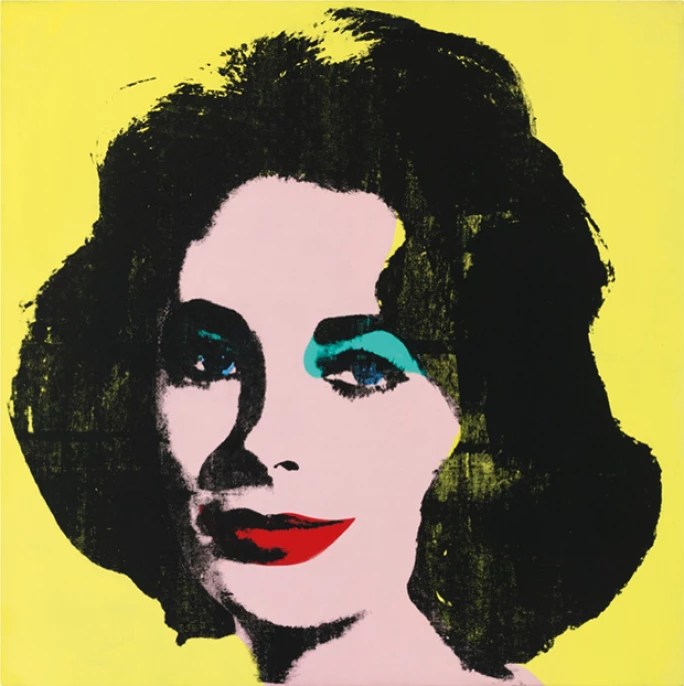
Andy Warhol was one of the first who applied silk printing, a process through which ink is transferred onto canvas (or paper) through a mesh screen with a stencil. Warhol appropriated a 1950s publicity photo of Elisabeth Taylor as the source material for the silk screen. He worked with professionals to have the photos he chose transferred onto the mesh of a silk screen. When Warhol passed an ink-laden squeegee over the mesh as the silk screen sat atop his canvas, the ink would pass through the mesh and impress a print of his image onto the canvas. Areas of the mesh where a layer of glue has been applied – in Warhol’s case, the “negative” space of the photos he selected – keep paint from passing through to the canvas. By his use of the silk-screen process mixed with high-key acrylic paint, Warhol imbued Liz #1 (Early Colored Liz) with a kind of tragic radiance; and by re-using the silkscreen of the ’50s publicity photo for other portraits of the film star and tabloid fixation, Warhol investigated through multiplicity the commodification of fame.
His first mass-produced portrait was of Marilyn Monroe. Marilyn, Hollywood’s brightest star of her time, had just died from a sleeping pill overdose on August 5th, 1962. Her shocking, sudden and unexpected death inspired Andy Warhol to create her silkscreen portrait later the same month. By the beginning of 1963, he had made 23 different Marilyn paintings-prints. Marilyn’s photo inspiration, his template, is based on a publicity photo for the 1953 film Niagara; at this point, she was 26 years old and at the peak of her career. She looked stunning and sensational. Her face was spotless and world known.
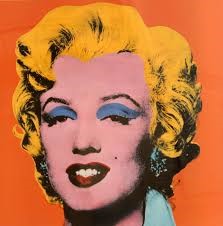
One of the reasons Warhol had chosen Marilyn is because she was a carefully made-up personality, a fake identity; so, using his art and by repeating her perfect face so many times, he managed to turn it into a consumable product that can be manufactured and used for any given purpose.
His obsession with celebrities inspired him to use their photos as his tarp, as wallpaper creating tweaked images of them to communicate his point of view. His brilliance allowed him to patronize world stars in a way today’s gossip blogs would: he produced ironic and flamboyant pieces of their portraits using vibrant and fluorescent colours. On top of that, his scribble over the prints became his unique signature, making the work ironic and iconic. As a result, he gradually managed to make their myth bigger by immortalizing their figure and creating a story around them. Throughout his career, Warhol silk-printed commissioned portraits from photos, turning them into prints. So, using celebrity photo portraits instead of paintings gave Warhol the advantage of instant material that is easy to access, easy to manipulate, and cheap to afford to have” wonderful errors” in being playful with it.
Along with photographic-inspired profiles based on celebrity portraits, he produced both comic and serious works. Subjects of his inspiration could be anything: from a soup can to a photo of an electric chair. Nevertheless, Andy Warhol never stopped recreating versions of Marilyn’s picture. In 1979 he created a negative film cut version by turning the dark sides into light and the light into dark creating more attraction and sensation around his work.
It is obvious that photography as a medium in Andy Warhol’s case was the trigger of an artistic chain reaction: It had been his starting point and the reason for his use of it as an expressive medium. He had been in constant dialogue with the photographic camera. However, it wasn’t only the power of the photographic film that helped Warhol achieve his goal; it was the features that came along with it as well. It was also very easy to reproduce copies of the original one; Repetition was something that had always captivated Warhol. Being able to mass-produce copies of the same icon helped him establish this strategy as well as underline the deeper meaning for him. Reduplication implies desolation: emotional, cultural, and social. When something is mass-produced most of the time loses its value; Warhol’s clever approach and eccentric touch have reversed the viewer’s experience. Photography in his hands had become an icon and a part of a whole contemporary movement on its own: having the privilege of the creator’s support and exposure to the public eye as something unique and not as a medium of capturing a moment. It was his personal triumph; He turned photographic portraits from unbearable, static, and indisputably boring into a playful scandal: a piece of art with unique handwriting, easy to copy but hard to be different from. It was Andy Warhol’s style.
Because of Warhol’s portraits, photographic art has become an integrated everyday life feature. It is living with people, being part of their everyday lives and by any means, it is everywhere. Warhol had managed to bring art to the masses. Photography was the main medium that helped him to achieve this. He used a simple concept and put his own voice into it. His legacy lives on making his legend more popular than ever.
NUMBER OF WORDS: 1040.
REFERENCES -SOURCES
”Anonymous”. (n.d.) Andy Warhols Silk Screening Process. Available at: https://hamiltonselway.com/andy-warhols-silk-screening-process/ (Accessed: 11 October 2022 ).
Kamholz, R. (2013) Andy Warhol and His Process. Available at: https://www.sothebys.com/en/articles/andy-warhol-and-his-process(Accessed: 11 October 2022 ).
Britannica, The Editors of Encyclopaedia. “Andy Warhol”. Encyclopedia Britannica, 2 Aug. 2022, https://www.britannica.com/biography/Andy-Warhol. Accessed 11 October 2022.
The Andy Warhol Diaries (2022) Directed by Andrew Rossi. Available at: Netflix (9 March 2022).
”Anonymous”. (n.d.) Andy Warhol and Merilyn Monroe. Available at: https://www.moma.org/collection/works/61240. Accessed 11 October 2022.
 Alexander's blog