Assignment three: Re-appropriating images
In 1997, illustrator Fernando Botero used Jan van Eyck’s painting of a married couple as a
wedding card design. Although his version is more comic and stylised, Botero has stuck with
many of the visual aspects of the fifteenth-century original. What has changed is the context of
the image, from a unique piece of high culture in a museum to a mass-produced card that most
people would easily be able to afford to buy, and with it the tone has changed from serious to
celebratory. By comparing the images we can start to identify how our attitudes might have
changed to marriage, the use of visual communication in celebrating or memorialising events,
and the way we choose to represent a situation.
Identify an example of re-appropriation within visual communication. As the Botero example
suggests, this could be illustrators or designers drawing from wider visual culture within their
work, advertisers using ideas from films, the satirical reuse of media images for political ends, or
the reuse of text and image within collage. The reuse could be within visual communication,
such as designers re-purposing typography, illustrations or iconic designs, or examples where
visual communicators have taken ideas from wider, perhaps global, visual cultures.
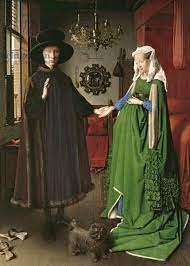
Jan van Eyck, The Portrait of Giovanni
Arnolfini and his Wife Giovanna Cenami
(The Arnolfini Marriage), 1434 (oil on
panel), Bridgeman Images

Fernando Botero, The Arnolfini (After Van Eyck),
1997 (oil on canvas) used as a wedding card
illustration, Bridgeman Images
114 Visual Studies 1: Creative Arts Today
“Interpretations of visual images broadly concur that there are three sites
at which the meanings of an image are made: the site(s) of the production
of the image, the site of the image itself, and the sites(s) where it is seen by
various audiences. Many of the theoretical disagreements about visual culture,
visualities and visual objects can be understood as disputes over which of these is most
important and why.”
(Rose, 2001, p.25)
• Look at the original image and do a semiotic analysis. Describe its contents (denotation)
and possible meanings (connotation) as you did in Part Three. Extend your inquiry by
researching the original context of the image. Why was it produced, where and when was it
originally located, and how might audiences have interpreted it?
• Also reflect on where the original is currently located. Where did you access it? Did you see
the original or have you seen a reproduction in print, online, or elsewhere? What does this
tell you about our modern relationship to the example you’ve chosen? Does it highlight any
change in attitudes or approaches to visual communication more broadly?
• Now reflect on your chosen re-appropriated image. Why was it produced, and how has it been
shown to audiences and what do you think their interpretations are?
• Make a comparison between the two images. You may want to place the two versions side
by side and annotate the visual similarities, differences, and other comparisons you make.
How does the new work make reference to the old? Does it maintain, subvert or alter the
original message in any way and, if so, how does this take place visually? Think about the
visual elements of the two items. How is image, composition, typography, visual narrative, or any other element used to construct meaning?
• Try and make connections between how the original and the re-appropriated image relate
to one another both in terms of their visual construction and their context. This might lead
to thoughts about wider cultural and social change, as well as differences in the use of
visual communication and media at different times.
• Draw together your notes from your learning log into a short (1,000 word) written essay
that reflects on the questions posed above.
Send your essay to your tutor together with a 500-word commentary about your experience of
Part Three. For example, which projects (s) most engaged your interest? Was there any activity
that you found particularly enjoyable – or difficult? Why was that? Has your work on this part of
the course inspired you to do further visual communications courses with OCA, for example, an
illustration or graphic design course?
115 Visual Studies 1: Creative Arts Today
Reflection
As with previous assignments, revisit the assessment criteria in the introduction to this course
guide and check that your assignment submission meets the criteria before you submit it to
your tutor.
Your tutor may take a while to get back to you so continue with the course while you’re waiting
Assignment 3

RESEARCH:
Owner:Ken Griffin
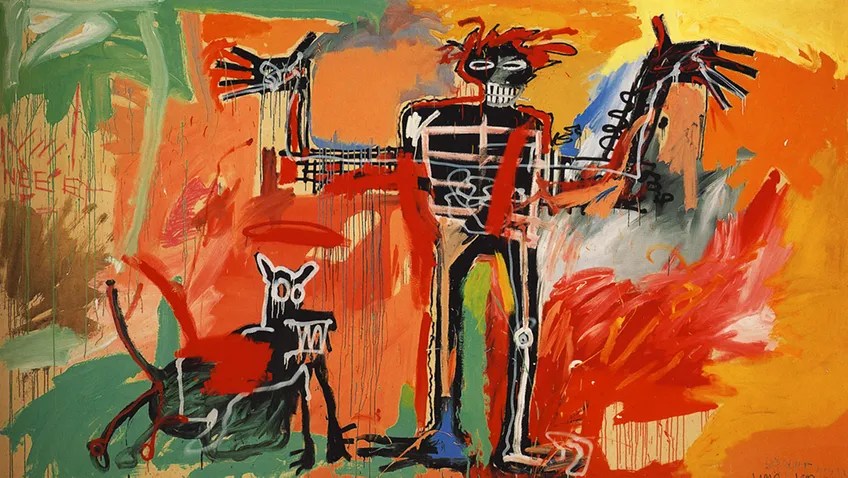
Boy and Dog in a Johnnypump is a painting created by American artist Jean-Michel Basquiat in 1982. The artwork, which depicts a boy with a dog, is among the most expensive paintings ever purchased. It was purchased for over $100 million in 2020, becoming Basquiat’s second most expensive painting following Untitled (1982), which was sold for $110.5 million in 2017.[1]

<<Boy and Dog (painting) in a Johnnypump was executed by Jean-Michel Basquiat in 1982, which is considered his landmark year. Reflecting on that period in an interview with The New York Times in 1985, Basquiat said: “I had some money, I made the best paintings ever.”[2] Measuring at nearly 14 feet wide and 8 feet high, the painting depicts a skeletal black boy and dog painted in similar style. They’re centre of the canvas in the spray of an open fire hydrant. A johnny pump is a New York slang term for a fire hydrant that is open in the summer for kids to play in the water.[3] The warm colours suggest a “blazing hot summer landscape.”[4]>>
Boy and Dog in a Johnnypump (2022). Wikipedia. Available at https://en.wikipedia.org/wiki/Boy_and_Dog_in_a_Johnnypump
(Accessed: 7 August 2022).
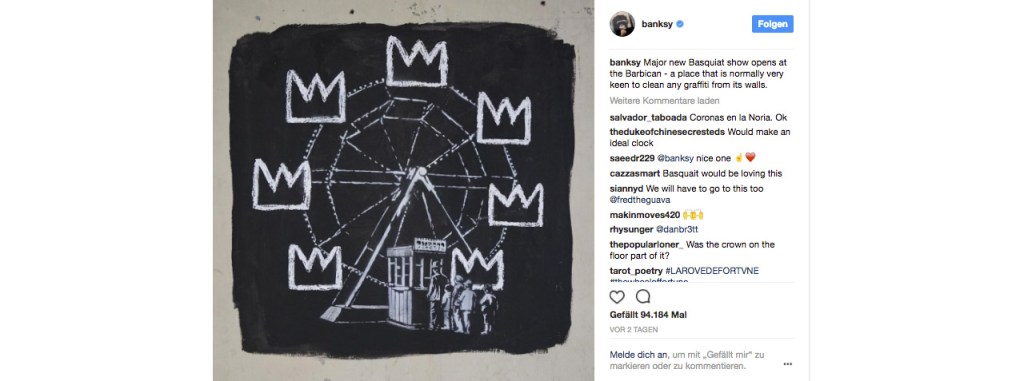
Banksy is no doubt aware of Basquiat’s tragic story, the young artist was said to have been cannibalized by an art world desperate to get its hands on his canvasses. Basquiat found it difficult to cope with the fame and attention, and after the death of his good friend and mentor, Andy Warhol, the Brooklyn-born artist became increasingly isolated and withdrawn. In 1988, just a year after Warhol, he died of a heroin overdose aged just 27. Banksy of course has chosen a distinctly different route, avoiding the limelight by keeping his name and identity well and truly secret.
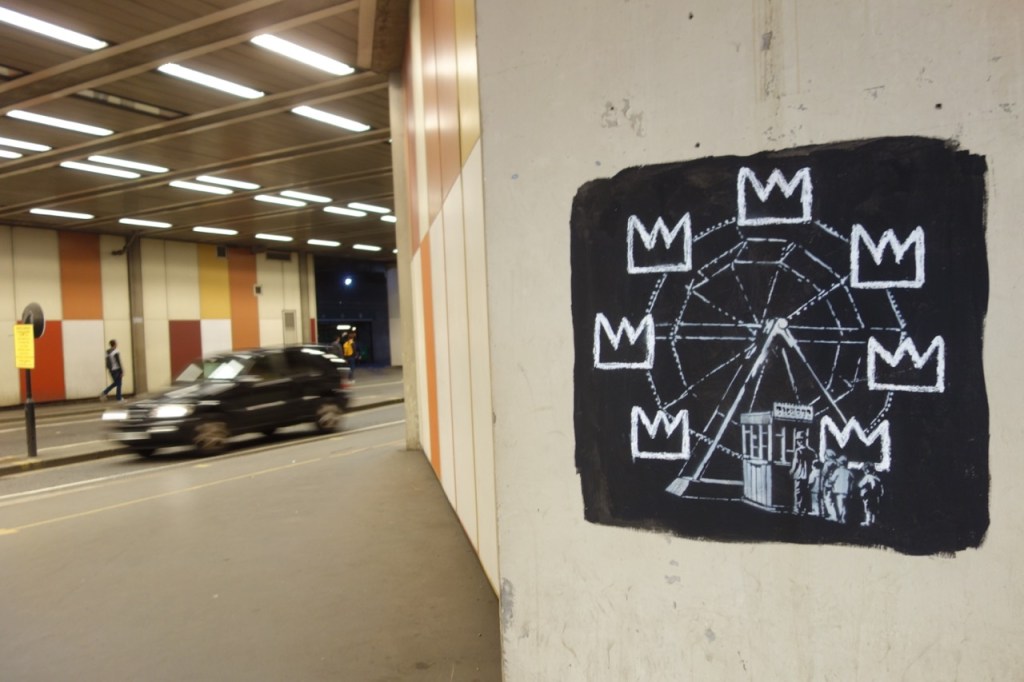
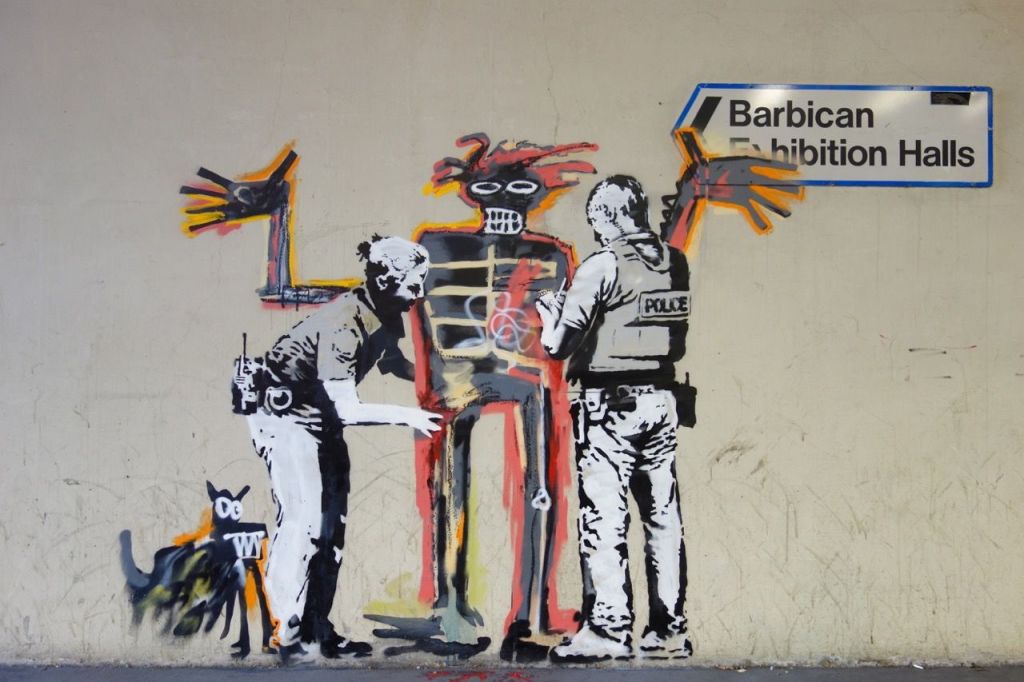
The British graffiti artist is clearly a huge fan of Basquiat, and is perhaps the only other artist to attain a similar degree of fame, having also made that same transition from street artist to mainstream art icon. Banksy also produced a second piece of artwork, featuring the London Eye passenger lifts replaced by crowns—a recurring Basquiat motif. Alongside the artwork he released the statement: “Portrait of Basquiat being welcomed by the Metropolitan police—an (unofficial) collaboration with the new Basquiat show.” It seems that although the street artist is keen to highlight the exhibition, in typical Banksy style he couldn’t pass up the chance to take a well-timed dig at the authorities.
Koidl N. (2018) ‘Banksy’s Snarling Collaboration with Jean-Michel Basquiat’,fineartmultiple,2018. Available at https://fineartmultiple.com/blog/banksy-jean-michel-basquiat-collaborate (Accessed: 7 August 2022).
REFLECTION
>Look at the original image and do a semiotic analysis. Describe its contents (denotation)
and possible meanings (connotation) as you did in Part Three. Extend your inquiry by
researching the original context of the image. Why was it produced, where and when was it
originally located, and how might audiences have interpreted it?
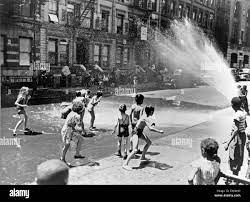
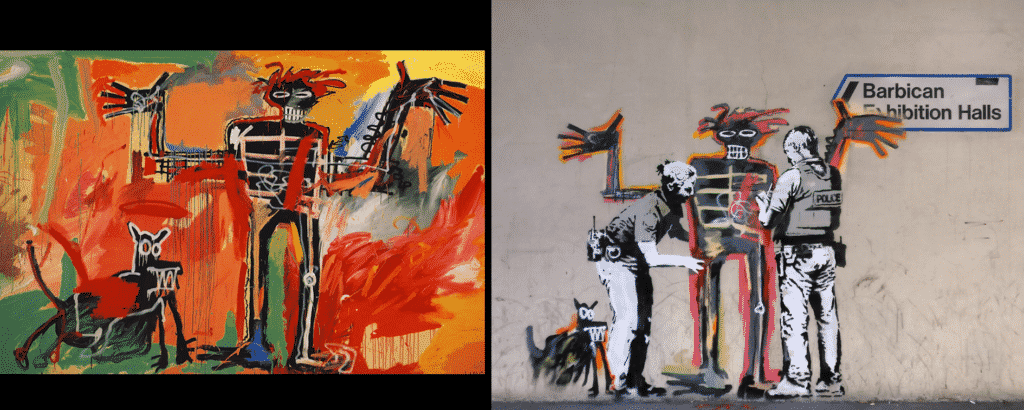
While researching to find an inspiring re-appropriation example, it was a painting by a late American artist that caught my attention: A Boy and Dog in a Johnnypump by Jean Michelle Basquiat(1982).
As the painting’s title indicates, the artwork is about a thin (skeletal) black boy and his dog enjoying a shower from an open fire hydrant. If we look at the picture, we can see someone who might look like Basquiat (the boy’s hairstyle suggests so), along with his companion, his dog, enjoying a water spray with open hands, like he is embracing it, a fact that makes us realise he is having a pleasant time. The colours of the painting are vivid and vibrant, implying the summer heat.
The whole painting brings back childhood memories, where every little activity could be a source of fun and amusement. The painter takes us back to his early years in the streets of New York, where ”Johnnypumps” spraying water was a common sight. Basquiat’s unique graffiti-style drawing encourages the viewer to participate in that joy and feel free again: be a careless child whose only concern is how to have fun and to find a way to embrace the joy of life in any environment possible. The streets of New York are not the best place for a child to grow up. However, even in such a hostile environment, children find a way to have fun. The boy’s pointy hairstyle can also be perceived as a crown; a poor and skinny black boy can enjoy simple things in life as a king.
As with his other artworks, his painting was denounced for making non-living distorted human or dog shapes with skeletal figures. His unique style, influenced by his Caribbean heritage as well as his life as a poor boy growing up in the streets of New York, didn’t fit into any existing trend at that time. Basquiat’s work has also been criticised for being overlooked and overpriced, with his handwriting being more of a fashion trend than an original piece of art. No matter the unique way he expressed himself through his work, he was considered a scruffy graffiti artist. His art market value, on the other hand, remained unaffected; his second highest grossing work, The Boy and Dog in Johnny Pump, caused a global sensation when it was sold for $100 million to Ken Griffin in 2020, and it is now housed in the Art Institute of Chicago.
The truth about Basquiat is that he was unique: after so many years of his death from a heroin overdose at the age of 27, Jean Michelle Basquiat’s esoteric, illusion-inspired paintings have reached a large audience, placing him as the highest-selling American artist of all time and making him one of the most influential painters of the 20th century.
Banksy (the anonymous British artist from Bristol), seeming to be a huge fan of Basquiat, took advantage of a show about the late artist at the Barbican Gallery in London and paid a tribute to his work by demonstrating the same character: a boy with a dog, but this time being interrogated and patted on the body by police officers, who also seem to be taking his details. He created his provoking work on the walls of the Barbican, where, as Banksy says, they tend to clean all graffiti off of them! It is so ironic, provocative and subversive that Banksy’s artwork has the same body stance as Basquiat’s, but it has been used to demonstrate a boy being interrogated by police officers, and it seems to be one of supplication and surrender instead of a thrilling experience and amusement. The provocative artist wanted to point out racism and human rights being violated.
Banksy also became ironic regarding the privileges of being famous: instead of having your graffiti taken away when your work goes under the spotlight, it becomes a reference point and a permanent fixture.
Growing up in New York as a person of colour, Basquiat faced a lot of racism when he was younger. Later, in the eighties, it seemed to the conservative society he was living in a paradox that a black painter, a prodigy artist, was living in, to live like a rock star. Even though he had been bullied at a younger age, Basquiat defended his corner. He once stated: “I’m not a black artist, I’m just an artist.”
What, unwillingly, Jean-Michelle had revealed to the world was the corruption and the lack of diversity in the art universe. Up to that point, there was no effort from the world of art to make more diverse artefacts, embrace different cultures, and highlight them. The Boy with the Dog in a Johnnypump is a great example of that phenomenon. Banksy seems to understand this, and he used a very clever way to show it. In Banksy’s terms, the police (authority) is ruling people’s lives and patronising them. What were pure joy and fun for Basquiat becomes a reason for submission and interrogation for Banksy: Basquiat is ”very welcomed” by the metropolitan police and ”very welcomed” by the art critics as well. To conclude, I would say that, through Jean Michelle’s work as well as Banksy’s, art has been used as a way of pointing out a very big problem in society.
Because of choice, background, or even political views, each artist has a different approach. Jean Michelle’s Bohemian handwriting was the reason for him being in the spotlight; a person of colour, a unique artist, who had paved the path for others to follow. Banksy leaves his sensational work to speak for him. He is political, satirical, and ironic. Only a few people know who he really is. He is a shadow, a ghost. But the writings on the walls are the only things that count to him.
For the record, Basquiat’s exhibition was a huge success: more than 250 thousand people attended the show. Banksy was his best ambassador. His work on the wall of the Barbican still speaks about it.
1003 words
References:
Boy and Dog in a Johnnypump (2022). Wikipedia. Available at https://en.wikipedia.org/wiki/Boy_and_Dog_in_a_Johnnypump
(Accessed: 7 August 2022).
Koidl N. (2018) ‘Banksy’s Snarling Collaboration with Jean-Michel Basquiat’,fineartmultiple,2018. Available at https://fineartmultiple.com/blog/banksy-jean-michel-basquiat-collaborate
(Accessed: 7 August 2022).
Jean Michelle Basquiat(2022). Wikipedia. Available at https://en.wikipedia.org/wiki/Jean-Michel_Basquiat
(Accessed: 15 August 2022).
BANKSY (2022). Wikipedia. Available at https://en.wikipedia.org/wiki/Banksy
(Accessed: 15 August 2022).
Send your essay to your tutor together with a 500-word commentary about your experience of Part Three. For example, which projects (s) most engaged your interest? Was there any activity that you found particularly enjoyable – or difficult? Why was that? Has your work on this part of the course inspired you to do further visual communications courses with OCA, for example, an illustration or graphic design course?
As assignment 3 concludes, I reflect on what my tutor firstly noticed: I’m becoming more and more engaged with my studies. I find them quite fascinating because I keep on learning new things all the time. On top of that, when I’m finished and I submit my work to my tutor, I thoroughly wait for third-party observations, ideas, and comments to take them on board and move further, to be able to understand and experience what I’m given to the fullest.
It has taken a lot of time and effort to research and process all the materials required to finish all the assignment 3 exercises. It was an exciting and enjoyable procedure, though.
Visual communications have shaped the world we live in today. From that point of view, it was fascinating to go all the way back and look at how this type of human interaction evolved and how it has influenced humanity in any given era. I really enjoyed the ‘Join the Navy’ and the semiotic analysis I had to do, along with more posters I had to find to point out their messages and the importance behind them.
Another interesting piece of work I got excited about working on was the film posters and the analysis of them; it shows how well thought out they are and how many hidden messages they entail. Sometimes a film poster becomes a case study on its own.
I also enjoyed the assignment’s 3 re-appropriation parts. It made me realise how deeply influenced artists from an existing piece of work can be and how an artefact or a study of one artist can become a source or a starting point for another. My research gave me the pleasure of finding out about Jean Michelle Basquiat and his amazing work. It was time travel to the 1980s New York, and it was about music, pleasures of any type, and the beginning of a new art movement: street art.
It was also really thrilling to see how another artist (Banksy) was inspired by Jean Michelle’s style a quarter of a century later, and his reaction was stimulated by his own point of view regarding Basquiat’s work. Furthermore, it made me think about how the field of vision of art has changed over a generation and how much art can influence, report, and protest through a piece of artefact, which sometimes wasn’t an original idea of the artist who created it.
It felt like a mute dialogue between two heterogeneous personalities, which was truly pleasant and appealing to find out about and study.
Visual communication, using illustrations and graphic design, is a very powerful tool. It is something I would be interested in finding out more about because the more I understand, the more I study, and the more I appreciate it as an expressive medium.
The amazing journey is still on.
I am looking forward to working on Assignment 4.
 Alexander's blog